
How does local competition change restoration ad costs?

- How do market size and the number of competitors change what a restoration company pays for ads?
- Why does the same restoration ad cost more in one town than another?
- Does a bigger city always mean more expensive restoration ads?
- How can I see how crowded my restoration market is before I spend?
- How do I see who I'm actually competing against in my ads?
- Does competition change what I pay for Local Services Ads leads too?
- Can I pay less than my competitors for the same spot?
- How do I compete in a crowded market without overpaying?
- Is a less competitive market always the cheaper one?
- Should I raise my budget when a new competitor starts bidding?
- What's different about ad competition for restoration companies
- A worked example: the same budget in a crowded and a quiet market
- Frequently asked questions
- Key takeaways
- More in this section
- Sources
The short version
- Each click costs what it takes to beat the ad below you, so more local bidders push the price up.
- LSA leads work the same way: similar local businesses' bids set what a lead is worth.
- Big markets: pricier clicks, more volume. Small markets: cheaper clicks, fewer searches.
- Measure your market with Keyword Planner and auction insights, then judge it on cost per booked job.
For restoration owners trying to work out why the same water damage ad costs more in one town than another, and what to do about it.
Get a free visibility audit · Book a growth call
How do market size and the number of competitors change what a restoration company pays for ads?
The more restoration companies bidding on the same searches in your area, the more each click and lead costs, because Google’s ad auction charges you what it takes to beat the advertiser ranked just below you, and Local Services Ads lead prices are set by what similar local businesses bid. In our judgement, big metros usually have more bidders and more searches, so clicks cost more but there’s more volume to buy; smaller markets often cost less per click but run out of searches sooner. Check your own market with Keyword Planner’s local bid ranges and the auction insights report, then judge it on cost per booked job, not cost per click.
Local competition is the part of ad cost you can’t change, so the work is choosing where and how to compete. We set restoration local ads around the towns and job types where you can win at a cost per booked job you can afford, and every package reports calls and cost per lead by source so you can see what each market really costs. Our restoration marketing page covers how ads and SEO fit together, and the restoration marketing guide covers overall budget. Other questions are answered one at a time in the restoration marketing questions library.
Why does the same restoration ad cost more in one town than another?
Because you’re bidding against a different set of companies in each place. Google’s page on the ad auction says the auction runs again on every search, with results that depend on the context of the person’s search and the competition among advertisers at that moment. A homeowner searching “water damage restoration” in a large metro sets off an auction with many restoration companies in it. The same search in a small town may draw two or three.
Google’s page on actual cost-per-click explains why that changes the price: you pay only what’s minimally required to clear the Ad Rank thresholds and beat the Ad Rank of the competitor immediately below you. With more competitors close behind you, that number is higher. With nobody close behind, it can be much lower. This page is about that standing, everyday difference between markets; the short-term jumps after a storm or freeze are covered in why ad costs spike in storms.
Does a bigger city always mean more expensive restoration ads?
Usually more expensive per click, but not always more expensive per job. In our judgement, bigger markets tend to attract more restoration companies, franchise locations and national brands bidding on the same terms, which pushes click prices up. But they also have more searches, so there’s more work to buy, and a strong campaign can fill crews there.
A smaller market can be cheaper per click and still disappoint, because there simply aren’t many water damage searches in a month. You may not be able to spend your budget, and a quiet month can mean almost no calls. The number to compare between markets is what each signed job costs once everything is counted, which a good cost per booked job walks through.
How can I see how crowded my restoration market is before I spend?
Google Ads’ Keyword Planner gives you a local picture. Google’s page on Keyword Planner forecasts describes these columns, all based on the location you select:
- Average monthly searches: how often people searched a keyword and its close variants.
- Competition: the number of advertisers that showed on a keyword relative to all keywords across Google, shown as low, medium or high, and specific to your location.
- Top of page bid, low and high range: roughly the 20th and 80th percentile of what advertisers have historically paid for a top-of-page bid on that keyword in your location.
Run the same restoration keywords for your home town and for each town you’d like to add, and compare. The same page notes the forecast takes your bid, budget, seasonality and historical ad quality into account, so treat it as an estimate, not a quote. In our judgement it’s most useful for comparing markets against each other, not for predicting a precise cost.
How do I see who I'm actually competing against in my ads?
Once your ads have run for a while, the auction insights report shows it. Google’s page on auction insights says it lets you compare your performance with other advertisers in the same auctions, which can help you make decisions about bidding and budgeting. For search campaigns it reports impression share, overlap rate, outranking share, position above rate, top of page rate and absolute top of page rate. Overlap rate is how often another advertiser’s ad showed when yours did.
Read it by market if you can. If one campaign or town shows several restoration companies with high overlap rates, that’s a crowded auction, and you’ll pay more for each position there. The page also notes the report doesn’t show insights when your impression share is less than 10%, so a tiny budget in a big market may leave you without this view at all.
Curious what your marketing is actually booking?
Get a free visibility audit — no obligation, no sales pitch.
Does competition change what I pay for Local Services Ads leads too?
Yes. Google’s page on Local Services Ads bidding says a bid is the most you’d pay for a lead, and that when similar local businesses bid on the same lead, those bids determine how much the lead is worth. More restoration companies in the LSA unit for your area means more bids on each lead.
Price isn’t the only effect. Google’s page on LSA ad rankings says the auction considers your bid and your profile quality, including responsiveness, rating, number of reviews and verification checks. In a crowded market, a company with more reviews and fewer missed calls can hold a spot that another company has to outbid to reach. What a restoration LSA lead costs covers the pricing rules in detail.
Can I pay less than my competitors for the same spot?
Sometimes. Google’s ad auction page says your position comes from Ad Rank, a combination of your bid, the quality of your ads and landing page, Ad Rank thresholds, the competitiveness of the auction, the context of the search and the expected impact of assets. It also says that even if your competition bids higher, you can still win a higher position at a lower price with high-quality ads and landing pages.
For a restoration company, in our judgement, that means a separate ad and landing page for each job type: water, mold, fire, sewage. Someone searching “sewage backup cleanup” should land on a sewage page that says you come today, not a general home page. Google’s Quality Score page is a useful check: it says a higher score means your ad and landing page are more relevant and useful to the searcher than other advertisers’, though it also says Quality Score itself isn’t an input in the auction. It’s a diagnostic, not a lever.
How do I compete in a crowded market without overpaying?
In our judgement, narrow the fight to the auctions you can win:
- Pick your towns. Target the areas your crews can reach fast rather than a whole metro. Fewer, closer towns can mean fewer competitors in each auction and leads you can actually serve. Setting your ad service area covers the targeting side.
- Split by job type. Some services draw fewer bidders than water damage. Keyword Planner’s competition column shows which, market by market.
- Cut wasted clicks. DIY, insurance-question and job-seeker searches cost the same per click and rarely book. Negative keywords for restoration ads lists what to block.
- Answer every call. A crowded market makes each click expensive, so a missed call wastes more money there than anywhere else.
- Build free visibility alongside. Your Google profile and website don’t get pricier when more competitors run ads, so they matter more the more crowded the auction gets.

Is a less competitive market always the cheaper one?
Not once volume runs out. Google’s impression share page defines impression share as the impressions your ads got compared with the total they could have got, and says it shows whether your ads might reach more people with a higher bid or budget. In a small market, you can reach close to all of the available searches and still not spend your budget, because there aren’t enough searches to buy.
That makes small markets good for a lower cost per job and bad for steady volume. In our judgement, many restoration companies end up with a mix: a core of nearby towns where they win cheaply, plus a measured share of the pricier metro auctions to fill the rest of their capacity. Deciding how to split money across towns is the subject of budgeting one city or several.
Should I raise my budget when a new competitor starts bidding?
Not automatically. Watch what changes first: your cost per click, your impression share and your booked jobs. If a new company’s arrival raises your cost per click but your cost per booked job stays under the most you can pay, you can keep going. If it pushes cost per booked job over that line, raising the budget only buys more expensive jobs.
In our judgement, it’s often better to tighten towns and job types, improve the landing page and lean on free visibility than to match a new competitor bid for bid. New entrants sometimes spend heavily at first and then pull back, so give it a few weeks of data before changing course.
What's different about ad competition for restoration companies
National brands and franchises bid locally. In many markets you’re up against franchise locations and national call networks as well as local shops, which in our judgement is one reason restoration clicks can cost more than you’d expect for the size of a town.
Urgent searches draw the most bidders. Emergency water damage searches are where the work is decided fast, so in our judgement that’s where competition is fiercest. Mold, fire and sewage terms can behave differently in the same town.
Storms layer on top. A crowded market gets even more crowded during a freeze or a storm, so set your normal-season targets first and plan surge rules separately.
Insurance-heavy jobs make high clicks bearable. A large loss can justify a click price that would sink a lower-ticket trade, as long as your booking rate and collections hold up.
Talk it through with someone who runs this every day
A 15-minute growth call: your market, your numbers, and what a realistic budget looks like. No pressure.
A worked example: the same budget in a crowded and a quiet market
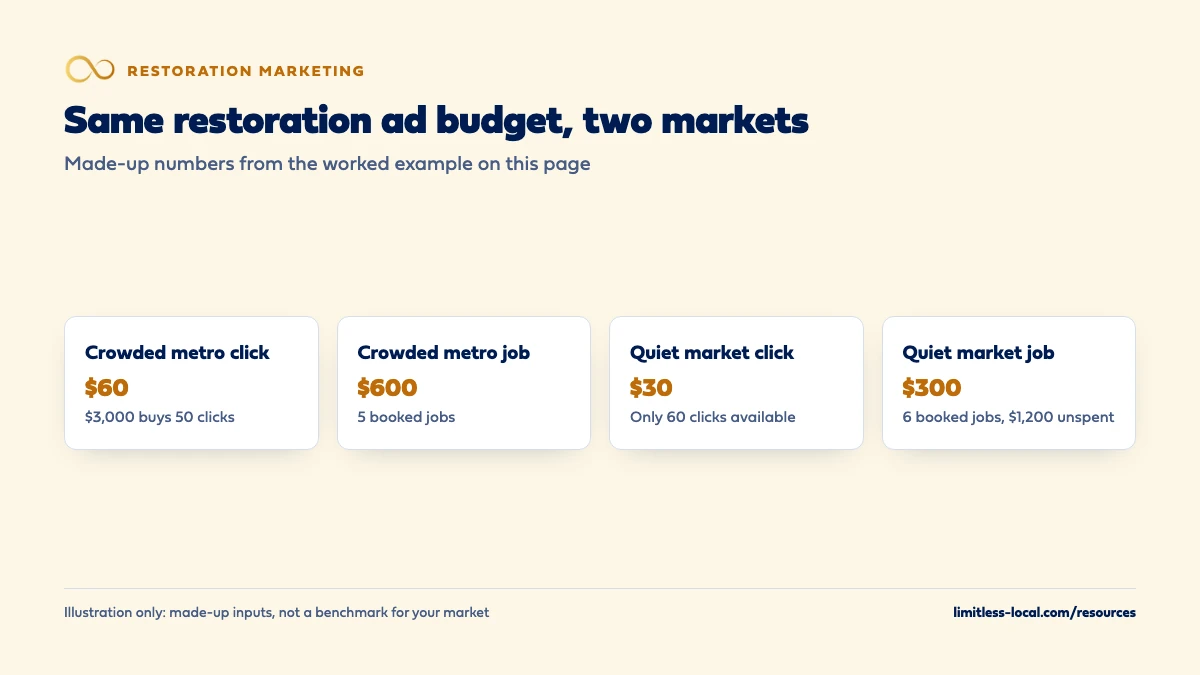
These numbers are made up to show the math, not a benchmark for your market. Say you put $3,000 a month into water damage search ads in two places, and in both, 20% of clicks become calls and you book 50% of calls.
Crowded metro. Your average actual cost per click is $60, so $3,000 buys 50 clicks. That’s 10 calls and 5 booked jobs, or $600 per booked job.
Quieter market. Your average cost per click is $30, so $3,000 could buy 100 clicks. But there are only enough searches for about 60 clicks a month, so you spend $1,800 and $1,200 goes unspent. Those 60 clicks bring 12 calls and 6 booked jobs, or $300 per booked job.
The quiet market books jobs at half the cost, but only 6 of them, and no extra budget will buy a seventh. The metro costs twice as much per job and can take more money if your crews have room. Which is better depends on your ceiling per job and how much work you need.
If an agency runs the ads, add its fee to both sides. Our Essentials package is $3,500 a month with Google Ads management up to $2,500 a month in ad spend, so a $3,000 budget like this one would sit in Growth, which is $4,500 a month and covers up to $5,000 in Google Ads spend plus Local Services Ads management. Ad spend is paid directly to Google in both.
Frequently asked questions
Is there a published average cost per click for restoration ads?
Not one we can point you to from a primary source. Use Keyword Planner’s top of page bid ranges for your own location, which are based on what advertisers there have historically paid.
Can I see my competitors' bids?
No. Auction insights shows how often other advertisers appear alongside you and outrank you, but not what they bid or spend.
Do national lead companies count as competition in my ad auctions?
If they bid on the same searches in your area, yes. Auction insights lists the advertisers whose ads appear in the same auctions as yours, whatever kind of business they are.
Will running ads in more towns lower my cost per click?
Not by itself. Each town’s searches have their own auction. Adding a quieter town can lower your average, but in our judgement it’s better to judge each town on its own cost per booked job.
How much budget do Local Services Ads need in a competitive market?
Google recommends a minimum budget of ten leads per week when you use its Maximize leads bidding. What those leads cost depends on what similar local businesses bid.
Can anyone guarantee a cost per lead in my market?
Not honestly. Prices are set by an auction that changes with every search and every new competitor. What you can expect is clear reporting on what you paid and what it booked.
Key takeaways
- You pay what it takes to beat the ad below you, so more local bidders mean higher clicks.
- LSA lead prices are set by what similar local businesses bid on the same lead.
- Keyword Planner shows local search volume, a competition rating and bid ranges for each town.
- Auction insights shows who’s in your auctions and how often they overlap or outrank you.
- Cheap markets can run out of searches; judge every market on cost per booked job.
- Better ads and landing pages can win a higher spot at a lower price, even against higher bids.
Ready to compare options?
Book a short growth call and we'll walk through the math for your service area, including when we're not the right fit.
More in this section
- What does a restoration lead cost on Local Services Ads?
- Why do restoration ad costs spike during storms and freezes?
- Restoration ads geo targeting: how tight a service area?
- Why do newer restoration competitors outrank my older company?
- Restoration leads: shared, exclusive or pay-per-call?
Sources
- The ad auction — Google Ads Help
- Actual cost-per-click (CPC): Definition — Google Ads Help
- About Keyword Planner forecasts — Google Ads Help
- Use auction insights to compare performance — Google Ads Help
- How bidding works for Local Services Ads — Local Services Help
- About ad rankings — Local Services Help
- About Quality Score for Search campaigns — Google Ads Help
- About impression share — Google Ads Help