
Why do newer restoration competitors outrank my older company?
- Why are newer restoration companies ranking above mine when I've been in business longer?
- Does being in business longer help my Google ranking?
- Where exactly is the newer company outranking me?
- Could the newer company just be closer to the people searching?
- Is their Google Business Profile more complete than mine?
- Are they getting reviews faster than me?
- Do they have more local links and mentions?
- Is their website more relevant to what people search?
- What if the newer company is breaking Google's rules?
- Could something on my side have slipped?
- What can an older company use that a newer one can't?
- How long will it take to pass them again?
- What's different about this for restoration companies
- A worked example: closing a review gap with past customers
- Frequently asked questions
- Key takeaways
- More in this section
- Sources
The short version
- Google lists relevance, distance, and popularity for local results; business age isn't on the list.
- Newer companies often win on a complete profile, specific pages and fresh reviews.
- Your history helps only once it shows up as reviews, links and detailed pages.
- Check whether you're losing on Maps, in regular results or to ads before fixing anything.
For restoration owners who’ve served their area for years and keep finding a company that opened recently sitting above them on Google Maps and in search.
Get a free visibility audit · Book a growth call
Why are newer restoration companies ranking above mine when I've been in business longer?
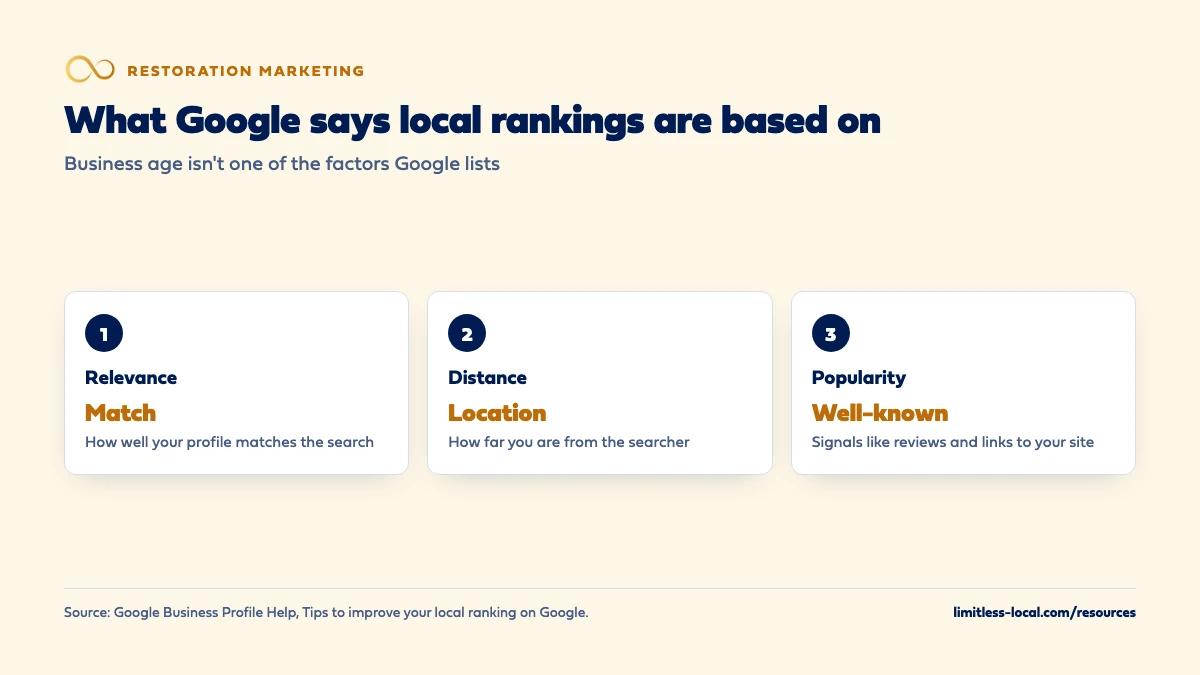
Newer restoration competitors outrank older companies because Google ranks local results on relevance, distance, and popularity, and years in business isn’t one of the factors Google lists. A newer company can win by being closer to the searcher, by having a more complete Business Profile and more specific service pages, and by collecting reviews and links faster than an older company that stopped working on them. An older company’s history only helps when it shows up as those signals, such as a steady flow of reviews, local links and detailed pages, so the fix is to turn your years of jobs into current signals rather than wait for age to count.
Being older isn’t a ranking signal, but years of past customers, jobs and local relationships are raw material for the signals that are, and turning them into calls is the work in our local SEO service for restoration companies. The restoration marketing guide covers the wider channel choices, and the restoration marketing questions library takes the rest one question at a time.
Does being in business longer help my Google ranking?
Not directly, as far as Google has published. Google’s help page Tips to improve your local ranking on Google says local results are mainly based on relevance, distance, and popularity. It describes relevance as how well a profile matches the search, distance as how far the business is from the searcher, and the third factor as how well-known a business is, based on information such as how many websites link to it and how many reviews it has. Years in business isn’t named.
In our judgement, age helps indirectly. A company that’s been around for fifteen years usually has more past customers, more mentions around town and more chances to have earned links and reviews. But if those stopped growing years ago, a newer company that works on them every week can pass you. Age is a head start, not a lead you keep for free.
Where exactly is the newer company outranking me?
Check before you fix anything, because each place works differently:
- The map pack and Google Maps run on your Business Profile, reviews and distance.
- The regular results below run on your website pages.
- Ads and Local Services Ads at the top are paid placements. Google’s page on how it ranks results says search results aren’t influenced by whether a business buys ads, ads are always labeled “Sponsored” or “Ad”, and nobody can pay Google for better ranking.
If the newcomer only beats you in the ads, they’re outspending you, not outranking you. If they beat you on Maps but not in regular results, the gap is in the profile and reviews. Search from a few different spots in your service area, because Maps results change with the searcher’s location.
Could the newer company just be closer to the people searching?
Often, yes. Distance is one of Google’s three local factors, and Google says that if a customer doesn’t share where they are, it uses what it knows about their location. A new company that opened an office across town is closer to every searcher on that side, and no amount of age changes that.
Restoration companies are usually service-area businesses, and Google’s page on managing service areas notes the area shouldn’t extend beyond about 2 hours of driving time from where the business is based. Listing a wide area doesn’t make you closer to searchers far from your base, in our judgement. If a newer company is winning on the far side of your territory, that’s often distance, and the fix may be ads there or a real second office, not more SEO.
Is their Google Business Profile more complete than mine?
This is where many older companies lose, in our judgement. A profile set up years ago often has one category, no services listed, old hours, a few photos from launch day and no description of current work. A newer company set its profile up recently, often with every field filled in.
Google’s local ranking page says businesses with complete and accurate info are more likely to show up in local search results, and asks for details like your hours, what kind of business you are and other attributes. Compare your profile with theirs field by field: primary and secondary categories, services, service area, hours, description, photos and recent posts. Choosing restoration profile categories covers the category choice, which is one of the most common gaps.
Are they getting reviews faster than me?
Check the count and, in our judgement, the pace. Google says the third local factor is based on information like how many reviews you have, and that more reviews and positive ratings can help your local ranking. It also says replying to reviews shows you value feedback and that positive reviews and helpful replies can help your business stand out.
Older companies often have a pile of reviews from a push years ago and very few since. A newer company asking after every job can pass that total quickly, and homeowners comparing two profiles see which one has recent reviews, in our judgement. The fix is a steady habit, not a one-time push: ask after every completed job. Getting detailed reviews after a water job covers how to ask.
Curious what your marketing is actually booking?
Get a free visibility audit — no obligation, no sales pitch.
Do they have more local links and mentions?
Possibly. Google’s local ranking page lists how many websites link to your business among the information behind the third factor. A newer company may be working on it deliberately: joining local trade groups, sponsoring events, getting listed with suppliers and showing up in local news after a big storm.
Older companies often have more real-world relationships than they have links. In our judgement, the plumbers, property managers, insurance agents and chambers you’ve worked with for years are the obvious places to ask for a listing or mention. Be careful with shortcuts: Google’s spam policies list buying or selling links for ranking purposes as link spam.
Is their website more relevant to what people search?
For the regular results, it often is. Google’s page on how it ranks results says the most basic sign that content is relevant is that it contains the same keywords as the search, such as in headings or body text, and that its systems also look for other relevant content beyond the keyword itself.
A newer company may have a page for water damage, another for mold, another for fire and smoke, and pages for the towns it serves. An older company often has one “services” page listing everything in a line. Google’s guide to creating helpful, reliable, people-first content is the standard to write to: pages that answer what homeowners need to know, not pages stuffed with town names. Ranking for water damage in your city walks through building the water damage page.
What if the newer company is breaking Google's rules?
It happens. Two common ones, from Google’s own rules:
- Keyword-stuffed names. Google’s Business Profile guidelines say your name should reflect your real-world business name, and that including unnecessary information in it isn’t permitted and could result in suspension.
- Bought links. Google’s spam policies treat buying links for ranking purposes as link spam.
Reporting a profile that breaks the rules is worth doing, but don’t build your plan around it. Report it once, then work on your own signals. Holding your map pack spot against a newcomer covers how to report and what to do meanwhile.
Could something on my side have slipped?
Sometimes an older company didn’t get outranked so much as it slid. In our judgement, check for:
- An old address or phone number still listed in directories after a move.
- A duplicate profile from years ago splitting your reviews.
- A website that hasn’t been updated, is slow on phones or lost pages in a redesign.
- An unanswered review pile, or a profile edit nobody noticed.
If you dropped out of the map pack suddenly rather than slowly, start with getting back into the map pack, which covers suspensions and sudden drops.
What can an older company use that a newer one can't?
Quite a lot, once you put it to work. In our judgement, your years give you:
- Past customers to ask for reviews. Thousands of finished jobs is a review pool a new company doesn’t have.
- Job photos and case stories for your profile and service pages: real before-and-after work from real neighborhoods.
- Relationships with plumbers, property managers and agents who can mention or link to you.
- Specific experience to write about: the types of losses, the local building stock, the storms you’ve worked through.
None of this ranks on its own. It ranks once it’s on your profile, your pages and other people’s websites.
How long will it take to pass them again?
It depends on the gap, and nobody can honestly promise a date. Ads can bring calls within days of launch, while SEO typically takes 3-6 months to show meaningful organic growth. Review and profile gaps tend to close faster than website and link gaps, in our judgement, because you can act on them every week.
Track your position in the places you checked at the start, from the same spots, every month. If the newcomer is closer to searchers on one side of town, accept that you may not pass them there, and decide whether that area deserves ads instead.
Want to see where your company stands?
A free visibility audit shows where you show up on Google, Maps and AI answers, and what it's costing you in calls.
What's different about this for restoration companies
Franchises open fast. A franchise location can arrive with a polished website and a profile filled in on day one. That’s a well-built newcomer, not an unfair one, and it’s why older independents need to keep their own profile current.
Storms produce review spikes. A company that works a big storm hard and asks every customer for a review can gain a lot of reviews in a few weeks. Have your review habit running before the next one.
Jobs are spread across services. Water, mold, fire and sewage are different searches. A newer company with a page for each can outrank an older company with one services page on all of them.
Referrals hide the problem. Older restoration companies often get much of their work from plumbers, agents and repeat clients, so a ranking slide can go unnoticed until referrals dip.
A worked example: closing a review gap with past customers
These numbers are made up to show the math, not a benchmark for your market. Say a newer competitor has 140 Google reviews after a few years of asking after every job. You’ve been in business fifteen years and have 60, most of them old. The gap is 80 reviews.
You finish 30 jobs a month. If you ask every customer and a third of them leave a review, that’s 10 new reviews a month, and the gap closes in about 8 months if the competitor stops. They won’t stop, so add your past customers: a polite request to recent past customers can add more in the first months.
Reviews are one signal, not the whole answer, and none of this guarantees a ranking. If you’d like help, our Growth package at $4,500 a month includes local SEO for up to 2 locations and advanced review generation.
Frequently asked questions
Does an older domain name rank better?
Google hasn’t listed domain age as a factor in its published ranking guidance, and in our judgement an old domain helps only through the links and content it has built up.
Can I pay Google to rank above a newer company?
No. Google says there’s no way to request or pay for a better local ranking. You can pay for ads, which are labeled and shown separately.
Should I put "since 1998" in my business name?
Not in the profile name unless it’s genuinely part of your real-world name. Google says unnecessary information in the name isn’t permitted. Put your history in the description, photos and website instead.
Will moving my office closer to the city center help?
It may help with searchers near the new office and hurt with those near the old one. Move for business reasons, not ranking alone.
Do newer companies get a temporary boost on Google?
Google hasn’t published anything saying so. In our judgement, newcomers usually rank on a fresh, complete profile and active review requests.
Should I copy the newer company's website?
No. Learn from what it covers, then write your own pages from your own jobs and experience. Copied content doesn’t help homeowners or rankings.
Key takeaways
- Google’s local results are mainly based on relevance, distance, and popularity; business age isn’t listed.
- Check whether you’re losing on Maps, regular results or ads before fixing anything.
- Newer companies usually win on a complete profile, specific service pages and a steady flow of reviews.
- Turn your history into signals: past customers for reviews, job photos, local relationships for links.
- Report rule-breaking once, then work on your own profile and pages.
Not sure what's working right now?
Start with a free visibility audit: rankings, Google profile, reviews and tracking, checked against your service area.
More in this section
- How does local competition change restoration ad costs?
- What marketing does a brand-new restoration company need first?
- How do I grow a restoration company past a plateau?
- How does a restoration company recover when its reviews drop?
- How do I hold my Map Pack spot against a new restoration competitor?
Sources
- Tips to improve your local ranking on Google — Google Business Profile Help
- Automatically generating and ranking results — Google Search
- Guidelines for representing your business on Google — Google Business Profile Help
- Spam policies for Google web search — Google Search Central
- Creating helpful, reliable, people-first content — Google Search Central
- Manage your service areas for service-area & hybrid businesses — Google Business Profile Help