
Are Local Services Ads better than Google Ads for HVAC?
- Local Services Ads or Google search ads: which books more profitable HVAC jobs?
- What's the real difference between Local Services Ads and Google search ads?
- Which one costs less per booked HVAC job?
- Which gives me more control over the jobs I get?
- Which is better for no-heat and no-cool emergency calls?
- Which is better for system replacements and installs?
- How do reviews and responsiveness change the math?
- What changed now that LSAs live inside Google Ads?
- What does each one need before it pays off?
- Which should a small HVAC company start with?
- When does running both make sense, and how do I split the budget?
- How do I compare them fairly once both are running?
- What's different about this choice for HVAC companies
- A worked example: same spend, different jobs
- Frequently asked questions
- Key takeaways
- More in this section
- Sources
The short version
- LSAs: pay per valid lead, no keywords, ranking driven by reviews and responsiveness.
- Search ads: pay per click, you choose keywords, ad text and landing page.
- LSAs fit repair and emergency calls; search ads fit replacements and installs.
- Compare them on cost per booked job and revenue, never on cost per lead alone.
For HVAC owners deciding where the next ad dollar goes: pay-per-lead Local Services Ads, pay-per-click search ads, or both.
Get a free visibility audit · Book a growth call
Local Services Ads or Google search ads: which books more profitable HVAC jobs?
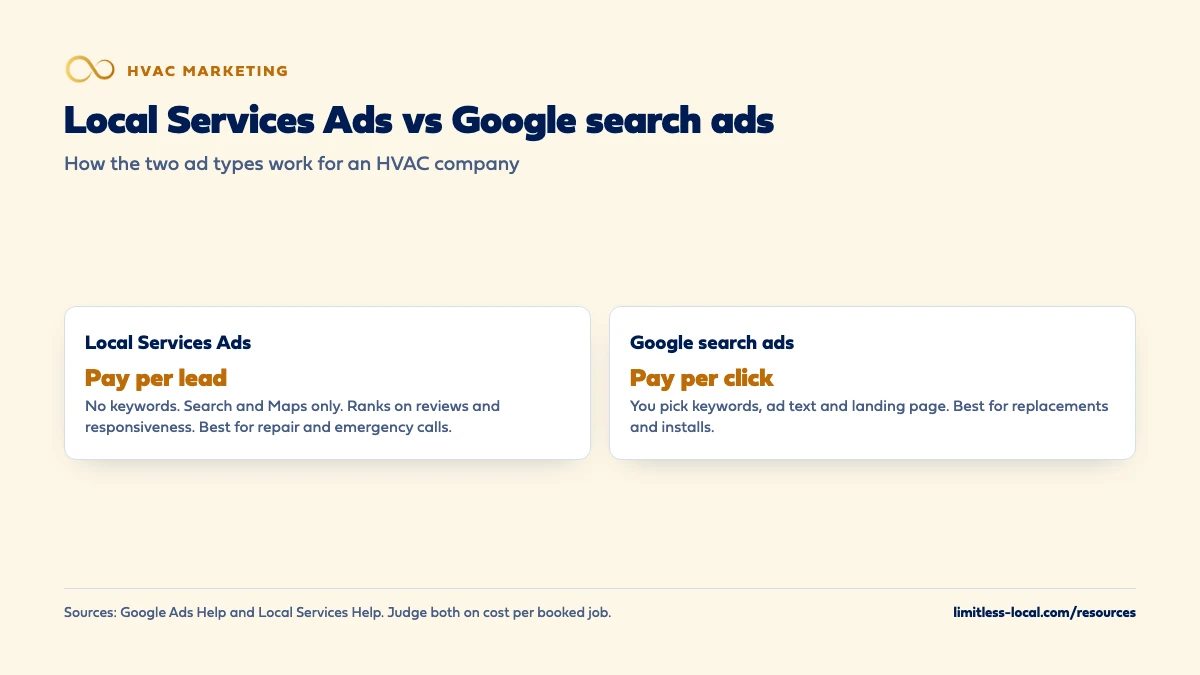
Neither is better for every HVAC company. Local Services Ads usually win for repair and emergency calls, because you pay per valid lead, there are no keywords to manage, and your ranking leans on reviews and how fast you answer. Google search ads usually win for jobs you want to target precisely, like system replacements and heat pump installs, because you pick the searches, write the ad and choose the landing page, though you pay for every click whether or not anyone calls. If you can fund both, run both and judge each one on cost per booked job, not cost per lead.
Most HVAC companies that ask this end up running both, because the two ads catch different jobs. That’s how our local ads work is set up: Local Services Ads management and Google Ads together in the Growth package, with call tracking so every booked job is tied to the ad that produced it. Our HVAC marketing page shows how that fits an HVAC company, the HVAC marketing guide covers every channel, and the HVAC marketing questions library goes question by question.
What's the real difference between Local Services Ads and Google search ads?
- How you pay. Local Services Ads charge for valid leads, such as calls, messages and booking requests. Search ads charge for clicks, whether or not the person ever contacts you.
- How you target. Local Services Ads are keywordless: you pick service categories, job types and areas. Search ads run on keywords you choose and the match types you set.
- Where the customer goes. With Local Services Ads, the homeowner calls or messages you straight from the ad. With search ads, they usually land on your website first.
- Where they show. Local Services Ads appear only on Google Search and Google Maps.
- What decides your spot. For Local Services Ads, reviews, rating, responsiveness and verification weigh heavily. For search ads, your bid, your ad and your landing page matter most.
Since August 2026, Local Services Ads have been moving into Google Ads, so both end up in the same account. Google’s transition page confirms Local Services Ads keep the pay-per-lead model and keywordless targeting after the move, so the differences above still hold.
Which one costs less per booked HVAC job?
There’s no national answer, and anyone quoting one is guessing about your market. Lead prices for Local Services Ads vary with your location, the job type, the type of lead and how you bid. Click prices for search ads vary with how many HVAC companies bid on the same searches in your area.
What you can compare is your own cost per booked job in each channel:
- Take what the channel cost for the month.
- Count the leads it produced that were real HVAC customers in your area.
- Count how many of those booked.
- Divide cost by booked jobs.
Local Services Ads often start with a lower cost per lead, because you never pay for a click that goes nowhere. Search ads can still come out ahead on profit, because you can aim them at replacement and install searches that are worth far more per job. That’s why the worked example below tracks revenue as well as cost.
Which gives me more control over the jobs I get?
Search ads, by a wide margin. You choose the keywords, and match types decide how close a search has to be. Exact match gives you the most say over who sees your ad, and broad match reaches the widest range of related searches (see keyword matching options). Negative keywords keep you off searches like “HVAC jobs”, “HVAC school” or “window unit”, and the search terms report shows the actual searches that triggered your ads, so you can cut the junk every week.
With Local Services Ads, your levers are the service categories, job types and service area you select, plus your schedule. That’s simpler, but blunter. And the settings matter more than they used to: Google no longer gives credits for leads about a job type you don’t do or an area you don’t serve, so a sloppy job-type list now costs you money. If you only do residential work, don’t leave commercial job types switched on.
Which is better for no-heat and no-cool emergency calls?
Usually Local Services Ads. Someone with a dead AC on a 98-degree afternoon wants to call, not browse a website, and the ad lets them do that in one tap. You also only pay when the contact is a valid lead.
The catch is the phone. A missed call during your business hours counts as a valid lead once the caller stays on the line for more than 20 seconds, and missed calls can hurt your ranking. If calls roll to voicemail on your busiest days, Local Services Ads punish you twice: you pay for the lead and slide down the list. Turning on message leads gives customers another way to reach you at night and on weekends.
Search ads can catch emergency calls too, with an ad schedule that matches when you can answer. They just cost you for every click, including people who tap, read and call someone else.
Which is better for system replacements and installs?
Usually search ads. A homeowner searching “heat pump replacement” or “new AC system cost” is shopping for a big-ticket job, and search ads let you bid on exactly those searches, write an ad about replacements and send the click to a page built for them: financing options, brands you install, your warranty terms, photos of real installs and a clear way to book an estimate.
Local Services Ads can bring replacement leads, but you have less say. The lead arrives as a call or message, and you find out what it is when you pick up. A repair caller and a replacement shopper cost you the same kind of lead.
Whether your HVAC company needs landing pages for Google Ads covers what that page should include.
Curious what your marketing is actually booking?
Get a free visibility audit — no obligation, no sales pitch.
How do reviews and responsiveness change the math?
For Local Services Ads, they’re a big part of the price you pay. The ad ranking help page lists your rating, number of reviews, average response time, photos and completed verification checks as profile quality, and higher-quality profiles may rank higher and may pay lower costs per lead.
A shop with a strong rating, steady new reviews and an office that answers fast can get Local Services Ads leads cheaper than a competitor with a bigger budget. A shop with a thin review count, or one that misses a lot of calls, may struggle to show at all, no matter what it bids.
Search ads care less about your reviews in the auction itself, though homeowners still check them before calling. That’s why a newer HVAC company with few reviews often gets more out of search ads first, while it builds the review count that makes Local Services Ads work.
What changed now that LSAs live inside Google Ads?
HVAC was in the first group to move, starting in August 2026. Your Local Services Ads are being moved to Performance Max campaigns with pay-per-lead goals, managed in the same account as your search ads. A few things to know when comparing the two:
- Budgets are daily. A month’s spend is capped at your daily average budget times 30.4.
- No more manual lead bids. Setting your own maximum price per lead isn’t supported.
- Old reports didn’t come along. Your history from the old Local Services Ads dashboard doesn’t carry over, so save it if your account hasn’t moved yet.
- It’s not regular Performance Max. Standard Performance Max charges per click and runs across YouTube, Gmail and display sites. The pay-per-lead version stays on Search and Maps.
Having both in one account makes side-by-side comparison easier, as long as you read the columns correctly. In a pay-per-lead campaign, Conversions means leads you were charged for. In your search campaigns, it means whatever conversion actions you set up. Whether Local Services Ads are worth it for HVAC covers the rest of the change.
What does each one need before it pays off?
Local Services Ads need:
- Google’s business screening and verification passed.
- A healthy rating and a steady flow of new reviews.
- Someone answering during your listed hours, every time.
- Job types and service areas that match the work you want.
- Your Google Business Profile in order, because your name, address and hours sync from it.
Search ads need:
- A landing page that loads fast on a phone and makes calling or booking easy.
- Call and form tracking, so you know which clicks turned into leads.
- A negative keyword list and weekly search term reviews.
- Someone with the time and skill to manage bids, keywords and ad copy.
If you can’t cover a list yet, that’s your answer for now.
Which should a small HVAC company start with?
It depends on what you already have going for you:
- Good reviews and a phone that always gets answered: start with Local Services Ads. Setup is simpler and you don’t pay for clicks.
- Few reviews, but a solid website: start with search ads on your best-margin services while you build reviews.
- One truck, and you’re on jobs all day: Local Services Ads can hurt you if calls go unanswered. Fix call coverage first, or use search ads with a schedule that only runs when someone can pick up.
- Replacements are the goal: search ads with a replacement page, even on a small budget.
Whether to start with LSAs, Google Ads or SEO walks through the first-channel decision in more depth.
When does running both make sense, and how do I split the budget?
Running both makes sense once each one has the basics from the list above. They tend to catch different jobs: Local Services Ads take the “AC not working” call, search ads take the “heat pump installation” shopper. Together they cover more of the page for the searches you care about.
A simple way to split a budget:
- Start Local Services Ads at a budget that fits your call capacity. How much to spend on Local Services Ads shows how to size it.
- Put search ad money on your highest-value services first, usually replacements and installs.
- After a full month, compare cost per booked job and revenue per booked job in each.
- Move money toward whichever brings more profit per dollar, as long as your schedule has room.
Don’t split evenly by default: the jobs each channel brings aren’t worth the same.
How do I compare them fairly once both are running?
Use the same yardstick for both. Platform numbers won’t line up on their own: a Local Services Ads conversion is a charged lead, while a search ads conversion might be a call over a set length or a form fill. Neither one tells you what booked.
- Give each channel its own tracking so calls and forms are tagged by source.
- Mark in ServiceTitan, Housecall Pro or Jobber which leads booked and what each job sold for.
- Pull a month at a time, and give each channel two to three months before you cut it, because one heat wave can skew a single month.
- Compare cost per booked job and revenue per booked job, side by side.
The same approach works for weighing paid ads against SEO. How to tell if SEO or Google Ads is making profitable jobs covers that comparison.
Not sure which of these is costing you jobs?
A free visibility audit checks the Google profile, reviews, site and tracking, and shows what to fix first.
What's different about this choice for HVAC companies
Two peak seasons. Demand jumps in the first heat wave and the first cold snap. Local Services Ads respond to that demand automatically, while search ads let you shift money toward cooling or heating searches as the season turns.
Repair calls and replacements are different jobs. A tune-up or capacitor swap and a full system replacement can come from the same homeowner, but they’re worth very different amounts. Track which kind each lead becomes, or cost per lead will mislead you.
After-hours calls. No-heat calls come in at night. If you don’t run after-hours service, keep both ad types off the hours you can’t answer. If you do, Local Services Ads with message leads turned on can catch those customers.
A worked example: same spend, different jobs
These numbers are made up to show the math, not a benchmark for your market.
Say you spend $2,100 a month on each channel.
Local Services Ads: 30 charged leads at $70 each. 12 book (40%), so each booked job cost $175. Most are repairs averaging $400, so that’s $4,800 in revenue.
Search ads: 42 calls and forms, about $50 each. 8 book, so each booked job cost $262.50. But 2 of those 8 are system replacements averaging $11,000, and 6 are repairs at $400. That’s $22,000 plus $2,400, or $24,400 in revenue.
Judged by cost per booked job, Local Services Ads win. Judged by revenue per dollar, search ads win by a lot, because they reached replacement shoppers. In real life you’d also count margin and maintenance plan sign-ups. The point is that the cheaper lead isn’t always the better channel.
For reference, our Growth package is $4,500 a month and includes Local Services Ads management plus Google Ads up to $5,000 a month in spend. Essentials is $3,500 a month with Google Ads up to $2,500 in spend but no Local Services Ads. Ad spend is paid to Google separately in both.
Frequently asked questions
Do I need a website to run Local Services Ads?
Not for the lead itself. Customers call, message or book straight from the ad, and your business details come from your Google Business Profile. A good website still helps, because many homeowners check you out before they call.
Can I choose keywords in Local Services Ads?
No. They stay keywordless after the move into Google Ads. Targeting comes from the service categories, job types and areas you select.
Do I pay for spam calls with either one?
With Local Services Ads, Google filters spam and duplicate contacts and may credit low-quality leads automatically. With search ads you pay for the click, so a spam call that came from an ad click has already cost you.
Do Local Services Ads show on YouTube or other websites?
No. They show only on Google Search and Google Maps. Standard Performance Max campaigns are the ones that run across YouTube, Gmail and display sites.
Will my Local Services Ads and search ads compete with each other?
They’re different ad types in different spots on the page, so both can show for the same search. Track them separately so each gets credit only for its own leads.
Is pay per click ever cheaper than pay per lead?
It can be, if your ads and landing page turn a high share of clicks into calls. A max cost-per-click bid caps what one click costs, and you’re often charged less, so a strong page can bring the cost per lead below what Local Services Ads charge in your area.
Key takeaways
- Local Services Ads charge per valid lead and are keywordless; search ads charge per click and run on keywords you choose.
- Local Services Ads usually suit repair and emergency calls; search ads usually suit replacements and installs.
- Reviews, rating and answering the phone shape what you pay for Local Services Ads leads.
- Search ads give you far more control through keywords, negative keywords and the search terms report.
- Compare both on cost per booked job and revenue per booked job, tracked in your field software.
Want a second set of eyes on your setup?
We'll look at how you show up locally and where calls are leaking, then send you a plain-English breakdown.
More in this section
- Are Google Local Services Ads worth it for an HVAC company?
- How much should an HVAC company spend on Local Services Ads?
- Do Google Ads work for a brand-new HVAC company?
- Do Facebook ads work for getting HVAC calls?
- Should my HVAC company start with LSAs, Google Ads or SEO?
Sources
- Local Services Ads transition to Performance Max campaigns with pay-per-lead goals — Google Ads Help
- How leads work — Google Local Services Help
- About ad rankings — Google Local Services Help
- About Automated Local Services Ads lead credits — Google Local Services Help
- About keyword matching options — Google Ads Help
- About the search terms report — Google Ads Help
- Cost-per-click (CPC): Definition — Google Ads Help