
Can a pool builder rank in Google Maps without a website?
- Can a new pool company get into the Google Maps 3-pack with no website yet?
- Can my pool company show up in Google Maps with no website at all?
- What does a website give Google that my profile can't?
- How far can the profile alone carry a pool builder?
- What happens when a homeowner finds my profile and there's no website?
- Should I put my Facebook or Instagram page in the website field?
- Does a website help me in Maps, in regular search or both?
- What should a pool builder with no website do first?
- What's the smallest website that actually helps a pool builder?
- How do reviews and links make up for a missing website?
- How do I know if having no website is costing me jobs?
- When does it make sense to hold off on a website?
- What's different about a missing website for pool builders
- A worked example: what one lost consultation costs
- Frequently asked questions
- Key takeaways
- More in this section
- Sources
The short version
- A verified profile with a phone number can rank in Maps with no website.
- Google weighs relevance, distance and popularity; a website feeds the first and the last.
- Fill in categories, services, service areas, photos and reviews before anything else.
- A small site with your pool types, towns and real projects is the next step, not a full redesign.
For pool builders who are just starting out, or running on referrals, and want to know how far a Google Business Profile can go on its own.
Get a free visibility audit · Book a growth call
Can a new pool company get into the Google Maps 3-pack with no website yet?
Yes. A verified Google Business Profile can show up in Google Maps without a website, because Google ranks local results mainly on relevance, distance and popularity, and its guidelines ask for a phone number or a website, not both. But with no site, Google has less to read about what you build and where, other sites have nothing of yours to link to, and homeowners comparing builders have nowhere to see your work before they call. Get the profile complete first, then add a simple website with your pool types, towns and finished projects.
Getting found in Maps is one of the three places we work on for pool builders, alongside regular Google results and AI answers. Our pool builder marketing page covers the whole picture, our website builds start with a themed site, and the rest of the pool builder marketing questions library goes question by question.
Can my pool company show up in Google Maps with no website at all?
Yes. Nothing in Google’s rules requires a website to have a Business Profile or to show up in Maps. Google’s guidelines for representing your business ask you to provide a phone number that connects to your business, or a website that represents it. Plenty of pool builders run a verified profile with a phone number and nothing else.
Whether that profile ranks is a separate question. Google says local results are mainly based on relevance (how well your profile matches the search), distance (how far you are from the person searching) and popularity, which it describes as how well-known a business is. Its local ranking tips also say verified businesses with complete, accurate information are more likely to show up, and that there’s no way to request or pay for a better local ranking.
So a profile-only pool company can rank, especially in a small market or for homeowners searching close to where you’re based. The real question is how many of the homeowners who find you go on to call.
What does a website give Google that my profile can't?
More to read. Google builds what it knows about a business from several places, and one it names first is publicly available information such as crawled web content, including a business’s official website. Its guidelines add that Google can detect category information from your website and from mentions of your business across the web.
A profile has limited room. A description, a services list and some photos can say you build pools. A website can say you build gunite pools with spas and outdoor kitchens in six named towns, show twenty finished projects, and explain your design process, warranty and financing. That’s the detail that helps Google match you to a search like “custom pool builder” plus a town name.
A site also feeds popularity. Google says it looks at information like how many websites link to your business. A builder with a website gives suppliers, local news, home show organizers and partner landscapers somewhere to point. With no site, those mentions have less to hang on.
How far can the profile alone carry a pool builder?
Further than most owners use it. Before you think about a website, make sure every part of the profile is doing its job:
- Categories. The most specific one that describes what your business is, such as a pool builder or swimming pool contractor, with extra categories only for the work you really do.
- Services. Google says that when customers search for something you offer, that service may be highlighted on your profile. List new pool construction, spas, renovations, resurfacing, decking and anything else you sell, with short descriptions.
- Service areas. The towns or postal codes you build in, up to 20, kept within about two hours of driving from where you’re based.
- Description and hours. Plain words about what you build and where, and the hours someone will answer the phone.
- Photos. Real finished pools and builds in progress, uploaded steadily.
- Reviews. Asked for at handover, every time, and replied to.
Each step is covered in more depth in optimizing a pool builder Google Business Profile. With no website, the profile is your whole shop window, so it has to be complete.
What happens when a homeowner finds my profile and there's no website?
They decide from what’s in front of them. A pool is one of the biggest purchases a family makes for their home, and most homeowners compare a few builders before they ask for a design consultation. On the profile, they see your rating, reviews and photos, and a call button.
Some will call straight from there, especially if a neighbor recommended you. Others want a gallery of pools like the one they’re picturing, the towns you work in and whether you offer financing. With no website to tap through to, they often go back and tap the next builder who has one.
That’s the real cost. No website may not stop you showing up in Maps, but it can stop a homeowner who found you from booking a consultation, and you’ll never see those lost homeowners in any report.
Should I put my Facebook or Instagram page in the website field?
Be careful with what goes in that field. Google’s guidelines say not to use phone numbers or URLs that redirect or “refer” people to landing pages other than those of the actual business, and they mention pages created on social media sites in that same rule. Never put a lead-generation page, a directory listing, a link shortener or someone else’s page there.
If your own Facebook or Instagram page is all you have, treat it as a stopgap while a site gets built. It doesn’t give Google the detail about your pool types and towns that a site does, and you don’t control what sits next to your posts.
Curious what your marketing is actually booking?
Get a free visibility audit — no obligation, no sales pitch.
Does a website help me in Maps, in regular search or both?
Both, in different ways. Homeowners find pool builders in three places: the regular Google results, the Maps 3-pack and, more and more, AI answers like Google AI Overviews and ChatGPT. A Business Profile on its own only competes in the second.
In Maps, the website works in the background, giving Google more detail for relevance and something for other sites to link to. In the regular results, the website is what ranks. Google’s SEO Starter Guide says creating content people find compelling and useful will likely influence your site’s presence in search results more than any of its other suggestions. A page about fiberglass pools in your county, with your own photos and prices explained in plain words, is exactly that kind of content.
With no site, you’re only competing in Maps.
What should a pool builder with no website do first?
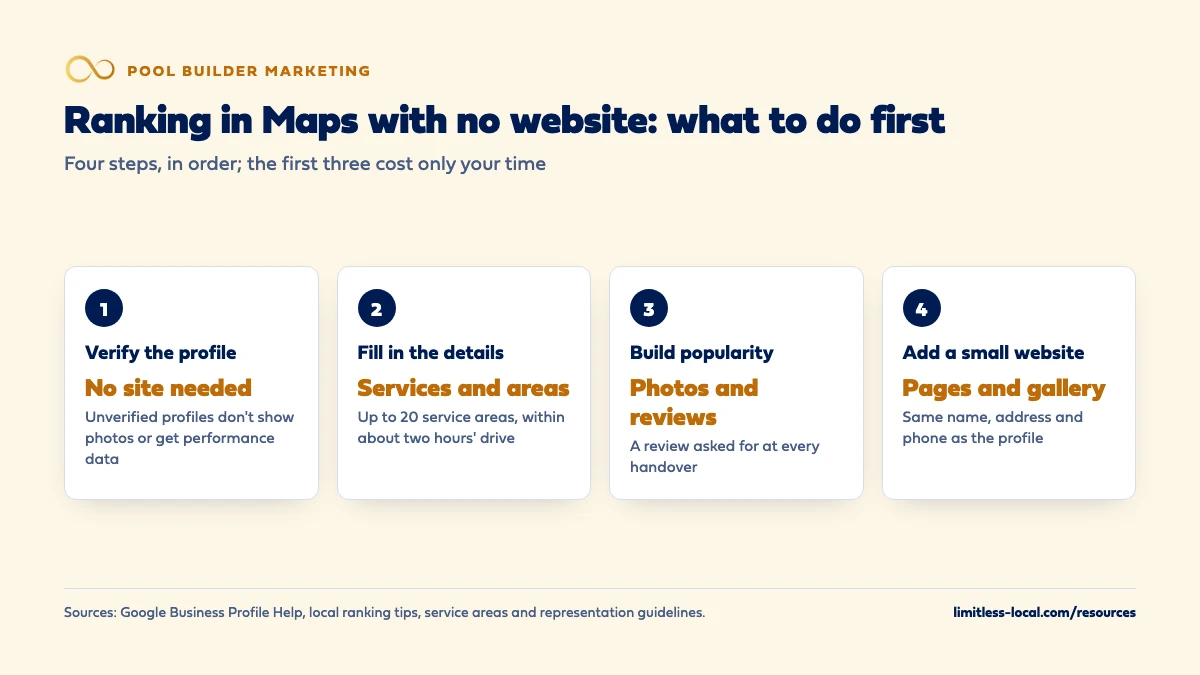
Work in this order. Each step is free except your time, and each one makes the next count for more:
- Claim and verify the profile. Your photos and videos only show on Google after you verify, and performance data is only available for verified profiles.
- Set categories, services and service areas to the work you actually want and the towns you’ll actually drive to.
- Add photos from every build: the dig, steel, shell, tile, first fill and the finished yard.
- Ask every past customer for a review, starting with the most recent, and reply to each one.
- Use one phone number everywhere and answer it. A profile that ranks but rings out is worse than one that doesn’t rank.
- Then build a small website with the same business name, address and phone number as the profile.
If your profile isn’t set up yet, setting up and verifying a pool company’s Google profile walks through it.
What's the smallest website that actually helps a pool builder?
You don’t need fifty pages. A starter site that does its job for a pool builder has:
- A home page that says what you build and names the towns you build in.
- A page for each main pool type or service, such as new gunite pools, fiberglass pools and renovations, so Google and homeowners can match you to the right search.
- A project gallery of your own finished pools, with the town and pool type on each one. Setting up a project gallery page covers how to lay it out.
- An about page with your story, license and insurance details, and photos of you and your crew.
- A consultation request form and a phone number that work on a phone.
Keep the business name, address and phone number exactly the same as on the profile, and link the site from the profile’s website field.
How do reviews and links make up for a missing website?
Partly. Reviews are the one popularity signal you can build hard with no website at all. Google says more reviews and positive ratings can help your business’s local ranking, and a pool builder can ask every customer at handover, when they’re happiest.
Links are harder. Google counts how many websites link to your business as part of how well-known you are, and most links point to a website. Directory listings and local mentions still help, but a builder with a website gets more out of every supplier listing or local news story that mentions them. How backlinks and listings help a pool builder rank in Maps covers which ones matter.
If you have to choose, reviews come first: they help you rank and help the homeowner already looking at your profile decide to call.
How do I know if having no website is costing me jobs?
Look at your profile’s numbers and at who’s beating you. Google’s Business Profile performance report shows, for verified profiles, how many people viewed your profile on Search and Maps, the search terms they used, and how many called. It also counts website clicks, which on a profile without a site will always be zero.
Three signs no website is holding you back:
- Plenty of views, few calls. Homeowners are finding you and leaving without contacting you.
- The builders above you in Maps all have websites with pages for the pool types you build.
- Homeowners ask “do you have a website?” or say they couldn’t find examples of your work.
If every builder in the top three has a site full of project photos and you’re the only one without, that gap is the first thing to close.
When does it make sense to hold off on a website?
When the profile isn’t finished yet, or the calendar is already full. If you’re a new builder whose first season is booked by referrals, getting the profile complete, collecting reviews from every build and photographing every pool is the better use of the next few months. That material becomes your website later.
It stops making sense once you want work from people who don’t already know you, once you plan to run search ads, or once competitors with sites start outranking you. Most search ads send people to a page on your website, so whether you need a landing page for Google Ads is worth reading before you spend on clicks.
Start small, with real photos and real towns, and add pages as you build more pools.
Want to see where your company stands?
A free visibility audit shows where you show up on Google, Maps and AI answers, and what it's costing you in calls.
What's different about a missing website for pool builders
Homeowners research longer. A plumber with no website can still get an emergency call straight from Maps. A homeowner planning a pool wants to see finished work, understand the process and compare builders, which a profile alone can’t fully show.
Your best proof is visual. Pools photograph well, and a gallery of finished backyards does more selling than any description. A website lets you organize that by pool type and town; a profile shows photos newest first.
The sales cycle is long. Many homeowners look in winter and sign in spring, and a website keeps working for them across those months.
Pool types are separate searches. Gunite, fiberglass, renovations and spas are each searched on their own, and one profile description has to cover them all.
A worked example: what one lost consultation costs
These numbers are made up to show the math, not a benchmark for your market. Say your profile gets 300 views in a spring month, and 15 of those homeowners call. Now say 6 more would have asked for a consultation if they could have seen your pools on a website, but went to the next builder instead.
If 1 in 4 consultations signs, those 6 lost homeowners were worth about 1.5 signed pools that month. Even if only one of them would have signed, and your average pool is $60,000, that one contract is worth far more than the cost of a simple website.
For comparison, our themed website is $3,750, or $3,000 alongside any of our marketing packages, with up to 25 pages, and payment plans over 6 or 12 months. Custom sites start at $5,000. Whether a site pays back faster than more ads or more reviews depends on how many homeowners are already finding you, which is what a free visibility audit checks.
Frequently asked questions
Does Google rank businesses with websites above those without?
Google doesn’t list having a website as a ranking factor. It ranks local results mainly on relevance, distance and popularity, and a website helps the first and the last by giving Google more detail and giving other sites something to link to.
Can I use my home address on the profile if I have no website or office?
If homeowners don’t visit you there, set the profile up as a service-area business and hide the address. Google’s guidelines say a service-area business should clear its address from the profile.
Can I run Google Ads with no website?
Most search ads send people to a page on your site, so you’ll want at least one page that matches the pool type you’re advertising and asks for a consultation before you spend on clicks.
Will a free website builder page work?
It can, as long as it’s on your own domain, shows your own pools and towns, and uses the same business name, address and phone number as your profile.
How long after launching a website will my Maps ranking change?
There’s no set time. Google has to find and read the new site, and SEO typically takes 3 to 6 months to show meaningful organic growth, so judge it over a season, not a week.
Should I build the website before I collect reviews?
No. Start asking for reviews now, because they help with or without a site. Build the website alongside, using photos from the same jobs.
Key takeaways
- A verified Google Business Profile with a phone number can rank in Maps without a website.
- Google ranks local results mainly on relevance, distance and popularity; a website feeds relevance and gives other sites something to link to.
- Finish the profile first: categories, services, service areas, photos and reviews.
- Never put a page that isn’t yours in the profile’s website field.
- A small site with pool-type pages, your towns and a real project gallery is enough to start.
Not sure what's working right now?
Start with a free visibility audit: rankings, Google profile, reviews and tracking, checked against your service area.
More in this section
- Do project photos help pool builders rank in Google Maps?
- How does proximity affect a pool builder's Google Maps ranking?
- How do I get my pool company to rank in Google Maps?
- Which online listings should a pool builder have besides Google?
- How do backlinks and listings help a pool builder rank in Maps?
Sources
- Tips to improve your local ranking on Google — Google Business Profile Help
- Guidelines for representing your business on Google — Google Business Profile Help
- Understand how Google sources & uses info in Business Profiles & local search results — Google Business Profile Help
- Manage your services on your Business Profile — Google Business Profile Help
- Manage your service areas for service-area & hybrid businesses — Google Business Profile Help
- Understand your Business Profile performance & insights — Google Business Profile Help
- Manage your Business Profile photos & videos — Google Business Profile Help
- SEO Starter Guide: The Basics — Google Search Central