
What is review velocity, and should a pool builder care?

- What does review velocity mean for a pool construction company's Google profile?
- What does review velocity actually mean?
- Is review velocity a Google ranking factor?
- Why do homeowners care how recent my reviews are?
- Can getting too many reviews too fast hurt my pool company?
- What review pace is realistic for a pool builder?
- How do I keep reviews coming in during the off-season?
- Should I give my team a monthly review target?
- Does review velocity matter on Yelp too?
- How do I track my review velocity?
- What should I do if my pool company's reviews have stalled?
- What's different about review velocity for pool builders
- A worked example: a pool builder's review pace across a year
- Frequently asked questions
- Key takeaways
- More in this section
- Sources
The short version
- Review velocity means how fast new reviews come in, not how many you have in total.
- Google doesn't call it a ranking factor, but it counts reviews and ratings as part of how well known you are.
- Unusual bursts of reviews can look like manipulation; a steady pace tied to real handovers is the pattern Google's rules expect.
- Measure the requests you send, not a review quota for your team, which Google doesn't allow.
For pool builders who have heard that the pace of new reviews matters as much as the total, and want to know what that means for a business that may finish only a few dozen pools a year.
Get a free visibility audit · Book a growth call
What does review velocity mean for a pool construction company's Google profile?
Review velocity is the pace at which new reviews arrive, such as two a month, as opposed to the total number you’ve collected. Google doesn’t name it as a ranking factor; it says the number of reviews and positive ratings can help your local ranking, and its policies treat unusual volumes or patterns of reviews as possible rating manipulation. A pool builder should care for a different reason: homeowners notice dates, so a steady flow of reviews tied to the pools you hand over keeps your profile looking current without the unusual bursts Google’s policy warns about.
Review response and basic review generation are part of our local SEO work in the Essentials package, at $3,500 a month; see our pool builder marketing page. The rest of the pool builder marketing questions library covers the other pieces of showing up in Maps.
What does review velocity actually mean?
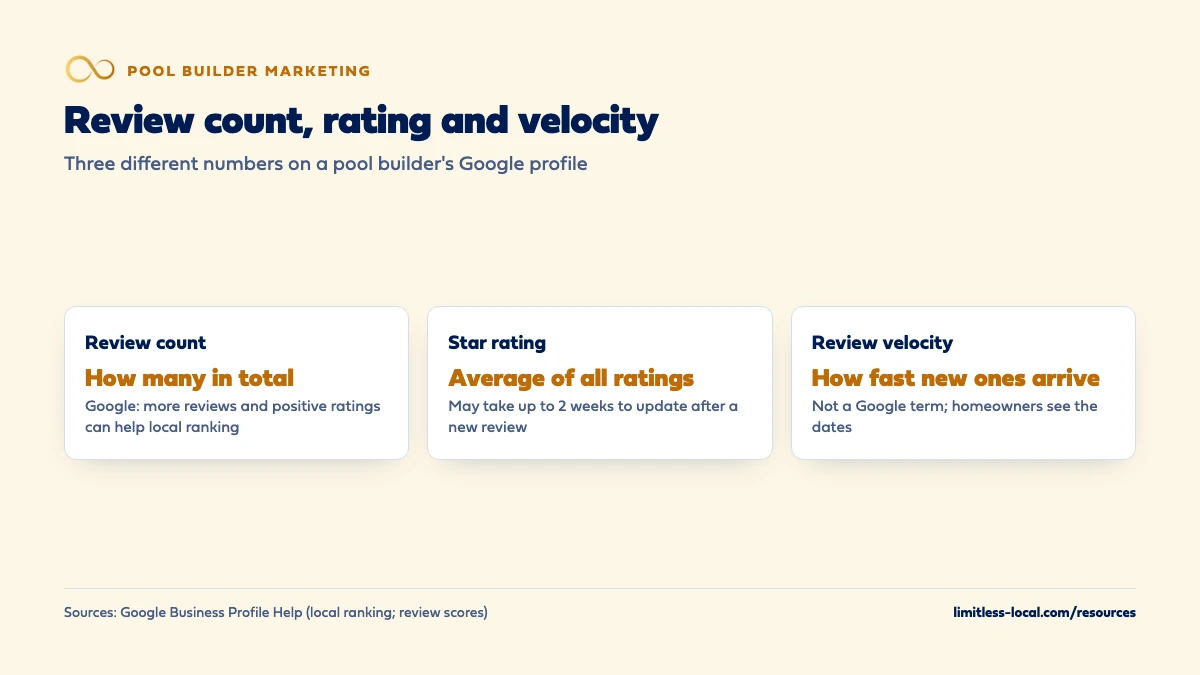
Review velocity is a marketer’s term for the rate at which new reviews arrive on your profile: three this month, one last month, none in December. It sits alongside two numbers you already know:
- Review count: how many reviews you have in total.
- Star rating: the average of all ratings published on Google for your business.
- Review velocity: how fast new ones come in, which also decides how old your newest review is.
A builder can have a big count and a good rating and still have poor velocity, for example 120 reviews where the newest is eight months old. Homeowners see that date. Google’s help pages on ranking and reviews don’t use the term, so treat velocity as a way of describing your review flow, not as a setting or a score you can look up.
Is review velocity a Google ranking factor?
Google doesn’t say so. It says local results are mainly based on relevance, distance and popularity, that how well known a business is depends partly on how many websites link to it and how many reviews it has, and that more reviews and positive ratings can help your local ranking. It also says it keeps the details of the algorithm confidential and that there’s no way to pay for a better local ranking. Source: Tips to improve your local ranking on Google.
So anyone who tells you exactly how much the pace of reviews moves your Maps position is guessing. In our judgement, velocity matters to ranking mostly indirectly: a steady pace is how the review count grows over the years, and it keeps your profile active. If you want the bigger picture on Maps, read how proximity affects a pool builder’s Google Maps ranking, because distance often explains more than reviews do.
Why do homeowners care how recent my reviews are?
Because a recent review tells them you’re still building, with the same crews and the same standards. In BrightLocal’s Local Consumer Review Survey 2026, a panel of 1,002 US adults, 74% said they seek reviews written in the last three months, and 44% named a review posted in the last month as one of the most important factors. Source: Local Consumer Review Survey 2026.
That survey covers local businesses in general, not pool builders, and a homeowner choosing a pool builder isn’t choosing a lunch spot. Still, in our judgement the instinct carries over: someone about to sign a large contract wants evidence that your recent customers are happy, not just the ones from three seasons ago. It also matters which reviews say what; what pool customers mention in their Google reviews covers the content side.
Can getting too many reviews too fast hurt my pool company?
It can if the burst looks manufactured. Google’s policy lists “content exhibiting unusual volumes or patterns of review contributions that are indicative of efforts to manipulate a place’s rating” as rating manipulation, which isn’t allowed and will be removed. The same policy bars incentives such as payment, discounts or free goods in exchange for reviews, and bars asking only happy customers. Source: Prohibited & restricted content.
Google can also restrict a profile that breaks its fake engagement policy, for example stopping it from receiving new reviews for a set period, unpublishing existing reviews for a period, or showing a warning that fake reviews were removed. Source: Business Profile restrictions for policy violations.
None of this means a good month is dangerous. A spring where you hand over a batch of pools and every customer reviews you is a genuine pattern. What draws trouble is a burst with no real jobs behind it, or reviews bought, swapped or collected with a discount on the final invoice.
Curious what your marketing is actually booking?
Get a free visibility audit — no obligation, no sales pitch.
What review pace is realistic for a pool builder?
Work it out from your builds, not from what a plumber down the road gets. Your review flow can’t be faster than the number of customers who reach a finished pool, times the share who actually post after you ask. A builder who hands over a couple of pools a month in season will see a couple of reviews a month at best, and nothing about that is a problem.
You can add to the flow honestly: renovation and remodel customers, customers from past seasons who were never asked, and anyone who has a genuine experience with your company. Google suggests reminding customers to leave reviews with a Google link or QR code. Source: Tips to get more reviews.
How the total compares with the builders around you is a separate question, answered in how many Google reviews a pool builder needs.
How do I keep reviews coming in during the off-season?
If your handovers bunch up in the warmer months, your reviews will too, and they’ll thin out in winter. In our judgement, these keep the flow from stopping:
- Ask past customers in the quiet months. A short, personal message to customers from previous seasons who were never asked, sent through the winter rather than all on one day.
- Ask at every finish, not just new builds. Renovations, resurfacing and equipment upgrades finished in the off-season are genuine experiences too.
- Don’t hold requests for spring. Ask when each job finishes, so the timing follows the work.
The right point to ask in each build is covered in when a pool builder should ask for a review during the build.
Should I give my team a monthly review target?
Not a target for reviews. Google’s policy says merchants shouldn’t request that staff solicit a certain number of reviews, or reviews that include specific content such as naming a staff member, and that merchants shouldn’t pressure customers to leave ratings on the premises. Source: Prohibited & restricted content.
What you can measure is the asking. In our judgement, the useful team number is the share of finished jobs where a review request actually went out, which your job software can usually show. That keeps the pace steady without anyone leaning on customers, and it tells you whether a quiet month means fewer handovers or a dropped process.

Does review velocity matter on Yelp too?
Yelp is the exception to everything above. Yelp asks businesses not to ask anyone for reviews, says staff should never compete to collect them, and says its software may not recommend reviews that seem to have been prompted by the business, which may hurt your Yelp rating. Source: Don’t Ask for Reviews.
So on Yelp you can’t manage the pace; you can only keep your listing accurate and reply well when reviews arrive. Google allows you to ask for genuine reviews without incentives, which is why, in our judgement, Google is where your asking effort belongs.
How do I track my review velocity?
Keep it simple. Once a month, write down three numbers: how many new Google reviews arrived, the date of your newest review, and how many review requests went out. Compare them with how many pools and renovations you finished that month.
Allow for lag. Google says reviews are checked against its policies, which in some cases can take a few days and delay a review’s appearance, and that after a new review it may take up to 2 weeks for your review score to update. Sources: About missing or delayed reviews; Understand review scores for local places & businesses.
If requests are going out and reviews aren’t coming back, the problem is the ask itself, and how to get more Google reviews for a pool company walks through the fixes.
What should I do if my pool company's reviews have stalled?
- Check whether asks stopped. A new office manager, a software change or a busy season is often the reason, not unhappy customers.
- Check the link. Make sure the link or QR code you send still goes to your current profile.
- Restart with recent customers first, then past seasons, spread over weeks.
- Reply to the reviews you have. It shows homeowners someone is paying attention between reviews.
- Don’t fill the gap with bought or incentivized reviews. The restrictions above can leave you with fewer reviews than you started with.
Want to see where your company stands?
A free visibility audit shows where you show up on Google, Maps and AI answers, and what it's costing you in calls.
What's different about review velocity for pool builders
Few jobs, big decisions. A service trade can finish many jobs in a week; many pool builders finish a few dozen pools in a year. In our judgement, that’s why pool builders should judge their pace against their own handovers, not against service companies in the same map results.
The review comes months after the lead. A homeowner who called in February may not be swimming until summer. Reviews describe builds you sold long ago, so a dip in reviews can trail a dip in sales by a season.
Handovers bunch up. In most markets completions tend to cluster before swim season, so a spring burst of genuine reviews is normal for a builder. Keeping the winter months from going silent is the part that takes planning.
A worked example: a pool builder's review pace across a year
These numbers are made up to show the math, not a benchmark. A builder hands over 30 new pools a year: 22 between April and September and 8 between October and March. The office sends a review request at every handover, and about 60% of customers post one.
- Warm months: 22 handovers at 60% is about 13 reviews over six months, roughly two a month.
- Cool months: 8 handovers at 60% is about 5 reviews over six months, less than one a month.
- Year total: about 18 reviews.
The winter gap is where the newest review starts to look old. If the office also writes to 40 past customers who were never asked, spread over January and February, and 25% of them post, that’s about 10 more reviews, landing in exactly the months that would otherwise be quiet. Nothing about this is a burst: every review comes from a real customer, and the pace follows real work.
Frequently asked questions
Is review velocity the same as review recency?
They’re linked but not the same. Velocity is how often new reviews arrive; recency is how old your newest review is. A steady pace keeps recency good almost automatically.
How many reviews a month should a pool builder get?
There’s no published number. Your pace is limited by how many customers finish a pool or renovation and how many of them post after you ask, so set a goal for requests sent, not reviews received.
Will Google remove reviews if I get a lot in one week?
Google removes reviews it judges to be fake or manipulated, and its policy names unusual volumes or patterns of reviews as a sign of manipulation. Genuine reviews from real handovers are allowed; the risk is a burst with no real customers behind it.
Does replying to reviews affect review velocity?
Not directly, since velocity is about new reviews. Google does recommend replying to reviews, and in our judgement replies help homeowners see the business is active between reviews.
Can my job software send review requests automatically?
If yours has a review-request feature, set the trigger to the final stage of the build and make sure every customer gets the request, not just the ones you expect to be happy. The setup is covered in when to ask for a review during a build.
Should I ask customers to mention my crew or the pool type?
No. Google’s policy says merchants shouldn’t request specific content in reviews, including content that identifies a staff member. Ask for an honest review and let customers write what they want.
Key takeaways
- Review velocity is the pace of new reviews; Google’s help pages don’t use the term or name it as a ranking factor.
- Google says the number of reviews and positive ratings can help local ranking, so a steady pace builds the count that matters.
- Unusual volumes or patterns of reviews can count as rating manipulation, so match your pace to real handovers.
- Measure review requests sent, not a review quota for staff, which Google’s policy doesn’t allow.
- Fill the winter gap by asking past customers and off-season renovation customers, spread over weeks.
Not sure what's working right now?
Start with a free visibility audit: rankings, Google profile, reviews and tracking, checked against your service area.
More in this section
- When should a pool builder ask for a review during the build?
- Google reviews a pool builder needs: how many is enough?
- How fast should a pool builder respond to a new lead?
- How do pool builders qualify leads before the design consultation?
- How should a pool builder respond to negative Google reviews?
Sources
- Tips to improve your local ranking on Google — Google Business Profile Help
- Prohibited & restricted content — Google Maps User Contributed Content Policy Help
- Business Profile restrictions for policy violations — Google Business Profile Help
- Understand review scores for local places & businesses — Google Business Profile Help
- About missing or delayed reviews — Google Business Profile Help
- Tips to get more reviews — Google Business Profile Help
- Don't Ask for Reviews — Yelp Support Center
- Local Consumer Review Survey 2026 — BrightLocal