
How should a roofing company get its first website built?

- What's the best way for a roofing company to get a website made?
- What does a roofing company's first website actually need to do?
- Should a roofer build the website themselves?
- When does a freelancer make sense for a roofing website?
- When is an agency the better route?
- What should a roofing company own before the site is built?
- What pages should a first roofing website start with?
- How important is it that the site works on phones?
- How long should a first roofing website take to build?
- What should happen right after the website launches?
- What are the warning signs of a bad website deal?
- What's different about a first website for a roofing company
- A worked example: comparing three build routes
- Frequently asked questions
- Key takeaways
- More in this section
- Sources
The short version
- Decide what the site must do: turn searchers and ad clicks into inspection requests.
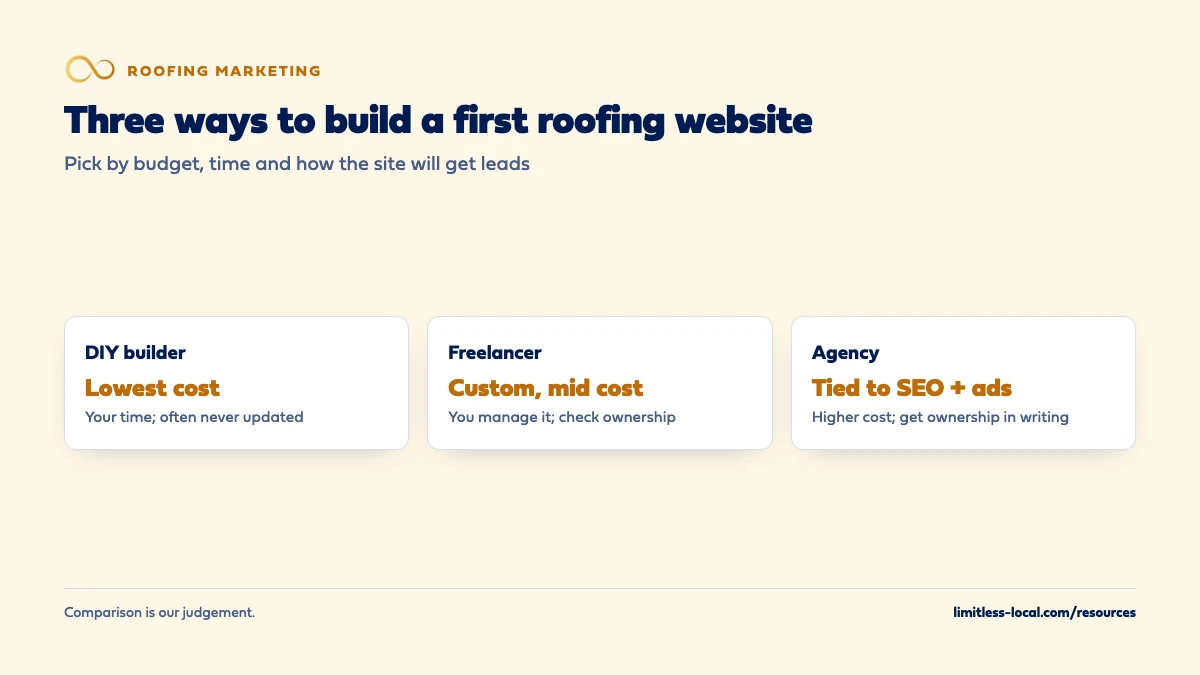
- DIY builder, freelancer or agency: choose by budget, time and whether you need SEO and ads tied in.
- Own the domain, hosting and every admin login in the company's name.
- Start small: home, a page per main service, service areas, about, reviews and contact.
- Get scope, timeline, ownership and post-launch support in writing before paying.
For roofing owners with no website, or only a Facebook page, deciding whether to build it themselves, hire a freelancer or hire an agency.
Get a free visibility audit · Book a growth call
What's the best way for a roofing company to get a website made?
Decide first what the site has to do (bring in inspection requests from Google and ads), then pick the route that fits your budget and time: a do-it-yourself builder if money is tight and you have evenings, a freelancer for a simple custom site, or an agency if you want the site tied to SEO, ads and tracking. Whatever the route, register the domain in the company’s name, own the hosting and admin logins, make it work well on phones, and get written scope, timeline and post-launch support before you pay. A small first site with a page per main service and per main town is enough to start.
We build roofing websites as part of a wider marketing plan, with themed and custom options on our website design page. See how websites fit with SEO, ads and follow-up on roofing marketing. The roofing marketing guide covers where a website sits among the other channels, and the roofing marketing questions library answers the follow-ups.
What does a roofing company's first website actually need to do?
One job: turn people who find you on Google, in the map results or from an ad into calls and inspection requests. Everything else, including how it looks, serves that job.
That gives you a short brief to hand any builder: your main services (replacement, repair, storm damage, maybe gutters or commercial), the towns you serve, proof that you’re real (reviews, photos of your own roofs, licenses and insurance where your state requires them), and an easy way to call or request an inspection on a phone. What a roofing website should include covers the content in detail. This page is about the route: who builds it, what you should own, and what to expect.
Should a roofer build the website themselves?
It can work if money is tight and you have time. Drag-and-drop builders make a basic site possible in a weekend or two, and they handle hosting for you.
The tradeoffs, in our judgement:
- Your time. Writing pages, taking photos and fixing layout on phones takes longer than most owners expect, and it competes with running jobs.
- A ceiling on growth. Some builders make it harder to add many location pages, track forms properly, or move the site later.
- Nobody watching it. A DIY site often launches and then sits unchanged for years.
If you go DIY, keep it simple, follow the page list below, and plan to revisit the decision when you start spending real money on ads or SEO.
When does a freelancer make sense for a roofing website?
When you want a custom, professional site without agency pricing, and you’re comfortable managing the project yourself. A good freelance web designer can build a solid small-business site; the risk is in what happens around the build.
Ask before you hire:
- Will the site be built on a platform I can take to another developer?
- Will the domain, hosting and admin logins be in my company’s name?
- Who writes the content, and who takes the photos?
- What does support cost after launch, and how fast do you respond?
- Can you show two or three local service business sites you built that are still live?
A freelancer who disappears is the most common way roofers lose access to their own site, in our judgement. Ownership protects you from that.
When is an agency the better route?
When the website is part of a bigger plan: ranking in your towns, running ads to it, and tracking which visitors become inspections. An agency that builds the site and also runs SEO and ads can plan pages around the searches and towns you want, set up call and form tracking from day one, and keep improving the site after launch.
The tradeoff is cost, and the risk of being tied in. Ask the same ownership questions you’d ask a freelancer, and get them in writing. Google’s own guidance on hiring an SEO is useful here: it notes that a great time to hire is when you’re considering a site redesign or planning a new site, so the site is built with search in mind from the start (Google Search Central).
Curious what your marketing is actually booking?
Get a free visibility audit — no obligation, no sales pitch.
What should a roofing company own before the site is built?
Everything that would be painful to lose:
- The domain name, registered in the company’s name with an email you control. ICANN says it’s your right to transfer your domain between registrars, and your registrar must provide the transfer code within five calendar days of your request (ICANN). If someone else registered it, that right is theirs to exercise, not yours.
- Hosting and the website admin login, as an owner-level account.
- Google Search Console, verified with you as an owner. Owners have full control of the property and can add and remove other users (Search Console Help).
- Analytics and tracking accounts, with you as an admin.
If you don’t know who your registrar is, ICANN’s lookup tool shows it. One timing note: a registrar may deny a transfer within 60 days of initial registration, so plan any move of a new domain accordingly.
What pages should a first roofing website start with?
Fewer than you think, as long as each one is useful. A solid starting set, in our judgement:
- Home: what you do, where, and how to reach you, with your phone number and a short form near the top.
- One page per main service: roof replacement, roof repair, storm damage, and any others you want to grow.
- Service areas: your main towns, with real detail about the work you do there, not copied text with the town name swapped.
- About: who you are, how long you’ve worked locally, licenses and insurance.
- Reviews and project photos: your own crews and roofs, not stock images.
- Contact: phone, a short inspection-request form, and your hours.
Google’s guidance is to make content helpful, reliable and people-first (Google SEO Starter Guide). For a roofer, that means pages that answer what homeowners actually ask.
How important is it that the site works on phones?
Very. Many homeowners search for a roofer on a phone, often while looking at a leak. Google also uses the mobile version of a site’s content for indexing and ranking (Google Search Central), so a site that hides content or breaks on phones can hurt you in search too.
Check that the phone number is tap-to-call, the form is short and easy to fill in with a thumb, and pages load quickly on a normal cell connection. How to know your site works well on phones has a checklist.
How long should a first roofing website take to build?
Plan in weeks to a few months, not days, if you want it done well. The build itself is rarely the slow part; content, photos and your feedback are. Ask any builder for a written timeline with milestones (design approval, content, launch) and what they need from you at each step.
Our own timeline is concept to launch in 100 days or less, with themed sites around 60 days, deliberately buffered because client feedback is the usual wait. Search results take longer to move than the launch: Google’s starter guide notes that some changes take effect in a few hours and others could take several months (Google SEO Starter Guide).
What should happen right after the website launches?
A short launch checklist:
- Add the website to your Google Business Profile. You can share your website on your profile, and some categories can add more links, like appointments (Google Business Profile Help).
- Verify Search Console and submit the site so Google can find the pages.
- Test every form and phone link on a phone and a computer, and make sure leads reach someone who answers them.
- Set up call and form tracking so you know which visitors become inspections.
- Update your listings so the website, name, address and phone match everywhere.
If you’ve been running on a Facebook page, link the two. A Facebook page instead of a website explains why the website should be the main home.
What are the warning signs of a bad website deal?
Walk away, or at least ask hard questions, if you see any of these:
- The builder registers the domain in their own name, or won’t say whose name it’s in.
- You won’t get admin access, or the site is on a system only they can edit.
- No written scope: number of pages, who writes content, how many revision rounds.
- Promises of first-page rankings or a set number of leads. Nobody can honestly guarantee those.
- No clear answer on support after launch, or on what happens to the site if you stop paying a monthly fee.
These are our judgement based on how ownership disputes usually start, not a legal checklist; read any contract carefully, and this isn’t legal advice.
Not sure which of these is costing you jobs?
A free visibility audit checks the Google profile, reviews, site and tracking, and shows what to fix first.
What's different about a first website for a roofing company
Trust has to be visible. Homeowners worry about storm chasers. Real photos of your crews and roofs, reviews, a local address or service area, and license and insurance details where your state requires them do more for a roofer’s site than design flourishes.
Urgent and researched buyers land on the same site. A homeowner with a leak wants your phone number in two seconds; one planning a replacement wants to read about materials and warranties. The home page has to serve both.
Storm pages need care. Storm-damage pages help, but keep them factual and avoid promising insurance outcomes; insurance questions belong to the homeowner and their insurer.
Towns matter. Roofers usually serve many nearby towns. Plan service-area pages from the start so the site can grow with your area.
A worked example: comparing three build routes
These numbers are illustrations for comparison, not quotes for your market, except where noted. A roofer with no site compares three routes:
- DIY builder: low monthly software cost, but the owner spends many evenings writing and laying out pages, and nobody improves it after launch.
- Freelancer: a one-time build fee and a monthly care plan; good if the freelancer is reliable and the owner can manage content and photos.
- Agency: for reference, our own published pricing is a themed website at $3,750 ($3,000 with any Limitless Engine package), up to 25 pages, or a custom website from $5,000, with 6- or 12-month payment plans, 10% off paid in full, and 30 days of post-launch support.
The deciding question isn’t only price. It’s whether the site will be connected to how you plan to get leads. If you’ll run ads and want to rank in several towns within the year, the cheapest build can become the most expensive if it has to be rebuilt. If you just need a credible home for referrals to check, a simple site is fine for now.
Frequently asked questions
Can I use a free website builder for my roofing company?
You can, especially to get started. Make sure you can use your own domain name and that you can move the site or its content later if you outgrow it.
Who should own my roofing website's domain name?
Your company, registered with an email you control. If a designer registers it in their name, the right to transfer it is theirs, not yours.
How many pages does a roofing website need at launch?
Enough to cover your main services, your main towns, who you are and how to contact you. For most small roofers that’s under a couple of dozen pages, in our judgement.
Will a new website rank on Google right away?
Usually not. Some changes show up in hours and others take months, and SEO typically takes three to six months to show meaningful organic growth.
Should I write the website content myself?
You know the work best, so your input matters. Many owners give the facts and photos and let a writer shape the pages.
Do I need a website if I already get referrals?
Referrals check you out online before they call. A simple site with reviews and photos of your work helps close the referrals you already get.
Key takeaways
- Start from the site’s job: turning searchers and ad clicks into inspection requests.
- DIY, freelancer or agency: choose by budget, time and whether the site must work with SEO and ads.
- Own the domain, hosting, Search Console and every admin login in the company’s name.
- Launch small with a page per main service and main town, and make it work well on phones.
- Get scope, timeline, ownership and support in writing before paying.
Want a second set of eyes on your setup?
We'll look at how you show up locally and where calls are leaking, then send you a plain-English breakdown.
More in this section
- How does a roofing company get links from local websites?
- What should a roofing website include to get more estimate requests?
- How can my roofing company stand out from other roofers online?
- How should a roofing company market commercial roofing?
- Can a roofing company use a Facebook page instead of a website?
Sources
- FAQs for Registrants: Transferring Your Domain Name — ICANN
- Managing owners, users, and permissions — Google Search Console Help
- Mobile-first Indexing Best Practices — Google Search Central
- SEO Starter Guide: The Basics — Google Search Central
- Do You Need an SEO? — Google Search Central
- Edit your Business Profile — Google Business Profile Help