
Will SEO work for a roofer without a big marketing budget?
- Can a small roofing company get results from SEO on a tight budget?
- Can SEO really work for a roofer on a small budget?
- What does a small SEO budget actually buy for a roofer?
- Which free SEO work matters most for a roofer?
- Which towns and services should a small-budget roofer focus on?
- Where should the first dollars of a small SEO budget go?
- What can't SEO do on a small budget?
- How long will SEO take on a small budget?
- Should a roofer on a tight budget start with SEO or ads?
- How do I know if my small-budget SEO is working?
- When does a small budget stop being enough for roofing SEO?
- What's different about small-budget SEO for roofing companies
- A worked example: a year of small-budget SEO for a roofer
- Frequently asked questions
- Key takeaways
- More in this section
- Sources
The short version
- SEO works on a small budget if you narrow the towns and services you chase.
- The highest-value work is mostly free: Google profile, reviews, photos, service pages.
- Start with the towns closest to you, where distance is on your side.
- A small budget can't win a crowded metro fast; expect months, not weeks.
- Spend your first dollars where your own time runs out, not on link packages.
For roofing owners who can’t spend thousands a month on marketing and want to know what SEO can realistically do on a small budget, where to focus, and when the budget stops being enough.
Get a free visibility audit · Book a growth call
Can a small roofing company get results from SEO on a tight budget?
Yes, SEO can work for a roofer without a big budget, as long as you narrow it: one or two main services, the towns closest to your shop, and the free basics done well. Google doesn’t charge for organic rankings, and the work that matters most locally, a complete Google Business Profile, a steady stream of reviews and a clear page for each service, costs time more than money. What a small budget can’t do is win roof replacement searches across a big, crowded metro quickly, so expect a slower ramp and pick the searches you can win first.
Our local SEO work for roofers is a full monthly program, and it isn’t the small-budget option; if you’re not there yet, the free basics on this page are the right place to start. The roofing marketing page shows what the full program covers, the roofing SEO guide explains how search books roofing jobs, and the roofing marketing questions library has the rest.
Can SEO really work for a roofer on a small budget?
Yes. Organic rankings aren’t for sale: Google says it never accepts money to include or rank sites in its search results, it costs nothing to appear in organic results, and if you run a small local business you can probably do much of the work yourself. That puts a one-truck roofer and a 20-crew company on the same starting line for the searches that matter in their own towns.
The difference a big budget buys is speed and reach: more pages, more towns, more links, more people doing the work every week. A small budget buys focus. Done well, focus is enough to win the searches near your shop, and those are often the ones that sign best because your crews are close.
What does a small SEO budget actually buy for a roofer?
Think of it in three levels:
- Time only. You or someone in your office does the Google profile, review requests, photos and a few service pages. Cost: a few hours a week.
- Time plus targeted help. You do the routine work and pay for the parts you can’t do well, like a one-time website fix, a set of well-written service pages, or tracking setup.
- A full monthly program. Someone else does the ongoing work: content, links, technical fixes, profile management and reporting.
Most roofers without a big budget belong in the first or second level, and there’s nothing second-rate about that. What each level usually costs in dollars is covered in how much a roofer should expect to pay for SEO.
Which free SEO work matters most for a roofer?
Start with your Google Business Profile, because it’s what shows in the map pack, and Google’s help page on local ranking says plainly that businesses with complete and accurate info are more likely to show up in local search results, and more reviews and positive ratings can help your local ranking. That points to a free to-do list:
- Verify the profile and pick the most accurate primary category.
- Fill in everything: services, service area, hours, description, photos of real jobs and your crew.
- Ask every customer for a review when the roof is done, and reply to each one.
- Add a few new job photos every month.
- Turn on Google Search Console for your website so you can see what’s working.
How a roofer should optimize a Google Business Profile walks through the profile settings one by one.
Which towns and services should a small-budget roofer focus on?
Narrow both. Local results are mainly based on relevance, distance and popularity, and distance is the one factor you can’t change. So start where it works for you: the towns closest to your shop or where most of your past jobs are.
- Towns: pick two to four. Build a strong page for your home town first, then one for each nearby town where you already have jobs, photos and reviews to show.
- Services: pick the one or two that make you the most money, usually roof replacement and roof repair. Give each its own page that answers what homeowners ask: what the job involves, how long it takes, what materials you install, and how inspections and estimates work.
Chasing 25 towns with thin, copy-paste pages spreads a small budget so thin that none of them rank. Which services and cities a roofer should build pages for goes into how to choose.
Curious what your marketing is actually booking?
Get a free visibility audit — no obligation, no sales pitch.
Where should the first dollars of a small SEO budget go?
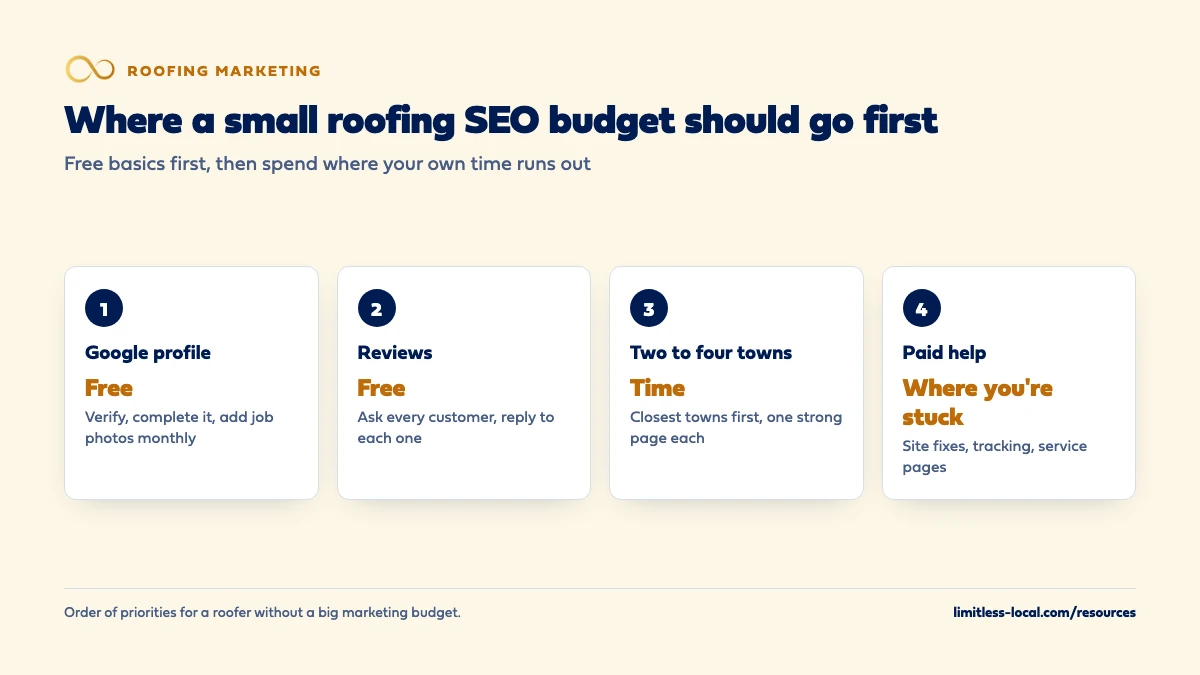
Spend money where your own time or skill runs out, in roughly this order:
- Fix anything broken on the website: a site that’s slow or hard to use on a phone, a contact form that doesn’t send, a click-to-call button that doesn’t work.
- Tracking: a call tracking number for the website and Google profile so you know what search produces.
- Good service pages for your main service and town, if writing isn’t your thing.
- Review request automation through the job software you already pay for.
- Local links from real relationships: a sponsorship, a supplier listing, the chamber.
Notice what’s not on the list: bulk directory submissions, “500 backlinks” packages and monthly reports with no work behind them. On a small budget, those take money from the things that actually bring calls. How links and citations fit is covered in how local backlinks and citations help a roofing company.
What can't SEO do on a small budget?
Be clear-eyed about the limits:
- It can’t win a crowded metro fast. “Roof replacement” in a big city with dozens of established roofers takes sustained work over many months.
- It can’t cover a huge service area. Every town needs proof that you work there: reviews, photos, a real page.
- It can’t fix a broken foundation cheaply. A site Google can’t crawl, or a profile that’s suspended or duplicated, needs to be fixed before anything else works.
- It can’t fill the schedule next month. If you need jobs now, SEO alone is the wrong tool.
None of that means small-budget SEO is a waste. It means picking a smaller target and hitting it.
How long will SEO take on a small budget?
Longer than on a big one. SEO typically takes 3 to 6 months to show meaningful organic growth, and a lean effort in a competitive market can run past that. Google’s SEO Starter Guide notes that some changes take effect in a few hours and others could take several months, and suggests waiting a few weeks before judging whether a change helped.
Profile work and reviews usually show first, often as more calls and direction requests from Maps in the towns closest to you. Website rankings for service-plus-town searches tend to follow. How long SEO takes to bring a roofer their first leads lays out what to expect month by month.

Should a roofer on a tight budget start with SEO or ads?
It depends on how soon you need the work. Ads can generate leads within days of launch; SEO takes months. If the schedule has gaps next month, a small, tightly targeted ad campaign fills them while the free SEO basics build in the background. If you’re busy enough today and want steadier leads next year, put your time into SEO and keep ad spend small or off.
The U.S. Small Business Administration’s advice on stretching a marketing budget fits roofers well: when the budget is tight, ramp up the low-cost or free methods and be very selective about the expensive ones. For roofers, the free methods are the profile, reviews and referrals. Whether $1,000 a month is enough for roofing marketing shows how to split a small paid budget.
How do I know if my small-budget SEO is working?
Check three free reports once a month and write the numbers down:
- Google Search Console can show you how often your site appears in Google Search, which search queries show your site, and how often searchers click through. Look for more searches that include your service and town names.
- Your Google Business Profile performance report shows calls, website clicks and the searches people used to find your business.
- Your job software should show how many leads came from Google and how many signed.
A rising line in all three over several months means it’s working. Flat numbers after six months of steady effort mean something in the plan needs to change, usually the pages, the reviews or the towns you picked.
When does a small budget stop being enough for roofing SEO?
A small budget has done its job when you start seeing these signs:
- You show up well in your closest towns and want to reach the next ring of towns.
- Competitors in your market are clearly outworking you on reviews, pages and links.
- You’re too busy to keep the routine going, and it keeps slipping.
- You can see from tracking that organic leads sign well, so more of them would be worth paying for.
That’s the point to add help, one piece at a time, starting with whatever you’ve stopped doing consistently.
Not sure which of these is costing you jobs?
A free visibility audit checks the Google profile, reviews, site and tracking, and shows what to fix first.
What's different about small-budget SEO for roofing companies
Your job photos are free content. Every roof you finish is before-and-after material for your profile and your service pages. Roofers have more visual proof than most trades; use it.
Storms bring new competition. After hail or high winds, new companies and out-of-town crews create profiles and run ads. A small-budget roofer with years of local reviews and real job photos has an edge they can’t buy quickly.
One signed replacement can pay for a year of basics. Because roof replacement is high-ticket, small-budget SEO only needs to bring a few extra signed roofs a year to pay off. Judge it on signed roofs, not traffic.
Manufacturer listings are free visibility. If you hold a manufacturer certification, make sure its contractor-finder listing is complete and links to your site.
A worked example: a year of small-budget SEO for a roofer
These numbers are made up to show the math, not a benchmark and not a client result. A one-crew roofer spends 3 hours a week on the Google profile, reviews and photos, and pays $300 a month for help with service pages and tracking. That’s $3,600 for the year.
For the first six months, organic leads barely move. In months seven through twelve, the profile and the home-town replacement page start bringing about 4 extra leads a month, or 24 over those six months. If 1 in 4 of those leads signs, that’s 6 extra roofs for the year. The cash cost per extra signed roof is $3,600 divided by 6, or $600, plus the owner’s time. For a high-ticket roof, that’s a strong return, and the second year starts from a much better place.
Where we fit: our Essentials package is $3,500 a month, which covers local SEO, Google profile management, link building, content and Google Ads management for one location. That isn’t a small budget, and we’ll say so if the math doesn’t work for your company yet. We don’t guarantee rankings or lead counts; nobody honestly can.
Frequently asked questions
Is cheap SEO worse than no SEO?
It can be, if it buys bulk links, spammy directory listings or copy-paste town pages. Free basics done well beat cheap work that breaks Google’s rules.
Can I do roofing SEO without a website?
You can get calls from a strong Google profile alone, but a website with service pages lets you rank in the regular results and gives homeowners more reasons to trust you.
How many hours a week does small-budget SEO take?
Two to three hours a week covers review requests, photos, profile updates and a monthly check of your numbers. Writing new pages takes extra time in bursts.
Should I pay for SEO tools?
Not at first. Google Search Console and your Google profile’s performance report are free and cover what a small roofer needs to track.
Can a small roofer outrank big roofing companies?
In the towns closest to you, often yes, because distance and local reviews count. Across a whole metro, the bigger budget usually wins over time.
Is social media part of small-budget SEO?
Not directly, but posting real job photos and sharing your reviews helps homeowners recognize your name when they search.
Key takeaways
- SEO can work for a roofer without a big budget if you narrow towns and services.
- The most valuable local SEO work, the Google profile, reviews and photos, is mostly free.
- Start with the towns closest to your shop and your one or two most profitable services.
- Spend money where your own time or skill runs out, never on bulk link packages.
- Expect months, not weeks, and judge it on signed roofs from search.
Want a second set of eyes on your setup?
We'll look at how you show up locally and where calls are leaking, then send you a plain-English breakdown.
More in this section
- Can a roofing company do its own SEO?
- How much should a roofer expect to pay for SEO?
- Is SEO still worth it for roofers in 2026 with AI search?
- How long does SEO take to bring a roofer their first leads?
- Which roofing companies get the best results from SEO versus ads?
Sources
- Do You Need an SEO? Tips for Hiring an SEO — Google Search Central
- Tips to improve your local ranking on Google — Google Business Profile Help
- SEO Starter Guide: The Basics — Google Search Central
- About Search Console — Search Console Help
- Understand your Business Profile performance & insights — Google Business Profile Help
- How to Get the Most From Your Marketing Budget — U.S. Small Business Administration