
Should plumbers combine paid ads, SEO and referrals?

- Should I combine paid ads for calls now with SEO and referrals for later?
- Why combine marketing channels instead of picking one?
- What does each channel do best for a plumbing company?
- Do paid ads and SEO help each other?
- Where do referrals and repeat customers fit in?
- What order should a plumber add channels in?
- How should I split my budget between ads, SEO and referrals?
- When is combining channels a mistake?
- How do I know which channel booked the job?
- Will SEO and referrals let me stop paying for ads?
- Can I reward customers for referrals and reviews?
- What's different about combining channels for plumbers
- A worked example: how the blended cost per job can change
- Frequently asked questions
- Key takeaways
- More in this section
- Sources
The short version
- Ads bring calls now; SEO builds over months; referrals grow with every good job.
- Start with one paid channel funded properly, plus the free SEO and referral basics.
- Don't spread a small budget across so many channels that none gets enough to work.
- Tag every lead by source and move money by cost per booked job.
For plumbing company owners deciding whether to run ads, SEO and a referral program together or put everything into one channel.
Get a free visibility audit · Book a growth call
Should I combine paid ads for calls now with SEO and referrals for later?
Most plumbers should combine them, in an order and at a scale their budget can carry. Paid ads can bring calls within days, SEO typically takes 3 to 6 months to build, and referrals and repeat customers often cost the least per job but can’t be switched on when the phone goes quiet. A sensible order is to fund one paid channel well for calls now, start the free SEO basics and a referral habit at the same time, and shift money as the slower channels start booking jobs.
Running these together is what our packages are built for: local SEO and your Google Business Profile, Google Ads, and review generation in one plan, with call tracking and source tagging so you can see which channel booked each job. Ad spend is paid to Google separately. The tiers and what each covers are on our marketing packages page, how it fits a plumbing company is on our plumbing marketing page, and the rest of the plumbing marketing questions library goes channel by channel.
Why combine marketing channels instead of picking one?
Because each channel runs on a different clock and a different cost, and a plumbing company needs calls on more than one timescale. Paid ads can generate leads within days of launch. SEO typically takes 3 to 6 months to show meaningful organic growth. Referrals and repeat customers build with every job you do well, and can’t be switched on when the phone goes quiet.
Relying on one channel also means one point of failure. If all your calls come from ads, a price jump in your market or a suspended account stops the phone. A 2019 post on the SBA’s blog makes the general point for small businesses: including a mix of marketing methods helps maximize results, and you shouldn’t put all your eggs in one basket (SBA: How to Get the Most From Your Marketing Budget). In our judgement, the question for most plumbers isn’t whether to combine, but in what order and how thin to spread.
What does each channel do best for a plumbing company?
- Paid ads (Google search ads and Local Services Ads) buy calls now, from people searching right now. You control the budget, the hours and the jobs, and the calls stop when the money does.
- SEO, meaning your Google Business Profile, the map pack and your website, builds slowly and keeps working when you’re not paying per click. Google says a small local business can probably do much of its SEO work itself (Google Search Central: Do you need an SEO?).
- Referrals and repeat customers come from people who already trust you. In our judgement, they’re usually the cheapest jobs you’ll get and among the most likely to book, but you can’t turn up the volume on demand.
Put together, ads cover the gap while the slower channels grow. Which plumbing channel brings the highest-quality leads compares them on lead quality.
Do paid ads and SEO help each other?
They can, in a few practical ways. Your search ads tell you which searches turn into calls. Google’s search terms report shows how your ads performed when triggered by actual searches (Google Ads Help: About the search terms report), and in our judgement the searches that book well in ads are good candidates for website pages, because you already know they bring work.
Reviews pull in both directions too. Google says local results are mainly based on relevance, distance and popularity, and that more reviews and positive ratings can help your local ranking (Google Business Profile Help: Tips to improve your local ranking). Every job you win from ads is a chance at a review that helps your Maps ranking, and every happy customer from any channel is a possible referral.
What doesn’t happen: paying for ads doesn’t raise your organic ranking. Google says it never accepts money to include or rank sites in its search results.
Where do referrals and repeat customers fit in?
Underneath everything else. Every job from ads or SEO can become a repeat customer and a source of referrals, which is what brings your average cost per job down over time. The SBA blog post lists word-of-mouth among the virtually free ways to get in front of the public, and suggests ramping up low-cost methods when the budget is tight.
Referrals still need a system, or they stay luck. Field software can help: Jobber, for example, offers a referral program where clients earn a credit for each successful referral of a friend, with tracking of how many referrals clients generated, the jobs created from them and the revenue those jobs brought in (Jobber Help Center: Referrals). Whether you offer a reward is your call. In our judgement, asking at the right moment and following up quickly with the people who are referred matter more. Getting more repeat customers and referrals covers how to ask.
Curious what your marketing is actually booking?
Get a free visibility audit — no obligation, no sales pitch.
What order should a plumber add channels in?
In our judgement, a sensible order for most plumbing companies is:
- The free foundation. A complete, verified Google Business Profile, a habit of asking every customer for a review, and a way to see which calls became booked jobs.
- One paid channel, funded properly. Local Services Ads or Google search ads, aimed at the jobs and towns you want most.
- SEO, started at the same time. Because it’s slow, it should start early, even if it’s only your own time on the Google profile and a few strong service pages.
- A referral and repeat habit. Follow-up after every job, a reason to stay in touch, and a simple ask.
- A second paid channel, once the first is booking jobs under your ceiling and the schedule still has room.
Which paid channel to start with depends on your reviews, your hours and the jobs you want. Whether to start with LSAs, Google Ads or SEO walks through that choice.
How should I split my budget between ads, SEO and referrals?
Unevenly, and differently over time. There’s no honest standard split for plumbing, and we won’t give you one. In our judgement, a workable pattern is:
- Early on, most of the cash goes to the paid channel, because it’s the one that books jobs this month. SEO starts with time more than money: your profile, reviews and a few service pages.
- As SEO starts producing calls, keep paying for it, and hold ad spend steady instead of raising it automatically.
- Referrals and repeat work mostly cost time and a bit of software, not ad dollars.
Then let the numbers move the money. Each month, look at cost per booked job by channel. If SEO and referrals are covering more of the schedule, you may be able to trim ads; if the schedule has room and ads book under your ceiling, you may want more. When to raise or cut your plumbing marketing budget gives the signals.
When is combining channels a mistake?
When it spreads a small budget so thin that no channel gets enough to show results. Three campaigns at a few hundred dollars each can each look like a failure, when one campaign with the full amount might have worked. The SBA blog post makes a similar point for tight budgets: lean on the low-cost or free methods and be very selective about the more expensive ones.
Combining is also a mistake when:
- You can’t tell which channel booked which job, so you can’t decide what to keep.
- The schedule is already full, and more channels just mean more calls you can’t run.
- No one answers the extra calls. Two channels ringing into the same unanswered phone are twice the waste.
In those cases, fix the gap first and add channels one at a time.

How do I know which channel booked the job?
Tag every lead at the moment it comes in, and check it against booked jobs in your software. Housecall Pro has a Lead Source field that tracks where customers found your business, on customers, jobs and estimates, so you can invest in the sources that bring good jobs (Housecall Pro Help Center: How to use lead sources). Jobber’s Lead Source Report shows which marketing channels bring the most valuable leads, by number of leads and the first revenue tied to them, whether the source is referrals, your website or social media (Jobber Help Center: Lead Source Report).
For calls, separate tracking numbers for ads, your Google profile and your website make the tagging automatic. For referrals, the oldest method still works: the SBA blog post suggests simply reminding employees to ask new customers where they learned about your business. Tracking which plumbing marketing books jobs covers the full setup.
Will SEO and referrals let me stop paying for ads?
Maybe less, but plan carefully before you plan for none. In our judgement, it usually makes sense to keep some paid coverage for emergency work even when SEO and referrals are strong, because emergency calls go to whoever shows up first with a phone number, and the map pack can’t cover every search in every town you serve.
What usually changes is the mix. As organic calls and referrals take more of the schedule, ads can shift toward the jobs and towns the slower channels don’t reach yet, or toward high-value planned work. Nobody can promise when that happens or how far it goes, because SEO depends on your market and your competitors. Watch cost per booked job by channel, and let the trend, not a target date, decide. Which marketing works best for emergency vs planned plumbing jobs covers why the two kinds of work need different channels.
Can I reward customers for referrals and reviews?
Referrals and reviews are different questions. A referral reward, like a credit on the customer’s next invoice when a friend books, is a common business choice, and field software supports it.
Reviews have federal rules. The FTC’s guidance on its consumer reviews rule says it doesn’t ban incentives for reviews, as long as there’s no express or implied requirement that the reviews express a particular sentiment, and that failing to disclose incentives could violate the FTC Act (FTC: The Consumer Reviews and Testimonials Rule, Questions and Answers). So never tie a reward to a good review. This isn’t legal advice; check with an attorney before you attach any reward to a review request. In our judgement, the safest and simplest version is to ask every customer for an honest review, with no reward, and keep any referral reward separate.
Not sure which of these is costing you jobs?
A free visibility audit checks the Google profile, reviews, site and tracking, and shows what to fix first.
What's different about combining channels for plumbers
Emergency work favors whoever shows up first. Burst pipes and backed-up drains don’t wait for a referral. Paid ads and a strong map pack listing catch those calls; referrals rarely do. That’s why, in our judgement, plumbing is a trade where some paid coverage tends to stay in the mix.
Planned work is where referrals and SEO shine. Water heater replacements, repipes and remodels give the customer time to ask a neighbor or read your website. Those are the jobs your slower channels can win at the lowest cost.
Your techs are a marketing channel. Every visit is a chance at a review, a referral and the next job. A tech who explains the work clearly and leaves a card does more for the referral side than most campaigns.
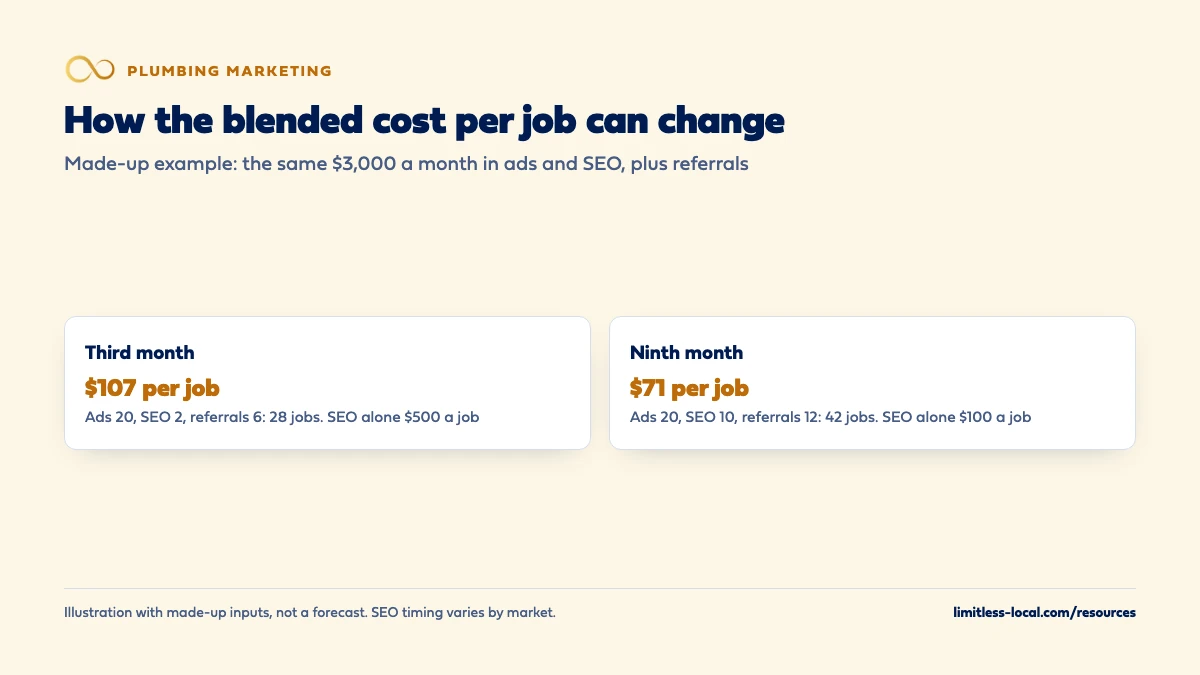
A worked example: how the blended cost per job can change
These numbers are made up to show the math, not a forecast for your company. Say you spend $2,000 a month on ads and $1,000 a month on SEO, and track every job by source.
- Third month: ads book 20 jobs, SEO books 2 and referrals or repeat customers bring 6. That’s $3,000 across 28 jobs, or about $107 per booked job. Looked at alone, SEO cost $500 per job, which looks terrible.
- Ninth month: ads still book 20 jobs, but SEO now books 10 and referrals bring 12. The same $3,000 across 42 jobs is about $71 per booked job, and SEO alone is down to $100 per job.
Cutting SEO in the third month would have looked sensible and been expensive. That’s the case for combining channels and judging each on its own clock. Real results depend on your market and can be slower. A free visibility audit can show where your own channels stand.
Frequently asked questions
Can I do SEO myself while paying for ads?
Often, yes. Google says a small local business can probably do much of its SEO work itself, starting with its SEO starter guide. In our judgement, a workable split is to handle the Google profile and reviews yourself and pay someone to run the ads.
Do I need a website to combine these channels?
In our judgement, yes, once you run search ads or want SEO beyond your Google profile. Ads need a page about the job to send people to, and SEO needs pages to rank.
Should I run ads in towns where I already rank well?
Sometimes. In our judgement, check whether the ads bring booked jobs you wouldn’t have gotten anyway; if the cost per booked job is under your ceiling and the schedule has room, it can still pay.
Are referral programs worth it for a small plumbing company?
They can be, because the cost is mostly time and a small reward. What matters more is asking at the right moment and making it easy for the customer to pass your name along.
How many channels can a one-truck plumber handle?
In our judgement, one paid channel plus the free basics: your Google profile, reviews and staying in touch with past customers. Add another channel once the first is booking jobs you can measure.
What if two channels claim the same job?
It happens, for example a referral who also clicked an ad. Pick one rule, such as the first source the customer names, and use it every time so the trend stays readable.
Key takeaways
- Most plumbers do best combining channels, in an order their budget can carry.
- Ads bring calls now; SEO typically takes 3 to 6 months; referrals grow with every good job.
- Start the slow channels early, because they can’t be rushed later.
- Don’t spread a small budget so thin that no channel gets enough to work.
- Tag every lead by source and judge each channel on its own clock by cost per booked job.
- Never tie a reward to a positive review; keep referral rewards separate.
Want a second set of eyes on your setup?
We'll look at how you show up locally and where calls are leaking, then send you a plain-English breakdown.
More in this section
- Are Google Local Services Ads worth it for plumbers?
- Should my plumbing company start with LSAs, Google Ads or SEO?
- How long does plumbing SEO take to bring in calls?
- Plumbing marketing: Facebook ads vs Google ads, which works better?
- How does competition affect how fast plumbing SEO works?
Sources
- How to Get the Most From Your Marketing Budget — U.S. Small Business Administration
- Do You Need an SEO? Tips for Hiring an SEO — Google Search Central
- Tips to improve your local ranking on Google — Google Business Profile Help
- About the search terms report — Google Ads Help
- Referrals | Marketing Tools — Jobber Help Center
- Lead Source Report — Jobber Help Center
- How to Use Lead Sources — Housecall Pro Help Center
- The Consumer Reviews and Testimonials Rule: Questions and Answers — Federal Trade Commission