
Which sites should mention my pool company besides my own website?
- Where should a pool builder get mentioned online to build trust with Google, AI tools and homeowners?
- Why do mentions on other websites matter for a pool company?
- Which listings should a pool company have before anything else?
- Which pool-industry sites should mention my company?
- Which home-improvement and design sites matter?
- How do local news and press mentions help a pool builder?
- Which partner and supplier websites should link to my pool company?
- Do sponsorships, the chamber and community groups count?
- Should I pay for mentions or links?
- Do mentions on Reddit, forums and YouTube help with AI search?
- What should each mention say about my pool company?
- How do I find out where my pool company is already mentioned?
- What's different about mentions for pool builders
- A worked example: one quarter of mention-building
- Frequently asked questions
- Key takeaways
- More in this section
- Sources
The short version
- Start where homeowners already look for pool builders: manufacturer dealer pages, association directories and Houzz.
- Add your real-world relationships: landscapers, builders, realtors, suppliers, sponsorships and local news.
- Each mention should name your company, your town and what you build, and link to the most relevant page.
- Don't buy links or fake mentions; Google's spam policies and AI guidance both say they don't help.
For pool builders who’ve claimed the basic listings and want to know which other websites are worth showing up on, and which aren’t worth chasing.
Get a free visibility audit · Book a growth call
Where should a pool builder get mentioned online to build trust with Google, AI tools and homeowners?
Beyond your own website and the main listings, a pool company should be mentioned on the sites homeowners and Google already trust for pools: manufacturer and supplier dealer pages, industry association directories like the Pool & Hot Tub Alliance, design and home-improvement sites such as Houzz, trade partners’ websites, local news and community organizations you actually work with. Google builds business information partly from crawled web content and licensed third-party data, and counts links and reviews toward how prominent a business is, so real mentions help both. Skip anything you’d have to pay for just to get a link, and any site no homeowner would ever read.
Mentions on other sites are one of the pieces we pull together for Maps and AI search, alongside your Google profile, your reviews and your own pages. That work is part of our local SEO service, and the pool builder marketing page shows how it fits a pool company. More answers like this one are in the pool builder marketing questions library.
Why do mentions on other websites matter for a pool company?
Because Google, AI tools and homeowners all look past your own website to decide whether you’re real and any good.
Google says the information in Business Profiles is compiled from a variety of sources, including publicly available information such as crawled web content, licensed data from third parties and contributions from users. So what other sites say about your name, your town and your work feeds what Google shows about you.
Mentions also count toward how well-known you are. Google’s tips to improve your local ranking say local results are mainly based on relevance, distance and popularity, and that prominence, how well-known a business is, is based on information like how many websites link to your business and how many reviews you have.
Homeowners do the same thing in their own way. Before they invite a builder into a big backyard project, they search your name and see who else talks about you. A manufacturer listing you as a dealer or a local paper covering your work says more than anything on your own site.
Which listings should a pool company have before anything else?
Get the basics done first: Google Business Profile, Bing Places, Apple Business, Yelp, the Better Business Bureau, Facebook and Nextdoor. They’re the places homeowners and map apps actually use, and they’re the foundation every other mention builds on.
Each one needs the same business name, phone number and website as your Google profile. Small differences, like an old phone number or a former business name, make it harder for Google and homeowners to be sure they’re looking at the same company.
We won’t repeat the setup here. Our page on which online listings a pool builder should have besides Google goes through each one in order. This page is about what comes after: the sites that mention you because of who you are and who you work with.
Which pool-industry sites should mention my company?
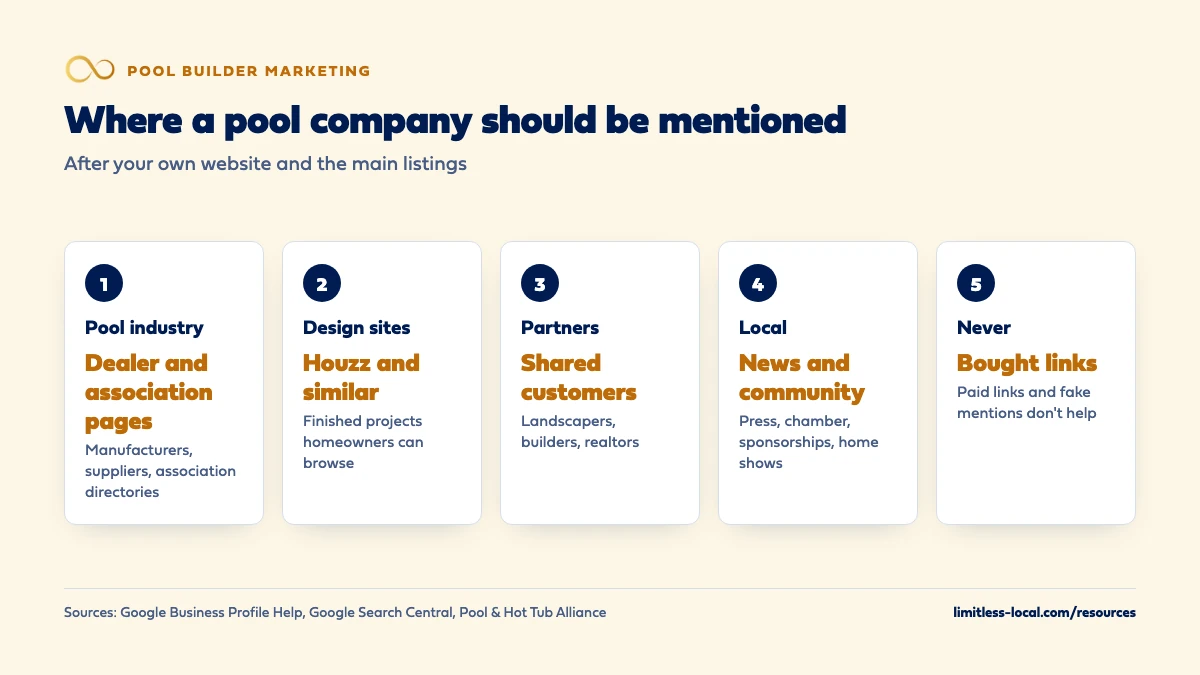
- Manufacturer and dealer pages. If you install a brand’s fiberglass shells, equipment, finishes or covers, ask to be listed in their dealer or installer locator. Homeowners who’ve already picked a product use those pages to find someone near them.
- Supplier pages. Distributors and stone, tile or plaster suppliers sometimes feature the builders who buy from them, especially for showcase projects.
- Industry association directories. The Pool & Hot Tub Alliance runs a Find a Pro directory aimed at homeowners looking for builders and service professionals. State and regional pool associations often have their own member lists.
- Award programs. Industry design awards usually publish the winners with photos and the builder’s name, which gives you a mention and a story to share.
These carry weight because they’re relevant: a pool manufacturer vouching for a pool builder is exactly the kind of connection that makes sense to a homeowner and to Google.
Which home-improvement and design sites matter?
Houzz is the big one for pool builders, because homeowners go there to collect ideas and look at finished projects before choosing a builder. A complete profile with your best pools posted as separate projects is a mention that also sells. Our page on how a pool builder uses Houzz to get leads covers setting it up.
If you already have a profile on a lead marketplace like Angi, keep it complete whether or not you buy leads there. It’s one more place your name, town and reviews appear.
Beyond those, be choosy. A home-improvement site is worth your time if homeowners in your area actually use it, or if it ranks when someone searches for pool builders in your town. If you can’t find it in a search and nobody you know has heard of it, a listing there won’t change much.
How do local news and press mentions help a pool builder?
They’re some of the strongest mentions you can get, because a local news site is trusted, read by the homeowners you want and very hard to fake.
You don’t need a publicist. Local reporters and community sites need stories, and pool builders have more of them than they think:
- A big or unusual project, like a challenging hillside build or a backyard transformation.
- An award or a milestone year.
- A new showroom or office opening.
- A donation or community project, like helping a local team or a nonprofit.
- Practical seasonal advice for homeowners planning a pool, offered as an expert source.
Send a short email with the story, a few good photos and a way to reach you. Local magazines, neighborhood newsletters and community event pages count too. When a story runs, link to it from your website and share it; it keeps working for years.
Curious what your marketing is actually booking?
Get a free visibility audit — no obligation, no sales pitch.
Which partner and supplier websites should link to my pool company?
The businesses you already work with. Landscape designers, outdoor kitchen and patio builders, fence companies, home builders and realtors meet the same homeowners you do, and a link from their website to yours makes sense to everyone who sees it.
The best version is a real recommendation: a landscaper’s project page that credits you for the pool, a home builder’s list of preferred contractors, or a realtor’s guide to local pros. Ask when you finish a job together, and offer the same in return where you genuinely recommend them.
Keep it natural. Google’s spam policies list excessive link exchanges, and partner pages made only for cross-linking, as link spam. A few real partners who mention each other is normal business; a page of fifty “partners” you’ve never worked with isn’t.
Our page on getting referrals from landscapers and builders covers how to start those relationships.
Do sponsorships, the chamber and community groups count?
Yes, when they’re real. Many local organizations list their sponsors and members on their websites, often with a link:
- The local chamber of commerce or business association.
- Youth sports teams and leagues you sponsor.
- Charity events, school fundraisers and community festivals.
- Homeowners associations or neighborhood groups that list trusted local vendors.
- Home and garden shows, which usually list exhibitors online.
These mentions say something simple and useful: this company is part of this town. That matters for a builder who wants to be known in specific communities, and it gives homeowners another place to come across your name.
Pick causes and groups you’d support anyway. A sponsorship you do only for the link usually isn’t worth the money; one that puts your name in front of local families for a season might be.
Should I pay for mentions or links?
Not for the link itself. Buying or selling links for ranking purposes is link spam, including exchanging money, goods or services for links, or sending someone a product in exchange for writing about it with a link.
Paying for advertising, sponsorships or directory memberships is fine when you’d want the exposure anyway. The test is simple: would you still pay if the link didn’t exist? A home show booth, a chamber membership or a sponsored post in a local magazine homeowners actually read can pass that test. A “guest post” on a random blog that sells links to anyone doesn’t.
Be wary of anyone selling you a package of mentions or backlinks for a flat fee. Our page on how backlinks and listings help a pool builder rank in Maps covers which link tactics can hurt you.
Do mentions on Reddit, forums and YouTube help with AI search?
They can, when they’re genuine. Google’s guide to optimizing for generative AI features says its AI features can show what’s being said about products and services across the web, including in blogs, videos and forum discussions. It also says seeking inauthentic mentions isn’t as helpful as it might seem, and lists pursuing inauthentic mentions among the tactics you can ignore.
For a pool builder, that means:
- Do post your own build videos on YouTube, answer questions in local groups when you have something useful to say, and let happy customers share their projects.
- Don’t post fake recommendations, have staff pose as customers, or pay people to mention you in forums.
The real mentions take longer, but they’re the ones that last. Our page on how a pool builder shows up in AI search results covers the rest of what AI tools look at.
What should each mention say about my pool company?
- Your business name, exactly as it appears on your Google profile.
- Your town or service area, so the mention connects you to the places you work.
- What you build: custom pools, fiberglass pools, renovations. A mention that says “pool builder” helps more than one that just lists your name.
- A link to the most relevant page. A manufacturer’s dealer page should link to the page about that kind of pool; a news story about a project should link to that project’s page.
- Your phone number, if the site shows one, matching your Google profile.
When you ask for a mention, send the exact wording and link you’d like. Most people are happy to use it, and it saves you from fixing a wrong phone number later.
How do I find out where my pool company is already mentioned?
- Search your business name in Google and Bing, with and without your town, and go a few pages deep.
- Check Search Console’s Links report, which shows a sample of the sites that link to you and your most-linked pages. It isn’t a complete list of every link, but it’s free and a good start.
- Ask an AI assistant what it knows about your company and which pool builders it would suggest in your town. Note which sites it seems to draw on.
- Ask your suppliers and partners whether they list you anywhere you haven’t seen.
Fix what’s wrong first: old phone numbers, a previous business name, a closed address. Then make a list of the mentions you’re missing from the sections above, and work through a few a month.
Want to see where your company stands?
A free visibility audit shows where you show up on Google, Maps and AI answers, and what it's costing you in calls.
What's different about mentions for pool builders
Product makers send homeowners to builders. Fiberglass shell, equipment and finish manufacturers often have dealer locators, which is an unusually direct source of mentions most trades don’t have.
Projects make news. A finished pool is photogenic and local, which gives pool builders more press and award chances than most home-service companies.
Partners share the same customer. Landscapers, outdoor living builders and home builders meet your buyers first, so their websites are natural places to be mentioned.
The decision is high-trust. A homeowner spending this much will look you up in several places before calling, so every mention is a chance to confirm you’re the real thing.
A worked example: one quarter of mention-building
This plan is made up to show how the work adds up, not a target. Say a pool builder spends the slow season on mentions, with a goal of one or two a week for 12 weeks.
- Weeks 1 to 2: fix old listings and the wrong phone numbers found in a name search.
- Weeks 3 to 5: ask the three manufacturers and suppliers they buy from for a dealer or installer listing, and join the industry association directory.
- Weeks 6 to 8: ask four landscape and builder partners to credit them on shared project pages.
- Weeks 9 to 12: pitch two local stories, and renew the chamber listing and a youth sports sponsorship they already pay for.
If half of those asks land, that’s still a handful of real, relevant mentions from sites homeowners trust, with no money spent on links. The ones that don’t land this quarter are next quarter’s follow-ups.
Frequently asked questions
Does a mention without a link still help?
It can. Google builds business information partly from what’s published on other websites, and homeowners see your name either way. A link is a bonus, not the only point.
How many mentions does a pool company need?
There’s no target number. A handful of relevant, trusted mentions, like a manufacturer, an association, a partner and a local news story, beats dozens of directories nobody reads.
Should I list my pool company on national directories I've never heard of?
Usually not. If homeowners in your area don’t use a site and it doesn’t show up when people search for pool builders in your town, a listing there won’t change much.
Can I ask a happy customer to mention my company online?
Yes, asking them to share their project or recommend you when neighbors ask is fine. Don’t offer anything in return, and never write the post for them.
What if a site lists my pool company with the wrong information?
Ask the site to correct it, or update it yourself if you can claim the listing. Old phone numbers and former business names are the most common problems.
Do mentions help with Google Ads?
Not directly; ads are an auction. They help with the homeowner who sees your ad, searches your name and decides whether to trust you.
Key takeaways
- Google builds business information partly from other websites, and counts links and reviews toward prominence.
- After the main listings, focus on pool-industry pages: manufacturer dealer locators, suppliers and association directories.
- Real relationships make the best mentions: trade partners, local news, sponsorships and community groups.
- Never pay for a link itself or post fake mentions; both are called out in Google’s guidance.
- Each mention should give your exact business name, town and what you build, with a link to the most relevant page.
Not sure what's working right now?
Start with a free visibility audit: rankings, Google profile, reviews and tracking, checked against your service area.
More in this section
- Which online listings should a pool builder have besides Google?
- How do I advertise a pool construction company?
- What should a pool builder website include to get more consultations?
- Is word-of-mouth and a basic website enough for a pool builder?
- Should a pool builder make a page for every city it serves?
Sources
- Understand how Google sources & uses info in Business Profiles & local search results — Google Business Profile Help
- Tips to improve your local ranking on Google — Google Business Profile Help
- Spam Policies for Google Web Search — Google Search Central
- Google's Guide to Optimizing for Generative AI Features on Google Search — Google Search Central
- Links report — Search Console Help
- Find a Pro — Pool & Hot Tub Alliance