
Should a small HVAC firm advertise on Instagram or Google?

- Instagram ads or Google Ads: where should a small HVAC company spend first?
- What's the real difference between Instagram ads and Google Ads for HVAC?
- Which one brings HVAC calls faster?
- Where should a small HVAC firm's first ad dollars go?
- What if my budget only covers one channel?
- What are Instagram ads actually good for in HVAC?
- Can Instagram ads bring emergency AC and furnace calls?
- Is boosting an Instagram post the same as running Instagram ads?
- How does remarketing on Instagram fit in?
- What does each one cost a small HVAC firm?
- When should a small HVAC firm add Instagram?
- How do I compare Instagram and Google fairly?
- What's different about Instagram and Google for HVAC
- A worked example: all on Google, or split with Instagram
- Frequently asked questions
- Key takeaways
- More in this section
- Sources
The short version
- Google catches people searching for HVAC help right now; Instagram reaches people scrolling.
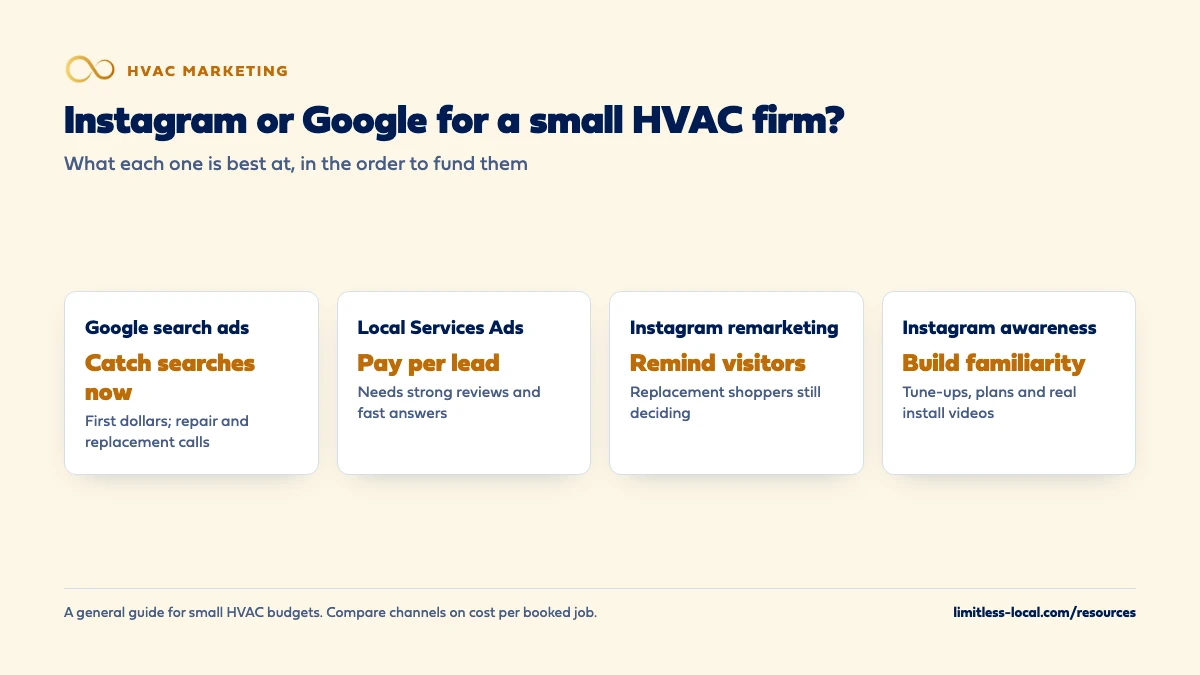
- First dollars go to Google search ads or Local Services Ads.
- Instagram fits remarketing, tune-up offers and local awareness.
- Track each separately and compare cost per booked job.
For owners of small HVAC companies with a limited ad budget, deciding whether the first dollars go to Google, Instagram or both.
Get a free visibility audit · Book a growth call
Instagram ads or Google Ads: where should a small HVAC company spend first?
A small HVAC firm should put its first ad dollars into Google, because Google search ads show to people who are searching for HVAC help right now, while Instagram ads show to people scrolling who mostly don’t need you today. Add Instagram once Google is booking jobs at a cost you’re happy with, and use it for what it does well: remarketing to people who visited your site, tune-up and maintenance plan offers, and making your company familiar around town. Judge both by cost per booked job, with separate tracking for each.
That’s the order we’d fund a small HVAC ad budget in. Google Ads management is in every one of our HVAC marketing packages, with Essentials covering up to $2,500 a month in ad spend, and Growth adds Local Services Ads management and Meta remarketing, which can show on Instagram as well as Facebook. The HVAC marketing guide covers every channel, and the rest of the HVAC marketing questions library goes question by question.
What's the real difference between Instagram ads and Google Ads for HVAC?
Timing. A Google Ads auction runs every time someone searches, and what they typed, where they are and when they’re searching all feed into which ads show. When a homeowner types “AC repair near me,” your ad shows up at the moment they need a company.
Instagram works the other way around. Meta shows ads to people in the target audience you define, and an auction picks which ad each person sees as they scroll. The person might be a homeowner in your town, but they opened Instagram to look at their friends’ photos, not to find an HVAC company. Most of them don’t need you today.
That’s the whole decision in one line: Google is for catching demand that already exists, and Instagram is for creating familiarity before the need shows up.
Which one brings HVAC calls faster?
Google, for almost every small HVAC company. When the AC dies, people search; they don’t open Instagram. Google search ads and Local Services Ads can both start producing calls within days of going live, because the demand is already there.
Instagram can bring calls too, especially with a strong seasonal offer, but it’s slower and less predictable. A small firm that needs the phone to ring next month should start where people are already asking for help. If you’re choosing between Google’s options, whether to start with LSAs, Google Ads or SEO covers that decision.
Where should a small HVAC firm's first ad dollars go?
In this order, for most small firms:
- Your Google Business Profile and reviews. Free, and they make every paid ad work better.
- Google search ads or Local Services Ads for your core repair and replacement work, in the area your trucks actually cover.
- Remarketing, including on Instagram, to people who visited your site and didn’t call.
- Instagram awareness ads for tune-ups, maintenance plans and getting your name known.
Don’t skip ahead because Instagram feels cheaper. A budget spread across four channels usually does less than the same budget focused on one that works. A good monthly starting budget for HVAC pay-per-click helps size that first step.
What if my budget only covers one channel?
Then pick Google and keep it tight. A one- or two-truck HVAC company with a small budget does better running search ads for a handful of job types in the few towns closest to the shop than spreading the same money thinly across platforms. Pause the ads when the schedule is full, and turn them back up when it isn’t.
Meanwhile, use Instagram the free way: post real job photos and short install videos from your own account. It costs time, not ad money, and it builds the content you’ll want for ads later. When the budget grows, the first Instagram dollars should go to remarketing, because those people have already shown interest in you.
What are Instagram ads actually good for in HVAC?
A few things, and they’re worth doing once Google is working:
- Showing real work. Short videos of a clean install, a crew in branded shirts, a before-and-after of a dirty coil. People remember the company they’ve seen.
- Planned work. Spring AC tune-ups, fall furnace checks and maintenance plans suit Instagram, because nobody needs them today, and a reminder at the right time books them.
- Remarketing. Following up with people who looked at your replacement page and left.
- Local familiarity. When a homeowner finally searches, a name they’ve seen on Instagram is easier to pick.
Instagram ads can appear in Feed, Stories, Explore and Reels, and you need an Instagram account to be the face of the ads. Meta recommends Advantage+ placements, which spread the budget across Facebook and Instagram wherever it expects the best results.
Curious what your marketing is actually booking?
Get a free visibility audit — no obligation, no sales pitch.
Can Instagram ads bring emergency AC and furnace calls?
Rarely. A homeowner with no heat is searching Google or asking a neighbor, not scrolling Reels. Even when an Instagram ad does reach someone with a broken system, they’re likely to search afterward and call whichever company shows up first there.
So keep emergency repair on Google. Whether Facebook ads work for HVAC calls goes deeper on why scroll-based ads struggle with urgent jobs, and the same logic applies to Instagram, since both run on Meta’s ad system.
Is boosting an Instagram post the same as running Instagram ads?
It’s the simple version. You can boost posts, Reels and Stories straight from the Instagram app once you have a professional account, but the app sets the audience and placement for you. Meta Ads Manager has the full set of tools.
One cost trap to know about: in most regions, adding funds to your ad account in the Instagram iOS app may add an Apple service fee of 30% of your total ad payment. Boosting from instagram.com in a browser avoids it. For anything beyond a quick test, build the campaign in Ads Manager, where you can control the audience, the area and the goal.
How does remarketing on Instagram fit in?
Remarketing is often the best first use of Instagram for a small HVAC company. Website custom audiences let you show ads to people who visited your website, for example in the last 30 days, using the Meta Pixel on your site.
That’s useful for replacement shoppers. Someone who read your new-system page, priced you against two other companies and left is still deciding. An Instagram ad showing your install crew, your financing options or a review from a recent replacement keeps you in the running. Using remarketing for HVAC leads covers how to set it up and what to show.
What does each one cost a small HVAC firm?
Neither has a fixed price. On Google, you typically pay when someone clicks, and the auction sets the price based on your bid, the quality of your ad and landing page, the search itself and how many other companies want the same spot. On Instagram, Meta’s auction weighs your bid, how likely the person is to respond and the ad’s quality, so a more relevant ad can beat a bigger bid.
That’s why national “average cost” figures don’t help much. Your own numbers will depend on your market, your season and your ads. Compare the two the only way that counts: what each one cost per booked job.
When should a small HVAC firm add Instagram?
When most of these are true:
- Google search ads or Local Services Ads are booking jobs at a cost per job you’re happy with.
- You’re already showing for most of the searches you want in your area, so more Google budget buys less.
- Your website gets enough visitors to make remarketing worth it.
- You have real photos and short videos of your crews and installs.
- Someone can answer messages and comments, not just calls.
If Google isn’t working yet, Instagram won’t fix it. Fix the Google side first, because it’s closer to the money.
How do I compare Instagram and Google fairly?
Give each its own way to be counted: a separate call tracking number, a tagged link to your site, and a lead source in your field software. Then compare cost per booked job, not cost per click or cost per lead.
Be fair to Instagram on one point. Some of its value shows up as people searching your company name later, which Google gets the credit for. Watch whether searches for your name rise while Instagram runs, and ask new callers how they heard about you. To carry each lead through to a paid invoice, see how to tell if HVAC ads bring real customers, not just calls.
Not sure which of these is costing you jobs?
A free visibility audit checks the Google profile, reviews, site and tracking, and shows what to fix first.
What's different about Instagram and Google for HVAC
Breakdowns drive searches. Most HVAC revenue starts with something failing, and failures send people to Google, not to social media. That’s the main reason Google comes first for this trade.
Tune-ups and plans have no urgency. Nobody searches for a fall furnace check until someone reminds them. Instagram is a good place for that reminder, timed for the shoulder seasons before the first cold snap or heat wave.
Installs are visual. A clean, well-run install is easy to show in a short video and hard to show in a text ad. If you do replacement work well, Instagram is a good place to prove it to the people who’ll need a new system in the next year or two.
A worked example: all on Google, or split with Instagram
These numbers are made up to show the math. They aren’t a benchmark for either platform.
Say a small HVAC firm has $1,500 a month for ads.
- All on Google search: 32 calls, 16 booked jobs. Cost per booked job: about $94.
- Split: $1,000 on Google brings 21 calls and 11 booked jobs; $500 on Instagram brings 6 leads and 2 booked tune-ups. That’s 13 booked jobs, about $115 each.
On this month’s numbers, all-Google wins. The split might still be worth testing if Google is close to maxed out in your area, or if the Instagram ads lift searches for your company name over the next few months. That’s the kind of test to run with tracking in place and a clear end date, not a split to start with.
Frequently asked questions
Should I just boost my Instagram posts?
Boosting is fine for a small test, like a tune-up offer. For anything you want to measure, use Meta Ads Manager so you control the area, the audience and the goal, and put a tracking number on the ad.
Are Instagram ads and Facebook ads the same thing?
They run on the same Meta ad system and are built in the same Ads Manager. You can run on Instagram only, Facebook only, or let Meta place the ads across both.
Can I run Instagram ads without a website?
Yes, with call or form ads. But remarketing to site visitors needs a website with the Meta Pixel installed, and that’s one of the best uses of Instagram for HVAC.
Does posting on Instagram for free help me get calls?
It helps people who already know you trust you more, and it gives your ads real content to use. On its own it rarely makes the phone ring, so don’t count it as your marketing plan.
How long should I test Instagram ads before deciding?
At least a month, with its own tracking number, and longer for planned work like tune-ups. Judge it on booked jobs, and watch searches for your company name over the same period.
What about TikTok or YouTube?
The same logic applies: they reach people scrolling or watching, not searching. Fund them after Google is working, and only if you have the video to feed them.
Key takeaways
- Google catches homeowners searching for HVAC help now; Instagram reaches people who mostly don’t need you yet.
- A small HVAC firm’s first ad dollars belong on Google search ads or Local Services Ads.
- Instagram fits remarketing, tune-up and maintenance plan offers, and showing real installs.
- Boost from a browser or Ads Manager, not the Instagram iOS app, to avoid the Apple service fee.
- Track each channel separately and compare cost per booked job.
Want a second set of eyes on your setup?
We'll look at how you show up locally and where calls are leaking, then send you a plain-English breakdown.
More in this section
- Are Google Local Services Ads worth it for an HVAC company?
- Do Google Ads work for a brand-new HVAC company?
- Can a small HVAC company afford TV advertising?
- Should an HVAC company run emergency ads while SEO builds?
- How much should an HVAC company spend on Google Ads?
Sources
- How the Google Ads auction works — Google Ads Help
- About ad auctions — Meta Business Help Center
- About the Instagram ad placement — Meta Business Help Center
- Ways to advertise on Instagram — Instagram Help Center
- About website custom audiences — Meta Business Help Center