
What website changes help a roofer show up in AI results?
- Which roofing website changes make AI Overviews, ChatGPT and Copilot more likely to cite you?
- Does a roofer need a different website to show up in AI results?
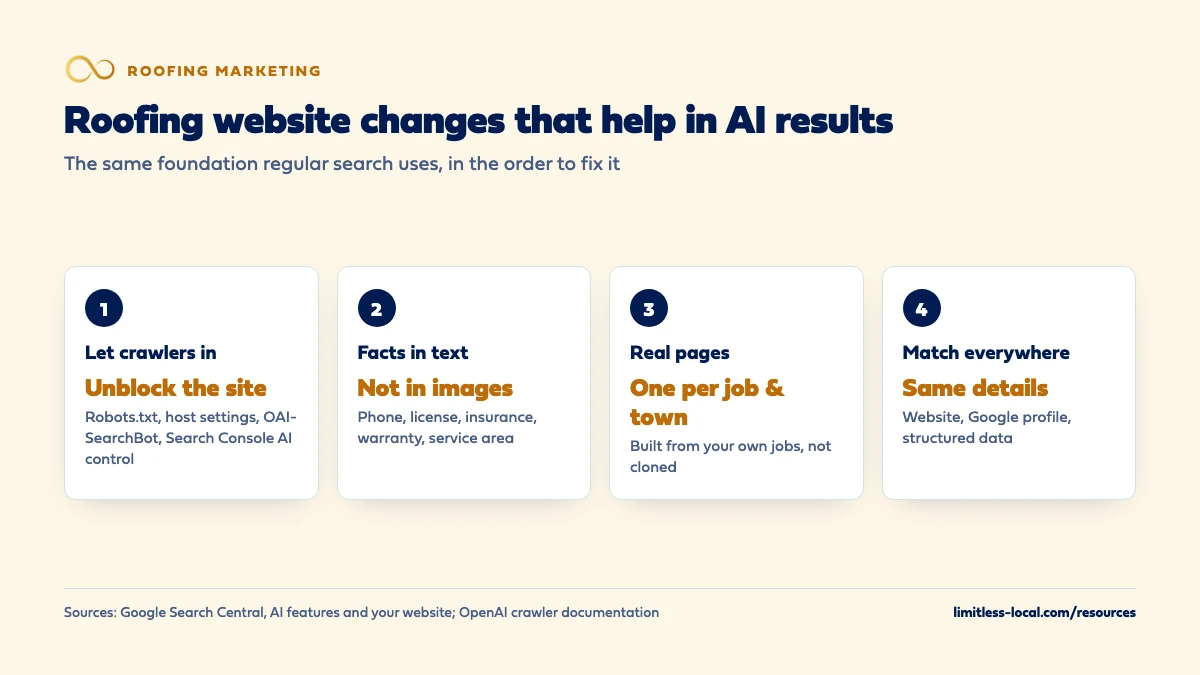
- Change 1: Can search engines and AI crawlers reach your site?
- Change 2: Is your key information in text, not images?
- Change 3: Does each roofing service have its own page?
- Change 4: Are your town pages genuinely different from each other?
- Change 5: Do your pages answer what homeowners actually ask?
- Change 6: Can visitors and AI tools see your proof?
- Change 7: Should a roofer add structured data for AI?
- Change 8: Do your business details match everywhere?
- Change 9: Is your site easy to crawl and use on a phone?
- Which AI website tricks can a roofer skip?
- How do I know if the website changes are working?
- What's different about AI results for roofing companies
- A worked example: fixing one roofing website
- Frequently asked questions
- Key takeaways
- More in this section
- Sources
The short version
- Make sure search engines and AI crawlers aren't blocked.
- One page per roofing service, and real town pages, not copies.
- License, insurance, warranty and service area in plain text, not images.
- Business details that match your Google profile, plus structured data that matches the page.
- Skip llms.txt files, "chunking" and other AI hacks.
For roofing owners who want their website ready for AI answers, and want to know which changes matter and which ones are just noise.
Get a free visibility audit · Book a growth call
Which roofing website changes make AI Overviews, ChatGPT and Copilot more likely to cite you?
The website changes that help a roofer show up in AI results are the same ones that help in regular search: let search engines and AI crawlers reach your pages, give each roofing service and each core town its own page built from your real jobs, and put your license, insurance, warranty and service area in plain text. Keep your business name, address and phone identical to your Google Business Profile, and add local business structured data that matches what’s on the page. Google says its AI features have no technical requirements beyond a page being indexed and eligible to show with a snippet, so special AI files and tricks aren’t the answer.
We build for three places owners need to show up: the regular Google results, the Maps 3-pack, and AI answers like ChatGPT, Google AI Overviews and Siri. The website changes on this page are part of the content and SEO work in our Limitless Engine packages, alongside the Google profile work that feeds the same answers. For how it all fits a roofing business, see our roofing marketing page and the roofing marketing guide, and browse the rest of the roofing marketing questions library.
Does a roofer need a different website to show up in AI results?
No. The search engines behind the big AI tools build their answers from the same pages they already crawl and index for regular search. Google’s guidance on AI features says a page only has to be indexed and eligible to show in Search with a snippet to appear as a supporting link in AI Overviews or AI Mode, with no additional technical requirements. Bing’s webmaster guidelines say the same about Copilot: its AI answers rely on the same crawling, indexing and ranking foundation as regular search.
So the job isn’t a new website. It’s fixing the parts of your current one that make it hard to read, hard to trust or hard to tell apart from every other roofer in town. The changes below are in the order we’d make them. For the listings and reviews side of AI recommendations, see how a roofing company gets recommended by ChatGPT.
Change 1: Can search engines and AI crawlers reach your site?
Nothing else matters if the crawlers are locked out. Check these with whoever manages your site:
- Your robots.txt file and your host. Crawling has to be allowed in robots.txt and by any CDN or hosting setup. Some security and firewall settings block bots without anyone noticing.
- ChatGPT’s search crawler. OpenAI’s crawler documentation says sites that block OAI-SearchBot won’t be shown in ChatGPT search answers, and recommends allowing it. Its training crawler, GPTBot, is a separate setting, so you can allow one and block the other.
- The AI setting in Search Console. Google added a Search generative AI control that lets a site exclude its links and content from AI features. Including your site is the default, but check it once, especially if someone else set up your Search Console.
- Leftover noindex tags from when the site was built.
If you’ve never set up Search Console, start there; the first SEO fixes a roofer should make walks through it.
Change 2: Is your key information in text, not images?
Roofing sites are full of information that only exists in pictures: a phone number baked into the header graphic, a services list in a banner image, a license number on a scanned certificate, a warranty explained in a PDF. People can read those. Crawlers often can’t use them the same way, and important content belongs in text.
Put these in real, selectable text on the page:
- Your company name, phone number and the towns or counties you serve.
- Every roofing service you offer, by name.
- Your license number and the fact that you’re insured.
- What your workmanship warranty covers and for how long, plus any manufacturer warranties you can offer.
- Your hours, and whether you take emergency leak calls.
Keep the nice graphics if you like them. Just make sure the same facts also appear as words.
Change 3: Does each roofing service have its own page?
A single “Services” page that lists roof replacement, repairs, leaks, storm damage, gutters and metal roofing in one paragraph gives an AI answer very little to work with. When a homeowner asks about metal roof installation near them, a page that’s actually about metal roofs, in your area, from your crews, is far easier to match and cite.
Give each job you want more of its own page:
- Roof replacement
- Roof repair and leak repair
- Storm, wind and hail damage inspections
- Each roof type you install, such as metal, tile or architectural shingles
- Commercial roofing, if you do it
Each page should say what the job involves, who it’s for, what it costs to think about (factors, not a price promise), how long it takes, what the warranty is, and photos of that kind of job you’ve done. What a roof repair or replacement service page should include has a full checklist.
Change 4: Are your town pages genuinely different from each other?
This is where roofers get into trouble. It’s tempting to clone one page fifty times and swap the town name. Google’s guide to optimizing for generative AI search warns that creating separate content for every variation of how people might search, mainly to manipulate rankings or AI answers, violates its scaled content abuse spam policy, and that more pages don’t make a site higher quality.
Build a page for each core town only when you can make it worth reading:
- Real jobs you’ve done there, with photos and the roof type.
- What’s common in that area: the age of the housing, the roof styles, the HOA or permit quirks you deal with.
- Reviews from homeowners in that town.
- How quickly you can get an inspector there.
If you can’t say anything specific about a town, list it on your service area page instead. Which services and cities a roofer should build pages for helps you pick.
Curious what your marketing is actually booking?
Get a free visibility audit — no obligation, no sales pitch.
Change 5: Do your pages answer what homeowners actually ask?
AI answers often come from questions, not keywords: “should I repair or replace my roof,” “how long does a roof replacement take,” “what does a roofer check on an inspection.” AI search can run several related searches behind the scenes to build one answer, so pages that cover a topic properly have more chances to get pulled in.
Answer those questions from your own work, not with the generic tips every other roofing site has. A first-hand take from experience stands out; a summary of what’s already out there doesn’t. For a roofer, that’s things like:
- What you actually find when you inspect a 20-year-old roof in your area.
- Why you recommend replacement over repair in certain situations.
- What a replacement day looks like on a real job, with photos.
Put the answers on the service pages where they belong, plus a few focused articles. Which questions a roofing website should answer for AI Overviews lists the ones worth covering.
Change 6: Can visitors and AI tools see your proof?
When a homeowner asks an AI tool for a reliable roofer, the answer has to come from somewhere. Make your proof easy to find and read:
- License and insurance on every page, in the footer and on the contact page.
- Warranty terms on their own page or section, in plain words.
- Manufacturer certifications, if you hold them, named in text.
- Project photos with captions that say the town, the roof type and the job.
- Review quotes on the pages they relate to, with the homeowner’s first name and town if they’ve agreed.
- An about page with who owns the company and how long you’ve worked locally.
One thing not to do: Google’s local business structured data documentation says review and rating markup is only recommended for sites that capture reviews about other local businesses. Show your reviews as text on the page, but don’t add star-rating markup for your own company.
Change 7: Should a roofer add structured data for AI?
Add it, but for the right reasons. Local business structured data is code that tells search engines your name, address, phone, hours and the like in a standard format; the required properties are your business name and address. Structured data isn’t required for Google’s AI features, and there’s no special schema markup to add for them, but it still helps with eligibility for rich results in regular search.
Three rules keep it useful:
- It must match the visible page. Nothing in the code that a visitor can’t see.
- It must match your Google Business Profile. Same name, same phone, same hours.
- Keep it to what’s true. Don’t mark up services you don’t offer or an address you don’t have.
Change 8: Do your business details match everywhere?
AI tools pull local business information from more than your website. Google’s AI answers can include local business details, and a Business Profile helps your services show up in them; AI answers can also reflect what’s being said about a business across the web. If your website says one phone number, your Google profile another and an old directory listing a third, you’ve given every system a reason to doubt which one is right.
Pick one version of your business name, address and phone, and use it on your website, your Google Business Profile, Bing Places, Apple Business and the main directories. Update your hours and service areas in the same places when they change. It’s dull work, and it’s some of the most useful work on this list.
Change 9: Is your site easy to crawl and use on a phone?
The basics still count, because Google’s AI features sit on top of its regular ranking systems:
- Internal links. Link from your homepage to each service page, from each service page to related towns and back, using plain words like “metal roof installation in Tampa” instead of “click here.”
- Page experience. Pages that load fast and work on a phone, with the main content easy to tell apart from pop-ups and banners.
- Fewer duplicate pages. Old landing pages, test pages and near-copies of each other waste crawling and confuse which page should rank.
Which AI website tricks can a roofer skip?
Plenty of people sell “AI optimization” extras. For Google, you can ignore these:
- llms.txt files or special AI markup. Google Search doesn’t use them.
- “Chunking” pages into tiny pieces so AI can read them.
- Rewriting your content in a special way for AI. AI systems understand synonyms and meaning, so you don’t need every keyword variation.
- Chasing fake mentions across the web.
If someone pitches one of these as the key to AI visibility, ask what it changes on the page a homeowner reads.
How do I know if the website changes are working?
Give it a few months, then look in three places:
- Search Console’s generative AI performance report. It shows impressions for your site in AI Overviews and AI Mode, and you can group them by page to see which pages AI features link to.
- Your regular Search Console performance report, to see whether your service and town pages are getting more impressions and clicks.
- Your own lead records. Ask every new caller how they found you, and add “ChatGPT” or “an AI search” as an answer your office can pick.
What counts in the end is booked inspections and signed roofs, not impressions. How to know if AI search is sending your roofing company leads covers the tracking in more detail.
Not sure which of these is costing you jobs?
A free visibility audit checks the Google profile, reviews, site and tracking, and shows what to fix first.
What's different about AI results for roofing companies
Trust questions come first. Homeowners hiring a roofer, especially after a storm, ask whether a company is licensed, insured and local before they ask about price. Sites that answer those questions in plain text give AI tools something to repeat.
Storm searches spike fast. After hail or high wind, homeowners search and ask AI tools about storm damage inspections all at once. A storm damage page that already exists, with real local photos, is ready when that happens; one written during the surge usually isn’t.
Roof types are regional. Tile in one market, metal in another, cedar shake somewhere else. Pages built around the roofs you actually install in your area are easier for both homeowners and AI to match.
A worked example: fixing one roofing website
This roofer is made up to show the process. The site has five pages: home, about, a single services page, a gallery and contact. The phone number is part of the header image, the license number is on a scanned certificate, and a “service areas” page lists 30 towns with no details.
The fix, in order: unblock and check crawling, then move the phone, license and service area into text on every page. Split the services page into six pages, one for each job the roofer wants more of. Replace the town list with pages for the four towns where most jobs happen, each with real projects and reviews, and keep the rest as a list. Add local business structured data that matches the contact page and the Google profile. Then caption every gallery photo with the town and roof type.
If the site is too old to fix page by page, a rebuild can be faster. Our themed website is $3,750, or $3,000 with any Limitless Engine package, for up to 25 pages; custom sites start at $5,000.
Frequently asked questions
Do I need an llms.txt file on my roofing website?
Not for Google. Google says its search, including its AI features, doesn’t use llms.txt or other special AI files or markup.
Will blocking GPTBot keep my roofing company out of ChatGPT?
Not by itself. GPTBot is OpenAI’s training crawler; ChatGPT search uses OAI-SearchBot, which is a separate setting. Allow OAI-SearchBot if you want to appear in ChatGPT search answers.
Can I pay to have my roofing website show up in AI Overviews?
No. Pages appear as supporting links when they’re indexed, eligible for a snippet and relevant to the search. Paid ads are a separate product.
Should I use AI to write my roofing pages?
You can use it to help with drafts, but the parts that make a page worth citing, like your jobs, photos, towns and warranty, have to come from you. Using ChatGPT to write roofing website content covers where it helps.
Does page length matter for AI answers?
Google says there’s no ideal page length. Write each page long enough to cover the job properly for a homeowner, and no longer.
Do website builders like Wix or Squarespace work for AI results?
They can, as long as pages are crawlable and indexable, key details are in text, and you can add a page for each service. Check that the builder’s settings aren’t blocking crawlers.
Key takeaways
- AI results come from the same crawled, indexed pages as regular search, so fix the foundation first.
- Check robots.txt, host settings, OAI-SearchBot and Search Console’s AI control so nothing is blocked.
- Put phone, license, insurance, warranty and service area in plain text on every page.
- Build one page per roofing service and real town pages; cloned pages can break Google’s spam policies.
- Use structured data that matches the page and your Google profile, and skip llms.txt and other AI hacks.
Want a second set of eyes on your setup?
We'll look at how you show up locally and where calls are leaking, then send you a plain-English breakdown.
More in this section
- How do I know if AI search is sending my roofing company leads?
- Which questions should a roofing website answer for AI Overviews?
- Is SEO still worth it for roofers in 2026 with AI search?
- How does a roofer see which searches and pages bring leads?
- Do Local Services Ads help a roofer rank on Google Maps?
Sources
- AI features and your website — Google Search Central
- Optimizing your website for generative AI features on Google Search — Google Search Central
- Search generative AI control — Search Console Help
- Generative AI performance report (Search) — Search Console Help
- Local business (LocalBusiness) structured data — Google Search Central
- Overview of OpenAI crawlers — OpenAI
- Bing Webmaster Guidelines — Bing Webmaster Tools