
Which questions should a roofing website answer for AI Overviews?
- What homeowner questions give a roofing site a shot at Google's AI answers?
- What are AI Overviews, and why should a roofer care?
- Do I need to do anything special to show up in AI Overviews?
- Which homeowner questions should a roofing website answer?
- Why does answering from my own jobs matter?
- Should every question get its own page?
- How should I format the answers?
- Does FAQ schema get my answers into AI Overviews?
- Can I block AI Overviews from using my roofing site?
- How do I know if AI answers are sending me work?
- What's different for roofing companies
- A worked example: turning estimator questions into answers
- Frequently asked questions
- Key takeaways
- More in this section
- Sources
The short version
- Answer the questions homeowners ask before calling: repair or replace, cost factors, timing, materials, storms, warranty.
- Google says no special optimization is needed; pages must be indexed and eligible to show with a snippet.
- Answer from your own jobs and photos; Google favors unique, non-commodity content.
- Don't build a page for every variation of a question; Google calls that scaled content abuse when it's done to manipulate results.
For roofing owners who see Google’s AI Overviews answering homeowner questions above the regular results and want their own website to be one of the sources it links.
Get a free visibility audit · Book a growth call
What homeowner questions give a roofing site a shot at Google's AI answers?
A roofing website should answer the questions homeowners ask before they call: whether to repair or replace, what drives the cost of a roof, how long a replacement takes, which materials suit their home and climate, what happens after storm or hail damage, what a warranty covers, and how to check that a roofer is local and legitimate. Google says there’s no special optimization for AI Overviews; a page has to be indexed and eligible to show with a snippet, and the same people-first content that ranks in regular search is what its AI features draw on. So answer those questions on your service pages and a few focused articles, in your own words and from your own jobs, rather than building a page for every phrasing.
Showing up in AI answers is now part of local search, and it’s one of the three places our local SEO work aims for, next to the regular results and the map pack. It’s also how we approach roofing marketing. For the bigger question of whether SEO pays off for a roofer, see is SEO worth it for roofers, and the roofing marketing questions library covers the rest one question at a time.
What are AI Overviews, and why should a roofer care?
AI Overviews are the AI-written summaries that sometimes appear at the top of Google’s results, with links to the sites they drew on. Google describes them as helping people get to the gist of a complicated topic or question more quickly, with a jumping-off point to explore links, and says they’re only shown when its systems decide they add something to classic Search, so they often don’t trigger (Google Search Central).
For a roofer, they show up most on the research questions homeowners ask before they’re ready to call, such as whether a roof can be repaired or needs replacing. In our judgement, being the linked source on those questions puts your name in front of a homeowner early, before they’ve started comparing bids.
Do I need to do anything special to show up in AI Overviews?
Not technically. Google says that to be eligible as a supporting link in AI Overviews or AI Mode, a page must be indexed and eligible to be shown in Google Search with a snippet, and that there are no additional technical requirements. It also says specific optimization isn’t required, while existing SEO fundamentals stay worthwhile: allowing crawling, internal links, a good page experience, important content in text form, good images, structured data that matches the visible text, and an up-to-date Business Profile (Google Search Central).
So the first check is the same as for regular search: are your pages indexed at all? Why a roofing website isn’t on the first page of Google walks through that.
Which homeowner questions should a roofing website answer?
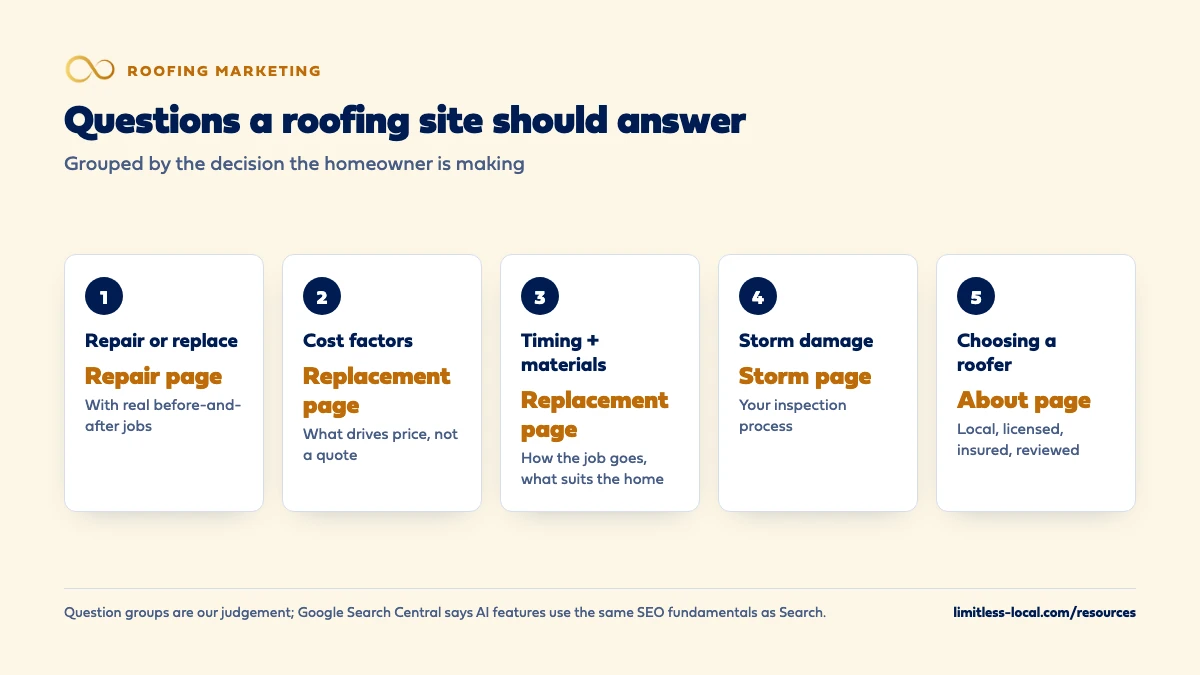
In our judgement, the questions homeowners ask before they pick up the phone, grouped by the decision they’re making:
- Repair or replace? Can this leak be fixed? How do I know my roof needs replacing? How long do roofs last here?
- Cost. What drives the price of a new roof? Why do bids vary so much? Is financing available?
- Timing. How long does a replacement take? What happens if it rains mid-job? How soon can someone inspect?
- Materials. Shingles or metal for my home? What holds up to hail or wind where I live?
- Storms. What should I do after hail damage? What does a storm inspection involve?
- Warranty. What does a workmanship warranty cover, and how is it different from the manufacturer’s?
- Choosing a roofer. How do I check a roofer is local, licensed and insured?
These are the same questions your estimators answer every week. That’s the point: you already know the answers better than a generic article does.
Why does answering from my own jobs matter?
Because Google says it does. Its guide to generative AI features says creating unique, compelling and useful content is likely to influence your presence in AI search more than any other suggestion in the guide, and warns that commodity content based on common knowledge typically adds little. It recommends a unique point of view, such as a first-hand take based on experience, and says not to just recycle what others have said or what a generative AI model could easily produce (Google Search Central).
For a roofer, first-hand means the replacement you did last month on a home like theirs, photos of real hail damage you found, the questions homeowners asked during that job. A paragraph any roofer in the country could have written is the commodity version. If you’re using AI tools to help write, using ChatGPT to write roofing website content covers where it helps and where it doesn’t.
Curious what your marketing is actually booking?
Get a free visibility audit — no obligation, no sales pitch.
Should every question get its own page?
No. Google’s guide warns that creating separate content for every possible variation of how people might search, including fan-out queries, primarily to manipulate rankings or AI responses violates its scaled content abuse spam policy, and that a high quantity of pages doesn’t make a website higher quality or more relevant to users (Google Search Central).
In our judgement, most of these questions belong on the pages you already have. The repair-or-replace and cost-factor questions go on your repair and replacement pages; the storm questions on your storm damage page; questions about choosing a roofer on your about page; warranty questions wherever you sell. What a roof repair or replacement service page should include shows where each fits. Give a question its own article only when it needs a full answer, such as comparing roofing materials for your climate.
How should I format the answers?
For people first. Google’s guide says people appreciate pages organized by paragraphs and sections with headings that give a clear structure (Google Search Central). In our judgement, that means a question as a heading, a direct answer in the first sentence or two, then the detail, photos and caveats.
A few practical points:
- Put the answer in text on the page, not inside an image or a video only. Google lists making important content available in text form among the fundamentals (Google Search Central).
- Add your own photos where they help. Google says its AI features can bring in relevant images and video, which means more chances to appear (Google Search Central).
- Keep it honest. Give ranges and factors, not promises, and keep insurance answers to your process, never what a claim will pay.
Does FAQ schema get my answers into AI Overviews?
Don’t count on it. Google announced that FAQ rich results from FAQPage structured data would only be shown for well-known, authoritative government and health websites (Google Search Central). And Google’s AI features guidance asks only that structured data match the visible text on the page; it doesn’t name a markup that earns a spot (Google Search Central).
In our judgement, structured data is fine to have, but the visible answer is what matters. Write the answer well, and mark it up only if it’s true to what’s on the page.

Can I block AI Overviews from using my roofing site?
You can, but it usually isn’t worth it for a local roofer. Google says site owners can use nosnippet, data-nosnippet, max-snippet or noindex to set display preferences, and that more restrictive settings will limit how content is featured in its AI experiences (Google Search Central). In our judgement, a roofer wants homeowners to find them, so most should leave these off unless a page holds something genuinely private.
How do I know if AI answers are sending me work?
Google says that sites appearing in AI features are included in the overall search traffic in Search Console (Google Search Central), so they aren’t split out as a separate line there. In our judgement, the practical test is the same as for any channel: ask callers how they found you, use call tracking, and watch whether the pages answering these questions produce inspection requests. How to know if AI search is sending roofing leads covers the measurement in detail, and getting a roofing company recommended by ChatGPT covers the other AI tools.
What's different for roofing companies
Homeowners research before they call. A roof is a large, rare purchase, so many homeowners read up before contacting anyone. In our judgement, that research stage is where AI answers show most, which makes roofing a better fit for this kind of content than trades where nearly every search is an emergency.
Storm questions come in waves. After hail or high winds, questions about storm damage and inspections rise together. A storm page that already answers them, from your own inspections, is ready when it matters.
Insurance and safety answers need care. Explain your inspection and documentation process; don’t tell homeowners what their policy covers or what a claim will pay. This is general information, not legal or insurance advice.
Want to see where your company stands?
A free visibility audit shows where you show up on Google, Maps and AI answers, and what it's costing you in calls.
A worked example: turning estimator questions into answers
This example is made up to show the process. A roofer asks the two estimators to write down every question homeowners ask during a week of inspections. The list has repeats, so they group it:
- Repair or replace questions go into a new section on the repair page, with photos of two recent jobs: one repaired, one replaced, and why.
- Cost questions become a section on the replacement page explaining what drives price, without quoting a number that would be wrong for most roofs.
- Hail questions go on the storm damage page, with photos from real inspections.
- Materials questions become one standalone article comparing the materials the roofer actually installs, written from their own jobs.
The result is a few stronger pages, not a pile of thin ones. Whether those pages show up in AI Overviews isn’t in anyone’s control, and nobody can promise it. What the roofer controls is having the clearest, most first-hand answer in their area when Google looks.
Frequently asked questions
Do AI Overviews take clicks away from my roofing website?
Some searches will end at the summary. Google says that on pages with AI Overviews, clicks are higher quality, with users more likely to spend more time on the site. In our judgement, a roofer still needs the call, so make the linked page easy to act on.
Should I write blog posts to get into AI Overviews?
Only for questions that need a full answer of their own. What blog posts a roofing company should publish covers which ones are worth it.
Does my Google Business Profile matter for AI Overviews?
Google lists keeping Business Profile information up to date among the fundamentals for its AI features, so keep hours, services and service area accurate.
Can I pay to appear in AI Overviews?
Google describes supporting links as coming from pages that are indexed and eligible to show with a snippet, and in our judgement there’s no way to buy one. Ads are a separate product with their own rules.
Do I need an llms.txt file or special AI markup?
No. Google’s guide to its generative AI features says you don’t need new machine-readable files, AI text files or special markup to appear in Google Search, because Google Search itself doesn’t use them.
How long before answers show up in AI results?
There’s no set time, and no guarantee. Google’s starter guide notes changes can take from hours to months to show in Search, and AI features draw on the same index.
Key takeaways
- Answer homeowner questions about repair vs replace, cost factors, timing, materials, storms, warranty and choosing a roofer.
- Google says pages need only be indexed and eligible to show with a snippet; there’s no special AI markup.
- Write from your own jobs and photos; Google favors unique, non-commodity content.
- Put most answers on existing service pages instead of building a page for every variation.
- Measure with call tracking and caller questions, since Search Console doesn’t split out AI traffic.
Not sure what's working right now?
Start with a free visibility audit: rankings, Google profile, reviews and tracking, checked against your service area.
More in this section
- How do I know if AI search is sending my roofing company leads?
- What should a roofing website include to get more estimate requests?
- Which search terms should a roofing company target for jobs it wants?
- What blog posts should a roofing company publish?
- How many city pages should a roofing website have?
Sources
- AI features and your website — Google Search Central
- Optimizing your website for generative AI features on Google Search — Google Search Central
- Top ways to ensure your content performs well in Google's AI experiences on Search — Google Search Central Blog
- Changes to HowTo and FAQ rich results — Google Search Central Blog
- SEO Starter Guide: The Basics — Google Search Central