
What blog posts should a roofing company publish?

- Which roofing blog topics are worth writing, and which waste your time?
- What makes a roofing blog post worth publishing?
- Which roofing topics do homeowners actually search for?
- Which roofing blog posts waste your time?
- Should blog posts or service pages come first?
- What should go inside a good roofing blog post?
- Do blog posts help a roofing company show up in AI answers?
- Can AI or a freelancer write my roofing blog posts?
- How often should a roofing company publish blog posts?
- How do I know if my roofing blog is working?
- Should I delete old roofing blog posts?
- What's different about blogging for a roofing company
- A worked example: turning a month of calls into a topic list
- Frequently asked questions
- Key takeaways
- More in this section
- Sources
The short version
- Write the questions your office answers on the phone every week, in the homeowner's words.
- Tie each post to a service you sell and link it to that service page.
- Use proof only you have: real jobs, local weather, your own photos and process.
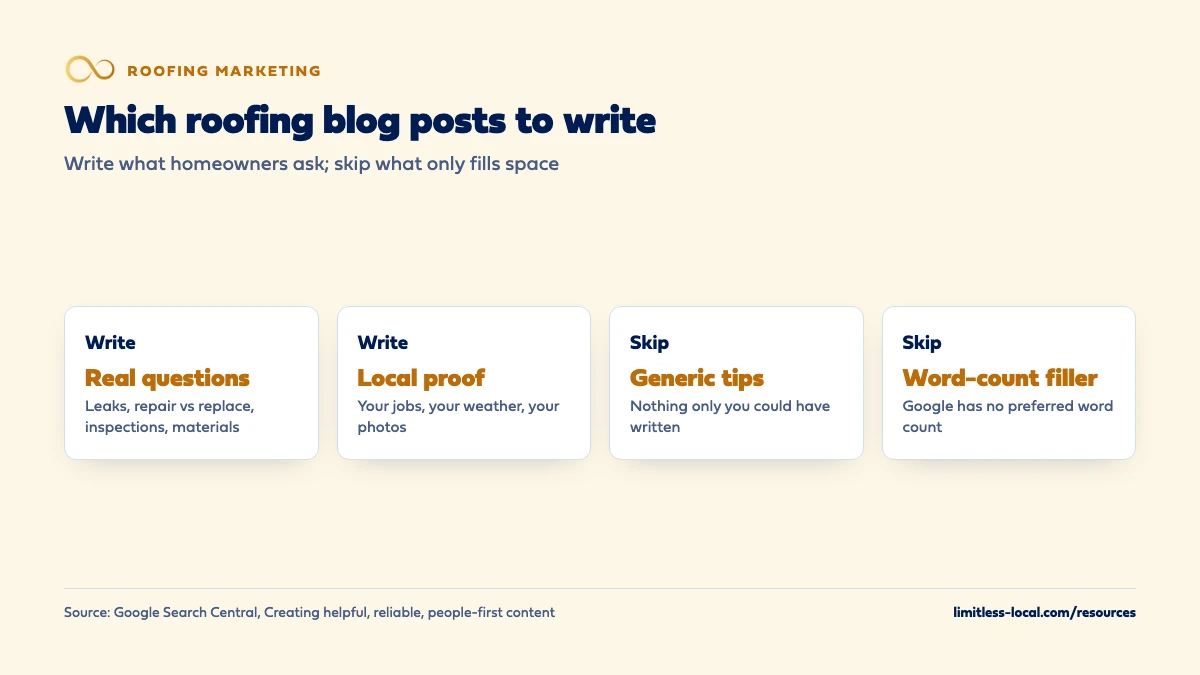
- Skip generic tips lists, news rewrites and posts written to a word count.
For roofing company owners deciding what to put on the company blog, and what to stop paying someone to write.
Get a free visibility audit · Book a growth call
Which roofing blog topics are worth writing, and which waste your time?
A roofing company should publish posts that answer the questions homeowners in its service area actually ask before they call: what a leak or storm damage looks like, repair versus replacement, materials and what suits the local weather, what an inspection involves, and what the process and timeline look like. Each post should show first-hand knowledge, such as real jobs, local conditions and photos from your own work, and link to the matching service page. Skip generic roofing tips lists, news rewrites and anything written only to hit a keyword, because Google says content made mainly to attract search visits is a warning sign.
Content is part of how we turn on lead flow for roofers: our Essentials and Growth packages include blog posts, and our local SEO service plans them around the towns and jobs you want. Our roofing marketing page shows how we work with roofers, whether SEO is worth it for roofers covers the bigger decision, and the roofing marketing questions library goes question by question.
What makes a roofing blog post worth publishing?
A post is worth publishing when a homeowner in your area would be glad they found it, and when it could only have been written by a roofer who does the work. Google’s guidance on helpful content asks a few plain questions that work well as a filter:
- Would your existing or intended customers find it useful if they came to you directly?
- Does it show first-hand expertise, the kind that comes from actually doing the work?
- Will the reader leave knowing enough to take the next step, without having to search again?
If a post passes those three, it belongs on your site. If it doesn’t, it’s probably filler, no matter how well it’s written. Google also says that SEO is helpful when it’s applied to content made for people, not when content is made mainly to rank.
Which roofing topics do homeowners actually search for?
Start with your own phone. The questions your office answers every week are the best topic list you’ll ever get, because they come from people who were close enough to call. In our judgement, most useful roofing posts fall into six groups:
- Problem posts: signs of a leak, what missing or curling shingles mean, what to do after a storm before a roofer arrives.
- Repair or replace posts: when a repair makes sense, when it doesn’t, and what drives the difference on your local housing stock.
- Material posts: asphalt versus metal, tile or flat roofing, explained for your climate rather than in general.
- Process posts: what an inspection involves, what a tear-off day looks like, how long a replacement takes, what happens to the yard and the driveway.
- Cost-driver posts: what changes the price of a roof (size, pitch, layers, materials, access) without publishing a price you can’t stand behind.
- Local posts: roofs on a particular style of home that’s common in your area, or what hail or wind does to roofs in your region.
Write each title the way a homeowner would say it out loud. “How do I know if my roof needs replacing?” beats “Roof replacement indicators.”
Which roofing blog posts waste your time?
Google lists several warning signs of content made mainly for search engines. For roofers, they translate into a short list of posts to stop writing:
- Generic tips lists that any roofer in any state could have published, with nothing from your jobs in them.
- News rewrites of industry stories that summarize what others said without adding anything. Google names “mainly summarizing what others have to say” as a warning sign.
- Trend posts on topics you’d never write about for your own customers.
- Posts padded to a word count. Google says plainly that it doesn’t have a preferred word count.
- Dozens of near-identical town posts that swap one city name for another. That’s a city-page question, and how many city pages a roofer needs covers it.
- Re-dated old posts. Google says changing dates to look fresh when nothing changed is a warning sign, and that adding or removing lots of content just to seem fresh won’t help.
Should blog posts or service pages come first?
Service pages first. A homeowner ready to book searches “roof replacement near me” and wants a page that says you do it, where you do it, and how to book. A blog post supports that page by answering the questions that come before the call. If your site doesn’t yet have a clear page for repair, replacement, storm damage and each roof type you install, build those first; what a roofing service page should include walks through them.
Then link every post to the service page it supports, with a plain anchor such as “our roof repair page.” In our judgement, a blog that doesn’t link to the pages that book jobs is doing half its work.
Curious what your marketing is actually booking?
Get a free visibility audit — no obligation, no sales pitch.
What should go inside a good roofing blog post?
- The answer near the top. One or two sentences that answer the title question before any background.
- Something only you know. What you see on roofs in your area, a job you did (without customer details they haven’t approved), the questions homeowners ask during inspections.
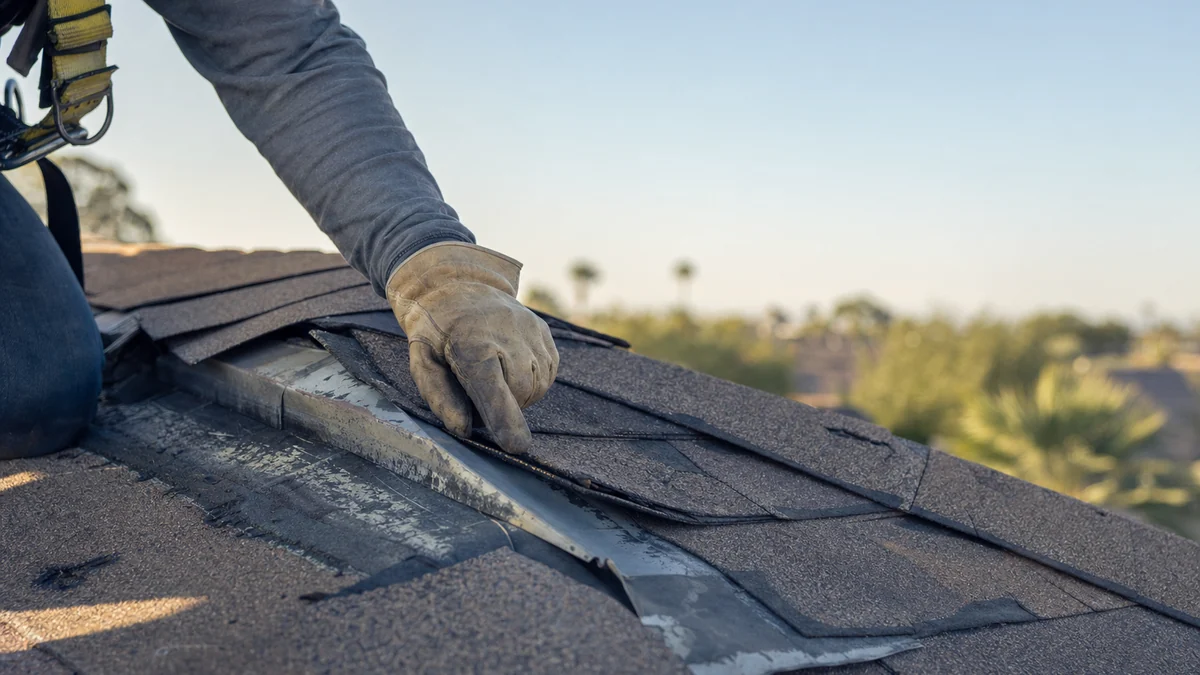
- Your own photos. Real job-site photos beat stock images. Google’s image guidance recommends descriptive filenames and alt text, so name the file for what it shows.
- A clear author. Google’s helpful-content guidance suggests making it clear who wrote the content and what their background is. A post signed by the owner or a project manager with years on roofs is stronger than one with no name.
- A next step. A link to the matching service page and a plain way to book an inspection.
Do blog posts help a roofing company show up in AI answers?
They can, if they’re the kind of page an answer engine can quote. Google says specific optimization isn’t required for AI Overviews and AI Mode, and that the same foundational SEO best practices apply. In practice, that means the same things on this page: clear questions as headings, a direct answer under each, and content that shows real expertise.
In our judgement, a post that answers one homeowner question well is more useful to an AI system than a long post that answers ten loosely. For the page-by-page version, see questions a roofing site should answer, and for getting named by assistants, getting recommended by ChatGPT.
Can AI or a freelancer write my roofing blog posts?
Who types the words matters less than whether the post carries your knowledge. Google’s warning list includes “extensive automation to produce content on many topics,” so the risk with AI or a cheap writer is volume without expertise. That question has its own page: using ChatGPT for roofing content. The practical fix is to give the writer what they can’t invent: your answers to the topic question, a few photos and a note on what you see locally. Then read the draft before it goes live.
How often should a roofing company publish blog posts?
Consistency matters more than volume. Google says adding lots of new content just to make a site seem fresh won’t help, and producing lots of content on many topics in hope that some performs is one of its warning signs. In our judgement, a steady handful of strong posts a month, each tied to a service and a real question, does more than a burst of thin ones followed by silence.
For reference, our Essentials package includes 2 blog posts a month and Growth includes 4. That’s what we’ve chosen to deliver, not a rule from Google. If you write your own, pick a pace you can keep through storm season.
How do I know if my roofing blog is working?
- Search Console queries. Check which searches each post shows up for. If a repair post ranks for questions homeowners ask, it’s doing its job.
- Clicks to service pages. A post that sends readers on to your repair or replacement page is feeding the pages that book work.
- Leads that mention it. Ask new callers how they found you, and tag website leads by the page they came from.
Blog posts are a slow channel. SEO typically takes three to six months to show meaningful organic growth, so judge a blog on a season, not a month. If you can’t tell which leads become signed roofs, start with tracking leads to signed jobs.
Should I delete old roofing blog posts?
Not just to look fresh. Google says removing lots of older content mainly to seem fresh won’t help. In our judgement, the useful approach is a yearly review: update posts that are still right but out of date (materials, process, photos), merge posts that answer the same question twice, and retire posts that no longer match anything you sell. If you remove a post that has links or traffic, point its address at the closest matching page.
Want to see where your company stands?
A free visibility audit shows where you show up on Google, Maps and AI answers, and what it's costing you in calls.
What's different about blogging for a roofing company
Weather drives the questions. After hail or high wind, the searches shift fast toward damage, leaks and what to do next. A post that explains what storm damage looks like and what happens during an inspection should be published before storm season, not after.
Insurance questions come up constantly. Homeowners ask about claims, but a roofer’s blog shouldn’t give insurance or legal advice. In our judgement, it’s safer to explain what your inspection documents and to tell readers to confirm coverage with their insurer.
High-ticket, slow decisions. A homeowner may read several posts over weeks before calling about a replacement. Posts about materials, process and cost drivers do their work early in that cycle.
Photos are your proof. Roofing is visual. Before-and-after shots, close-ups of flashing and ventilation, and crews working safely make a post clearly yours.
A worked example: turning a month of calls into a topic list
These numbers are made up to show the method, not a benchmark. Say your office logs 40 calls in a month and writes down the main question each caller asked. Sorting them, you find 12 asked whether a leak means a full replacement, 9 asked what happens during a free inspection, 7 asked about metal roofing and the rest were scheduling or billing.
That’s three posts, in order: “Does a roof leak mean I need a new roof?”, “What happens during a roof inspection?” and “Is a metal roof worth it for homes around here?” Each links to the matching service page. Together those questions came up 28 times in one month, which is a better reason to write them than any keyword tool.
For context on our side: our Essentials package is $3,500 a month and includes 2 blog posts a month; Growth is $4,500 and includes 4. We don’t guarantee rankings or lead counts from any of it.
Frequently asked questions
How long should a roofing blog post be?
As long as it takes to answer the question well. Google says it doesn’t have a preferred word count, and writing to one is a warning sign.
Should I write about roofing topics outside my service area?
In our judgement, no. Posts for homeowners you can’t serve bring visits that never become jobs. Keep local posts about the towns and weather you actually work in.
Can I post the same article on my blog and Facebook?
Yes. Sharing a link to the post on your social pages is a good way to get it read. Keep the full post on your website so it supports your service pages.
Should I write about roofing prices?
Writing about what drives price (size, pitch, layers, materials, access) is useful. In our judgement, avoid publishing a specific price you can’t honor once you see the roof.
Do I need a blog if I already rank in Google Maps?
Not necessarily first. Your Google Business Profile and service pages usually matter more for booking. A blog adds answers to the questions homeowners ask before they’re ready to call.
Can I use photos from manufacturers in my posts?
Only if you have the right to use them. Your own job-site photos are better proof anyway, because they show work only you did.
Key takeaways
- Write the questions your office answers every week, in the homeowner’s words.
- Every post should show first-hand roofing knowledge and link to a service page.
- Skip generic tips lists, news rewrites, re-dated posts and word-count filler.
- Build service pages first; blog posts support them.
- Judge a blog over a season, by searches, clicks to service pages and leads.
Not sure what's working right now?
Start with a free visibility audit: rankings, Google profile, reviews and tracking, checked against your service area.
More in this section
- How should a roofing company market commercial roofing?
- How can my roofing company stand out from other roofers online?
- How does a roofing company get links from local websites?
- What marketing should a roofing company add first to grow?
- How should a roofing company market metal roof installs?
Sources
- Creating Helpful, Reliable, People-First Content — Google Search Central
- AI features and your website — Google Search Central
- Image SEO Best Practices — Google Search Central
- Tips to improve your local ranking on Google — Google Business Profile Help