
Why is my roofing website not on the first page of Google?
- What keeps a roofing website off page one of Google's regular results?
- Am I looking at the right part of Google?
- Step 1: Has Google indexed my roofing website?
- Can Search Console show me where my roofing site stands?
- Step 2: Do I have a page for the search I want to win?
- Step 3: Is my page better than the ones on page one?
- Step 4: Does my site work on a phone?
- Step 5: Do other sites link to my roofing website?
- Could my site be doing something Google doesn't allow?
- How long should I wait after making changes?
- What does it cost to get a roofing website onto page one?
- What should I fix first?
- What's different for roofing websites
- A worked example: working through the steps
- Frequently asked questions
- Key takeaways
- More in this section
- Sources
The short version
- First check that Google has indexed your pages at all, with a site: search or Search Console.
- Make sure you have a dedicated page for each job and core town you want to rank for.
- Compare your page honestly with the ones on page one; thin pages rarely beat detailed ones.
- Fix phone experience and links last, and give changes weeks to months, not days.
For roofing owners whose website doesn’t show in Google’s regular results for the jobs and towns they want, and who want to know what to check, in order.
Get a free visibility audit · Book a growth call
What keeps a roofing website off page one of Google's regular results?
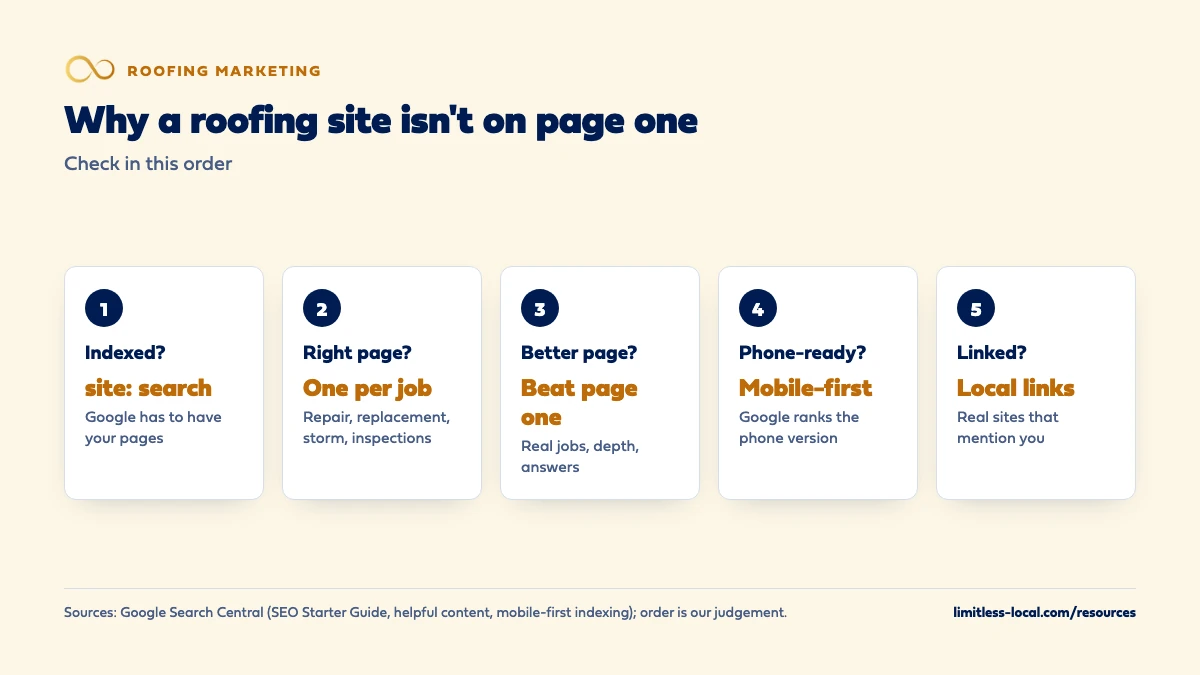
A roofing website usually stays off the first page of Google for one of five reasons: Google hasn’t indexed the pages, there’s no page that actually matches the search (such as roof replacement in your town), the pages are thinner or less helpful than the ones that rank, the site has technical problems on a phone, or other sites mention and link to competitors more than to you. Check them in that order, because there’s no point building links to a page Google can’t find. Even after fixes, Google says changes can take from a few hours to several months to show, so SEO is a ramp, not a switch.
Getting a roofing site into the regular results is the slower half of local search, and it’s the work behind our local SEO service and how we approach roofing marketing. If you’re still deciding whether the ramp is worth it, is SEO worth it for roofers lays out the trade-off, and the roofing marketing questions library goes one question at a time.
Am I looking at the right part of Google?
A roofing search usually shows three things: ads at the top, the map pack with three businesses, and the regular results below. This page is about the regular results, where your website ranks. The map pack runs on your Google Business Profile, not your website, and it has its own causes and fixes; why a roofing company isn’t showing up on Google Maps covers those.
Also check the search itself. Results change with where the searcher is, so a search from your shop isn’t what a homeowner across town sees. In our judgement, it’s more useful to look at the search terms your site is actually showing for than to search your own name from the office.
Step 1: Has Google indexed my roofing website?
Before anything else, make sure Google has your pages at all. Google’s starter guide suggests a site: search (for example site:yourdomain.com): if results point to your site, you’re in the index; if not, check the technical requirements to make sure nothing is preventing your site from showing (Google Search Central). The same guide points to the URL Inspection tool in Search Console to see how Google sees a page.
Common causes on roofing sites, in our judgement: a new site launched with a setting that blocks search engines, pages that aren’t linked from anywhere, or a rebuilt site where the old addresses were never redirected.
Can Search Console show me where my roofing site stands?
Yes, and it’s free. Google’s starter guide says setting up a Search Console account helps you monitor your site, and points to its URL Inspection tool for seeing how Google sees an individual page (Google Search Central).
In our judgement, three things in it are worth a roofer’s time each month: which pages are indexed and which aren’t, the searches your site already shows up for (often on page two or three, which tells you what’s within reach), and which pages get clicks. A roof replacement page sitting just off page one for your town is a better bet than a page that doesn’t show at all, because it’s closer to the finish line.
If you have an agency, ask for access in your own name. It’s your site’s data, and you should be able to see it without asking.
Step 2: Do I have a page for the search I want to win?
If you want to rank for “roof replacement” in your town and the only page that mentions it is the home page, you’re asking one page to win every search. In our judgement, most roofers need separate pages for roof repair, roof replacement, storm and hail damage and inspections before anything else. What a roof repair or replacement service page should include covers what goes on each.
Then pick the searches that bring the jobs you want, not just the most popular words. Which search terms a roofing company should target walks through that choice.
Step 3: Is my page better than the ones on page one?
Open the pages that rank for your search and compare honestly. Google’s guidance on helpful content asks whether a page provides original information, a substantial or complete description of the topic, and whether it’s the sort of page you’d bookmark or share (Google Search Central).
A roofing page with two paragraphs and a stock photo rarely beats one with real jobs, the process, materials, warranty and answers to common questions. In our judgement, this is where most roofing sites lose: the pages exist, but they say less than the competition.
Curious what your marketing is actually booking?
Get a free visibility audit — no obligation, no sales pitch.
Step 4: Does my site work on a phone?
Google uses the mobile version of a site’s content, crawled with its smartphone agent, for indexing and ranking (Google Search Central). If your phone version hides text, cuts pages or loads slowly, that’s the version Google judges.
Roofing sites are photo-heavy, which makes speed a common problem. How to tell if your roofing website works well on phones lists the checks.
Step 5: Do other sites link to my roofing website?
Links still matter. Google’s starter guide says it primarily finds pages through links from other pages it has already crawled (Google Search Central). For local results, Google says how well-known a business is (what it calls prominence) is also based on info like how many websites link to your business (Google Business Profile Help).
For a roofer, the useful links are local and real: suppliers, local associations, sponsorships, community news. Bought links are a risk; Google’s spam policies list link spam, including buying or selling links for ranking purposes (Google Search Central). Getting links from local websites covers where to find good ones.
Could my site be doing something Google doesn't allow?
Sometimes the problem is something that was done to help. Google’s spam policies name doorway abuse, including pages targeted at specific regions or cities that funnel users to one page, and scaled content abuse, many pages generated mainly to manipulate rankings, no matter how they’re created (Google Search Central).
Dozens of near-identical town pages, keyword-stuffed footers listing every suburb, or a batch of AI-written blog posts nobody reviewed can all fall into that. In our judgement, fewer, better pages are the safer fix.

How long should I wait after making changes?
Longer than most owners want to. Google’s starter guide says some changes might take effect in a few hours and others could take several months, and that you likely want to wait a few weeks to assess whether your work had beneficial effects (Google Search Central). The same guide is clear that there’s no guarantee any particular site will be added to Google’s index.
Our own rule of thumb matches that: ads can bring leads within days of launch, while SEO typically takes 3-6 months to show meaningful organic growth. Nobody can honestly promise you page one by a date.
What does it cost to get a roofing website onto page one?
There’s no fixed price, because it depends on how far the site is from the competition and how competitive your market is. How competitive roofing marketing is in your city helps size that up.
For reference, our own packages start at $3,500 a month for Essentials, which covers one location, including a content sprint, blog posts, link building and Google Ads management; Growth is $4,500 a month and covers up to two locations. Ad spend is paid directly to Google and isn’t included. We don’t guarantee rankings, and nobody honestly can.
What should I fix first?
Work down the steps in order, in our judgement:
- Make sure Google has indexed your pages.
- Build or fix the service pages for the jobs you want most.
- Make each one better than what ranks today.
- Fix the phone experience.
- Earn real local links.
While SEO ramps up, ads and your Google Business Profile can keep the phone ringing. Treat the website as the slow, compounding part of your marketing, not the thing you wait on to pay this month’s bills.
Not sure which of these is costing you jobs?
A free visibility audit checks the Google profile, reviews, site and tracking, and shows what to fix first.
What's different for roofing websites
Searches spike after storms. After hail or high winds, more homeowners search for storm damage and roof inspections. In our judgement, a storm damage page that’s already indexed and linked is what has a chance of showing; a page built the week after the storm usually doesn’t have time to rank before the rush passes.
Out-of-town crews compete for the same searches. After big storms, roofers from elsewhere buy ads and spin up pages. A local roofer’s edge in the regular results is real local proof: jobs, photos and reviews in the towns you serve.
High-value jobs make page one worth the wait. A single signed replacement can be worth more than a month of small service calls in other trades, so in our judgement the slow ramp of SEO tends to pay back for roofers who stick with it.
A worked example: working through the steps
This example is made up to show the order of checks. A roofer wants to rank for roof replacement in their home town and the two towns next to it.
- Step 1: a site: search shows the home page and the about page, but not the services page. It was never linked from the menu after a redesign. Fix: link it and request indexing.
- Step 2: there’s one “Services” page covering repair, replacement, gutters and siding in a few lines each. Fix: separate repair and replacement pages.
- Step 3: the replacement pages that rank show materials, process, warranty and dozens of photos. Fix: write the same depth from the roofer’s own jobs.
- Step 4: on a phone, the photo gallery loads slowly. Fix: compress and resize photos.
- Step 5: a supplier and a local association list the roofer without a link. Fix: ask for links.
None of this produces page one next week. Each fix removes a reason not to rank, and the results show up over the following months.
Frequently asked questions
Why does my roofing website show for my company name but not for "roofer"?
A name search has one obvious match: you. A search like “roof replacement” has dozens of roofers competing, so it takes pages that match the job and town, plus more local proof and links.
Can I pay Google to rank higher in the regular results?
No. Ads sit in their own spots, marked as sponsored. Google says there’s no way to request or pay for a better local ranking, and in our judgement the regular results work the same way, which is why SEO takes time.
Will a new website fix my rankings?
Not by itself, and a rebuild can hurt if old addresses aren’t redirected. In our judgement, fix content and indexing on the current site first unless it’s truly beyond repair.
Do blog posts help a roofing site rank?
They can, if they answer questions homeowners actually ask and link to your service pages. A batch of thin posts written for search engines is more likely to be ignored.
Should I worry if a competitor outranks me with a worse site?
Look past the design. They may have more links, more reviews, an older site or a closer office. Those are the gaps to close.
Does the first page matter if I'm in the map pack?
Both matter. Some homeowners skip the map and click the regular results, and a strong website helps your map listing convert too.
Key takeaways
- Check indexing first; a site: search or Search Console tells you whether Google has your pages.
- Build a dedicated page for each job and core town, and make it better than what ranks today.
- Google ranks the phone version of your site, so fix mobile speed and layout.
- Earn real local links, and avoid near-identical town pages and bought links.
- Give changes weeks to months; SEO is a ramp, and nobody can promise page one by a date.
Want a second set of eyes on your setup?
We'll look at how you show up locally and where calls are leaking, then send you a plain-English breakdown.
More in this section
- Why isn't my roofing company showing up on Google Maps?
- What should a roofing Google ad actually say?
- Why are my roofing ads getting clicks but no calls?
- How does a roofing company get links from local websites?
- How can my roofing company stand out from other roofers online?
Sources
- SEO Starter Guide: The Basics — Google Search Central
- Creating helpful, reliable, people-first content — Google Search Central
- Mobile site and mobile-first indexing best practices — Google Search Central
- Spam Policies for Google Web Search — Google Search Central
- Tips to improve your local ranking on Google — Google Business Profile Help