
What does attribution mean for my HVAC marketing?

- What does marketing attribution mean for an HVAC company's calls and booked jobs?
- What does attribution actually mean for an HVAC company?
- Why does one booked job get claimed by more than one channel?
- What's the difference between last-click and data-driven credit?
- Where does credit get lost between the ad and the invoice?
- Why do searches for my company name muddy the picture?
- How long after the first click does a job still get credited?
- Why don't Google Ads, Google Analytics and my field software agree?
- How do booked jobs get back to the channel that earned them?
- Does asking "how did you hear about us?" still matter?
- What can attribution never tell me?
- How should I use attribution to make budget decisions?
- What's different about attribution for HVAC companies
- A worked example: what the ads account says versus what booked
- Frequently asked questions
- Key takeaways
- More in this section
- Sources
The short version
- Attribution = which marketing gets credit for each call and booked job.
- Every platform credits itself, so their totals add up to more jobs than you ran.
- Credit gets lost at the phone, at the front desk and at the invoice.
- Judge channels on cost per booked job from your own field software.
For HVAC owners who keep hearing the word in agency reports and want to know how a booked job gets credited to a channel, and where that credit goes missing.
Get a free visibility audit · Book a growth call
What does marketing attribution mean for an HVAC company's calls and booked jobs?
Attribution is how you decide which marketing gets the credit for a call, a lead or a booked job. For an HVAC company, it means tracing each booked job back to where the homeowner found you, such as a Google ad, your Google Business Profile, Local Services Ads, a referral or your truck, so you can see what each channel really costs per job. It matters because most platforms count their own credit, the same homeowner can touch three of them before calling, and a lot of credit gets lost between the first click and the finished invoice.
That last point is how we report, too: every package includes call tracking with recording, form and chat lead tracking, source tagging and a monthly report with a cost-per-lead breakdown, so each booked job can be traced back to the channel that earned it. Essentials includes basic attribution, Growth adds advanced attribution, and Scale gets custom attribution and dashboards; you can compare them on our packages page. For how that fits HVAC marketing as a whole, the HVAC marketing guide covers every channel, and the HVAC marketing questions library takes them one question at a time.
What does attribution actually mean for an HVAC company?
Google’s own Analytics help defines attribution as assigning credit for important actions to the different ads, clicks and other factors along a person’s path to taking that action. For you, the important action isn’t a click. It’s a homeowner calling, booking and paying for a job.
So attribution, in HVAC terms, is answering one question for every booked job: what made this person call us? Was it the Google ad they tapped on a 98-degree afternoon, the map listing with your reviews, the Local Services Ad, a neighbor’s referral, or the wrapped truck they passed twice that week?
Get it right and you can do the math that matters: what each channel cost, divided by the booked jobs it produced. Get it wrong and you cut the channel quietly doing the work, or feed one taking credit for jobs you’d have booked anyway.
Why does one booked job get claimed by more than one channel?
Because every platform keeps its own score, and none of them can see the others. Picture a homeowner whose AC quits on a Saturday. She searches, taps your Google ad, reads your reviews, leaves, checks your Google Business Profile that evening and calls from the listing on Monday.
Your Google Ads account may count that as a conversion. Your Business Profile counts a call. If you also run Local Services Ads and she tapped that ad at some point, it might count a lead too. Meanwhile, your office may have marked her as “Google” in the field software, and she’s one booked job.
That’s why the totals from your ad platforms often add up to more jobs than you actually ran. The fix is to pick one place as the final word, which for most HVAC shops is the field software where the job is booked and invoiced, and treat the platform numbers as each channel’s own view. The difference between a click, a lead and a booked job covers why those platform numbers rarely match your schedule.
What's the difference between last-click and data-driven credit?
These are the two attribution models Google Ads still offers. According to Google’s page on attribution models:
- Last click gives all the credit to the last ad clicked and its keyword.
- Data-driven spreads the credit across the ad interactions that led to the conversion, based on your account’s past data. It’s the default for most conversion actions.
If a homeowner first searched “AC not cooling,” then later searched your company name and clicked again, last click hands all the credit to your branded keyword. Data-driven gives some of it to the first search too. Neither one sees what happened outside Google Ads, like the yard sign or the referral. Inside your ads account, data-driven usually gives the fairer picture; just don’t mistake it for the whole story.
Where does credit get lost between the ad and the invoice?
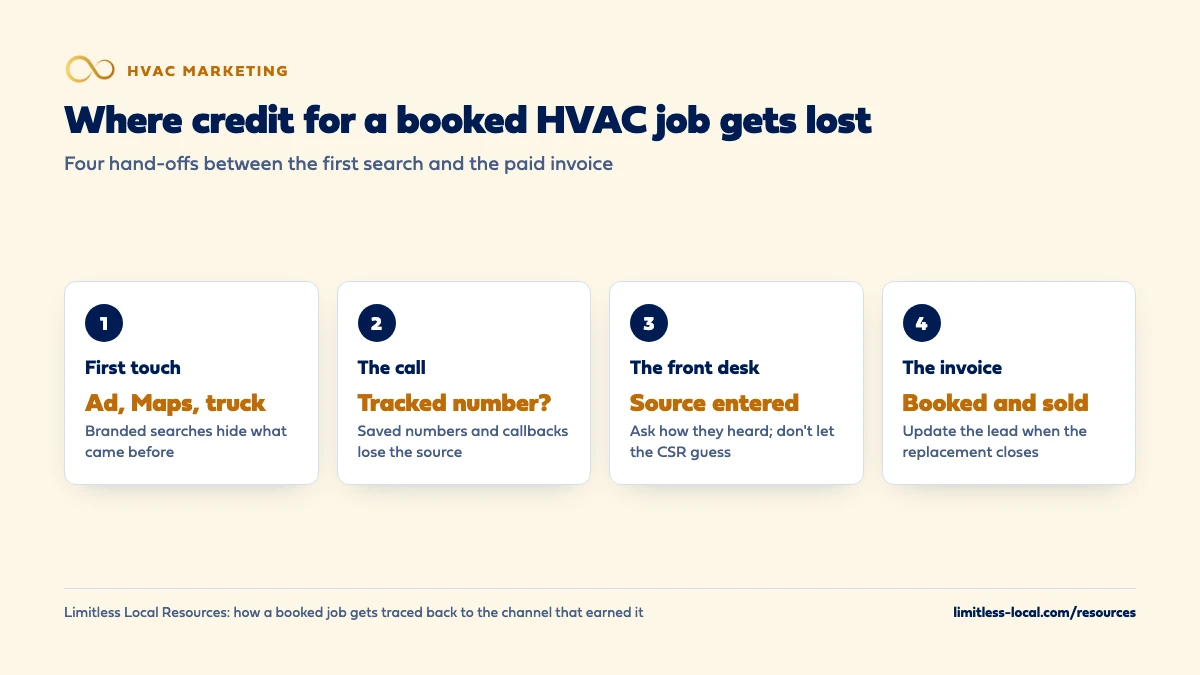
Most attribution problems in HVAC aren’t about models. They’re about gaps where the trail goes cold. The common ones:
- Untracked phone numbers. If the number on your website, your listing and your ads is the same plain number, every call looks alike.
- Saved numbers. A homeowner who found you through an ad last summer saves your number and calls direct this winter. That job shows up with no source at all.
- Callbacks. Your office returns a missed call from caller ID. The booking happens on an outbound call, so the original source never gets attached.
- The front desk guess. When the source field is a drop-down, a busy CSR picks “Google” for anything vaguely online, or skips it.
- Estimates that close later. The lead gets credit for the estimate, but nobody updates it when the replacement sells three weeks later.
Each one is fixable with setup and habit. Tracking whether your HVAC marketing is paying off walks through the setup step by step.
Why do searches for my company name muddy the picture?
Because a search for your business name is usually the last step, not the first. Something else put your name in the homeowner’s head: a truck in the neighborhood, a referral, a review they read last month, a postcard, a past service visit. Then they search your name, and whatever they click gets the credit.
If you run Google Ads on your own name, those clicks often look like your cheapest, best-converting ads. Some of that is real, since the ad keeps a competitor off your name, but many of those homeowners were calling you anyway.
Two simple habits keep this from fooling you. First, look at your branded and non-branded campaigns separately, so the branded numbers don’t flatter the rest. Second, when branded searches rise, ask what changed upstream. More trucks on the road, a burst of new reviews or a direct mail drop can all show up as “Google” in your reports.
Curious what your marketing is actually booking?
Get a free visibility audit — no obligation, no sales pitch.
How long after the first click does a job still get credited?
That depends on the conversion window, which is how long after an ad interaction a conversion still gets recorded. On Google’s page about conversion windows, the default click-through window for most conversions is 30 days, and you can set it anywhere from 1 to 90 days depending on the source. Anything that happens after the window closes isn’t recorded.
For a broken AC, 30 days is plenty; most of those homeowners call the same day. For a system replacement, it can be tight. A homeowner may click your ad, book an estimate, get two other quotes, wait on financing and sign weeks later. If your ad platform only gets the first call and never hears about the sale, your replacement ads look worse than they are.
Google Analytics has its own version, called the lookback window, which defaults to 90 days for most actions. When the two tools use different windows, their numbers won’t match, and that’s expected. How long an HVAC lead takes to turn into a booked job helps you set the window to fit your own sales cycle.
Why don't Google Ads, Google Analytics and my field software agree?
Because each one counts different things, in different ways, on a different clock. A few reasons they drift apart:
- Who can get credit. Google Analytics reports give credit to paid and organic channels by default. Google Ads reports, by default, only credit Google’s paid channels.
- What counts. Your ads account counts a call that lasted long enough, or a form fill. Your field software counts a booked job.
- Time zones. If your Google Analytics property and Google Ads account sit in different time zones, the daily numbers can shift.
Don’t spend hours making them match. Keep your field software as the source of truth for booked jobs, and use the platforms to steer inside each channel: which keywords, which ads, which towns.
How do booked jobs get back to the channel that earned them?
Two ways, and the best setups use both.
From the platform to you. A tracking number for each channel tags every call at the source. Pass that tag into your field software, whether that’s ServiceTitan, Housecall Pro or Jobber, so the lead source is already on the job when it’s booked, without the CSR guessing.
From you back to the platform. Google Ads lets you import what happens after the ad. Its page on offline conversion imports describes exactly the HVAC situation: an ad starts a customer down a path that ends in a sale at your office or over the phone, and importing those conversions lets you measure what happened after the click or call. For calls, Google’s phone call conversion tracking also lets you import call conversions from another system, so you can count only the calls that turned into sales, with their values.
Once booked and sold jobs flow back, your ads get judged on jobs instead of calls.
Does asking "how did you hear about us?" still matter?
Yes, and it catches what software misses. The SBA’s article on getting the most from your marketing budget notes that tracking can be as simple as reminding employees to ask new customers where they learned about your business.
Software is good at the last touch. People are good at the first one. A homeowner who called from your Google listing may tell your CSR, “My neighbor used you,” or “I see your trucks all over Oak Hill.” That’s the real reason they called, and no tracking number will ever record it.
Make it a required question in your booking script, with a short pick list plus a notes field, and compare it with the tracked source monthly. Where they disagree, you’ll learn which offline channels are quietly feeding your online ones.
What can attribution never tell me?
Some marketing works without ever getting the last touch. Your reviews make a homeowner pick you over the company above you. A truck wrap plants your name. A tune-up visit two years ago is why a family calls you for the replacement. None of these show up neatly in a report.
That doesn’t make them worthless. It means you judge them differently: by what happens to the trackable channels when you change them. If you add a second wrapped truck, do branded searches and direct calls in that area rise over the next few months? If reviews jump, does your booking rate from Maps go up?
Change one thing at a time, give it long enough, and watch your total booked jobs, not just the channel you changed. An owner who knows the gaps makes better calls than one who trusts the report blindly.
How should I use attribution to make budget decisions?
Use it to compare cost per booked job across channels, then move money slowly. A simple monthly routine:
- Pull booked and sold jobs by source from your field software.
- Add up what each channel cost, including agency fees and ad spend.
- Divide cost by booked jobs for each channel.
- Look at the revenue behind those jobs, because a $9,000 replacement and a service call aren’t the same win.
- Shift a modest share of budget toward the channel with the best cost per booked job, and check again next month.
Be careful cutting a channel because it rarely gets the last click. A channel that starts lots of jobs but rarely closes them, like non-branded search, can look weak on last click and still be feeding your branded searches. The numbers an HVAC owner should track every week covers the routine that keeps these decisions on schedule.
Want to see where your company stands?
A free visibility audit shows where you show up on Google, Maps and AI answers, and what it's costing you in calls.
What's different about attribution for HVAC companies
Emergency calls are short trips. A no-cool call in July usually goes from search to phone in minutes, often with one touch. Attribution is easy there, and last click is close to the truth.
Replacements are long trips. A system replacement can involve several searches, a few visits to your site, an in-home estimate, other quotes and a financing decision. Update the original lead when the job sells.
Maintenance plans and repeat customers. A plan member calling to book a tune-up isn’t a new lead from your ads, even if they found your number by searching. Tag existing customers separately, or your marketing will look better than it is.
The season skews everything. In the first heat wave, every channel looks great because demand is up everywhere. Compare a channel against the same weeks last year, not against the slow month before.
A worked example: what the ads account says versus what booked
These numbers are made up to show the math, not a benchmark for your market. Say you spend $3,000 on Google Ads in a month, and the account reports 40 conversions. That looks like $75 per conversion.
Now check those 40 against your field software:
- 12 were existing customers or maintenance plan members calling about work you’d have gotten anyway.
- 8 were real homeowners who never booked: price shoppers, wrong service, or a callback that came too late.
- That leaves 20 new booked jobs (40 − 12 − 8).
Your real cost per booked job is $3,000 ÷ 20 = $150, twice what the ads account suggested. That doesn’t mean the ads are bad. It means $150 is the number to compare against your other channels and against what those jobs are worth, and that tagging existing customers and speeding up callbacks would improve it without spending a dollar more.
Frequently asked questions
Is attribution the same thing as call tracking?
No. Call tracking is one tool that feeds attribution by tagging each call with its source. Attribution is the bigger job of deciding which marketing gets credit for each booked job, using call tracking, form tracking, your field software and what customers tell you.
Which attribution model should my Google Ads account use?
Google Ads now offers last click and data-driven, and data-driven is the default for most conversion actions. Data-driven usually gives a fairer view of which searches start a job, but it only sees Google Ads, so your field software still has the final word.
Why does my agency report show more leads than my office booked?
Usually because the report counts calls and form fills, including existing customers, repeat callers and people who never booked. Ask for the same report filtered to new booked jobs, matched against your field software.
Do I need special software for attribution?
Not to start. A tracking number per channel, a required lead source field in ServiceTitan, Housecall Pro or Jobber, and a “how did you hear about us?” question get most HVAC shops most of the way.
Should referrals and repeat customers count as marketing?
Track them as their own sources. They’re among your cheapest jobs, and lumping them in with ad leads makes paid channels look better than they are.
Key takeaways
- Attribution means tracing each booked job back to what made the homeowner call.
- Ad platforms each credit themselves, so pick your field software as the final word.
- Most lost credit comes from untracked numbers, callbacks, guessed lead sources and estimates nobody updates.
- Replacements need a longer window and a lead that gets updated when the job sells.
- Compare channels on cost per booked job, and move budget slowly.
Not sure what's working right now?
Start with a free visibility audit: rankings, Google profile, reviews and tracking, checked against your service area.
More in this section
- How do I know if a marketing agency really understands HVAC?
- How do I track whether my HVAC marketing is paying off?
- How do I grow my HVAC company with marketing?
- What does good HVAC advertising look like?
- How do I know if my HVAC marketing agency is getting results?
Sources
- Select attribution settings — Google Analytics Help
- About attribution models — Google Ads Help
- About conversion windows — Google Ads Help
- About offline conversion imports — Google Ads Help
- About phone call conversion tracking — Google Ads Help
- How to Get the Most From Your Marketing Budget — U.S. Small Business Administration