
What happens to plumbing leads over time if I stop paying Google Ads?
- How fast do plumbing calls fall off after I turn off Google Ads or Local Services Ads?
- What happens to my plumbing leads on day one?
- Why does the first week still feel normal?
- When do the gaps show up on the schedule?
- What does month two and beyond look like?
- How much of the lost traffic do free Google results win back?
- Does where I rank for free change how fast leads fall?
- Which plumbing calls fall off first?
- How long do open estimates keep closing after the ads stop?
- What happens to leads if I pause Local Services Ads?
- Does the season change how fast plumbing calls fall off?
- How can I tell the pause from something else going wrong?
- What's different about a pause for a plumbing company
- A worked example: one shop's pause, week by week
- Frequently asked questions
- Key takeaways
- More in this section
- Sources
The short version
- Ad calls stop on day one; the schedule usually feels it a week or more later.
- Gaps tend to show in weeks two to six, as booked-ahead work runs out.
- Emergency calls and far-off towns go first; open estimates trail off slowly.
- Free search results recover only a small share of the lost ad clicks.
For plumbing owners weighing a pause in paid ads, who want to know how fast the calls fall off, which ones go first and when the schedule feels it.
Get a free visibility audit · Book a growth call
How fast do plumbing calls fall off after I turn off Google Ads or Local Services Ads?
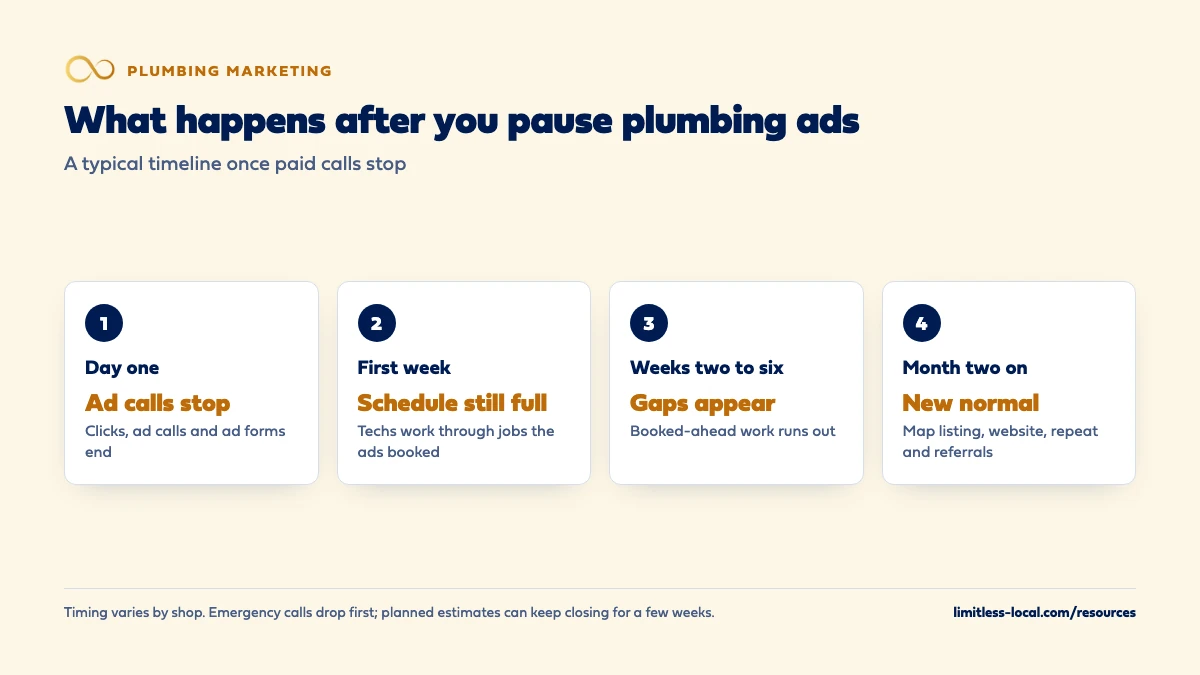
Ad calls stop the day you pause, but most plumbing shops don’t feel it for a week or more, because the techs are still working through jobs the ads already booked. The gaps usually show up somewhere in weeks two to six, and by month two the schedule settles at whatever your map listing, website, repeat customers and referrals bring in on their own. Free search results won’t fill much of the hole: in Google’s pause studies across advertisers of all kinds, an average of 85% to 89% of paid clicks were simply lost when campaigns were paused. Emergency calls and calls from towns farther from your office fall off first, while planned estimates trail off over a few weeks.
The first step in planning any pause is knowing what share of your booked jobs the ads bring in. Every Limitless Engine package, from $3,500 a month, includes Google Ads management and call tracking with source tagging, so that share is in your monthly report and not a guess; Growth adds Local Services Ads. See how our local ads work for plumbing companies, or browse more plumbing marketing questions.
What happens to my plumbing leads on day one?
New ad clicks, calls from the ad and form fills from your ad landing pages stop the same day. Nobody new finds you through a paid listing, and the landing pages built for the ads go quiet, even though they’re still live.
That’s the only instant part of the drop, and most owners barely notice it, because the phone rarely goes silent. Your map listing, website, repeat customers and referrals keep calling, so day one just feels like a slow-ish day.
A few ad-driven calls also trickle in after the pause: people who saw your ad and saved the number, people who look you up by name a day later, and callbacks already sitting in your office’s queue. If you’re still deciding whether to pause at all, or whether to pause or remove a campaign, if I stop Google Ads, will my plumbing leads drop covers that decision. This page is about what happens after, week by week.
Why does the first week still feel normal?
Because your schedule runs on work booked days or weeks ago. A call that came in from an ad last Tuesday is a job on next Monday’s board. A water heater estimate from two weeks back may be closing this week.
So in the first week after a pause, the trucks are still busy. Techs are running jobs, the office is confirming appointments, and revenue looks about the same. The thing that changes is quieter: fewer brand-new customers calling to book the week after next.
That lag is why a pause can look free in week one. It isn’t. You’re spending down a backlog the ads built.
The early signal to watch isn’t revenue. It’s how full the schedule is two weeks out, and how many new-customer jobs got booked this week compared with the same week before the pause.
When do the gaps show up on the schedule?
For most shops, somewhere in weeks two to six. How fast depends on how far ahead you book:
- Mostly same-day and next-day service work: gaps can show by the second or third week, because there was little backlog to begin with.
- A mix of service calls and planned installs: service gaps show first, then the install calendar thins out a few weeks later.
- Booked out two or three weeks: the drop can take a month or more to show, and then it arrives all at once.
This is the stretch when owners feel the pause, often later than they expected and sometimes blamed on something else, like the weather or a slow month.
What does month two and beyond look like?
By month two, the backlog is gone and you’re seeing your floor: the jobs that come in without paid ads. For most plumbing shops that’s some mix of:
- Calls and direction taps from your Google Maps listing.
- Calls from pages on your website that rank on their own.
- Repeat customers, who call the number on the sticker on their water heater or look you up by name.
- Referrals from neighbors, realtors, property managers and other trades.
- Trucks, yard signs and anything else offline.
A shop with a strong map listing, lots of reviews and a long customer list has a high floor and feels a pause much less than a shop that’s two years old and runs mostly on ads.
If you know what share of your new-customer jobs came from ads before the pause, you know roughly where the floor will land. How to track which plumbing marketing books jobs shows how to get that split.
How much of the lost traffic do free Google results win back?
Not much. Google measured this in its search ads pause studies, published in 2011 and 2012 across all kinds of advertisers, not plumbers in particular. The first study found that an average of 89% of paid clicks were lost, not recovered by extra organic clicks, when a search campaign was paused, and that the figure was consistent across industries.
The 2012 update looked at more than 5,300 cases. For paused campaigns, the average came in at 85%. When advertisers cut spend instead of pausing, 80% of the traffic from the cut ads still wasn’t made up by organic clicks.
So don’t plan on your free search results quietly absorbing the ad calls over a few weeks. The studies counted clicks, not booked jobs, and results vary by business, but the direction is clear: most of what the ads brought in goes to whoever is still showing.
Curious what your marketing is actually booking?
Get a free visibility audit — no obligation, no sales pitch.
Does where I rank for free change how fast leads fall?
Yes, a lot. A follow-up study on organic rankings looked at what happens when the advertiser also has a free result on the same page. On average, 66% of ad clicks happened with no free result for that advertiser on the first page at all. Where there was one:
- Ranked first: about 50% of ad clicks were extra traffic the free result wouldn’t have caught.
- Ranked second to fourth: 82% were.
- Ranked fifth or lower: 96% were.
For a plumber, that turns into a quick check you can do before or during a pause. Search your main services, like “plumber,” “drain cleaning” and “water heater repair,” in each town you serve, and note where you show up without the ad. Where you’re at the top in your home town, those leads fall off slowly. Where you don’t show up at all, they’re gone in the first week.
Which plumbing calls fall off first?
The calls your ads were winning that nothing free was winning:
- Emergency searches you don’t rank for. “Emergency plumber,” “burst pipe” and “water heater leaking” come from people who book that day. If you’re not on the page for free, those calls go to someone else from day one.
- Towns farther from your office. Google weighs distance when ranking local results, so your map listing is strongest close to your shop. Ads were often what reached the next town over, and those calls dry up fast.
- High-ticket jobs you were bidding on, like tankless installs, sewer line replacement or repipes, if your website doesn’t rank for them on its own.
Repeat customers and referrals fall off last, if at all, because they never depended on the ads. Pull the job types and towns from your last few months of ad-booked jobs. That list is your early-warning list.
How long do open estimates keep closing after the ads stop?
For a few weeks. Planned work moves slower than emergencies: a homeowner pricing a water heater replacement, a repipe or a sewer line may take one to three weeks to decide, so estimates given in the last weeks of ads keep turning into jobs after the pause.
That’s money you’ve already paid for, so don’t let it slip. While the ads are off:
- Pull a list of every open estimate from the last month.
- Follow up on each one by phone, not just text or email.
- Answer every new call, because each one now matters more.
Once that tail of estimates runs out, planned-work volume drops to whatever your free channels bring in. That’s usually the second wave of the drop, after emergency calls have already slowed.
What happens to leads if I pause Local Services Ads?
Local Services Ads run as their own campaign, so pausing your search campaign doesn’t pause them. That stays true as they move into Google Ads: Google’s page on the move to Performance Max with pay-per-lead goals lists plumbing among the select home service advertisers in the first phase, which began in August 2026, with existing Local Services Ads campaigns migrating automatically to their own specialized campaign type. Check every campaign in the account, not just the one you meant to pause.
Once Local Services Ads are paused, new leads from them stop, the same as with search ads. Two things are different:
- A free listing may show. Google’s page on Local Services Ads scheduling says that when your ad is paused or outside its scheduled hours, a free version of your listing may be displayed. It may or may not appear, so don’t count on it to replace the paid spot.
- Leads you already have stay workable. Google’s page on managing leads says you can still respond to inactive leads at any time. Work through them during the pause; a few will still book.
Because these leads are mostly calls from people ready to book, the drop is quick. Expect Local Services Ads volume to fall off in the first days, not weeks.
Does the season change how fast plumbing calls fall off?
Yes. The same pause plays out very differently depending on the month:
- Before a hard freeze or a busy season, a pause hurts fast. Burst-pipe and no-water calls spike, and they go to whoever shows up first on the page that morning. Those customers often keep calling whoever came out.
- In a genuinely slow stretch, there are fewer searches to lose, so the drop is smaller, and it’s a lower-risk time to pause.
- Right before a holiday week, the backlog runs out while the office is short-staffed, so the gap and the missed calls land together.
If you pause, pick the slow window on purpose and set the restart date before the next busy stretch, not on the morning the phones start ringing. How plumbers prepare their marketing for a winter freeze covers the timing for the cold months, and keeping plumbing calls coming in slow months covers the other end of the year.
How can I tell the pause from something else going wrong?
Split your calls and booked jobs by source each week and compare them with the same weeks before the pause. The pause should only move the ad-sourced lines.
- Ad calls at zero, everything else steady: that’s the pause doing what you expected.
- Map listing or website calls also falling: something else is going on, like a profile problem, a broken tracking number or a site issue.
- Calls steady but booked jobs down: look at how calls are being answered and followed up, not at the ads.
One easy thing to break during a pause: if a call tracking number from the ads also lives on your Google profile or website, canceling it with the ads sends those calls nowhere. If the phone has gone quieter than the ads alone can explain, what to check when your plumbing phone stops ringing walks through the other causes.
Want to see where your company stands?
A free visibility audit shows where you show up on Google, Maps and AI answers, and what it's costing you in calls.
What's different about a pause for a plumbing company
Emergency calls decide the speed. Burst pipes, sewage backups and no-hot-water calls are booked the same day, so a shop that runs mostly on emergency work feels a pause within a week or two. A shop heavy on planned installs feels it later.
Plumbing customers come back. Water heaters age out, drains clog again and houses get sold. A long, well-kept customer list raises your floor more in plumbing than in trades where a customer buys once a decade.
Capacity changes the math. If you’re short a plumber or a truck is down, the calls you lose in the first weeks may be calls you couldn’t have run anyway. The drop that matters is in jobs you had room for.
A worked example: one shop's pause, week by week
These numbers are made up to show how the drop unfolds, not a benchmark for your market. Say a plumbing shop runs about 12 new-customer jobs a week, and about 5 of those came from Google Ads before the pause.
- First week: the techs still run 11 new-customer jobs, mostly work booked before the pause. The office notices fewer new calls but the board looks normal.
- Weeks two and three: about 8 a week. Emergency calls from towns the shop doesn’t rank in have dried up, but a couple of water heater estimates from before the pause still close.
- Weeks four to six: the estimate tail runs out and the shop settles at about 7 a week, the jobs its map listing, website, repeat customers and referrals bring in.
So the full drop of 5 jobs a week took about a month to show, even though the ad calls stopped on day one. A free visibility audit can run the same split on your own call and job data.
Frequently asked questions
Do people who saw my ad last week still call?
Some do. They saved your number or remember your name and search for it later. It’s a small trickle, and it fades within days.
Is a two-week pause long enough to notice?
Often not in revenue, because the techs are still working through booked jobs. You’ll see it first in new-customer bookings and in how full the schedule is two weeks out.
Should I pause Google Ads or Local Services Ads first?
Pause the one with the higher cost per booked job in your own tracking. If you can’t tell which that is, fix your tracking before you pause anything.
Should I tell my office the ads are off?
Yes. Fewer new calls means each one matters more, and the office is the first to notice if calls drop more than expected.
How long can I pause before it's hard to refill the schedule?
A paused campaign can be turned back on whenever you like. The harder part is the calendar: the longer the pause, the longer it takes for new bookings to fill it again, so restart a week or two before you need the work.
Key takeaways
- Ad calls stop on day one, but most shops don’t feel it until the booked-ahead work runs out, often in weeks two to six.
- By month two you see your floor: what your map listing, website, repeat customers and referrals bring in.
- Google’s pause studies found that free results recover only a small share of lost ad clicks, and less the lower you rank.
- Emergency calls, far-off towns and high-ticket jobs you don’t rank for fall off first; open estimates trail off for weeks.
- Local Services Ads run as a separate campaign, so pause them separately; their leads drop within days.
- Track booked jobs by source weekly so you can tell the pause from something else going wrong.
Not sure what's working right now?
Start with a free visibility audit: rankings, Google profile, reviews and tracking, checked against your service area.
More in this section
- If I stop Google Ads, will my plumbing leads drop?
- Why are my plumbing Google Ads getting clicks but no calls?
- Should a plumber use lead form extensions in Google Ads?
- How long should a plumber wait before changing Google Ads?
- How should I structure my plumbing Google Ads campaigns?
Sources
- Search Ads Pause Studies Update — Google Research
- Impact of Organic Ranking on Ad Click Incrementality — Google Research
- Local Services Ads transition to Performance Max campaigns with pay-per-lead goals — Google Ads Help
- About ad scheduling — Local Services Help
- Manage leads and jobs — Local Services Help