
What should a roofer do when Google reviews and rating drop?
- How does a roofing company recover after its Google rating or review count slips?
- Why did my roofing company's Google rating drop?
- Step 1: How do I find out what changed?
- Step 2: What if Google removed reviews or restricted my profile?
- Step 3: What if I'm being hit with fake one-star reviews?
- Step 4: How should I reply to the negative reviews that are real?
- Step 5: How do I fix the problem behind the real complaints?
- Step 6: How do I rebuild my review ask process?
- What should a roofer never do to fix a falling rating?
- Does a lower rating hurt my map pack ranking and leads?
- How long does it take to recover a roofing company's rating?
- How do I keep my rating from dropping again?
- What's different about reviews for roofing companies
- A worked example: how long a rating takes to recover
- Frequently asked questions
- Key takeaways
- More in this section
- Sources
The short version
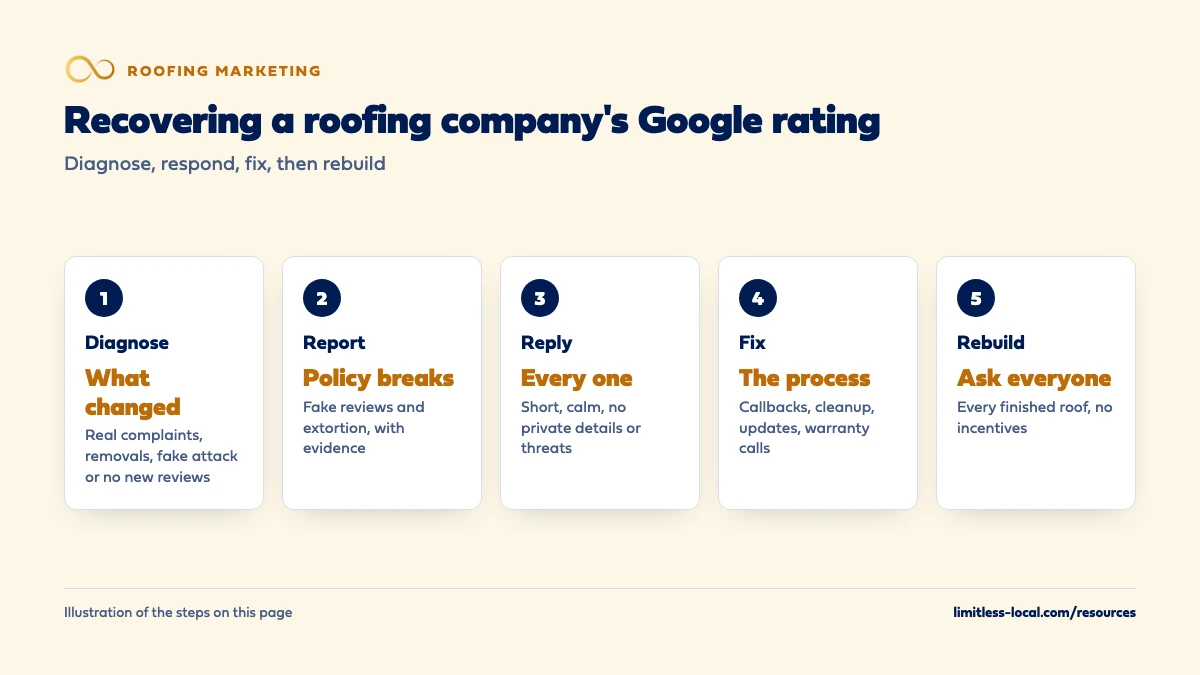
- Diagnose first: real complaints, removed reviews, fake attacks or no new reviews.
- Report reviews that break Google's rules; reply calmly to the real ones.
- Fix the process problem behind real complaints.
- Rebuild with an honest ask to every customer, no incentives.
- Recovery takes months of steady reviews, not a quick fix.
For roofing owners whose star rating has slipped, whose review count went down, or who just got hit with a run of one-star reviews.
Get a free visibility audit · Book a growth call
How does a roofing company recover after its Google rating or review count slips?
First find out why it dropped: a run of real complaints, reviews Google removed for breaking its policies, a sudden burst of fake one-star reviews, or no new reviews coming in while competitors keep collecting them. Report anything that breaks Google’s rules, reply calmly to every recent negative review, and fix the job or process problem behind the real ones. Then rebuild with a steady, honest ask after every finished roof, sent to every customer and never tied to a discount or gift, so new reviews outweigh the dip over the following months.
Reviews are part of the work in every package we run. Essentials includes review responses and basic review generation, Growth adds advanced review generation, and Scale adds automated review requests. That review work sits inside our local SEO and Google profile service for roofing companies. For the bigger search picture, read our guide to roofing SEO, or browse more roofing marketing questions.
Why did my roofing company's Google rating drop?
A rating or review count that slips almost always comes down to one of these:
- A run of real complaints. A busy season, a new crew, a sub who cut corners or a sales rep who overpromised, and several homeowners said so.
- Reviews removed by Google. Reviews that break its policies get taken down, sometimes in batches, and sometimes they were five-star reviews you were counting on.
- A fake attack. A sudden burst of one- and two-star reviews from people who were never customers.
- A profile restriction after Google decided reviews on the profile were fake or incentivized.
- No new reviews. Nothing technically dropped, but the newest review is months old and the one bad review sits at the top.
Each one has a different fix, so don’t start replying, reporting or asking for reviews until you know which you’re dealing with.
Step 1: How do I find out what changed?
Open the reviews on your Business Profile and look at the last three to six months:
- Count new reviews by month, and note the star rating of each.
- Read every negative one. Are they from real customers you recognize? Do several mention the same problem?
- Compare against your own records. If you kept screenshots or a count of reviews, see whether some are missing, and which ones.
- Check your email for any notice from Google about your profile.
- Look at timing. Did a pile of low ratings land in a few days, from accounts with no other history?
The usual reasons a review goes missing or gets delayed: reviews are checked against policy, which can delay them a few days; merged profiles can take a few days to show reviews from both; and reviews removed for policy violations won’t be restored. It also notes that reviews sometimes go missing after a profile is reinstated, and that support can help in that case.
Step 2: What if Google removed reviews or restricted my profile?
If good reviews vanished, ask how they were collected. Google’s prohibited and restricted content policy doesn’t allow reviews that were paid for directly or in kind, reviews from people with a conflict of interest such as current or former employees and family, reviews posted after an incentive like a discount, or unusual volumes or patterns of reviews that look like an effort to manipulate a rating.
When Google decides a business broke its fake engagement rules, it may go further than removing the reviews and restrict the profile: the profile may be blocked from getting new reviews for a set period, existing reviews may be unpublished for a set period, or a warning may tell customers fake reviews were removed. Google says it emails the owner before applying a restriction, and you can appeal if you think it got it wrong.
If reviews came from family, crew members or a review-for-discount offer, stop now and don’t try to replace them the same way. A fresh batch of the same kind of reviews is how a dip becomes a restriction.
Step 3: What if I'm being hit with fake one-star reviews?
A sudden pile of one- and two-star reviews from strangers, sometimes followed by a message asking for money to make them go away, is a known scam. Google’s page on negative review extortion scams says not to engage with or pay the people behind it, not to offer money or services to resolve it yourself, to gather evidence right away and to report it through Google’s merchant extortion form with screenshots of the reviews and messages.
For fake reviews without a demand, report each one from your profile. You can report any review, but only those that break Google’s policies are eligible for removal. Google doesn’t get involved in disagreements between businesses and customers, and reviewing a report typically takes several days.
While you wait, post a short, calm reply under each fake review saying you have no record of the reviewer as a customer and inviting them to call the office. Homeowners reading your profile will see you handled it like a professional. What a roofer should do about an unfair Google review covers the grey-area cases, like estimates that never became jobs.
Step 4: How should I reply to the negative reviews that are real?
Reply to every recent one, within a few days, and keep it short. Google’s tips for review replies say to stay professional and polite, never share a reviewer’s private information, acknowledge mistakes without taking responsibility for things outside your control, apologize where it fits and invite the customer to contact you by phone or email to sort out complex problems privately.
A reply that works for a roofer usually has four parts: thank them, name the problem in one line, say what you’ve done or will do about it, and give a person’s name and a way to reach them. Skip the defense of your crew and the detail about the claim or contract.
Watch what you say, too. The Federal Trade Commission’s questions and answers on its consumer reviews rule say you can respond publicly to a negative review, but you can’t make an accusation about the reviewer you know is false, and you can’t use physical threats or intimidation to get a review changed or removed. How a roofer should reply to Google reviews has example replies.
Curious what your marketing is actually booking?
Get a free visibility audit — no obligation, no sales pitch.
Step 5: How do I fix the problem behind the real complaints?
If several reviews say the same thing, the reviews aren’t the problem. The process is. Common patterns for roofers, and the usual fix:
- “Never called back” or “no-show for the estimate.” One named person owns new leads, and every inspection gets a reminder text the day before.
- “Nails in the driveway” or “mess left behind.” A cleanup checklist and a magnet sweep signed off by the crew lead before they leave.
- “Nobody told us what was happening.” A text the day before install, when the crew arrives and when it’s done.
- “Leak came back and they won’t return calls.” A fast, named path for warranty calls, with a promised response time.
- “The sales rep promised something different.” Written estimates that spell out scope, materials and timing.
Then contact the customers behind the real complaints and try to make it right, with no strings attached. Customers can still change their review after seeing your reply, but asking them to change it in exchange for a fix or a refund crosses Google’s incentive rule.
Step 6: How do I rebuild my review ask process?
A rating recovers when steady new reviews from real customers outweigh the dip. That takes a process, not a one-time push:
- Ask every customer. Google’s policy doesn’t allow businesses to discourage negative reviews or ask only the happy customers, so the ask goes to everyone.
- Make one person responsible, usually whoever sold or ran the job.
- Ask at the final walkthrough, while the homeowner is looking at the finished roof.
- Text the review link the same day, using the link or QR code from your Business Profile.
- Send one reminder a few days later, then stop.
- Ask past customers from the last year or two who were never asked.
No discounts, gift cards or entries into a drawing in exchange for a review. Getting more Google reviews after a roof replacement has the scripts and timing.
What should a roofer never do to fix a falling rating?
- Buy reviews, or pay anyone to post them.
- Ask crew members, family or friends to leave reviews.
- Offer a discount, gift or refund for a review, or for changing or removing one.
- Ask only the customers you know are happy.
- Push a big batch of review requests in a few days to bury the bad ones; unusual review patterns are exactly what Google screens for.
- Pay a stranger who contacts you demanding money to stop or remove bad reviews.
- Threaten or argue with a reviewer in public or private.
Every item on that list can make the rating worse, through removed reviews, a restricted profile or a public argument that every future customer can read.
Does a lower rating hurt my map pack ranking and leads?
It can, on both counts. Google’s help on local ranking says more reviews and positive ratings can help your business’s local ranking, so a slide in rating or count works against you in the map pack.
The bigger effect is usually on the homeowner. A roofer is a big, rare purchase, and homeowners compare ratings and read the recent reviews before they call. A lower rating means fewer calls from the same visibility, and more price shoppers among the calls you get. How review velocity affects Maps ranking for roofers goes deeper on the ranking side.
How long does it take to recover a roofing company's rating?
Longer than it took to drop, because every new review is averaged in with all the old ones. How long depends on how many roofs you finish each month, how many customers leave a review when asked, and how far the rating fell. The worked example below shows the math.
Two things speed it up: asking every single customer, and fixing the problem behind the complaints so the new reviews are strong. Two things slow it down: going back to asking only now and then, and new complaints about the same problem.
Recent reviews also matter on their own. Even before the average climbs back, a profile with fresh, specific reviews and calm replies to the bad ones reads very differently to a homeowner than one whose newest review is a complaint.
How do I keep my rating from dropping again?
Put reviews on a monthly checklist, the same way you’d check your ad spend:
- New reviews this month compared with roofs finished. If the share drops, the ask is slipping.
- Every review replied to within a few days.
- Any repeated complaint flagged and taken back to the crew or office.
- Total review count checked against last month, so you notice removals early.
A steady pace beats bursts. How many Google reviews a month a roofer should get helps set a target that fits your volume.
Not sure which of these is costing you jobs?
A free visibility audit checks the Google profile, reviews, site and tracking, and shows what to fix first.
What's different about reviews for roofing companies
Big jobs, fewer reviews. A roofer finishes far fewer jobs a month than a plumber or HVAC company, so each review moves the average more, in both directions. A few bad ones hurt fast, and recovery takes longer.
Storm seasons bring rushed complaints. When crews are stretched after a storm, callbacks slow down and cleanup suffers. Plan the review ask and the complaint follow-up for the busiest months, not just the quiet ones.
Problems show up later. A leak that appears months after install often becomes a review. A fast warranty response turns many of those into a fair review instead of an angry one.
A worked example: how long a rating takes to recover
These numbers are made up to show the math, not a benchmark for your market, and they treat the rating as a simple average. Say you had 60 reviews averaging 4.8 stars, which is 288 stars in total. Then 8 one-star reviews land in a bad month. You now have 68 reviews and 296 stars, an average of about 4.35.
To climb back to 4.7 with nothing but five-star reviews, you’d need about 79 more. If you finish 20 roofs a month and half the homeowners leave a review, that’s 10 a month, or roughly eight months of steady asking with no new complaints.
That’s why the process matters more than any quick push: the dip came in a month, and the recovery takes most of a year.
Frequently asked questions
Can I get Google to restore reviews it removed?
Not if they were removed for policy violations; Google says those won’t be restored. If reviews went missing after your profile was reinstated, contact Google Business Profile support.
Should I ask unhappy customers to update their review after I fix the problem?
You can fix the problem and let them know it’s done, and they may update the review on their own. Don’t offer anything in exchange for changing it.
Will deleting and recreating my Google profile reset the rating?
Don’t try it. You’d lose every good review and your history, and duplicate or recreated profiles bring their own problems with Google.
Do reviews on Facebook or Yelp help if my Google rating dropped?
They help homeowners who check those sites, but they don’t replace Google reviews on your Google profile. Rebuild the Google ask first.
Should I reply to old negative reviews from years ago?
Yes, if they have no reply. A short, calm reply still shows homeowners reading today how you handle problems.
Is a 4.3 rating bad for a roofer?
It depends on your market and your competitors’ ratings. Recent reviews and how you reply to complaints often matter as much to a homeowner as the number.
Key takeaways
- Find the cause first: real complaints, removed reviews, a fake attack or no new reviews.
- Report reviews that break Google’s rules and never pay anyone to remove them.
- Reply calmly to every real complaint and fix the process behind it.
- Rebuild with an honest ask to every customer, with no incentives and no bursts.
- Recovery takes months, so start the steady ask now.
Want a second set of eyes on your setup?
We'll look at how you show up locally and where calls are leaking, then send you a plain-English breakdown.
More in this section
- What should a roofer do about an unfair Google review?
- How should a roofer reply to Google reviews?
- How many new Google reviews a month should a roofer get?
- Can a roofer offer a discount in exchange for Google reviews?
- How do I get more Google reviews after a roof replacement?
Sources
- Prohibited and restricted content — Maps User Contributed Content Policy Help
- About missing or delayed reviews — Google Business Profile Help
- Business Profile restrictions for policy violations — Google Business Profile Help
- Report negative review extortion scams on your Business Profile — Google Business Profile Help
- Report inappropriate reviews on your Business Profile — Google Business Profile Help
- Tips to get more reviews — Google Business Profile Help
- Tips to improve your local ranking on Google — Google Business Profile Help
- Consumer Reviews and Testimonials Rule: Questions and Answers — Federal Trade Commission