
Where can a plumbing company advertise online?
- Which online ad channels are worth it for a plumbing company, and in what order?
- What are all the places a plumber can advertise online?
- Where do emergency plumbing customers look first?
- How do Google search ads work for a plumber?
- Where do Local Services Ads fit in now?
- Is it worth advertising a plumbing company on Bing?
- Where do Facebook, Instagram and Nextdoor fit for a plumber?
- Should a plumber advertise on Angi, Thumbtack or Yelp?
- What about YouTube, display and streaming TV ads?
- What free places should a plumber set up before paying for ads?
- In what order should a plumbing company add online ad channels?
- How do I split my budget across online channels?
- How do I know which places are worth keeping?
- What's different about advertising a plumbing company online
- A worked example: comparing three channels by cost per booked job
- Frequently asked questions
- Key takeaways
- More in this section
- Sources
The short version
- Search channels (Google ads, Local Services Ads, Bing) reach people who need a plumber right now.
- Social channels (Facebook, Instagram, Nextdoor) reach people who weren't looking yet.
- Lead marketplaces put you next to other plumbers inside their own apps.
- Add one channel at a time, and keep the ones with the lowest cost per booked job.
For plumbing owners who know they should be advertising online but aren’t sure which places exist, what each one is good for, or where to start.
Get a free visibility audit · Book a growth call
Which online ad channels are worth it for a plumbing company, and in what order?
A plumbing company can advertise online on Google search ads, Local Services Ads, Microsoft’s Bing search ads, Facebook and Instagram, Nextdoor, lead marketplaces like Angi and Thumbtack, and Google’s YouTube and display network. For emergency calls, start where people are already searching for a plumber: Google search ads and Local Services Ads, backed by a free, complete Google Business Profile. Add Facebook remarketing, Bing and Nextdoor once those are booking jobs, and judge every channel by what each booked job cost.
Choosing and running the paid side of that map is what our local ads work covers: Google Ads in every package, with Local Services Ads and Meta remarketing added in the Growth tier, all inside our plumbing marketing packages. The rest of the plumbing marketing questions library goes channel by channel.
What are all the places a plumber can advertise online?
There are more than most owners think, but they fall into three groups. The group matters more than the platform, because it tells you whether the person seeing your ad needs a plumber today.
- Search ads show up when someone types a search: Google search ads, Local Services Ads and Microsoft’s search ads on Bing. The person is already looking.
- Social and neighborhood ads show up while someone scrolls: Facebook, Instagram and Nextdoor. The person wasn’t looking, so these work best for planned jobs and for reminding people who already know you.
- Lead marketplaces like Angi, Thumbtack and Yelp sell you leads or ad placement inside their own apps. The homeowner is looking, but often on a site that shows them several plumbers.
There’s also a fourth group that isn’t advertising but behaves like it: free listings. Your Google Business Profile, a Nextdoor business page and a Bing listing cost nothing and show up in many of the same places. Every paid channel works better when those are complete.
Where do emergency plumbing customers look first?
On Google, on their phone, usually with water on the floor. Someone with a burst pipe or a backed-up sewer line isn’t scrolling Facebook hoping a plumber shows up. They search “emergency plumber near me” and call one of the first businesses they see.
That’s why Google is the first place almost every plumbing company should advertise. On one search, a homeowner can see Local Services Ads at the top, regular search ads, the map results with Google Business Profiles, and the regular website results below. Paid ads put you in the first two spots; your profile and website compete for the rest.
If you’re torn between the paid options on that page, whether to start with LSAs, Google Ads or SEO walks through which one fits your reviews, budget and how fast you need calls.
How do Google search ads work for a plumber?
You choose the searches you want to show up for, like “water heater replacement” or “sewer line repair”, write the ad and pick the page it sends people to. You typically pay when someone clicks, and you can add a call button so the click is a phone call.
Search ads give you the most control of any online channel:
- Which jobs: you can bid more on repipes and water heaters and less on small repairs.
- Which towns: you can show ads only where your trucks go.
- When: you can run ads harder at night and on weekends if someone answers then, and pull back if no one does.
- What they land on: a page about the exact job they searched for, which turns more clicks into calls.
The trade-off is work. Search ads need someone to keep adding search terms you don’t want to pay for, adjust bids and check which clicks became calls, every week.
Where do Local Services Ads fit in now?
Local Services Ads are the listings at the very top of many plumbing searches. You don’t pick keywords; you pick your job types and service area. You pay for valid leads, such as calls and messages, not clicks.
They’re also changing. Google’s page on the Local Services Ads transition says these ads are moving into the main Google Ads platform as Performance Max campaigns with pay-per-lead goals, and plumbing is named in the first phase, which began in August 2026 for select advertisers. The ads still show only on Google Search and Google Maps, you still pay per lead, and targeting is still based on service categories and areas. Your business name, address and hours now sync one way from your Google Business Profile, so your profile has to be right before your ads can be.
For a plumber, Local Services Ads tend to fit best when you have strong reviews and someone answers every call during your listed hours. Whether Local Services Ads are worth it for plumbers goes into the costs and the catches.
Is it worth advertising a plumbing company on Bing?
Often, but as a second search channel, not the first. Microsoft’s page on its search ads says they can appear on Microsoft Bing and on search partner sites such as Yahoo, AOL and DuckDuckGo. That’s a smaller audience than Google, but it’s the same kind of person: someone searching for a plumber right now.
Bing makes sense once your Google search ads are working and you know which searches and towns book jobs. Copy that structure across, then watch it separately. The only way to know whether Bing books jobs in your area is a capped test with tracking.
One setting to check: search partners. Watch partner-site traffic on its own before you let it keep spending.
Curious what your marketing is actually booking?
Get a free visibility audit — no obligation, no sales pitch.
Where do Facebook, Instagram and Nextdoor fit for a plumber?
These reach people who aren’t searching, which makes them weak for emergencies and better for two jobs:
- Reminding people who already know you. Meta’s help page on website custom audiences describes retargeting people who visited your website in the last 30 days but haven’t converted yet. For a plumber, that’s the homeowner who looked at your water heater page and didn’t call.
- Selling planned work. Water heater replacements before winter, drain maintenance plans, water softeners and whole-home repipes are jobs people think about for a while. An ad can start that thought.
Nextdoor is the neighborhood version. Its small business page offers a free Business Page, free Business Posts that show up in the neighborhood newsfeed, recommendations from customers and paid ads on top. For a local plumber, the free page and recommendations often do more than the ads, because neighbors ask each other who to call.
Facebook ads vs Google Ads for plumbers covers what Facebook can and can’t sell for a plumbing company.
Should a plumber advertise on Angi, Thumbtack or Yelp?
They’re worth knowing about, and they can fill a slow week, but treat them as a test, not a foundation. Each platform keeps the customer relationship inside its own app, sets its own rules for what you pay, and can change those rules. Expect the homeowner to be comparing you with other pros there, so speed decides who wins the job.
If you try one, set a firm budget, answer every lead within minutes, and track booked jobs from that platform separately from everything else. If the cost per booked job beats your Google channels, keep it. If it doesn’t, the profile can stay up for free while the paid part stops.
Whether Angi, Thumbtack and Nextdoor are worth it for plumbers goes platform by platform.
What about YouTube, display and streaming TV ads?
These are awareness channels. Your ad shows up while people watch videos, read websites or check email, long before most of them need a plumber. They can build name recognition, but they rarely make the phone ring on their own.
The place many plumbers run into them by accident is a standard Performance Max campaign in Google Ads. Unlike pay-per-lead campaigns, which serve only on Search and Maps, standard Performance Max can serve across YouTube, Gmail and the display network and charges per click. If your Google Ads spend is going there and you can’t see the booked jobs it produced, that’s worth a close look before you add any new channel.
What free places should a plumber set up before paying for ads?
Start with the places that cost nothing and feed every paid channel:
- Google Business Profile. Google offers a free Business Profile on Search and Maps with photos, reviews, hours, posts and quote requests. It’s where many homeowners decide between you and the next plumber, whether they clicked an ad or not.
- Bing Places and Apple Business Connect. Smaller, but free, and the same name, address and phone number should match everywhere.
- Nextdoor business page. Free, and neighbors can recommend you on it.
- A website with a page per main job. Water heaters, drains and sewer lines, leak repair, repipes. Search ads need pages to send people to.
Then put a tracking number on each one, so you can see which free listing rings the phone.
In what order should a plumbing company add online ad channels?
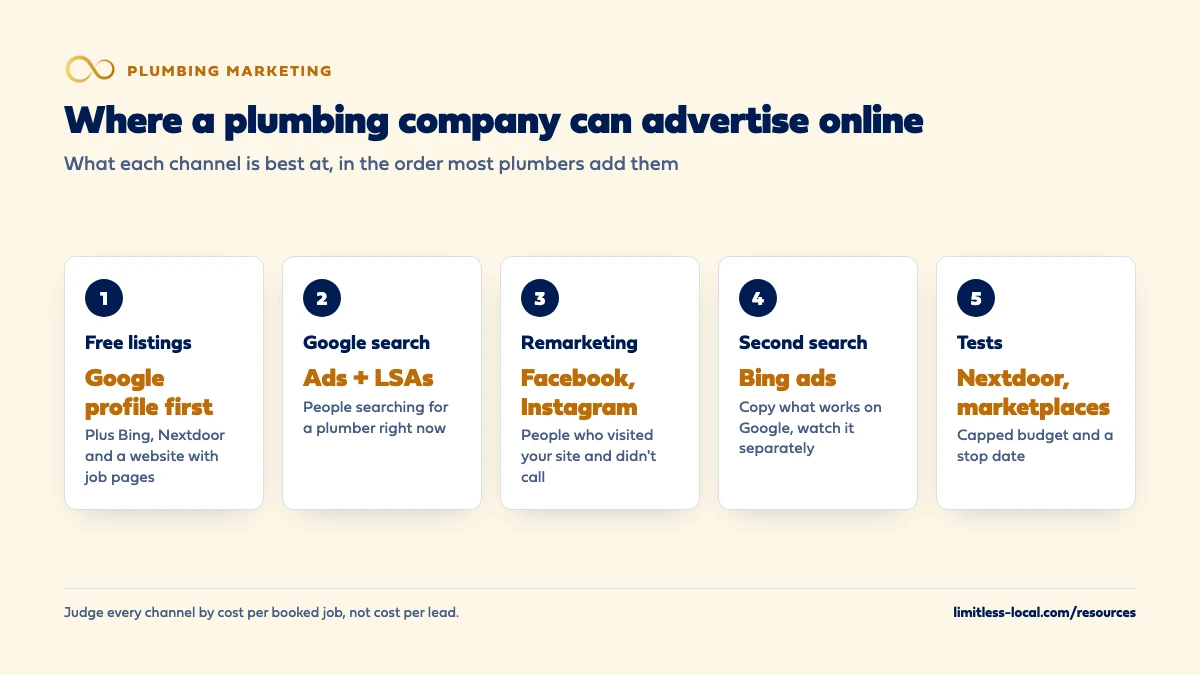
One at a time, each one proven before the next. A sensible order for most plumbing companies:
- Foundations: a complete Google Business Profile, a website with job pages, call tracking and someone answering every call, day and night.
- First search channel: Google search ads or Local Services Ads, whichever fits your reviews and budget.
- Second search channel: the other one, so you cover both the top of the page and the ad spots below it.
- Remarketing: Facebook and Instagram ads to people who visited your site, plus seasonal offers for planned work.
- Bing: a copy of what’s working on Google, watched separately.
- Tests: Nextdoor ads or a lead marketplace, with a cap and a stop date.
Skipping ahead is the common mistake: six half-run channels usually book fewer jobs than two well-run ones.
How do I split my budget across online channels?
Put most of it where people are searching, and keep the rest small enough to treat as a test. A new channel should earn more money only after it shows you a cost per booked job you’d happily pay again.
Two things shape the split for a plumber. First, your phones: if nobody answers after 6 p.m., money spent on night-time emergency ads is mostly wasted. Second, your jobs: if water heaters and repipes are where your margin is, the channels that can target those searches deserve more of the budget than the ones that bring mostly small repair calls.
How to budget money and time for each plumbing marketing channel goes deeper on the split, including how much of your own time each one takes.
How do I know which places are worth keeping?
Give every channel its own tracking number or link, mark the source on every booked job in your field service software, and once a month divide what each channel cost by the jobs it booked. Then look at the revenue behind those jobs, because a channel that books two water heater replacements can beat one that books ten clogged drains.
A channel with more calls isn’t the winner if its calls don’t book. Tracking which plumbing marketing books jobs shows how to tie a call from each channel to a job and an invoice.
Not sure which of these is costing you jobs?
A free visibility audit checks the Google profile, reviews, site and tracking, and shows what to fix first.
What's different about advertising a plumbing company online
Emergencies decide who wins. A burst pipe or a sewer backup doesn’t wait for a callback. Channels that reach people mid-search, and an office that answers in the first few rings, matter more in plumbing than in trades where the customer plans ahead.
After-hours calls are real money. A lot of plumbing emergencies happen at night and on weekends. If your ads run around the clock, your phones have to as well, or you pay for calls that go to a competitor.
Ticket sizes vary wildly. A clogged toilet and a whole-home repipe can both come from the same ad. Search ads and job pages let you aim at the big tickets; marketplaces and social ads often bring the small ones. Count both the jobs and the revenue.
A worked example: comparing three channels by cost per booked job
These numbers are made up to show the math, not a benchmark for your market. Say a plumbing company spends $3,000 in a month across three channels:
- Google search ads: $1,800, which booked 12 jobs. That’s $150 per booked job.
- Local Services Ads: $900, which booked 10 jobs. That’s $90 per booked job.
- Facebook remarketing: $300, which booked 3 jobs. That’s $100 per booked job.
Local Services Ads look like the winner. But say most of those 10 jobs were small drain and toilet calls, while the Google search ads, aimed at water heater and sewer line searches, booked two replacements. Revenue per channel can flip the ranking, which is why the job source and the invoice total belong on every job.
For comparison, our Essentials package is $3,500 a month and includes Google Ads management for up to $2,500 a month in ad spend. Growth is $4,500 a month and adds Local Services Ads management, Meta remarketing and Google Ads spend up to $5,000 a month. Ad spend is paid to Google and Meta directly, on top of either one.
Frequently asked questions
Can a plumber advertise online for free?
Yes, in a limited way. A Google Business Profile, a Nextdoor business page, Bing Places and a Facebook page are all free, and Nextdoor lets businesses post in the neighborhood feed at no cost. They show up in many of the same places ads do, but you don’t control when or where.
Do Local Services Ads still exist?
Yes. They’re moving into Google Ads as campaigns with pay-per-lead goals, but they still show at the top of Google Search and Maps and you still pay for valid leads, not clicks.
Is Instagram worth it for a plumbing company?
Mostly as part of a Facebook campaign, since both run through the same ad system. Instagram is better for showing finished work and reminding past visitors than for emergency calls.
Should I run ads on Google and Bing at the same time?
Once Google is working, yes, it’s reasonable to add Bing. Start Bing with the same searches and towns that already book jobs on Google, and track it separately.
Do I need a website to advertise a plumbing company online?
Not for every channel. Local Services Ads, Nextdoor and lead marketplaces can run without one. But Google search ads need a page to send people to, and a page about the exact job they searched for turns more of those clicks into calls.
How many online ad channels should a small plumbing company run?
Usually one or two to start, both on Google. Add another only when the first ones are booking jobs at a cost you’d happily pay again and you have time to watch a new one.
Key takeaways
- Search channels (Google ads, Local Services Ads, Bing) reach people who need a plumber now; start there.
- Local Services Ads are moving into Google Ads but still charge per lead and show only on Search and Maps.
- Use Facebook, Instagram and Nextdoor to remind past visitors and sell planned work, not for emergencies.
- Treat lead marketplaces as capped tests, not your foundation.
- Add one channel at a time, and keep the ones with the lowest cost per booked job and the best revenue behind it.
Want a second set of eyes on your setup?
We'll look at how you show up locally and where calls are leaking, then send you a plain-English breakdown.
More in this section
- How do I see what my plumbing competitors are doing online?
- How do I make my plumbing company look trustworthy online?
- How should a plumbing company market to commercial customers?
- Which plumbing services should I advertise first?
- What should a plumbing company website include?
Sources
- Local Services Ads transition to Performance Max campaigns with pay-per-lead goals — Google Ads Help
- Microsoft Search ads — Microsoft Advertising
- About website custom audiences — Meta Business Help Center
- Nextdoor Small Business Advertising — Nextdoor
- Stand out on Google with a free Business Profile — Google Business Profile