
Which SEO work produces leads first for a restoration company?
- Google profile, service pages or blog posts: which restoration SEO work brings calls soonest?
- Which SEO work tends to bring restoration calls first?
- Why does Google Business Profile work usually move first?
- What profile work should come first for a restoration company?
- Why do fixes to existing pages often beat new pages?
- Which service pages bring leads soonest?
- Where do town and city pages fit?
- Where do citations and links fit?
- Why does blog content produce leads last?
- How soon should each piece start to move calls?
- How do I see which SEO work is producing leads?
- What if I need calls before SEO starts working?
- What's different about SEO order for restoration companies
- A worked example: where SEO calls came from in one month
- Frequently asked questions
- Key takeaways
- More in this section
- Sources
The short version
- Google Business Profile work usually moves calls first.
- Fixing existing service pages often beats writing new ones.
- New service and town pages come next; water damage first.
- Blog posts support the money pages but rarely ring the phone themselves.
- Track profile calls and website calls separately so you can see which piece is working.
For restoration owners paying for SEO, or about to, who want to know which pieces should start ringing the phone first and which ones take longer.
Get a free visibility audit · Book a growth call
Google profile, service pages or blog posts: which restoration SEO work brings calls soonest?
Google Business Profile work usually produces restoration leads first, because a verified, complete profile with the right category and steady reviews shows up in Maps with a call button right there. Fixing your existing water damage, mold and fire pages comes next, then building new service and town pages, since those match the searches of people ready to hire. Blog content tends to produce leads last and least directly; it supports the service pages instead of ringing the phone. SEO as a whole typically takes 3-6 months to show meaningful organic growth, so expect an order, not a date.
That order is how our local SEO work runs: profile buildout and listing cleanup first, including name, address and phone synced across 50+ directories, then service and town pages, then ongoing content and links. See how it fits restoration companies, read the restoration marketing guide for the full channel picture, or browse more restoration marketing questions.
Which SEO work tends to bring restoration calls first?
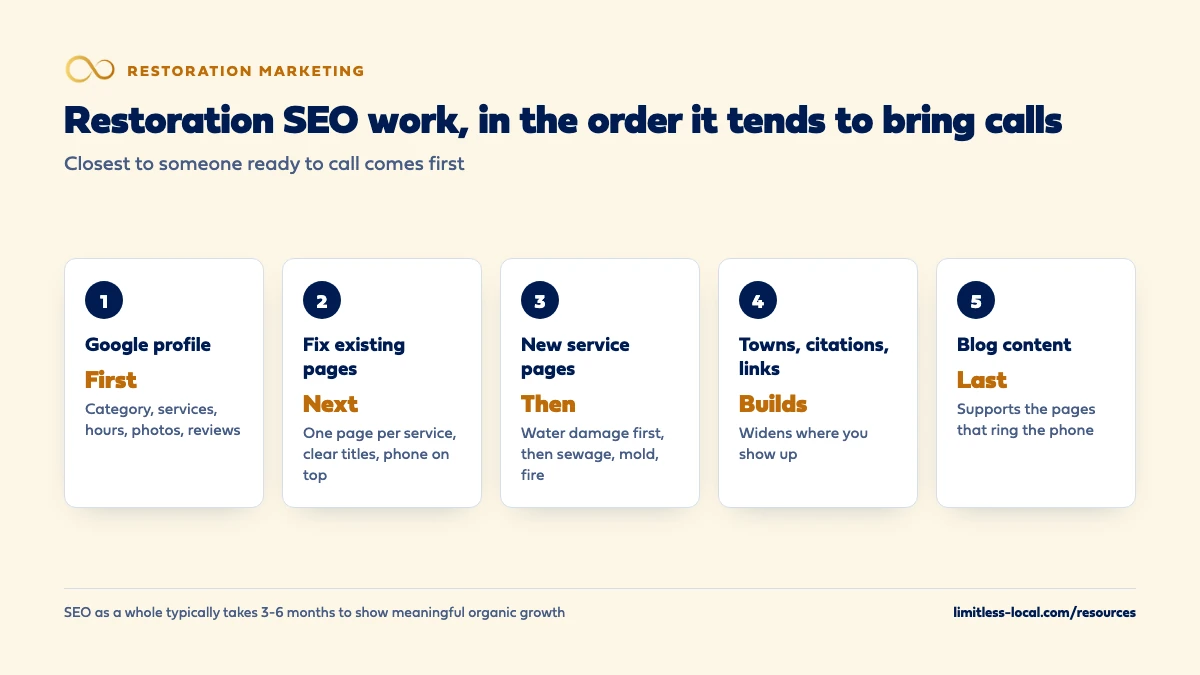
SEO is a bundle of different jobs, and they don’t pay off at the same speed. For a restoration company, the usual order looks like this:
- Google Business Profile work. Verification, the right category, services, hours, photos and reviews.
- Fixes to the pages you already have. Clear titles, one page per service, the phone number at the top.
- New service pages for the work you want most, water damage first.
- Town pages, citations and local links that widen where you show up.
- Blog content that answers questions and supports everything above.
The closer a piece of work sits to someone ready to call, the sooner it tends to produce a call. A homeowner searching “water damage restoration near me” sees Maps first and your service page second. Nobody with a flooded basement reads a blog post about drying techniques and then calls.
That doesn’t make the later steps optional. They’re what keeps you ranking once the quick wins are in, and they widen the net to more towns and more kinds of work.
Why does Google Business Profile work usually move first?
Because it puts your call button in the Maps results, which many emergency searchers see before any website. A tap on that button is a lead, no website visit needed.
Google’s local ranking tips say local results are mainly based on relevance, distance and popularity, and that businesses with complete and accurate info are more likely to show up. Verifying your profile tells Google you’re authorized to represent the business, which makes it more likely to show. Reviews and ratings feed the popularity part. All of that is work you can do right away.
The profile also connects to your website. Google builds profiles from several sources, including content crawled from your official website, so how Google sources business information is a good reason to make the website and the profile say the same things: same name, same phone, same services, same hours.
The limit is distance. You’ll tend to show up well near your address and less often at the edges of your service area. That’s where pages and paid channels pick up the slack.
What profile work should come first for a restoration company?
In rough order of how much it tends to matter:
- Verify the profile if it isn’t already, and make sure you have owner access, not just the old marketer.
- Pick the right primary category. Google’s page on business categories says the categories you select affect your local ranking, and recommends the most specific one that fits. For most restoration companies that’s the water damage category, with a few additional categories for the other work you really do.
- Add your services one by one: water extraction, sewage cleanup, mold remediation, fire and smoke damage.
- Set hours you really answer, and a phone number that rings a person.
- Add real photos: crews, trucks, drying equipment, before-and-after shots.
- Ask every finished customer for a review, and reply to every review you get.
Google may ask you to verify again after you add or edit a category, so do it once and do it right. Optimizing a restoration company’s Google Business Profile goes through each setting in detail.
Why do fixes to existing pages often beat new pages?
Pages you already have are already known to Google. Improving them is usually faster than waiting for a new page to be found and trusted.
Common fixes on restoration websites that tend to pay off early:
- One page doing five jobs. A single “Services” page that lists water, mold, fire, sewage and storm work in one paragraph each. Split it so each service has its own page.
- Vague titles. A page titled “Our Services” tells Google nothing. “Water Damage Restoration in [Your Town]” does.
- Words homeowners don’t use. Google’s SEO starter guide suggests thinking about the words people search for. Homeowners search “flooded basement cleanup” and “burst pipe”, not industry terms.
- Hidden phone numbers. Even if a page ranks, it won’t produce calls if the number isn’t a tap-to-call link near the top.
- Duplicate town pages. Ten copies of the same page with a different town name rarely help, and they use up budget better spent on real pages.
The same guide says some changes take effect in a few hours and others take several months, and suggests waiting a few weeks before judging whether a change helped.
Which service pages bring leads soonest?
Start with the work where people search with urgency and call right away. For most restoration companies that’s this order:
- Water damage restoration, plus the emergency variations: water extraction, burst pipes, flooded basements.
- Sewage cleanup. Urgent, often high value, and fewer companies have a strong page for it.
- Mold remediation. People search with less panic, compare more and call later, but the jobs can be large.
- Fire and smoke damage. Fewer searches, often slower decisions with insurance involved.
Each page should match the job: what you do, how fast you can get there, the towns you cover, real photos, how you work with insurance (without promising coverage) and a phone number at the top. What a sewage cleanup page should say to get emergency calls shows how one of those pages comes together.
If your best-paying work is something else, like commercial water losses, put that page higher. The rule is: build first for the calls you most want.
Curious what your marketing is actually booking?
Get a free visibility audit — no obligation, no sales pitch.
Where do town and city pages fit?
After your core service pages are solid. Town pages help you show up for searches like “water damage restoration [town]” in places away from your address, where Maps alone won’t reach.
They tend to work when:
- You really serve the town and can get a crew there fast.
- Each page says something specific: neighborhoods, common problems like older homes with failing supply lines, response times you can keep, jobs you’ve done there.
- The page links to your main service pages and the phone number is at the top.
They tend to fail when they’re copies with the town name swapped, or when they cover towns two hours away that you’d never drive to. Start with your biggest nearby towns and add more as the first ones bring calls.
How many service city pages a restoration website needs covers how many to build and in what order.
Where do citations and links fit?
Citations are listings of your business name, address and phone number on directories and data sites. Cleaning them up is a one-time job that helps Google trust your details are right. It rarely produces a burst of calls on its own, but messy listings with old phone numbers and old addresses can hold back everything else. Do it early, and then just keep it tidy.
Links from other websites take longer. They’re part of how well-known your business looks, and local ones matter most for a restoration company:
- Plumbers, property managers and insurance agents you work with.
- Local business groups and chambers of commerce.
- Local news or community sites, after a storm or a community project.
- Industry groups and suppliers.
Expect links to help over months, not weeks. Be wary of anyone selling hundreds of links for a flat fee; those tend to be the kind that do nothing or cause trouble.
Why does blog content produce leads last?
Because most people reading restoration blog posts aren’t ready to hire. They’re searching “how long does drywall take to dry”, “does insurance cover a burst pipe” or “is black mold dangerous”. Some are researching before a problem. Some are trying to fix it themselves. Very few call from the post.
Blog content still has jobs to do:
- It shows Google and AI tools that you know your trade, which can support your service pages over time.
- It gives you pages to link to your service pages from.
- It answers questions homeowners ask on the phone, so your team can send a link.
- A few posts, like ones about what to do in the first hour after a pipe bursts, can bring callers in the middle of an emergency.
If an SEO plan for a new restoration site starts with four blog posts a month and no service pages, the order is backwards. Get the profile and service pages right first, then write.
How soon should each piece start to move calls?
Nobody can honestly put a date on it. How fast each piece moves depends on your market, your competitors, the state of your site and profile today, and the season. What you can expect is the order:
- Profile work often shows up first in your profile’s views and calls.
- Page fixes show up next as more impressions and clicks on those pages.
- New pages, town pages and links build up over the following months.
- Blog content adds slowly in the background.
For SEO as a whole, plan on 3-6 months before meaningful organic growth, and use paid channels to carry the calls in the meantime. The early signs, like pages getting indexed and impressions rising, show up well before calls do. How to tell if restoration SEO is working before leads arrive lists what to look for month by month.
How do I see which SEO work is producing leads?
Measure the profile and the website separately, because they’re different channels:
- Profile calls. The performance report on your profile shows views, the searches people used to find you, and Calls, which counts taps on your call button. A tracking number on the profile lets you hear and log those calls too.
- Website calls and forms. Use a different tracking number on the website, swapped by source if you can, and count form fills.
- Page-level visibility. In Search Console, the Performance report shows clicks and impressions per page, so you can see whether the water damage page, the mold page or a town page is picking up.
Then mark which calls booked jobs. If the profile brings most of the calls, that’s normal early on. If the service pages are getting impressions but no calls, the pages need work on what’s above the fold and how easy calling is.
What if I need calls before SEO starts working?
Run paid channels alongside it. Local Services Ads and Google search ads can bring calls within days of launch, while SEO builds. As organic calls grow, you can lower ad spend in the towns where you rank well and keep it where you don’t.
Two things make that bridge work:
- Track paid and organic calls separately, so you can see SEO taking over.
- Send ads to the same service pages you’re building for SEO. A good water damage page helps both.
How to get restoration leads while SEO ramps up covers the bridge in more detail.
Want to see where your company stands?
A free visibility audit shows where you show up on Google, Maps and AI answers, and what it's costing you in calls.
What's different about SEO order for restoration companies
Several separate services. Water, sewage, mold and fire each need their own page, which is more page-building than many trades need before SEO can work.
Emergency searches are crowded. Ads, Local Services Ads and Maps sit above the organic results for urgent water searches, which is one more reason the profile tends to move first.
Reviews come slowly. Most customers hire a restoration company once, during a stressful week. Asking every customer, every time, matters more than in trades with repeat visits.
Distance rules Maps. Your profile works hardest near your address. Town pages and paid channels are how you reach the rest of your service area.
A worked example: where SEO calls came from in one month
These numbers are made up to show how to read the split, not a benchmark for your market. Say a restoration company tracks its organic calls separately and gets 36 in a month:
- Google profile: 22 calls, or 61%.
- Water damage service page: 9 calls.
- Town pages: 4 calls.
- Blog posts: 1 call.
That split follows the order on this page: the profile carries most of the load early, the main service page comes next, and the blog barely registers. The owner’s next move isn’t more blog posts. It’s a sewage cleanup page, two more town pages for nearby towns with steady calls, and a push for reviews to lift the profile further.
Frequently asked questions
Should a new restoration company start with SEO or ads?
Usually both: the Google profile and core service pages for the long run, and ads or Local Services Ads to bring calls while SEO builds.
Does posting on my Google profile bring calls?
Posts keep the profile active and give searchers something fresh to see, but categories, services, photos, hours and reviews tend to matter more. Treat posts as a finishing touch.
Is it worth paying for blog posts in the first few months?
Only once the profile and main service pages are done. Before that, the same money usually does more on service pages.
Can I skip the website and just rely on my Google profile?
You’ll get some calls, but Google pulls profile details from your website, and ads need a page to send people to. A small site with strong service pages is worth having.
Do mold and fire pages take longer to bring calls than water damage pages?
Often, because people searching for mold or fire work compare more and decide more slowly. Build them anyway; the jobs can be large.
What SEO work should I stop paying for?
Anything you can’t see results from after a fair stretch: bulk link packages, copy-paste town pages and blog posts that don’t link to your service pages.
Key takeaways
- Google Business Profile work usually brings restoration calls first.
- Fix and split your existing service pages before writing new content.
- Build service pages in the order of the calls you most want, water damage first.
- Town pages, citations and links widen your reach over the following months.
- Blog content comes last; it supports the pages that ring the phone.
Not sure what's working right now?
Start with a free visibility audit: rankings, Google profile, reviews and tracking, checked against your service area.
More in this section
- What can a restoration company use for leads while SEO ramps up?
- How can I tell if restoration SEO is working before leads arrive?
- Is paying for SEO worth it for a restoration company?
- Do Google Ads help a restoration company's SEO rankings?
- How should a restoration company use SEO and ads in a slow season?
Sources
- Tips to improve your local ranking on Google — Google Business Profile Help
- Understand how Google sources & uses info in Business Profiles & local search results — Google Business Profile Help
- Manage your business category — Google Business Profile Help
- SEO Starter Guide: The Basics — Google Search Central
- Understand your Business Profile performance & insights — Google Business Profile Help
- Performance report (Search results): Overview and basic setup — Search Console Help