
Will a marketing agency understand my local roofing market?
- Can an outside agency really learn my towns, my jobs and my reputation?
- What does understanding my local roofing market actually mean?
- Does an agency need to be local to understand my roofing market?
- What can an agency learn about my market before talking to me?
- What does an agency still need to learn from me?
- How will an agency understand my reputation?
- Why do storms and seasons matter so much to an agency?
- How can I test an agency's market knowledge before I sign?
- What are signs an agency doesn't understand roofing in my area?
- How long does it take an agency to really know my market?
- How do I keep an agency up to date on my market?
- What's different about local roofing markets
- A worked example: what a good market read looks like
- Frequently asked questions
- Key takeaways
- More in this section
- Sources
The short version
- No agency knows your market on day one; the good ones do homework and ask questions.
- Market means towns, jobs, competitors, storms and seasons, housing and your reputation.
- Ask for a market read before signing and judge how specific it is.
- A generic deck, national cost-per-lead numbers or ranking promises are red flags.
For roofing owners who’ve built a name in a handful of towns and worry an agency will run the same playbook it uses everywhere else.
Get a free visibility audit · Book a growth call
Can an outside agency really learn my towns, my jobs and my reputation?
A good marketing agency can understand your local roofing market, but nobody knows it on day one; it has to learn it from search and weather data and from you. That means which towns you want and can reach, the roofing jobs you make money on, who already owns the map pack in each town, your storm and seasonal swings, the age of the homes you work on, and what homeowners say about you in reviews. Test it before you sign: ask for a read on your market and judge how specific it is, and how many good questions they ask about your business.
That homework is how our work starts: a 15-minute discovery call, then about 2 to 3 hours of your team’s time during onboarding to give us what we need, with campaigns going live in the first week or two. See what’s included on the packages page and how it applies to roofers on the roofing marketing page. If you’re weighing agencies right now, how to choose a roofing SEO company covers what to check without getting burned, and the roofing marketing questions library goes question by question.
What does understanding my local roofing market actually mean?
More than knowing your city’s name. An agency that understands your market can tell you, in plain words:
- Where: the towns you want work in, the ones you’ll drive to and the ones you won’t, and which ones pay best.
- What: the jobs you make money on (full replacements, repairs, metal, flat or commercial roofs, gutters) and the ones you’d rather skip.
- Who: the homeowners you serve, the age and style of their houses, and the neighborhoods where you already have a name.
- Against whom: the roofers who own the map pack and the ads in each town, and how often storm crews from out of town show up.
- When: your busy and slow months, and what a hail or wind storm does to your phone.
- Your reputation: what your reviews say, what people say about you at the supply house, and what sets you apart.
An agency that can’t say these things back to you after onboarding is running a playbook, not a plan for your market.
Does an agency need to be local to understand my roofing market?
No. An office in your city doesn’t mean an agency knows which subdivisions are hitting re-roof age or which town’s homeowners never call off ads. And an agency two states away can learn your market well if it does the homework below and listens to you.
What matters is method. Did they search from your towns? Did they look at who ranks where? Do they know your storm season? Did they ask what you sell and what you won’t do? A local agency that skips those steps knows your market less well than a remote one that doesn’t.
One thing does help: an agency that already works with roofers knows how the trade sells: inspections, estimates, insurance-heavy storm work and long replacement decisions. That’s trade knowledge, not market knowledge, and you need both. Whether to hire a roofing-specialist agency or run marketing yourself covers the specialist question.
What can an agency learn about my market before talking to me?
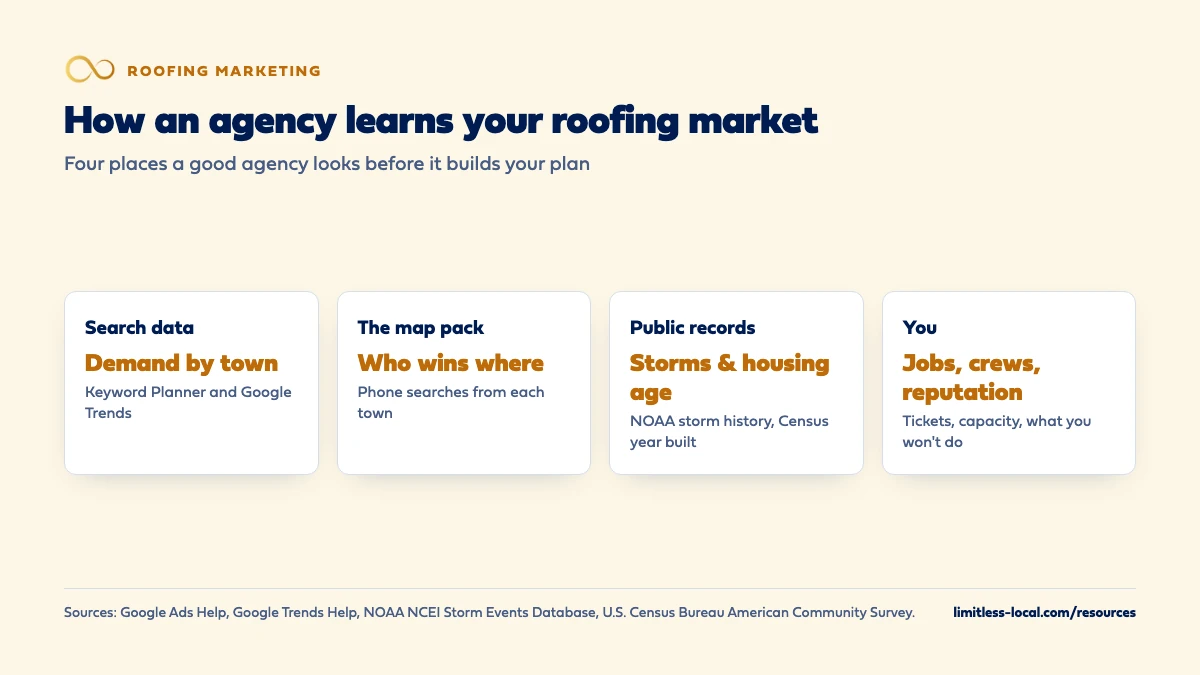
A lot, from public data and free tools:
- Search demand by town. Google’s Keyword Planner gives estimates of how many searches a keyword gets each month and the cost to target it. That shows whether “roof replacement” or “roof repair” gets searched more in each town, and what clicks might cost.
- Seasonal swings. Google Trends shows search interest over time, down to city level. Google’s FAQ about Trends data explains it’s a sample scaled from 0 to 100, so it shows when interest rises and falls, not how many people searched, and it should be treated as one data point among others.
- Storm history. NOAA’s Storm Events Database is a public record of significant weather events, searchable by state and area, with data from January 1950 to July 2026. It shows how often hail and wind have hit your counties.
- Housing age. The Census Bureau’s American Community Survey asks when each home was built and publishes housing-age statistics for the nation, states and local communities. Neighborhoods built in the same decade tend to need roofs around the same time.
- Who’s winning. Searching on a phone from each town shows who’s in the map pack and who’s running ads, along with their review counts and how recent their reviews are.
An agency that shows up to the first real conversation with some of this already done has taken your market seriously.
What does an agency still need to learn from me?
The things no tool shows:
- Your money jobs. Average ticket for a repair and a replacement, and which jobs you’d rather not take.
- Your capacity. How many crews, how many inspections your estimators can run a week, and how far out you’re booked.
- Your sales numbers. Roughly how many inspections turn into signed jobs, so the agency can work backward from the roofs you want to sell.
- Your line on insurance and storm work. Whether you chase it, take it when it comes, or avoid it.
- Your history. What you’ve tried, what worked, and what burned you, including past agencies.
- How leads get answered. Who picks up, when, and what happens after hours.
A good agency asks for this in the first few conversations. If one never asks about your crews, your tickets or your close rate, it’s planning to send leads, not to help you sign roofs.
Curious what your marketing is actually booking?
Get a free visibility audit — no obligation, no sales pitch.
How will an agency understand my reputation?
By reading what homeowners already say about you, and asking you what they don’t. That starts with your Google reviews and any other sites where you have them: what people praise, what they complain about, how recent the reviews are, and how you reply. It includes your name recognition: whether people in your home town search for your company by name, which shows up in your Google profile’s search terms.
Then the agency should ask what sets you apart and whether you can prove it: manufacturer certifications, warranties, years in town, a crew that’s been with you a decade, the way you clean up. That’s what turns generic ads and pages into ones that sound like you. How a roofing company can stand out from other roofers online covers the proof that works.
Why do storms and seasons matter so much to an agency?
Because they decide when the money should be spent. In a hail-prone market, a single storm can bring more calls in a week than a slow month. An agency that doesn’t plan for that either runs out of budget when the phone should be ringing, or keeps spending in winter as if nothing changed.
A market-aware plan answers questions like these before storm season: how much budget can go up when a storm hits, which towns you’ll serve and which you won’t, how calls will be answered when they double, and when to pull back. It also covers what Google Ads targeting can and can’t do. Google’s page on targeting geographic locations explains that by default ads can show to people in a location, regularly in it, or who’ve shown interest in it, so a storm-zone campaign needs its settings checked or it can reach homeowners outside the area.
How a roofing ad budget should change from storm season to winter goes into the numbers.
How can I test an agency's market knowledge before I sign?
Ask questions only someone who’s done the homework can answer:
- “Who’s in the map pack for roof replacement in my main town, and why?” You want names, review counts and a reason, not “we’ll look into it.”
- “Which of my towns would you start with?” A good answer weighs search demand, competition and where your crews already work.
- “What changes in storm season, and what happens in winter?” Listen for a budget and a plan, not a shrug.
- “What would you change on my Google profile and website first?” Specific gaps, not a list that fits any business.
- “How will I know which towns and jobs the leads turned into?” Tracking that ends at signed jobs, not clicks.
Then notice what they ask you. An agency that asks about your crews, your tickets and the work you turn down is building a plan. How a roofing company should choose a marketing agency covers contracts, ownership and the rest of the vetting.
What are signs an agency doesn't understand roofing in my area?
- The deck would fit a dentist. Same slides, with “roofing” typed in.
- A national cost per lead quoted as your number. Your market’s costs depend on your towns, your competition and the jobs you target.
- A promise of first-page rankings or a set number of leads. Nobody can honestly guarantee rankings, lead counts or revenue; platforms change how they work.
- A service area drawn to cover every town within two hours. More area isn’t more jobs if your crews won’t drive there.
- No questions about storm work, insurance work or seasons.
- Reports about clicks and impressions, with nothing about signed roofs.
Any one of these is worth a direct question. Several together usually mean the agency’s plan for you was written before it heard about your business.
How long does it take an agency to really know my market?
The first read comes from the homework and onboarding. The real understanding comes from your own data over the first few months: which towns call, which searches turn into inspections, which jobs sign, what a storm does to the numbers.
Paid ads produce that data fastest, often within days of launch. SEO typically takes 3 to 6 months to show meaningful organic growth, so the picture of which towns you can win in Maps and regular search fills in more slowly. An agency that’s still talking in generalities after a few months of call data isn’t learning from it. How to know if your roofing marketing agency is getting results covers what a useful monthly report shows.
How do I keep an agency up to date on my market?
Tell them what changes, as it changes:
- A new crew, a new estimator, or a crew you lost.
- A service you’re adding or dropping, like metal roofs or gutters.
- A town you want more of, or one you’re done driving to.
- A storm that just hit, or a busy spell that’s filled the schedule.
- A new roofer advertising heavily in your area.
- A price change, or a financing offer you’re adding.
A short monthly review of calls, signed jobs and what’s changed keeps the plan matched to your business. The agency brings the data; you bring what’s happening on the ground.
Want to see where your company stands?
A free visibility audit shows where you show up on Google, Maps and AI answers, and what it's costing you in calls.
What's different about local roofing markets
Housing age drives replacement demand. Subdivisions built in the same few years tend to need roofs around the same time. An agency that knows which of your towns are at that age can point replacement marketing where the work is coming due.
Storm markets and retail markets behave differently. In a hail-prone area, demand comes in waves and out-of-town crews show up after each one. In a calmer market, steady retail replacement and repair work carries the year. The plan, the budget rhythm and the message should differ.
Local trust is a big part of what you’re selling. Homeowners hiring for a roof often want someone who’ll still be around for the warranty. Years in town, local reviews and recognizable trucks are market assets an agency should use, not ignore.
Distance limits the map pack. Google’s local ranking tips say local results are mainly based on relevance, distance and popularity. An agency that understands your market knows which towns you can win in Maps from where you’re based, and which need ads or website pages instead. How competitive roofing marketing is in your city shows how to size that up.
A worked example: what a good market read looks like
This is a made-up roofer, to show the level of detail to expect, not a benchmark. A roofer works five towns around a metro area, mostly retail replacements, with storm work a few times a year. Before signing, the agency sends a one-page read:
- Town A (home base): older neighborhoods built mostly in the 1980s, the most searches for “roof replacement” of the five towns, and you’re already in the map pack. Protect it: reviews and a stronger replacement page.
- Town B: newer subdivisions, mostly built in the last decade or so. Fewer replacements due soon; repair and storm work only. Low priority.
- Town C: similar housing age to Town A, but the two roofers in the map pack have far more reviews and run ads. Ads first, while reviews build.
- Towns D and E: a long drive from your shop. Ads only, and only for replacements, since a small repair there doesn’t pay for the drive.
- Storm plan: the storm records show hail in your counties in most recent springs. Budget can rise for two weeks after a storm, with a second person answering phones.
None of this is complicated. It just can’t be written by someone who hasn’t looked.
Frequently asked questions
Should I give an agency access to my Google Business Profile before signing?
No. Before signing, a good agency can do its market read from public data and your answers. Give access after you sign, and keep ownership of the profile, ad accounts and website in your company’s name.
Can an agency work with two roofers in the same town?
Some do. Ask directly before you sign, and ask how they’d handle two clients going after the same searches and the same map pack.
Will an agency know my local building codes or permit rules?
That’s not its job. An agency needs to understand your market for marketing, not the trade itself. You’re the roofing expert; it should ask you what to say about the work.
What if I serve rural areas with few searches?
Search volume tools may show little or no data for small towns, so the agency has to lean more on you: where your jobs come from, word of mouth, and the larger town nearby where homeowners search.
Is a free market analysis from an agency worth anything?
It’s worth exactly as much as it’s specific. If it names your towns, your competitors and your gaps, it’s useful whether you hire them or not. If it could be about any roofer, it’s a sales brochure.
Do I need to explain insurance work to a marketing agency?
Tell them how much of your work is storm and insurance, and whether you want more or less of it. That changes the towns, the timing and what your ads and pages should say.
Key takeaways
- No agency knows your market on day one; judge it by its homework and its questions.
- Market knowledge covers towns, jobs, competitors, storms and seasons, housing age and reputation.
- Keyword Planner, Google Trends, NOAA storm records and Census housing data are public starting points.
- Your tickets, crews, close rate and the work you turn down only come from you.
- Test before signing with specific questions about your towns, your map pack and storm season.
- Expect the real picture to come from a few months of tracked calls and signed jobs.
Not sure what's working right now?
Start with a free visibility audit: rankings, Google profile, reviews and tracking, checked against your service area.
More in this section
- How do I know a roofing marketing agency is worth the cost?
- How should a roofing company choose a marketing agency?
- How do I know if my roofing marketing agency is getting results?
- Hire a roofing-specialist agency or run marketing myself?
- How do I tell how competitive roofing marketing is in my city?
Sources
- Use Keyword Planner — Google Ads Help
- FAQ about Google Trends data — Google Trends Help
- Storm Events Database — NOAA National Centers for Environmental Information
- Year Built and Year Moved In — U.S. Census Bureau, American Community Survey
- About targeting geographic locations — Google Ads Help
- Tips to improve your local ranking on Google — Google Business Profile Help