
How should a roofing company choose a marketing agency?

- How do I pick the right marketing agency for my roofing company before I sign?
- What should I decide before I call any roofing marketing agency?
- What should a good agency ask me on the first call?
- Which questions should I ask a roofing marketing agency?
- How do I check an agency's track record and reputation?
- Who should own my Google profile, ad account and website?
- What should an agency's audit or proposal show me?
- How do I compare the price of two roofing agencies?
- What contract terms should I read before I sign?
- Which red flags should make a roofer walk away?
- How should reporting work once I've hired someone?
- What's different when a roofing company picks an agency
- A worked example: comparing two roofing agency proposals
- Frequently asked questions
- Key takeaways
- More in this section
- Sources
The short version
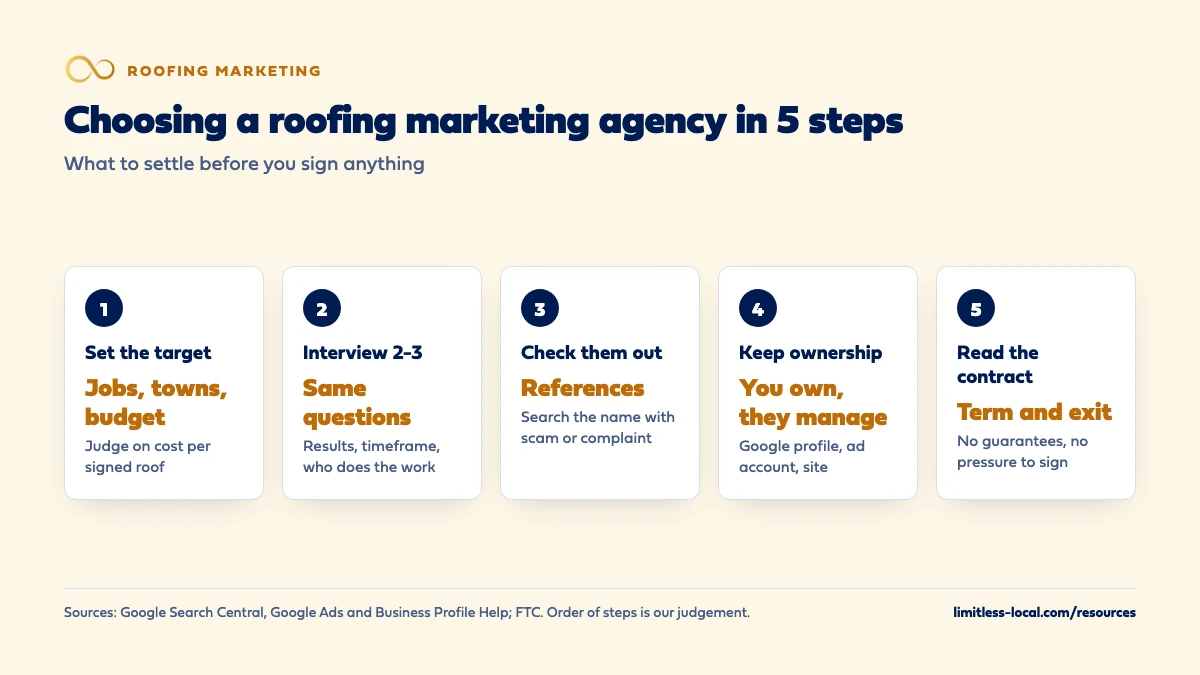
- Decide which roofing jobs, towns and monthly budget the agency will be judged on before the first call.
- Ask every agency the same questions, check references, and search its name with the words scam and complaint.
- Keep yourself as owner of the Google profile and admin of the ad account; give the agency manager-level access.
- Compare proposals on cost per signed roof, not on fee alone, and avoid anyone who promises rankings.
For roofing company owners about to hire their first agency, or replace one, who want a checklist to use before anything gets signed.
Get a free visibility audit · Book a growth call
How do I pick the right marketing agency for my roofing company before I sign?
Choose a roofing marketing agency the way you’d choose a subcontractor: decide first which roofing jobs and towns you want more of, then interview two or three agencies on how they’ll win that work, what it costs with ad spend included, and how they’ll show you which leads became signed roofs. Before you sign, get it in writing that your Google Business Profile, ad accounts, website and tracking numbers stay in your company’s name and that you can leave without losing them. Walk away from any agency that guarantees rankings or lead counts, won’t explain its work, or pushes you to sign that day.
That last comparison is the one we ask owners to make about us too. Our packages are priced on the page and run month-to-month, and the roofing marketing page shows how the work fits a roofing company. The roofing marketing guide covers each channel an agency might run for you, how to choose a roofing SEO company goes deeper on the SEO side, and more owner questions are in the roofing marketing questions library.
What should I decide before I call any roofing marketing agency?
Write down three things before the first sales call, because an agency can only be judged against a target you set:
- The jobs you want more of. Replacements, repairs, metal, commercial, storm work. Be specific, because an agency that fills your calendar with small repair calls when you wanted replacements hasn’t helped.
- The towns you’ll actually drive to. A tight list of core towns is easier to win than a whole metro.
- What you can spend each month, split in two. The agency’s fee, and the ad spend that goes to Google or Meta. Owners often compare fees and forget the second number.
Then decide what counts as a win. In our judgement, the only number that settles it is what each signed roof cost you once the fee and the ad spend are added together. Leads, clicks and rankings are steps along the way. If you haven’t settled how you’d pay, paying per lead versus a monthly retainer lays out both models.
What should a good agency ask me on the first call?
Pay attention to the questions coming at you, not just the pitch. Google’s own advice on hiring an SEO says a good one should ask what makes your business unique, who your competitors are, how search results can help and how your customers find you, and that if they aren’t interested in your business, you should find someone who is.
For a roofing company, the questions that show real interest sound like this: which jobs make you the most money, how many estimates turn into signed contracts, who answers the phone and how fast, how much of your work comes from storms, referrals and door knocking, and what software you track jobs in. An agency that skips straight to a package and a start date hasn’t learned enough about your business to know whether it can help.
Which questions should I ask a roofing marketing agency?
Ask every agency the same list so the answers can be compared. Several come straight from Google’s hiring guidance; the rest are roofing-specific:
- Can you show me examples of your previous work and share some success stories?
- What kind of results do you expect to see, and in what timeframe? How do you measure success?
- What’s your experience with roofing companies, and with my towns?
- Will you share every change you make to my site and ads, and explain why?
- Do you follow Google’s Search Essentials, and do you cite Google’s own documentation for your advice?
- Who will actually do the work each month, and who do I call when something breaks?
- What’s in the fee, what’s extra, and is ad spend billed separately?
- How will you show me which leads turned into inspections, estimates and signed roofs?
Vague answers to the last two are the ones to worry about.
How do I check an agency's track record and reputation?
Google suggests checking business references by asking past clients whether the service was useful, the agency was easy to work with and the results were positive. Ask for two or three references from home-service companies and call them yourself.
The Federal Trade Commission adds a simple check for any new company you’re about to do business with: search the company’s name online with the word “scam” or “complaint” and read what others are saying. Ask people you trust for recommendations, too; another roofer two towns over who isn’t competing with you for the same homeowners can be a good source.
Treat case studies as past results for one company. A result from another market, season or budget tells you the agency has done the work before, not what it will do for you.
Curious what your marketing is actually booking?
Get a free visibility audit — no obligation, no sales pitch.
Who should own my Google profile, ad account and website?
Your company should, from the first day. Settle this before price, because it decides what you keep if you ever part ways.
- Google Business Profile. A profile can have multiple owners but only one primary owner, and that should be you. Google’s managers have mostly the same access as owners, except they can’t add or remove users or remove the profile, so manager access is usually what an agency needs.
- Google Ads. Keep admin access in your own login. Admins are the ones who can give access, change access levels and unlink manager accounts. Google also notes that an account with only one administrator may lose access to its tags if that person becomes unavailable, so don’t let that one admin be the agency.
- Who creates the ad account. If an agency’s manager account creates a new Google Ads account, it automatically becomes the owner. If you link an account you already have, the agency doesn’t get ownership unless you turn it on, and you can always unlink a manager.
- Website, domain and tracking numbers. Registered and billed in your company’s name, with logins you hold.
The contract side of this is covered in whether a roofer should sign a 12-month marketing contract.
What should an agency's audit or proposal show me?
Many agencies open with a free audit. That’s fine, with one guardrail from Google: if an SEO offers an audit, give it read access to Search Console only at that stage, not write access. Google says an audit should give you realistic estimates of improvement and of the work involved, and that if someone promises their changes will put you in first place in search results, you should find someone else.
A useful proposal for a roofing company names the jobs and towns it will go after, lists the work month by month, separates the fee from ad spend, and says how leads will be tracked to signed roofs. It should also be honest about pace: ads can bring calls soon after launch, while search work typically takes months. What makes roofing marketing work faster or slower explains why two proposals can promise different timelines and both be honest.
How do I compare the price of two roofing agencies?
Line the proposals up on the same terms. For each one, write down the monthly fee, the ad spend it assumes, what’s included (Google profile, website pages, Google Ads, Local Services Ads, reviews, tracking, reporting), what’s extra, and how long you’re committed.
A low fee with ad spend folded in, or a scope that leaves out tracking, can look cheaper and cost more per signed roof. In our judgement, ask each agency to walk you through what a signed roof would need to cost for the plan to pay for itself in your market. The worked example below shows the math with made-up numbers.

What contract terms should I read before I sign?
Read four things in the agreement, in this order:
- Ownership. The contract should say your Google profile, ad accounts, website, domain, content and tracking numbers belong to your company.
- Term and exit. How long you’re committed, how much notice you give, and what happens if the agency doesn’t deliver what it promised.
- Scope. The work in plain words, not a list of software features.
- Fees. Setup fees, ad spend handling and any markup on spend.
A Federal Trade Commission and Better Business Bureau brochure warns that some sales agents rely on fine print and half-truths to get a signature, says not to sign documents with key terms left blank, and calls a salesperson who won’t hand over copies of all documents right then a possible sign of a scam. The same habits apply to a marketing contract. This isn’t legal advice; have anything unusual in the contract checked by your own attorney.
Which red flags should make a roofer walk away?
- Promised rankings or lead counts. Google says no one can guarantee a number-one ranking on Google, and warns about anyone claiming a “special relationship” with Google or a “priority submit”. For Maps, Google says there’s no way to request or pay for a better local ranking.
- “Buy ads and you’ll rank higher.” Google says advertising with it won’t have any effect on your site’s presence in its search results.
- Secrecy. An agency that won’t explain what it’s changing. Google points out that you are responsible for the actions of any companies you hire.
- Link schemes or submitting your site to thousands of search engines, which Google calls typically useless.
- Fake or swapped reviews. The FTC says posting fake reviews is illegal and warns about anyone claiming they can replace negative reviews or boost your scores on ratings sites.
- Pressure to pay today. The FTC lists urgency as a common scam tactic: scammers rush you into a quick decision before you look into it.
- Cold emails about your listings. Google says to be wary of agencies that email you out of the blue, and the FTC warns about fake directory listings and advertising that doesn’t exist.
How should reporting work once I've hired someone?
Agree on the report before you sign, so there’s no argument later about what it should show. At minimum: leads by source (calls, forms, Local Services Ads, Maps), which of those booked an inspection or estimate, which signed, and the total spend, so you can work out cost per signed roof yourself.
Roofs often sign weeks after the first call, so in our judgement a fair agreement looks at a rolling three months rather than a single month, and keeps door knocking, referrals and storm canvassing in their own columns so the agency is judged on the work it brought in. How to know if your roofing marketing agency is getting results goes through that review in detail.
Not sure which of these is costing you jobs?
A free visibility audit checks the Google profile, reviews, site and tracking, and shows what to fix first.
What's different when a roofing company picks an agency
Storm spikes. Demand can jump after a hail or wind event and fall away in winter. Ask each agency how it changes budgets and ads around storms and slow months, and how fast it can do that.
Long time to sign. A replacement can sign weeks after the inspection, so an agency that only reports this month’s leads will always look better or worse than it is.
Insurance-claim wording. Ads and pages that talk about insurance claims need care. Ask how the agency handles that wording, and read whether a roofing company should mention insurance claims in ads before you approve any copy.
Repair versus replacement. The two jobs pay very differently. The agency should be able to target and report them separately.
A worked example: comparing two roofing agency proposals
These numbers are made up to show the math, not a benchmark for your market and not a client result. Two agencies pitch the same roofer, and both plans assume $2,000 a month in ad spend paid to Google.
- Agency A charges a $1,800 fee, so the month costs $3,800. If it produces 4 signed roofs, each signed roof cost $3,800 divided by 4, or $950.
- Agency B charges a $3,200 fee, so the month costs $5,200. If it produces 8 signed roofs, each cost $5,200 divided by 8, or $650.
The cheaper fee was the more expensive way to sign a roof. The catch is that you can only run this math if the agency tracks leads through to signed jobs, which is why the reporting question matters as much as the price.
How we’d approach it: our Essentials package is $3,500 a month and includes Google Ads management for up to $2,500 a month in ad spend; ad spend is paid to Google or Meta directly and isn’t included in any package. The roofing result we publish is this one: a roofing client got 3x map pack visibility in its target towns; better presence and consistent info across the web increased inbound calls. That’s one company’s past result, not a forecast. We don’t guarantee rankings, lead counts or revenue. Nobody honestly can; platforms change how they work.
Frequently asked questions
Should a roofer hire an agency that only works with roofers?
Industry experience is one of the questions Google suggests asking, and it helps when an agency already understands storms, inspections and long sign times. In our judgement, how an agency tracks your leads to signed roofs matters more than whether its client list is all roofers. Hiring a roofing-specialist agency or running marketing yourself weighs the options.
How many agencies should I talk to?
Two or three is usually enough to compare answers without losing weeks to sales calls. Ask each the same questions so the answers line up.
Is it safe to give an agency access for a free audit?
Give read access only. Google’s advice is to grant read access to Search Console at the audit stage and not write access, and for your Google profile and ad account you can wait until you’ve signed.
Will advertising with Google help my roofing company rank in the free results?
No. Google says advertising with it won’t have any effect on your site’s presence in its search results, and that there’s no way to request or pay for a better local ranking on Maps.
What if an agency cold-calls or emails me about my listings?
Be careful. Google tells site owners to be wary of agencies that email out of the blue, and the FTC warns about scams selling advertising or directory listings that don’t exist.
Should the cheapest roofing agency win?
Not on fee alone. Compare total monthly cost, fee plus ad spend, against the signed roofs each plan could realistically produce, and check what’s left out of the scope.
Key takeaways
- Decide the jobs, towns and budget you’ll judge an agency on before the first sales call.
- Ask every agency the same questions, call references, and search its name with scam and complaint.
- Stay primary owner of your Google profile and admin of your ad account; agencies get manager access.
- Compare proposals on cost per signed roof, fee and ad spend together.
- Walk away from promised rankings, secrecy, fake-review offers and pressure to sign today.
Want a second set of eyes on your setup?
We'll look at how you show up locally and where calls are leaking, then send you a plain-English breakdown.
More in this section
- How do I know if my roofing marketing agency is getting results?
- How do I switch roofing marketing agencies without losing leads?
- Hire a roofing-specialist agency or run marketing myself?
- How should a roofing company market commercial roofing?
- What marketing should a roofing company add first to grow?
Sources
- Do you need an SEO? — Google Search Central
- Manage your Business Profile owners & managers — Google Business Profile Help
- About access levels in your Google Ads account — Google Ads Help
- Manager Accounts (MCC): About ownership of client accounts — Google Ads Help
- Tips to improve your local ranking on Google — Google Business Profile Help
- Scams and Your Small Business (brochure) — Federal Trade Commission and Better Business Bureau (via Texas Attorney General)