
What is a good cost per booked job for electrical marketing?

- How much should an electrician pay in marketing for each booked job?
- How do I work out the most I can pay for a booked job?
- What's the difference between cost per lead, cost per booked job and cost per sold job?
- What costs belong in my cost per booked job?
- Why can't one number work for every electrical job?
- How does my booking rate change my cost per booked job?
- Should repeat customers and referrals count toward the number?
- How do I find my real cost per booked job in Google Ads?
- Should I set a target cost in Google Ads to match my ceiling?
- How many jobs do I need before the number means anything?
- When is a cost above my ceiling still worth paying?
- What if my cost per booked job is above the ceiling?
- What's different about cost per booked job for electricians
- A worked example: two ceilings and one misleading average
- Frequently asked questions
- Key takeaways
- More in this section
- Sources
The short version
- Your ceiling = gross profit on a typical job x the share you're willing to spend to win it.
- Set a separate ceiling for each job type; a service call can't carry what a panel upgrade can.
- Count every marketing cost: ad spend, fees and tools, divided by booked jobs, not leads.
- Your booking rate moves the number as much as your ads do.
For electrical contractors who want a number to judge their marketing against, and would rather work it out from their own jobs than borrow someone else’s average.
Get a free visibility audit · Book a growth call
How much should an electrician pay in marketing for each booked job?
A good cost per booked job is one that stays under the most you can afford for that kind of job: take the gross profit on a typical job (the invoice minus labor, materials and other job costs), decide what share of it you’re willing to spend to win the job, and anything below that ceiling is good. There’s no reliable published benchmark for electricians, because the number swings with your market, the job type and how well your office books calls. Work out a separate ceiling for service calls, panel upgrades, EV chargers, generators and commercial work, then divide everything you spend on each channel by the jobs it actually booked.
Cost per booked job, with ad spend and our own fee both counted, is the number we’d judge any marketing by, including ours. Every one of our packages includes call tracking with recording, form and chat lead tracking, source tagging and a monthly report with a cost-per-lead breakdown, which is the raw material for this math. Our electrical contractor marketing page shows how that applies to electricians, and the rest of the electrical marketing questions library goes question by question.
How do I work out the most I can pay for a booked job?
Start from the job, not the ad. For each kind of work you want more of, you need three numbers from your own books:
- Average invoice for that job type over the last few months.
- Average job cost: labor, materials, permits and anything else that goes into doing the work. Leave marketing out of it.
- Gross profit per job: the first number minus the second.
Then make a decision only you can make: what share of that gross profit are you willing to hand to marketing to win the job? What you don’t spend has to cover overhead and profit, so it’s a business choice, not a formula. Gross profit per job times that share is your ceiling, the most a booked job of that type can cost you in marketing before it stops being worth winning.
A good cost per booked job is anything comfortably under the ceiling. The worked example below runs the math for two job types.
What's the difference between cost per lead, cost per booked job and cost per sold job?
They measure three different steps, and electricians need all three because so much of the work is quoted:
- Cost per lead is what you paid for each call, form or message. It’s what ad platforms report, and it tells you nothing about whether anyone hired you.
- Cost per booked job is what you paid for each lead that turned into a job on the schedule. For a service call, booked usually means paid.
- Cost per sold job matters for estimates. Booking a panel upgrade estimate isn’t the same as selling the panel upgrade, so for quoted work, divide by signed jobs, not booked visits.
For the rest of this page, “booked job” means the job you were paid for: a completed service call, or a signed quote for project work. The setup that gets you those counts by channel is covered in tracking which marketing brings in real jobs.
What costs belong in my cost per booked job?
Everything you spent to make the phone ring for that channel, and nothing you spent doing the work:
- Ad spend. What you paid Google, Meta or anyone else for clicks, calls or leads. On Local Services Ads, Google says low-quality leads may be credited back automatically after you’re charged, while the original charge still shows on your invoice, so use the net amount.
- Fees. Agency or freelancer management fees, including ours if you hire us. Leaving the fee out makes every channel look cheaper than it is.
- Tools. Call tracking, landing page software and lead-platform subscriptions tied to that channel.
Labor, trucks, materials and permits stay out, because they’re already in the job cost you subtracted to get gross profit. Counting them twice makes good marketing look bad.
Why can't one number work for every electrical job?
Because the gross profit behind each job type is so different. A small service call may leave you a modest profit, so the most you can spend to win one is small. A panel upgrade, a standby generator, an EV charger install or a commercial job can carry a much higher cost per booked job and still pay well.
That’s why a single blended number can mislead you in both directions. A channel that brings in mostly small service calls can look cheap per job and still lose money on each one, while a channel bringing in a few large upgrades can look expensive and be your best spend. Set a ceiling for each job type you market, and keep them in separate columns. If the bigger tickets are where you want to grow, getting more panel upgrade and EV charger jobs covers how to go after them on purpose.
How does my booking rate change my cost per booked job?
More than most owners expect. The same ad spend divided by more booked jobs is a lower cost per job, and nothing about the ads changed. Say $2,400 of ads brings in 40 calls (made-up numbers). Book 12 of them and each booked job cost $200. Book 18 and it’s about $133.
There’s real room here. ServiceTitan’s analysis of its own customers’ data from June 2022 put the average call booking rate across trades at 42%, and electrical at 41%. Shops with 25 or more technicians booked 59% of calls, while shops with fewer than five booked 24%, and mornings had the highest booking rates. That’s one platform’s customers in one month, not a target for your shop, but it shows how much of your cost per booked job is decided after the phone rings. How fast your office needs to answer is the place to start if your rate is low.
Curious what your marketing is actually booking?
Get a free visibility audit — no obligation, no sales pitch.
Should repeat customers and referrals count toward the number?
Not in the ceiling, in our judgement. Base the ceiling on the first job alone, because that’s the only revenue you know a new customer will bring. Jobber’s Lead Source Report takes the same view: its invoice value column shows only the first invoice tied to a lead, which Jobber says is how people usually think about a lead source.
Repeat work, maintenance agreements and referrals are real, and they’re a good reason not to cut a channel that sits just over your ceiling. Treat them as the upside, not the math that justifies the spend. If you’re building that repeat side deliberately, selling maintenance agreements to past customers covers it.
How do I find my real cost per booked job in Google Ads?
Google Ads shows a cost per conversion, but a conversion there is usually a call or a form, so it’s a cost per lead. To get to booked jobs, you have two options.
The simple one: count booked jobs by lead source in your field software and do the division yourself each month. Jobber’s lead source report shows leads with a quote, a job and an invoice for each source, and Housecall Pro’s conversion rate reporting shows lead conversion by lead source and, for its Voice users, how many estimates or jobs came from calls.
The more advanced one: send booked or sold jobs back into Google Ads. Google’s offline conversion imports let you record what happens after an ad results in a click or call, such as a signed contract, and Google now recommends enhanced conversions for leads for new setups. You can also attach a conversion value to each one, which Google says helps you measure the business value your campaigns produced instead of only the number of conversions.
Should I set a target cost in Google Ads to match my ceiling?
You can, but the target has to be per lead, not per job. Google’s Target CPA bidding lets you set the average amount you’d like to pay for a conversion, and Google Ads then tries to keep your cost per conversion at that target, with some conversions costing more and some less. If your conversions are calls and forms, convert your job ceiling into a lead ceiling first: multiply it by the share of leads that book. A $440 job ceiling with 1 in 4 leads booking means you can afford about $110 per lead.
Two cautions from Google’s own page. Setting the target too low may cause you to miss clicks that would have converted, so you can end up with fewer leads, not cheaper ones. And Google recommends judging performance over the last 30 days with at least 30 conversions, which a smaller electrical shop may not reach in a month on a single campaign.

How many jobs do I need before the number means anything?
More than one good week. A single panel upgrade or one big commercial job can swing a month’s cost per booked job a long way, so a number built on a handful of jobs is noise. In our judgement, look at a rolling quarter for project work and a month for service calls, and make big decisions only once a channel has booked enough jobs that one more or one less wouldn’t change your answer.
Timing matters too. Ads can bring calls within days of launch, while SEO typically takes three to six months to show meaningful organic growth, so judge an SEO channel’s cost per booked job on that longer timeline.
When is a cost above my ceiling still worth paying?
Sometimes, for a reason you can name. A few that hold up, in our judgement:
- A new crew to keep busy. An idle crew costs you wages either way, so a thinner margin on extra jobs can still beat no jobs, for a while.
- A new service line. Your first EV charger or generator jobs bring photos, reviews and know-how that make the next ones cheaper to win.
- A slow season. Keeping the schedule full through a slow stretch can be worth a temporarily higher cost per job.
Each of those should have an end date. A channel that sits above the ceiling month after month, with no reason you’d write down, is costing you money.
What if my cost per booked job is above the ceiling?
Find which step is broken before cutting the budget. Work back through the chain:
- Are the leads real? Lots of spam, wrong-service and out-of-area calls point to targeting.
- Are you booking them? A low booking rate is an office problem, and fixing it lowers cost per job without touching the ads.
- Are you closing the estimates? For quoted work, a low close rate makes every lead look expensive.
- Is the job mix right? A channel bringing only small service calls may need different keywords or ads, not more money.
Only once those check out is it time to cut or move the spend. Which Google Ads campaigns work best for electricians covers the targeting side, and how much an electrical contractor should spend covers setting the total budget.
Not sure which of these is costing you jobs?
A free visibility audit checks the Google profile, reviews, site and tracking, and shows what to fix first.
What's different about cost per booked job for electricians
A huge spread of job sizes. Few trades send the same truck to a small repair one day and a panel upgrade or generator install the next. That spread is why one cost-per-job number is less useful for electricians than ceilings by job type.
Estimates in the middle. Much of the work worth marketing for is quoted first. Booking the estimate is a step, not a sale, so a channel’s cost per sold job is the honest number for project work.
Commercial work runs on a longer clock. A commercial bid can take weeks to award and may come back as repeat work, so judge commercial channels over a longer period than residential service calls.
Cheaper competition on small jobs. Licensed electricians often compete with handymen on small residential jobs. In our judgement that keeps small-job ceilings low, one more reason to market the work where your license is why people hire you.
A worked example: two ceilings and one misleading average
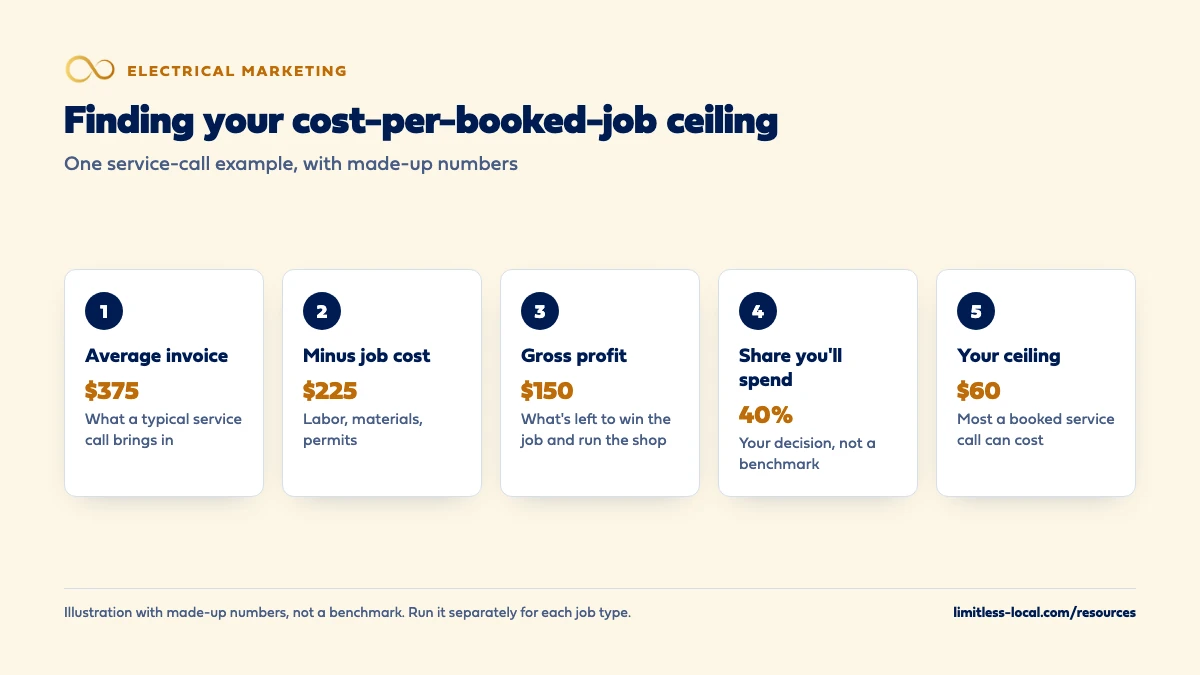
These numbers are made up to show the math, not a benchmark for your market. Say you’re willing to spend up to 40% of a job’s gross profit to win it.
- Service call. Average invoice $375, job cost $225, gross profit $150. Ceiling: 40% of $150, or $60.
- Panel upgrade. Average invoice $2,600, job cost $1,500, gross profit $1,100. Ceiling: 40% of $1,100, or $440.
Last month you spent $4,000 on marketing and booked 20 service calls and 6 panel upgrades, 26 jobs in all. The blended cost per booked job is $4,000 divided by 26, or about $154. That looks great against one ceiling and terrible against the other. Neither is the real story.
Split it out. If half the money, $2,000, went to campaigns that booked the service calls, that’s $100 per service call, above the $60 ceiling. The other $2,000 booked the 6 panel upgrades at about $333 each, under the $440 ceiling. The 20 service calls earned $3,000 in gross profit and the 6 upgrades earned $6,600, so the month as a whole made $9,600 in gross profit for $4,000 in marketing and left $5,600. The fix isn’t to cut the budget; it’s to move money from the service-call campaigns toward the upgrade work.
The same math applies when a marketing company is part of the cost. With our Essentials package at $3,500 a month, plus ad spend paid directly to Google, both belong in the total you divide by booked jobs. Running that math on your own numbers is what a free visibility audit is for.
Frequently asked questions
Is cost per booked job the same as customer acquisition cost?
Close enough for most electrical shops. Both divide marketing spend by the new business it produced; cost per booked job just counts it in jobs.
Should the ceiling be based on revenue or profit?
Profit. A job’s invoice includes the labor and materials you have to pay for, so a ceiling based on revenue lets you spend money you never actually made.
Is a lower cost per booked job always better?
No. If pushing the cost down means you book fewer jobs, or only small ones, you can end up with less gross profit in total. Compare total gross profit after marketing, not just the per-job number.
How often should I recalculate my ceilings?
Whenever your prices or job costs change, and at least once a year, since a price increase raises what you can afford to win each job.
Does a lead that books but cancels count?
Not as a booked job. Count it as a lead, and count the job only once it’s done and invoiced, or signed for quoted work, so cancellations don’t flatter the number.
Key takeaways
- Your ceiling is the gross profit on a typical job times the share you’re willing to spend to win it.
- Set separate ceilings for service calls, panel upgrades, EV chargers, generators and commercial work.
- Count ad spend, fees and tools; divide by jobs you were paid for, not leads.
- Your booking rate and close rate move cost per booked job as much as the ads do.
- A blended average can hide a channel that loses money and another that makes it.
Want a second set of eyes on your setup?
We'll look at how you show up locally and where calls are leaking, then send you a plain-English breakdown.
More in this section
- How much should an electrical contractor spend on marketing?
- How do I track which electrical marketing brings in real jobs?
- How do I know if my electrical marketing agency is getting results?
- How much should an electrician spend on Google Ads each month?
- What marketing should I pause while I'm hiring electricians?
Sources
- Data Report: Average Call Booking Rates — ServiceTitan
- About Target CPA bidding — Google Ads Help
- About conversion values — Google Ads Help
- About offline conversion imports — Google Ads Help
- Lead Source Report — Jobber Help Center
- Conversion Rate Reporting — Housecall Pro Help Center
- About Automated Local Services Ads lead credits — Google Local Services Help