
How do I attract fewer price shoppers to my HVAC company?

- How do I get fewer HVAC price shoppers when my budget is tight?
- What counts as a price shopper for an HVAC company?
- Where do price shoppers come from?
- How do negative keywords keep price shoppers away from my ads?
- How do I find the searches that are bringing in price shoppers?
- Should I narrow where my ads show to avoid bargain hunters?
- What should my HVAC ads say instead of leading with price?
- How do reviews and trust signals help me win on value?
- Should I show prices on my Google profile and website?
- How should I advertise financing without inviting trouble?
- How should my office handle price questions on the phone?
- What's different about price shoppers for HVAC companies
- A worked example: fewer leads, more revenue
- Frequently asked questions
- Key takeaways
- More in this section
- Sources
The short version
- Price shoppers mostly come from where and how you advertise.
- Use negative keywords, tight service areas and the right job types to filter them out.
- Lead with proof and what's included, not the lowest price.
- Expect fewer leads; judge by revenue per booked job, not lead count.
For HVAC owners tired of quoting jobs to callers who were only ever going to pick the cheapest number.
Get a free visibility audit · Book a growth call
How do I get fewer HVAC price shoppers when my budget is tight?
Stop advertising to them and start screening them out before they cost you a truck roll: cut “cheap”, “coupon” and DIY searches from your Google Ads with negative keywords, set your Local Services Ads job types and service areas to the work you actually want, and lead your ads with what you do better instead of the lowest price. Then give value-minded homeowners proof to choose you on, such as reviews that mention installs, a clear explanation of what your diagnostic or tune-up includes, and financing offered in compliant wording. Judge the change by revenue per booked job, not lead count, because you should expect fewer leads that are worth more.
Revenue per booked job is the number we judge HVAC marketing by, because a cheaper lead that never turns into a profitable job isn’t cheap. Google Ads management is part of our local ads work in every package, and Local Services Ads management comes in our Growth and Scale packages. See how it fits our HVAC marketing. If junk and shared leads are the bigger problem, the HVAC lead generation guide covers that, and the rest of the HVAC marketing questions library goes question by question.
What counts as a price shopper for an HVAC company?
Not everyone who asks “how much?” Almost every homeowner wants a rough idea of cost, and that’s fair. In our judgement, the price shopper you want fewer of is the caller whose only decision rule is the lowest number: they collect three quotes, ignore what’s included, book the cheapest, and often cancel your appointment the moment someone undercuts you.
It helps to write down what that looks like in your own call log before changing anything. Common patterns are coupon-only bookings that never turn into repeat work, estimates for replacements that end with “we went with someone cheaper”, and calls that open with price and hang up when they hear your diagnostic fee. Once you can name the pattern, you can find where it comes from.
Where do price shoppers come from?
Mostly from the way you ask for attention. In our judgement, three sources send the most:
- Price-first searches. Searches with words like “cheap”, “cheapest”, “coupon” or “free estimate” tell you what the person cares about before they ever see your ad.
- Price-first ads. If your headline is a dollar figure, you’re selecting for people who respond to dollar figures.
- Leads sold to several companies at once. When the same homeowner is handed to three HVAC companies, comparing prices is built into the setup. The HVAC lead generation guide covers shared leads in more depth.
The fixes below follow the same order: what you show up for, what you say, and what you prove.
How do negative keywords keep price shoppers away from my ads?
Negative keywords let you exclude search terms so your Google Ads don’t show for them. Google’s own example is an optometrist excluding “wine glasses” and “drinking glasses” so eyeglass ads don’t show for the wrong searches; for an HVAC company, the equivalent might be “cheap”, “cheapest”, “free”, “DIY”, “how to”, “jobs” and “salary”. Those are our examples, so test them against your own searches, because some homeowners who type “free estimate” still want quality.
A few rules from Google matter here. Negative keywords don’t match close variants, so you need to add synonyms and singular and plural versions yourself. A negative broad match keyword blocks your ad only when the search contains all of its words. And you can build one account-level list that applies across your search campaigns. Source: About negative keywords.
How do I find the searches that are bringing in price shoppers?
Open the search terms report in Google Ads. Google describes it as showing the actual searches that triggered your ads and how those searches performed. Read it every week or two in peak season and look for the patterns from your call log: coupon words, “cheap” variations, DIY questions, or towns you don’t want to drive to. Each one is a candidate for your negative keyword list.
Pair it with your job software. In our judgement, the useful question is not which searches got clicks, but which searches turned into booked jobs with a healthy ticket. If you can’t connect an ad click to a booked job yet, tracking whether your marketing pays off covers the setup. Source: About the search terms report.
Curious what your marketing is actually booking?
Get a free visibility audit — no obligation, no sales pitch.
Should I narrow where my ads show to avoid bargain hunters?
Narrow it to where you want to work. Google Ads lets you target countries, areas, a radius around a location, or groups of locations. Google’s recommended broad setting, “Presence or Interest”, can reach people who are in your area or who have shown interest in it; Google says to consider the “Presence” setting when you only want to reach people who are actually in the locations you target.
For Local Services Ads, Google says that if you’re getting unwanted leads, you should revisit your service areas, job types and categories, and it warns that tightening them may reduce your lead volume. It also no longer gives credits for leads about job types you don’t service or areas you don’t serve, so those settings decide what you pay for. In our judgement, an HVAC shop that would rather do replacements than five-dollar parts swaps should list the jobs it wants, in the towns it wants. Sources: Target ads to geographic locations and About Automated Local Services Ads lead credits.
What should my HVAC ads say instead of leading with price?
Say what a value-minded homeowner is actually afraid of, and answer it. In our judgement, the strongest non-price messages for HVAC are:
- Speed and availability. Same-day service or a real person answering at night, if that’s true.
- Who shows up. Licensed, background-checked, uniformed techs, if that’s true.
- How you quote. Upfront pricing before work starts, written options, no pressure.
- What’s included. A tune-up that’s a real checklist, not a quick look and an upsell.
- Proof. Your rating and review count, or a line from a real review.
You can still mention price. A clear diagnostic fee or a maintenance plan price can build trust by removing a fear. The difference is whether price is the headline or one fact among several. Run the two versions against each other and compare booked jobs and average ticket, not clicks.
How do reviews and trust signals help me win on value?
A homeowner who isn’t choosing on price needs another way to choose, and reviews are the most common one. Research from Northwestern’s Medill Spiegel Research Center found reviews move purchase decisions more for higher-priced items than cheaper ones, and that star ratings matter most for purchases that are expensive, involve safety or come from a brand the buyer doesn’t know. That research covered products sold online, but a system replacement fits that description for most homeowners.
In our judgement, the reviews that help most here mention specifics: the install crew, the cleanup, the tech who explained the options, the price matching the estimate. How much Google reviews affect calls covers the evidence, and making your HVAC company look trustworthy online covers the other proof homeowners check. Source: How Online Reviews Influence Sales.

Should I show prices on my Google profile and website?
Some, and with context. Google’s services editor lets you add details such as descriptions and prices to the services on your Business Profile, though it says to keep prices out of custom service names, and custom services that break its policy are rejected automatically. A service called “AC diagnostic” with a description of what’s included and the fee is fine; “$89 AC Diagnostic” as the name is not.
In our judgement, the prices worth showing are the ones that don’t change much job to job, such as a diagnostic or trip fee and a maintenance plan, with a plain list of what they include. Full replacement pricing is harder to post honestly, because the right system depends on the house. Explaining how you price a replacement, with options at more than one level and a written quote, usually does more than a single number. Source: Manage your services on your Business Profile.
How should I advertise financing without inviting trouble?
Financing helps value-minded homeowners say yes to the better system, but credit advertising has federal rules. Under Regulation Z’s advertising section, if a credit ad states certain terms, such as the amount of any payment, the number of payments or repayment period, the down payment, or the amount of any finance charge, it must also state other terms, including the down payment, the terms of repayment and the annual percentage rate. The rule applies even when the term can be worked out from the ad rather than stated outright.
In practice, a “low monthly payments” banner with a dollar figure on it is a credit ad with disclosure duties. Use the ad wording your financing provider approves, and keep payment examples off your trucks and social posts unless the full disclosure goes with them. That’s our practical reading, not legal advice. Source: § 1026.24 Advertising (Regulation Z).
How should my office handle price questions on the phone?
Answer them, then steer to value. In our judgement, a good call handler gives the diagnostic or trip fee straight away, explains in one sentence what it covers and that it goes toward the repair if that’s your policy, and offers a time. For replacements, the answer is that the price depends on the house and the system, that the visit is free or low cost if that’s true, and that the homeowner will get written options at more than one level.
What loses value-minded callers is dodging the question, and what attracts price shoppers is quoting a number for a job nobody has seen. Both are fixable with a short script. How your HVAC office should handle incoming calls covers the rest of the call.
Not sure which of these is costing you jobs?
A free visibility audit checks the Google profile, reviews, site and tracking, and shows what to fix first.
What's different about price shoppers for HVAC companies
Tune-up coupons are a choice, not a mistake. A low-price tune-up can fill shoulder-season schedules and start maintenance relationships. In our judgement, the question is whether those customers ever become members or replacement jobs. If your job software shows they rarely do, the coupon is buying price shoppers.
Replacements attract the most quote collectors. A system replacement is a big ticket, so homeowners compare. You won’t stop that, but you can make sure the comparison is on more than price: options at more than one level, the install crew’s track record, and reviews that mention installs. Marketing replacements differently from repairs covers the rest.
Peak season changes who calls. In the first heat wave, a homeowner with no cooling often books whoever can come today, and price matters less than speed. In mild weather, the same homeowner shops around. That’s our judgement, and it’s why ad messages that lead with availability tend to make more sense in peak season.
A worked example: fewer leads, more revenue
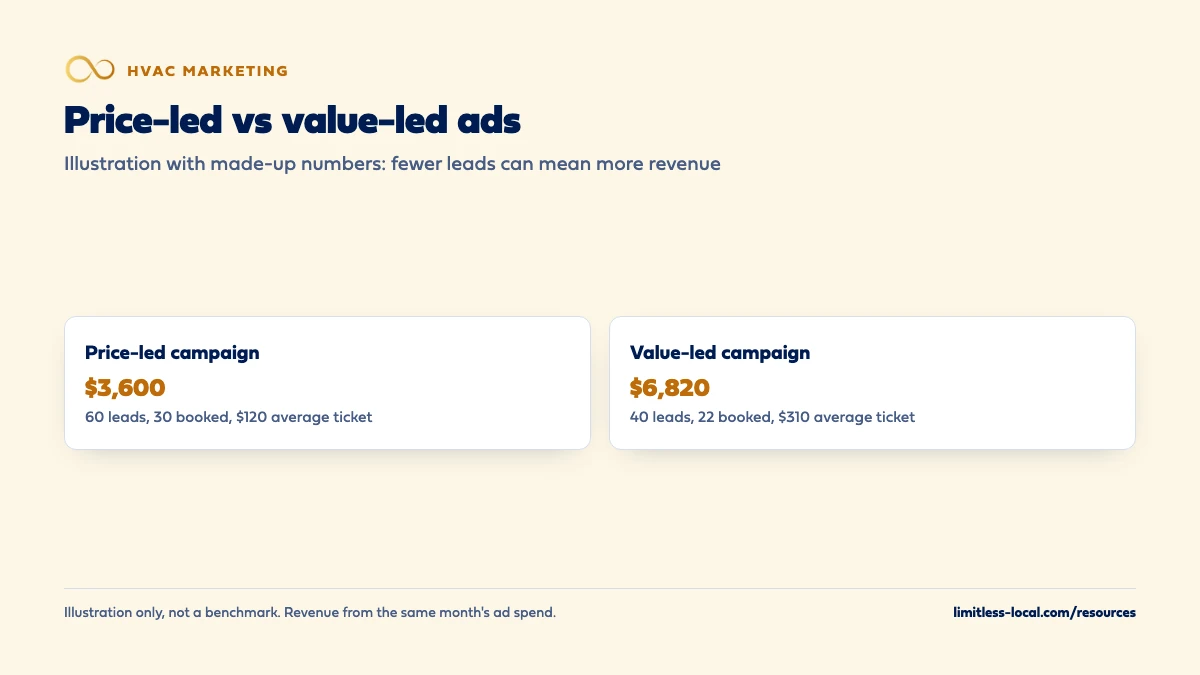
These numbers are made up to show the math, not a benchmark for your market. Say a price-led Google Ads campaign brings in 60 leads at $40 each, so $2,400 in spend. Half of them, 30, book a job, at an average ticket of $120. That’s $3,600 in revenue and a cost per booked job of $80.
Now say you add negative keywords, tighten your locations and lead with availability and reviews instead of a coupon. Leads drop to 40 and each one costs more, $50, so you spend $2,000. Fewer book, 22, but they’re bigger jobs, with an average ticket of $310. That’s $6,820 in revenue. Your cost per booked job went up to about $91, and your revenue nearly doubled.
That’s the trade: the lead count and the cost per lead both look worse, and the business looks better. If you only watch cost per lead, you’ll undo the change. Watch revenue per booked job and revenue per dollar of ad spend instead.
Frequently asked questions
Should I stop running a cheap tune-up special?
Not automatically. Check in your job software how many tune-up coupon customers later became maintenance members, repairs or replacements. If almost none did, the special is mostly buying price shoppers.
Are Local Services Ads leads more likely to be price shoppers?
It depends largely on your settings. Google says to revisit service areas, job types and categories if you’re getting unwanted leads, and it no longer credits leads for job types or areas you don’t serve. Whether the channel is worth it is covered in whether LSAs are worth it for HVAC.
Is it a bad sign when a caller asks about price first?
No. Most homeowners want a rough idea of cost. In our judgement, what matters is how your office answers: a clear fee, what it covers and an available time win the value-minded caller.
Can I just raise my prices to scare off price shoppers?
That’s a pricing decision, not a marketing one, and it only works if your ads, reviews and calls give homeowners a reason to pay more. Change the marketing first, then judge pricing on booked jobs and margins.
Will negative keywords cut my lead volume?
Usually somewhat, which is the point. Google notes negative keywords exclude search terms from your campaigns; track booked jobs and average ticket for a few weeks to confirm you cut the right ones.
Do I need a lawyer to advertise financing?
Regulation Z sets disclosure rules for credit ads that state terms such as payment amounts. Using the ad wording your financing provider approves is the practical starting point; for anything beyond that, ask a professional.
Key takeaways
- Price shoppers mostly come from price-first searches, price-first ads and shared leads.
- Use negative keywords, the search terms report, Presence targeting and tight LSA job types.
- Lead with speed, who shows up, how you quote and proof, with price as one fact among several.
- Advertise financing only in compliant wording; payment figures trigger federal disclosures.
- Expect fewer leads and judge the change by revenue per booked job.
Want a second set of eyes on your setup?
We'll look at how you show up locally and where calls are leaking, then send you a plain-English breakdown.
More in this section
- How do I get more repeat customers and referrals for my HVAC company?
- How should a commercial HVAC company market itself?
- How do I market my HVAC company in a new city where nobody knows us?
- How do I market a second HVAC location?
- What's the simplest marketing setup for a small HVAC company?
Sources
- About negative keywords — Google Ads Help
- About the search terms report — Google Ads Help
- Target ads to geographic locations — Google Ads Help
- About Automated Local Services Ads lead credits — Google Local Services Help
- Manage your services on your Business Profile — Google Business Profile Help
- How Online Reviews Influence Sales — Medill Spiegel Research Center, Northwestern University
- § 1026.24 Advertising (Regulation Z) — Consumer Financial Protection Bureau