
Does my roofing company info need to match on every listing?
- Do my roofing company's name, address and phone number have to be the same everywhere online?
- Does my roofing company's info really have to match everywhere?
- Which mismatches actually matter for a roofer?
- Should I list my LLC name, my DBA or the name on my trucks?
- How do I find every listing with the wrong info?
- In what order should a roofer fix the listings?
- What about tracking numbers on yard signs, trucks and ads?
- I run the business from home or a storage yard. Which address do I list?
- What do I do about duplicate listings?
- What if my roofing company moved or changed its name?
- How long do the fixes take to show up?
- Why does my Google profile matter even more if I run Local Services Ads?
- What's different about listings for roofing companies
- A worked example: one roofer's listing cleanup
- Frequently asked questions
- Key takeaways
- More in this section
- Sources
The short version
- Name, address or service area, and main phone should read the same on every listing.
- Dead phone numbers and wrong addresses cost the most; formatting differences matter least.
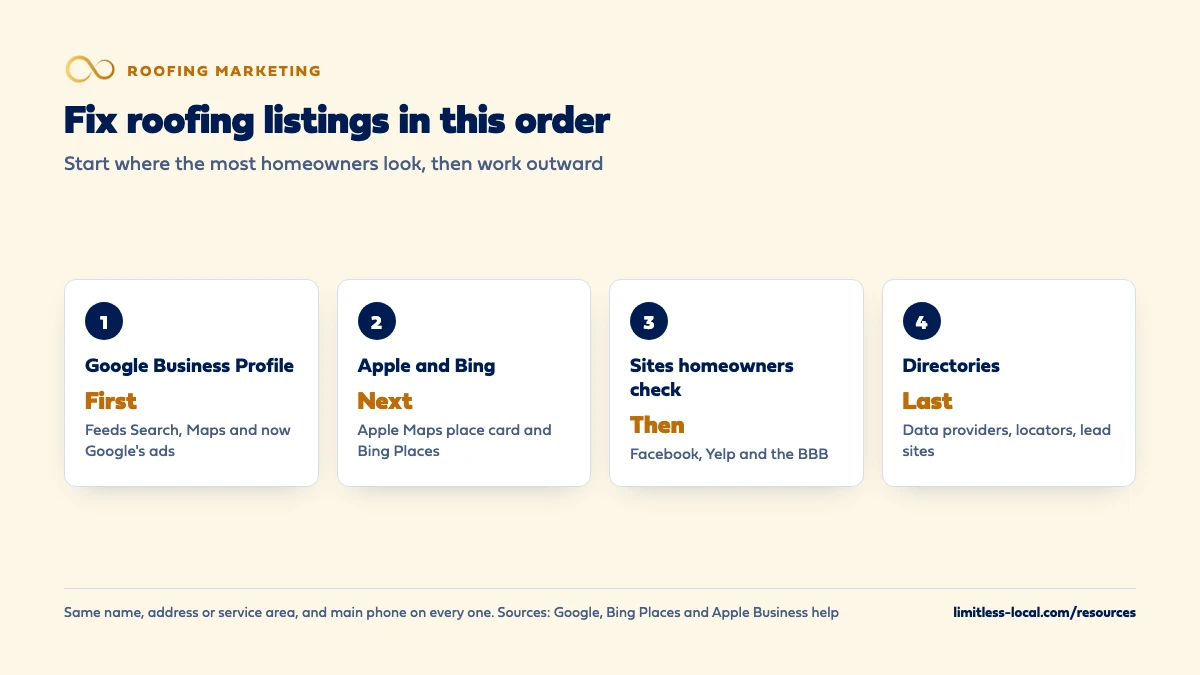
- Fix Google first, then Apple and Bing, then Facebook, Yelp and the BBB, then directories.
- Keep tracking numbers on signs and ads, and one main local number on your listings.
For roofing company owners whose name, numbers or address have changed over the years and are now scattered across the web.
Get a free visibility audit · Book a growth call
Do my roofing company's name, address and phone number have to be the same everywhere online?
Yes. Your business name, address or service area, and main phone number should read the same on your Google profile, Apple Maps, Bing, Facebook, Yelp, the BBB and every directory, because Google says accurate info helps you show up and Bing only applies changes that agree with outside data. The mismatches that cost roofers the most are old phone numbers from yard signs and past campaigns, a home or storm-market address that shouldn’t be public, and different versions of the company name. Fix Google first, then Apple and Bing, then the sites homeowners check, then the smaller directories, and expect the whole web to take weeks to months to catch up.
Clean, consistent listings are part of the foundation we set up before turning on more lead flow: business listing cleanup and buildout is part of our local SEO work for roofing companies, and we sync name, address and phone across 50+ directories. For where listings fit in the bigger plan to win more roofing jobs, see our roofing marketing guide, and the roofing marketing questions library takes the other pieces one at a time.
Does my roofing company's info really have to match everywhere?
Yes, for the parts a customer or a search engine acts on: your business name, your address or service area, and your phone number. Owners and agencies shorten that trio to NAP, and every place it appears online is called a citation.
Two platforms spell out why it matters. Google says businesses with complete and accurate info are more likely to show up in local search results, and that if your info isn’t accurate, your profile might not show up for relevant searches in your area. Source: Tips to improve your local ranking on Google. Bing goes further: it builds your listing from Bing Places and many outside data sources, and says changes to basic details are only applied if they align with trusted external data. If the rest of the web disagrees, your update may not publish, or may be overwritten. Source: Bing Places for Business help.
The plainer cost is the lost job: a homeowner with a leak who reaches a dead number calls the next roofer.
Which mismatches actually matter for a roofer?
Not all differences are equal. In our judgement, fix them in this order of damage:
- A wrong or dead phone number. The call never reaches you.
- An old or home address showing. It sends people, and map apps, to the wrong place, and a home address shown publicly breaks Google’s service-area rules.
- A different business name. An old name, a former partner’s name or a keyword-stuffed version makes it harder for platforms to tell that the listings are the same company.
- Formatting. “Street” versus “St.” or a missing suite number. Worth tidying, but far less urgent than the first four.
Write down your official version of each before you touch a single listing.
Should I list my LLC name, my DBA or the name on my trucks?
The name customers know you by. Google says your profile name should reflect your real-world name, as used consistently on your storefront, website, stationery and as known to customers. It doesn’t allow taglines, service information, phone numbers or website addresses in the name, and it only allows legal terms like LLC or Inc. if you can show real-world proof, such as signage, business cards or invoices, that consistently displays them. Adding unnecessary information can result in suspension. Source: Guidelines for representing your business on Google.
Roofing companies often carry three names at once: the LLC on the contractor registration and insurance paperwork, a trade name on the trucks, and a longer version on the website. In our judgement, the listing name should be the one on the trucks, the yard signs and the website header, written the same way everywhere. “Summit Roofing” works. “Summit Roofing & Storm Restoration | Free Inspections” is the kind of name Google’s examples rule out.
How do I find every listing with the wrong info?
Start with a search for your company name, then search each of these on its own, in quotes:
- Every phone number the business has used, including owners’ and estimators’ cell numbers from the early days, and numbers printed on old yard signs, door hangers and truck wraps.
- Every tracking number from past campaigns or from a lead service you used to buy from, since those can end up copied onto directories.
- Every past address, including your house if you started there, and any temporary address you used in a storm market.
- Every old name, including any pre-rebrand name.
Log each result in a spreadsheet: the site, what it shows, and whether you can log in. Also search Google Maps for your name; two pins for one company is a duplicate, covered below. If your profile is missing from Maps altogether, start with why a roofer is missing from Maps instead.
In what order should a roofer fix the listings?
- Google Business Profile. It feeds Search and Maps, and it now feeds Google’s ads too (more on that below). Fix the name, address or service area, phone, hours and website under Edit profile. Source: Edit your Business Profile. While you’re there, check that your categories describe the business; choosing Google categories for a roofer covers that.
- Apple Business, which controls your place card in Apple Maps.
- Bing Places for Business, which feeds Bing search and maps.
- The sites homeowners check before they call, such as Facebook, Yelp and the BBB. Whether reviews there matter is its own question, covered in roofing reviews on Facebook, Yelp and the BBB.
- Directories, data providers and roofing-specific listings, including shingle manufacturers’ contractor locators if you hold a certification, home-service lead sites you’ve used, and your local chamber or trade association.
In our experience, a handful of business-data companies feed many smaller directories, so fixing your record with them cleans up small sites over time.
Curious what your marketing is actually booking?
Get a free visibility audit — no obligation, no sales pitch.
What about tracking numbers on yard signs, trucks and ads?
Tracking numbers are worth having, because they tell you which yard sign, mailer or ad made the phone ring. The rules that matter are Google’s: the phone number on your profile must be under your direct control and connect to your business, a local number is preferred over a call center line, and numbers that redirect to someone else’s business aren’t allowed. Source: Guidelines for representing your business on Google. The profile editor allows a main number plus up to 2 more. Source: Edit your Business Profile.
In our judgement, the safe setup is: one main local number that you own, used on Google, Apple, Bing and every directory; a tracking number on the Google profile only if you own it and your main number is added as an additional number; and separate tracking numbers on yard signs, wraps and ads, where they don’t touch the citations at all.
The trap is the storm season. Numbers printed on signs and hangers can get copied onto directories. Keep every number you’ve printed forwarding to the office for as long as signs with that number might still be standing. Tracking which leads turn into signed jobs covers tying those numbers to revenue.
I run the business from home or a storage yard. Which address do I list?
Probably none, publicly. Google calls a business that goes to its customers a service-area business, and says it should hide its address. Its example is a plumber running the business from home: clear the address from the profile and list a service area instead. Source: Guidelines for representing your business on Google. You still enter the real address to verify; you turn off Show business address to customers. Source: Manage your business address.
Google’s other address rules, from the same guidelines:
- Businesses that show an address should have permanent signage with the business name there.
- A rented mailing address you don’t operate from, a virtual office, isn’t eligible, and P.O. boxes aren’t acceptable.
- The overall service area shouldn’t extend farther than about 2 hours of driving from where you’re based, though Google allows that larger areas may suit some businesses.
Bing also lets you hide your address once you add service areas. Source: Bing Places for Business help. Renting a mailbox in a storm town you’re working breaks the virtual-office rule and leaves stale listings behind when the work dries up.
What do I do about duplicate listings?
Google allows one Business Profile per business, and says a profile it considers a duplicate won’t show on Google Search or Maps. How you fix it depends on how it got there. Source: Resolve duplicate profiles & ownership issues.
- You created it by mistake, such as a second profile for gutters or one an estimator made: remove it from your account. Removing it deletes its content and managers, so be sure it’s the right one.
- It’s on Maps but nobody manages it: request a merge by reporting it on Google Maps. Merged profiles combine their reviews, though replies may be lost.
- Someone else owns it, such as a former sales manager or an old agency: request ownership. The current owner has 3 days to respond, and if they don’t, you may get the option to claim the profile.

What if my roofing company moved or changed its name?
The platforms disagree here, so follow each one’s own rule:
- Google, after a move: update the existing profile rather than creating a new one. Source: Resolve duplicate profiles & ownership issues.
- Google, after a rename: a minor change, where the proper nouns and services in the name stay the same and the category doesn’t change, can be made on the existing profile. A bigger change counts as a new business: mark the old profile closed and create a new one. Source: Guidelines for representing your business on Google.
- Bing, after a move or rename: Bing recommends the opposite of Google. It says not to update the existing listing, because that may lead to data conflicts over time; create a new listing and mark the old one closed. Source: Bing Places for Business help.
How long do the fixes take to show up?
- Google Business Profile: changes usually take about 10 minutes to show, but can take up to 30 days. Source: Manage your business address.
- Bing: changes publish after verification and the next publish cycle, typically 7 to 12 days in North America. Editing again while a change is pending resets the clock. Source: Bing Places for Business help.
- Apple Maps: Apple can edit your location name, status and hours itself when customers report a problem, and emails your account when it does, so make sure that email reaches someone. Source: Apple Business help.
Smaller directories are slower. In our experience, it takes weeks to months for most of the web to catch up, so re-run your searches monthly.
Why does my Google profile matter even more if I run Local Services Ads?
Google is moving Local Services Ads into Google Ads as Performance Max campaigns with pay-per-lead goals, and roofing is among the US home-service advertisers named in the first phase of that move, which begins in August 2026. In the new setup, your business name, address and hours sync one way from your Google Business Profile into Google Ads and can’t be edited there. Phone number and minor name changes sync within 24 hours. Significant changes to the name, storefront address or primary category trigger a verification review that typically takes 24 to 48 hours, and your campaign may pause while it happens. Source: Google Ads Help: Local Services Ads transition.
In practice: a wrong profile now means wrong ads, and a rename made in the middle of storm season can pause your lead flow at the worst time. Make big profile changes in a slow week. Google also says the phone number your ad leads ring to can be changed in Google Ads, so an ad tracking number doesn’t need to touch your profile.
Not sure which of these is costing you jobs?
A free visibility audit checks the Google profile, reviews, site and tracking, and shows what to fix first.
What's different about listings for roofing companies
Roofers print a lot of numbers. Yard signs, door hangers, truck wraps, mailers and storm-season canvassing all carry phone numbers, and many roofers use a different one for each. Every number that leaks onto a directory is one more place a homeowner can reach a dead line. Keep a list of every number you’ve printed, and keep them all forwarding.
Storm markets tempt temporary addresses. A rented mailbox in a town you’re working this season leaves listings behind when you leave. In our judgement, it’s better to serve storm towns from your real base through your service area, ads and website.
Several legal and trade names. Contractor registrations, insurance certificates and supplier accounts often carry the LLC name, while trucks carry the trade name. Pick the customer-facing name for listings and use it everywhere.
A worked example: one roofer's listing cleanup
These details are made up to show the process, not a benchmark. Say a roofing company started in the owner’s garage, moved to a small shop and storage yard, renamed from “Summit Roofing” to “Summit Roofing & Exteriors”, and ran a different phone number on yard signs each of the last three storm seasons. A search turns up the business on 32 sites: 11 still show the garage address, a few show old sign numbers, and Google Maps has two pins.
- Week one: on Google, hide the address, set the service area by town, update the name as a minor change and report the second pin for a merge. Update Apple, then Bing, following Bing’s own rule for the rename. Confirm every old sign number still forwards to the office.
- Weeks two and three: work down the spreadsheet: Facebook, Yelp, the BBB, the business-data providers and the shingle manufacturer’s contractor locator.
- Each month after: re-run the searches for the garage address and each old number, and mark what changed.
None of this promises a ranking. What it removes is the chance that a homeowner calls a number nobody answers. One of our own past results, for one client: a roofing client got 3x map pack visibility in its target towns; better presence and consistent info across the web increased inbound calls. That’s a past result, not a forecast for your company. Business listing cleanup and buildout is part of our Essentials package at $3,500 a month.
Frequently asked questions
Does "St." versus "Street" really matter?
In our judgement, very little next to a wrong phone number or an old address. Pick one format and use it on new listings, but spend your time on the errors that send a homeowner to the wrong place.
What is a citation for a roofing company?
Any place your company name, address and phone appear together online, such as a directory, a review site or a chamber listing. Links from local websites are a related but different thing, covered in getting links from local websites.
Can I list my cell phone as the main number?
Google requires a number under your direct control that connects to your business and prefers a local number, so a cell can work. In our view, a business line you’ll keep even if staff change is safer.
Do my profiles on lead sites need to match too?
Yes, wherever they show your name and phone publicly, they’re citations like any other. If you’ve stopped using a lead service, check what number its profile still shows.
Do I need to fix listings before running ads?
Fix your Google profile first, at least. With Local Services Ads moving into Google Ads, the profile’s name, address and hours sync into the ads and can’t be edited there.
Key takeaways
- Your name, address or service area, and main phone should read the same on every listing.
- Old phone numbers and wrong addresses cost roofers the most; fix those before formatting.
- Fix Google first, then Apple and Bing, then Facebook, Yelp and the BBB, then directories.
- Hide a home or yard address on Google and Bing, and don’t list storm-market addresses you don’t operate from.
- Follow each platform’s own rule after a move or rename; Google and Bing disagree.
- Make big profile changes in a slow week, since they can pause Google’s lead ads during review.
Want a second set of eyes on your setup?
We'll look at how you show up locally and where calls are leaking, then send you a plain-English breakdown.
More in this section
- How can my roofing company stand out from other roofers online?
- How does a roofing company get links from local websites?
- Does a roofing company need a CRM to follow up on leads?
- Can a roofing company mention insurance claims in its ads?
- Why isn't my roofing company showing up on Google Maps?
Sources
- Guidelines for representing your business on Google — Google Business Profile Help
- Tips to improve your local ranking on Google — Google Business Profile Help
- Edit your Business Profile — Google Business Profile Help
- Manage your business address — Google Business Profile Help
- Resolve duplicate profiles & ownership issues — Google Business Profile Help
- Local Services Ads transition to Performance Max campaigns with pay-per-lead goals — Google Ads Help
- Bing Places for Business: Manage your listing — Microsoft Bing
- Maintain location information accuracy with Apple Business — Apple Support