
Do Facebook ads work for getting roofing leads?
- Can a roofing company get real jobs from Facebook and Instagram ads?
- How are Facebook ads different from Google ads for a roofer?
- What are roofing leads from Facebook actually like?
- What is Facebook remarketing, and why does it suit roofers?
- Do cold Facebook ads to homeowners who've never heard of me work?
- Should a roofer use Facebook lead forms or send people to the website?
- Which roofing offers work best on Facebook?
- Do roofing ads on Facebook fall under a Special Ad Category?
- How fast do I need to call a Facebook roofing lead?
- How long should I run Facebook ads before deciding if they work?
- How do I know if Facebook ads are actually signing roofs?
- What's different about Facebook ads for roofing companies
- A worked example: one month of Facebook lead forms
- Frequently asked questions
- Key takeaways
- More in this section
- Sources
The short version
- Facebook and Instagram ads reach people by audience, not by search, so expect earlier, less urgent roofing leads.
- Remarketing to your own website visitors is usually the strongest place to start.
- Use a higher intent form with qualifying questions, and call every lead within minutes.
- Count signed roofs, not form fills; the cheapest leads are often the ones that never pick up.
For roofing owners deciding whether Facebook and Instagram ads are worth testing, and how to tell real roofing leads from form-fillers before they cost a sales visit.
Get a free visibility audit · Book a growth call
Can a roofing company get real jobs from Facebook and Instagram ads?
Facebook ads can produce roofing leads, but they work differently from Google: they show to people in an audience you choose, most of whom weren’t looking for a roofer that day, so the leads tend to be earlier and less ready than someone who searched “roof replacement”. They work best for roofers as remarketing to people who already visited your site, and for planned replacement offers in the towns you serve, with a lead form that asks qualifying questions. Judge them by cost per signed job, not cost per lead, because cheap form leads that never answer the phone aren’t cheap.
We run local ads for roofers with Google search first and Meta (Facebook and Instagram) remarketing on top in our Growth and Scale packages; the roofing marketing page shows how they fit together. The guide to getting roofing leads covers the full list of lead sources; this page covers only Facebook. More owner questions are answered in the roofing marketing questions library.
How are Facebook ads different from Google ads for a roofer?
The difference is who sees the ad and why. A Google search ad shows because someone typed something like “roof leak repair near me”. A Facebook or Instagram ad shows because the person fits an audience you defined. Meta says that each time there’s a chance to show someone an ad, an auction decides which ad they see, and the ads competing are the ones whose target audience includes that person.
So on Facebook you’re interrupting homeowners, not answering them. Most of the people in a “homeowners in these towns” audience don’t need a roofer this month. That’s why, in our view, Facebook is a weak first channel for urgent leak calls and a better one for planned replacements, for reminding people who already looked at you, and for staying visible between storms. If you’re still deciding where your first dollars go, Google search usually comes first for roofers, and splitting budget between Google Ads and LSAs covers that choice.
What are roofing leads from Facebook actually like?
Expect a mix. Some are homeowners who’ve been meaning to deal with an old roof and finally have a reason to. Many are curious, early or just tapping through. Meta’s lead forms can prefill a person’s name, email and phone number if they’ve already given that information to Meta, which makes a form fast to submit. Fast to submit also means easy to submit without much thought, which is our reading of why form leads vary so much in quality.
The practical result: a roofer running Facebook lead forms should expect more leads that don’t answer, don’t remember filling out the form, or aren’t ready for an inspection. That isn’t a reason to skip Facebook. It’s a reason to qualify harder and call faster than you would with a Google call lead.
What is Facebook remarketing, and why does it suit roofers?
Remarketing shows ads to people who already showed interest in your business. Meta calls these website custom audiences: with the Meta Pixel on your site, you can show ads to people who visited, and Meta’s own example is retargeting people who visited in the last 30 days but haven’t converted.
For a roofer, that fits the way homeowners buy. A roof is expensive and infrequent, and many homeowners visit a few roofers’ sites, get an inspection or two, and then stall. Remarketing keeps your name, your reviews and your warranty in front of them while they decide. In our view it’s the part of Facebook most roofers get the most from, and it’s what our Growth and Scale packages include on the Meta side. Pair it with a real follow-up process; following up on unsigned estimates covers the sales side.
Do cold Facebook ads to homeowners who've never heard of me work?
They can, but they’re the hardest version to make pay. A cold audience is everyone in your towns who fits your settings, and most of them don’t need a roof. Meta’s auction weighs your bid, how likely a person is to act on the ad, and the ad’s quality, so a plain, relevant ad can beat a bigger bid. Meta also says ad quality is judged partly on low-quality attributes such as withholding information, sensationalized language and engagement bait.
For roofers, that rules out the “Is YOUR roof hiding storm damage?!” style of ad as a long-term plan. In our judgement, cold ads work best when they’re specific: a planned replacement offer for one or two towns, real photos of roofs you’ve done there, and a clear next step. Run them as a test with a fixed budget, not as your main lead source.
Curious what your marketing is actually booking?
Get a free visibility audit — no obligation, no sales pitch.
Should a roofer use Facebook lead forms or send people to the website?
Both can work, and Meta lets you choose. Lead ads with instant forms keep people on Facebook or Instagram, which makes submitting easy. Sending people to your website is slower but puts your reviews, photos and warranty in front of them first.
If you use instant forms, set them up to filter:
- Choose the higher intent form type. Meta says it adds a line telling people your business may follow up and an extra screen to review their information, to cut down on people who are only marginally interested. The default is the more volume type.
- Ask custom questions: the work needed (leak, repair, full replacement), the age of the roof, whether they own the home, and when they want it done.
- Use conditional logic so a renter or a “just curious” answer goes down a different path.
- Consider phone number verification, which Meta says has people confirm their mobile number with a one-time code before submitting.
Expect fewer leads from a stricter form. That’s the point.
Which roofing offers work best on Facebook?
In our judgement, planned work beats emergencies on Facebook, because the ad reaches people who aren’t in a hurry. Offers that suit the channel:
- Replacement inspections for homes with older roofs, framed around what the homeowner gets: a photo report and a written estimate.
- Seasonal pushes before your slow months, which marketing in the slow season covers in more depth.
- Neighborhood jobs: real photos of a roof you just finished, shown to the surrounding area.
- Specialties like metal roofing, where a picture does most of the selling.
Be careful with storm and insurance-claim offers. Promising a free roof through insurance, or implying you’ll handle the claim, can create legal and trust problems; mentioning insurance claims in ads covers what to watch for.
Do roofing ads on Facebook fall under a Special Ad Category?
Meta requires advertisers to declare a Special Ad Category for ads about housing, employment, social issues and politics, and financial products and services, and says ads may be rejected if the right category isn’t chosen. Meta’s list of what counts as a housing ad includes housing listings, homeowners insurance, mortgage and financing options, and home equity or appraisal services. Roofing services aren’t on that list, though Meta says its examples aren’t comprehensive and don’t constitute legal advice.
Financing is the part to check. If an ad promotes financing for a roof, look at whether it falls under the financial products and services category before it runs. That’s a question to check against Meta’s policy, not something we can rule on for you, and nothing here is legal advice. Meta says these categories limit targeting: no ZIP code targeting, no excluded locations, age options generally fixed to 18 through 65+, all genders included, and city or pin-drop locations expanded to a 15-mile radius in the US.
How fast do I need to call a Facebook roofing lead?
Faster than a Google lead, in our view, because the homeowner’s interest is thinner. Someone who searched for a roofer is waiting for your call. Someone who tapped a form between videos may have forgotten about it within the hour. Call within minutes during business hours, text if they don’t answer, and have the form’s answers in front of you so the call starts with their roof, not with “what can I help you with?”
That means the leads have to reach your office instantly. Meta says you can connect a CRM system so new leads arrive in one place, or download them from Ads Manager if you don’t have a CRM. Downloading a spreadsheet once a day is too slow for these leads. How fast to call back a new lead covers the speed side.
How long should I run Facebook ads before deciding if they work?
Ads can bring in leads within days of launch, Facebook included. But roofing leads take time to turn into signed jobs: an inspection, an estimate, often a second visit, sometimes an insurance adjuster. In our judgement, a fair test runs long enough for the leads from it to reach a yes or a no, which for most roofers means judging the first month’s leads a month or two after they came in, not on the day they arrived.
Set the budget and the test period before you start, so you’re not deciding on gut feel after a slow week.
How do I know if Facebook ads are actually signing roofs?
Tag every Facebook lead by source in your CRM, then follow it all the way through: contacted, inspection booked, estimate sent, signed, and the contract value. Without that, Facebook will look either great (lots of cheap leads) or useless (nobody answers), and neither tells you what it’s worth.
The number that matters is cost per signed job: what you spent on Facebook divided by the roofs it signed. Compare that with the same number for Google and your other sources. Tracking which leads turn into signed jobs shows how to set that up.
Not sure which of these is costing you jobs?
A free visibility audit checks the Google profile, reviews, site and tracking, and shows what to fix first.
What's different about Facebook ads for roofing companies
Roofs are visual. A finished roof photographs well, and a before-and-after from a street the homeowner recognizes can say more than any headline. That makes Facebook and Instagram better suited to roofing than to trades whose work is hidden in a wall or a crawl space. That’s our judgement, not a Meta statement.
Storms change demand overnight. After hail or high wind, interest in a town can jump. Facebook lets you put real photos and a clear offer in front of homeowners in specific towns quickly, but storm ads are where insurance-claim promises and pressure tactics creep in. Keep the offer to an inspection and a written estimate.
Big tickets, long decisions. A replacement is a large purchase, often with financing or an insurance claim in the middle. Facebook leads tend to arrive early in that decision, so the sale depends on follow-up more than on the first call.
Ownership matters. Renters can’t sign for a new roof. A qualifying question on the form saves a sales visit.
A worked example: one month of Facebook lead forms
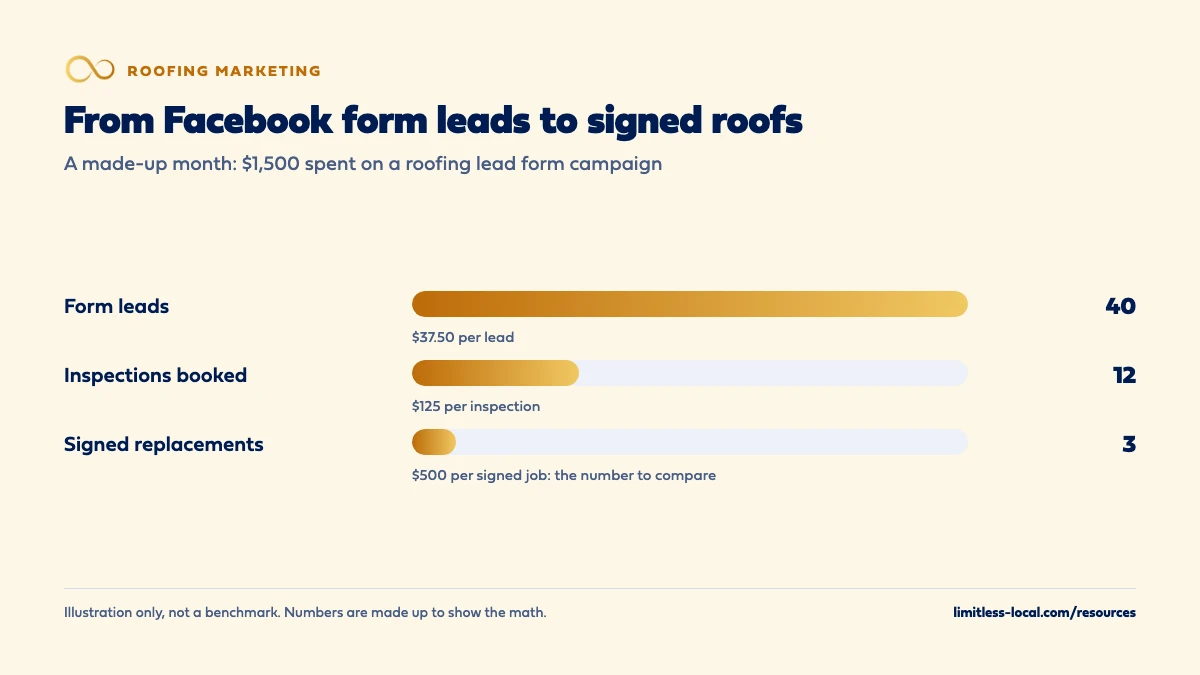
These numbers are made up to show the math, not a benchmark and not a client result. A roofer spends $1,500 in a month on a Facebook lead form campaign offering replacement inspections in three towns. The form uses the higher intent type with questions about the roof’s age and home ownership.
- Form leads: 40, so $1,500 / 40 = $37.50 per lead.
- Inspections booked: 12, after calling every lead within minutes, so $1,500 / 12 = $125 per inspection.
- Signed replacements: 3, judged after the leads had time to close, so $1,500 / 3 = $500 per signed job.
The $37.50 lead looks cheap, and most of those 40 leads never became inspections. The number to compare against Google, LSAs and referrals is the $500 per signed job, measured against what a replacement is worth to this roofer. If the same campaign had used the default form and produced more leads but the same 3 signed jobs, the cost per signed job wouldn’t change, but the office would have spent more hours calling people who were never going to buy.
How we’d handle it: our Growth package ($4,500 a month) includes Google Ads management up to $5,000 a month in ad spend, Local Services Ads management and Meta remarketing; our Essentials package ($3,500 a month) covers Google Ads only, with no Meta. Ad spend is paid directly to Google or Meta. Every package includes reporting with call tracking and source tagging, so Facebook leads can be followed through to signed jobs. We don’t promise a lead count or a cost per job; nobody honestly can. A free visibility audit shows whether your site and follow-up are ready before you add a channel.
Frequently asked questions
Do Instagram ads work differently from Facebook ads for roofers?
They’re bought in the same place, Meta Ads Manager, and lead forms can run on both. Meta says higher intent forms show only in the Facebook and Instagram feeds on mobile, not on desktop.
Should a roofer run Facebook ads right after a hailstorm?
It can make sense to show real photos and an inspection offer in the towns that were hit, in our view. Keep the offer to an inspection and a written estimate, and avoid promises about what insurance will pay.
Can I target Facebook ads to specific ZIP codes for roofing?
It depends on the campaign. Meta lists ZIP code targeting among the options that aren’t available in Special Ad Category campaigns, such as financial products and services, and says city locations in those campaigns expand to a 15-mile radius in the US.
Should a roofer run Facebook ads before Google Ads?
Usually not. In our view, Google search and Local Services Ads catch homeowners who are already looking, so they come first; Facebook works best layered on top, starting with remarketing.
Why do so many Facebook roofing leads never answer the phone?
Instant forms can prefill contact details, which makes them quick to submit with little thought. A higher intent form, qualifying questions and calling within minutes all help.
Do I need a CRM to run Facebook lead ads?
Meta says a CRM integration isn’t required; you can download leads from Ads Manager. But for speed, we’d connect one so leads reach your office the moment they come in.
Key takeaways
- Facebook reaches homeowners by audience, not search, so its roofing leads are earlier and less urgent than Google’s.
- Remarketing to people who already visited your site is the strongest place for most roofers to start.
- Use the higher intent form, ask qualifying questions, and call every lead within minutes.
- Check whether financing ads fall under Meta’s financial products and services category before they run.
- Judge Facebook by cost per signed job after the leads have had time to close, not by cost per lead.
Want a second set of eyes on your setup?
We'll look at how you show up locally and where calls are leaking, then send you a plain-English breakdown.
More in this section
- How do I get commercial roofing leads with Google Ads?
- Are Google Local Services Ads worth it for a roofing company?
- Why are my roofing ads getting clicks but no calls?
- Can a roofing company use a Facebook page instead of a website?
- Is door knocking or online marketing better for a roofing company?
Sources
- About ad auctions — Meta Business Help Center
- About website custom audiences — Meta Business Help Center
- About lead ads with instant form — Meta Business Help Center
- About instant form types — Meta Business Help Center
- About CRM system integrations for lead ads — Meta Business Help Center
- How to choose a Special Ad Category — Meta Business Help Center
- About ads for housing — Meta Business Help Center
- About audiences for housing, employment or financial products and services campaigns — Meta Business Help Center