
Will call tracking numbers hurt my plumbing Google rankings?
- Can call tracking numbers hurt a plumber's Google Business Profile or map ranking?
- What is a call tracking number?
- Why do plumbers worry tracking numbers hurt rankings?
- What do Google's rules say about the phone number on my profile?
- How should my plumbing company set up a tracking number on Google?
- Will swapping numbers on my website confuse Google?
- Where should my main number stay, with no tracking number at all?
- Can Google or a listing service change my number without asking?
- Do Google Ads and Local Services Ads need their own tracking numbers?
- Should my vans and door hangers get their own tracking numbers?
- What happens if I change call tracking companies or marketing agencies?
- How would I know if tracking numbers had hurt my rankings?
- What's different about tracking numbers for plumbers
- A worked example: where each number goes for a one-location plumber
- Frequently asked questions
- Key takeaways
- More in this section
- Sources
The short version
- A tracking number forwards to your main line and records where the caller came from.
- Google allows additional numbers on your profile, as long as each is under your control.
- Tracking number as primary on Google, main line as additional; main number everywhere else.
- The real risks are numbers leaking into directories and numbers cancelled while still listed.
For plumbing owners who want to know which marketing makes the phone ring, but worry that extra phone numbers will cost them their spot on Google Maps.
Get a free visibility audit · Book a growth call
Can call tracking numbers hurt a plumber's Google Business Profile or map ranking?
Call tracking numbers shouldn’t hurt your plumbing company’s Google rankings if your main local number stays the one the rest of the web knows. Google’s Business Profile guidelines ask for a number under your direct control that connects to your business, and they allow additional numbers, so the usual setup is a tracking number as the primary number on your Google profile with your main line added as an additional number. Keep your main number alone on directories and in your website’s code, and let tracking numbers swap in only for website visitors. When tracking numbers do cause trouble, it’s because they leak into directories or get cancelled while they’re still listed.
Knowing which calls came from Google Maps, your ads or your website is how you judge any of it on cost per booked job. Our plumbing marketing packages include call tracking with recording and source tagging, and our local SEO work cleans up and syncs your name, address and phone across 50+ directories, so the tracking and the listings don’t fight each other. The rest of the plumbing marketing questions library goes question by question.
What is a call tracking number?
It’s an extra phone number that forwards to your real business line and records where the caller found you. CallRail’s dynamic number insertion overview uses three terms worth knowing:
- Destination number: the number that rings at your business, usually your main line.
- Source tracking number: one static number for one source, such as a billboard or a Google ad.
- Website pool: a set of numbers that swap onto your website for visitors depending on how they arrived, so a call can be tied to the search or ad that brought them.
The caller dials the tracking number, your phone rings as normal, and the tracking system logs which source the call came from. Nothing about the call changes for the homeowner.
Why do plumbers worry tracking numbers hurt rankings?
Because of an old local SEO idea called NAP consistency: your business name, address and phone number should match everywhere online. If Google sees five different phone numbers for one plumbing company, the worry goes, it trusts the listing less.
Here’s what the sources actually say:
- Google says local results are mainly based on relevance, distance, and popularity, and that businesses with complete and accurate information are more likely to show up. If your information isn’t accurate, your profile might not show up for relevant searches (Tips to improve your local ranking on Google). Its ranking page doesn’t mention tracking numbers either way.
- CallRail’s own help page says NAP consistency was once considered an important ranking factor, but that most industry experts agree it no longer carries much impact, and still calls keeping your main number connected good practice. CallRail sells call tracking, so read that as a vendor’s view.
In our judgement, the useful version of the worry is about accuracy, not the existence of a second number. A tracking number that’s set up right is accurate: it rings your business. The trouble starts when numbers end up in places you don’t control, or stop working.
What do Google's rules say about the phone number on my profile?
Google’s Guidelines for representing your business on Google cover phone numbers in a few lines:
- Provide a phone number that connects to your individual business location.
- Use a local phone number instead of a central call center helpline number whenever possible.
- Don’t provide numbers that redirect or refer users to phone numbers other than those of the actual business.
- The phone number must be under the direct control of the business.
- Additional phone numbers can be used on Google Business Profile websites and other local surfaces.
- Premium phone numbers aren’t acceptable, whatever the caller is charged.
The same guidelines say phone numbers don’t belong in your business name, so adding any number to the name breaks the rules, tracking or not.
Read together, a local tracking number that forwards straight to your own line, on an account you control, fits those rules in our reading. A number that belongs to a lead-selling service and routes your callers to whichever plumber it chooses doesn’t.
How should my plumbing company set up a tracking number on Google?
The common setup is a tracking number as the primary phone on your Google Business Profile, with your main line added as an additional number. CallRail’s Google Business Profile integration, for example, swaps the primary number on your profile for a CallRail tracking number and sets your actual business number as a secondary number, which it says is to maintain NAP consistency.
A few details that matter, in our judgement:
- Use a local number, in your own area code, in line with Google’s preference for local numbers over call center lines.
- Make sure it rings the same phones as your main line, with the same after-hours routing.
- Give it time. CallRail notes that Google takes time to process number updates, and that changes typically show on Google Maps before the search results panel.
Setting up your plumbing Google profile covers the rest of the profile.
Will swapping numbers on my website confuse Google?
Not if the swap only happens for visitors. CallRail’s dynamic number insertion works through a script on your site: it finds the phone number on the page and swaps it for a tracking number when a visitor arrives from a source you’re tracking, then stores that source in a cookie so the visitor keeps seeing the same number when they come back. By default, the number it looks for and replaces is your destination number, your main line.
So the number written into your website stays your main number. In our judgement, that’s the setup to keep:
- Your main number in the page itself, in the header, footer and contact page.
- Your main number in your site’s LocalBusiness structured data, if you use it.
- Tracking numbers only as the swapped-in version a visitor sees.
What we’d avoid is hard-coding a tracking number into the page, especially one tied to a single ad campaign, because then it’s the number every crawler and directory scraper reads.
Curious what your marketing is actually booking?
Get a free visibility audit — no obligation, no sales pitch.
Where should my main number stay, with no tracking number at all?
Everywhere you don’t need to measure, and everywhere the number gets copied from. In our judgement, for a plumbing shop that means:
- Online directories and citation sites, and the data services that feed them.
- Your Better Business Bureau, chamber of commerce and trade association listings.
- Manufacturer and supply-house “find a plumber” listings, if you’re on them.
- Your invoices, estimates, stickers on water heaters you install, and anything a customer keeps.
- Commercial customers’ and property managers’ vendor lists.
Those are the places a number spreads from. If a campaign tracking number lands in one of them, it can get copied into others you never touched, and you lose control of where it shows up.
Can Google or a listing service change my number without asking?
Yes, both can. Google says it gathers information from sources such as user reports and licensed content, and if those sources say your profile is wrong or outdated, Google may update it. Changes Google made show in blue in your profile editor. When a user suggests an edit that needs your review, you have 4 days to accept or reject it; if you don’t respond, Google may publish it if it’s supported by other public information, such as your website (Understand Google updates on your Business Profile).
That’s why a stray number matters. If your website and a pile of directories show one number and your profile shows another, a suggested edit backed by those sources can win.
Listing services can do the same thing from the other direction. CallRail warns that if you manage your profile through a directory service, it can overwrite the tracking number on your listing unless you turn off its sync for the phone number, and then calls stop being tracked. Check your profile after any listing service runs, and look for blue text.
Do Google Ads and Local Services Ads need their own tracking numbers?
They come with their own, and those numbers never belong on your profile or in directories.
- Google Ads. With call reporting on, Google assigns a Google forwarding number to your call assets, location assets and call ads. Google’s About call reporting page says those numbers are Google’s property, can change or be reassigned, and can’t be used outside call reporting and website call conversion tracking. If you’d rather show your own number or use third-party tracking, you can turn call reporting off.
- Local Services Ads. Google’s Manage leads and jobs page says the number on your ad is a Google forwarding number that changes often, and there’s no way to choose it. You’ll hear “Call from Google” when one comes in, unless call forwarding or VoIP on your line stops the message.
CallRail adds one catch: a location extension number in Google Ads doesn’t update by itself when your Google profile changes, because Google Ads only pulls that data when the extension is created or edited. If you change the number on your profile, check your ads too.

Should my vans and door hangers get their own tracking numbers?
They can, in our judgement, as long as each one forwards to your main line and you keep paying for it as long as the van is on the road. A wrapped plumbing van is an ad that keeps running for years, and a separate number is about the only way to know whether it makes the phone ring.
Use a local number, never reuse a van or mailer number online, and keep a log of every tracking number, where it’s printed and what it forwards to.
What happens if I change call tracking companies or marketing agencies?
In our judgement, this is where tracking numbers most often hurt a plumbing company. CallRail’s integration page says that if you turn off its Google profile integration or close the account, you need to remove the tracking number from your listing yourself; your listing may not update automatically, and calls to a tracking number that stays listed won’t connect to your business.
Before you switch, in our judgement:
- Find out whose account each tracking number lives in, and get it in writing that you can keep or move the numbers if you leave.
- Put your main number back as the primary number on your Google profile before any tracking account closes.
- Move or keep the numbers printed on vans and mailers before cancelling anything.
- After the switch, call every listed number from a phone the office doesn’t know.
What to look for in an agency contract covers getting number ownership written down before you sign.
How would I know if tracking numbers had hurt my rankings?
Check the things that actually break, rather than guessing from a dip:
- Your Google profile shows the number you chose, with no blue text showing a Google update you didn’t make.
- Search your old and current tracking numbers in Google. Any directory listing that shows a campaign number is a leak to fix.
- Call every number you advertise. A number that says it’s no longer in service, while it’s still listed, is losing you calls today.
- Look at when the dip started. If map visibility fell right after a number change, check the profile and listings first; if it slid over months, look at reviews, competitors and your service area instead.
A sudden drop in calls is more often a broken number than a ranking problem, and why the phone stopped ringing goes through that checklist. For how map rankings work in general, see getting into the map pack, and for using the numbers to judge your marketing, tracking which marketing books jobs.
Want to see where your company stands?
A free visibility audit shows where you show up on Google, Maps and AI answers, and what it's costing you in calls.
What's different about tracking numbers for plumbers
Emergency callers dial straight from Maps. A homeowner with water on the floor often taps the call button on your Google profile without ever visiting your website. In our judgement, that makes the profile’s number the most important one a plumbing shop has, and the one to test most often.
Plumbing numbers live a long time on paper. Stickers on water heaters, magnets and invoices can sit in a home for years. Any number you print there needs to keep working as long as the paper does.
Phone systems change. Plenty of plumbing shops move their phones into field software such as Housecall Pro or ServiceTitan, or switch phone providers, as they grow. In our judgement, that’s when a profile most often ends up pointing at the wrong line, so check the profile and test every listed number the day the phone system changes.
A worked example: where each number goes for a one-location plumber
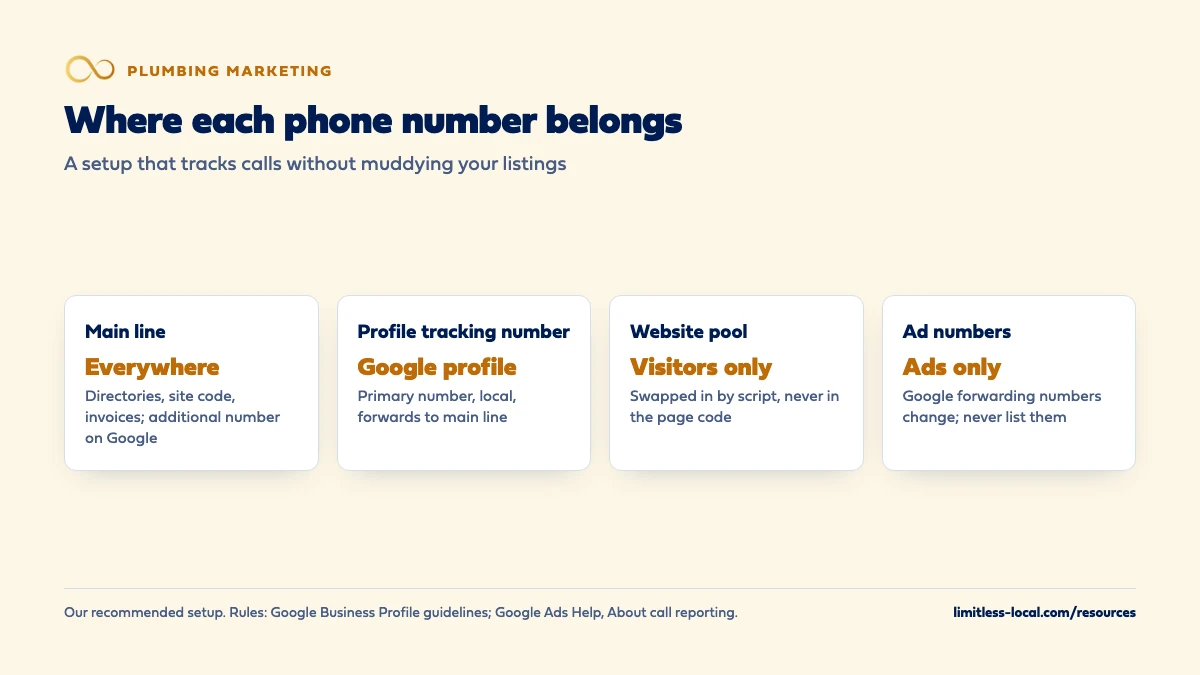
This is a made-up shop to show the setup, not a client. Say a plumbing company has one main line and wants to know whether Google Maps, Google Ads, its website and its vans each bring in calls. A tidy setup looks like this:
- Main line: on the website’s page code and structured data, every directory, invoices and water heater stickers. Added to the Google profile as an additional number.
- Tracking number for the Google profile: the primary number on the profile, a local number forwarding to the main line.
- Website pool: swaps in for visitors from search, ads and the profile’s website link, and nowhere else.
- Google Ads and Local Services Ads: Google’s own forwarding numbers, or third-party tracking with Google’s call reporting turned off.
- One number per van wrap: printed on the van only, and listed in the shop’s number log.
Every one of those numbers rings the same phones, and the shop keeps a log of them all.
Frequently asked questions
Can I put a tracking number as the main number on my Google profile?
Yes, that’s the common setup, as long as it’s a local number under your control that rings your business. Add your main line as an additional number on the profile.
Will reviews on my profile be affected if I change the number?
Google’s guidelines and help pages we cite don’t describe the phone number affecting your reviews. What changes is where calls ring, so test the new number before you switch.
Should my website show a tracking number to everyone?
No. Keep your main number in the page itself and let a tracking script swap in a number only for visitors from the sources you’re measuring.
Is it a problem if an old tracking number is still on a directory?
Only if it stops working or points somewhere else. Update the listing to your main number, and keep the old number active until it’s gone from the places people still find it.
Can I put my phone number in my Google business name?
No. Google’s guidelines don’t allow phone numbers in the business name, tracking number or not.
Key takeaways
- Call tracking numbers shouldn’t hurt your Google rankings when your main number stays the one the web knows.
- Use a local tracking number as primary on your Google profile, with your main line as an additional number.
- Keep your main number in your website’s code, directories and anything customers keep.
- Google forwarding numbers from ads change and must never be copied into listings.
- Watch for listing services or Google updates overwriting your number, and check for blue text in your profile.
- Never cancel a tracking number that’s still listed or printed somewhere.
Not sure what's working right now?
Start with a free visibility audit: rankings, Google profile, reviews and tracking, checked against your service area.
More in this section
- Why are my plumbing Google Ads getting clicks but no calls?
- How long does plumbing SEO take to bring in calls?
- Are Google Local Services Ads worth it for plumbers?
- Are LSAs or Google Ads better for emergency plumbing calls?
- Will Google AI Overviews take calls from my plumbing company?
Sources
- Guidelines for representing your business on Google — Google Business Profile Help
- Tips to improve your local ranking on Google — Google Business Profile Help
- Understand Google updates on your Business Profile — Google Business Profile Help
- Google Business Profile integration — CallRail Help Center
- Using CallRail with Google My Business — CallRail Help Center
- Dynamic number insertion overview — CallRail Help Center
- About call reporting — Google Ads Help
- Manage leads and jobs — Google Local Services Help