
Which restoration citations and directories are the ones that matter?

- What local listings, directories and mentions actually help a restoration company get found?
- What counts as a citation for a restoration company?
- Do directory listings actually help a restoration company rank in Maps?
- Which listings should every restoration company have?
- Which general directories are still worth claiming?
- Which restoration industry directories matter?
- Should I get listed in insurance and property manager networks?
- Which local organizations should mention my restoration company?
- What about paid directory links and sponsorships?
- How many citations does a restoration company actually need?
- How do I keep citations from going stale?
- What's different about citations for restoration companies
- A worked example: cleaning up a listing sprawl
- Frequently asked questions
- Key takeaways
- More in this section
- Sources
The short version
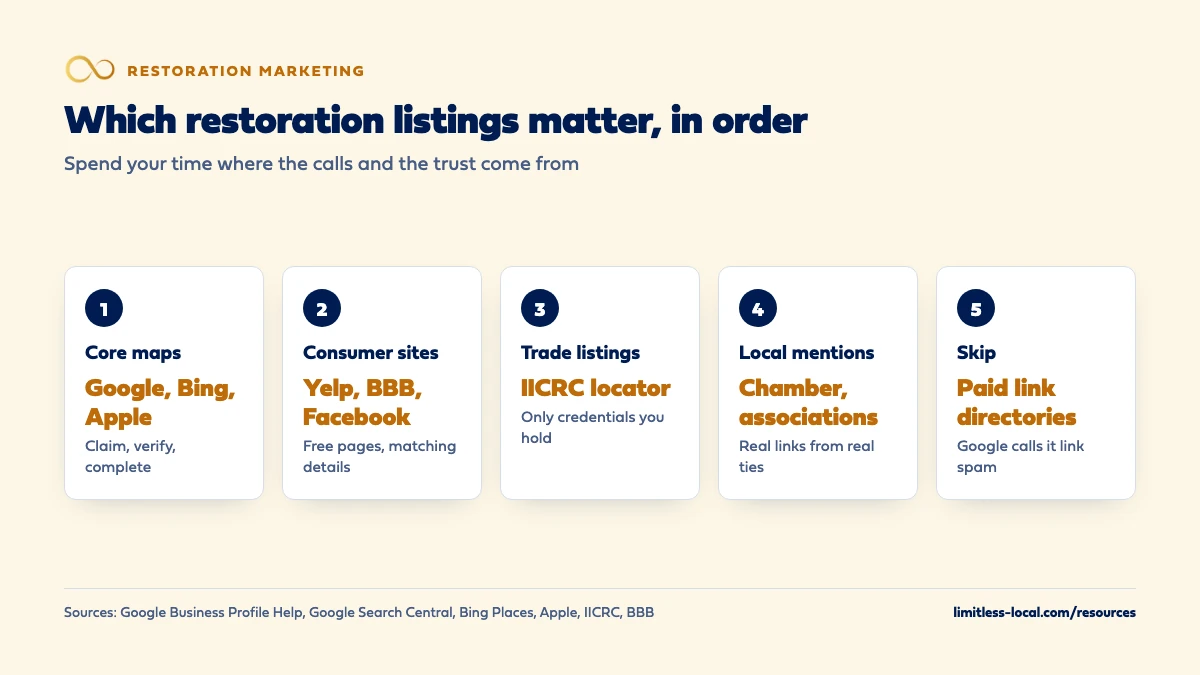
- Google, Bing and Apple map listings come first.
- Claim a short list of consumer sites people check: Yelp, BBB, Facebook, Nextdoor.
- Keep trade listings like the IICRC locator current, for credentials you actually hold.
- Earn a few real local links; never buy directory links.
For restoration owners deciding where their company should be listed online, and which directory offers to ignore.
Get a free visibility audit · Book a growth call
What local listings, directories and mentions actually help a restoration company get found?
For a restoration company, the citations that matter most are the Google, Bing and Apple map listings, a short list of consumer sites people check before calling, like Yelp, the BBB and Facebook, and trade listings such as the IICRC Global Locator if you hold the certification. Google says local results are mainly based on relevance, distance, and popularity, and that links from other websites and reviews help show how well-known a business is, so a few genuine local links beat a long list of directories. Skip directories that sell links: Google’s spam policies treat bought links, including low-quality directory links, as link spam.
Listing cleanup and buildout is part of every one of our packages, and our local SEO work syncs your name, address and phone across 50+ directories, so the owner’s time goes to the relationships that earn real local links. You can see how this fits water, fire and mold companies on our restoration marketing page. The restoration marketing guide covers where listings sit next to ads, your website and follow-up, and the rest of the restoration marketing questions library goes one question at a time.
What counts as a citation for a restoration company?
A citation is any place online that lists your company’s name, address or service area, and phone number: a business profile on a map app, a directory listing, a trade association’s member search, a chamber of commerce page, a local news mention. Some include a link to your website; many don’t.
They matter for two different reasons, and it helps to keep them apart:
- As data. Map apps build your listing from more than what you type in. Google says the information in its business profiles is compiled from several sources, including licensed data from third parties and facts contributed by users. Other listings are part of what feeds that.
- As trust and links. A listing on a site homeowners, adjusters or property managers actually use can send calls on its own, and a few of them link to your website, which Google counts toward how well-known you are.
Keeping the details identical everywhere is a separate job, covered in why NAP consistency matters. This page is about which places are worth being listed on at all.
Do directory listings actually help a restoration company rank in Maps?
Some help, most don’t move much, and none can be bought into a better ranking. Google’s page on improving your local ranking says local results are mainly based on relevance, distance, and popularity. On the third factor, Google says it’s about how well-known a business is, and that it’s also based on things like how many websites link to your business and how many reviews you have. The same page says there’s no way to request or pay for a better local ranking.
Read that carefully and the priorities fall out. Your Google Business Profile is the listing itself, so it comes first. Reviews count directly. Links from other websites count. A long tail of directory listings with no link, no traffic and no reviews isn’t something Google names at all. In our judgement, their main value is keeping your details accurate in the data map apps pull from, which is real but limited.
So the question to ask about any directory is: does it feed the map apps, does it send real calls, or does it give you a genuine link and some trust? If the answer is no on all three, skip it.
Which listings should every restoration company have?
Start with the places that run the maps people use when water is on the floor:
- Google Business Profile. It’s where most emergency searches end. Set it up properly before anything else; optimizing your restoration Google profile walks through categories, services and hours.
- Bing Places. Bing calls Bing Places one of the primary sources for its local listings, alongside other data sources. Claim it and verify it.
- Apple Business. Apple says it’s important to keep your location data up to date so customers find you, and customers can report problems, such as a location shown as open that’s actually closed, straight from your place card; Apple reviews those reports and can edit the card.
Those three cover the maps on almost every phone and computer your customers own. In our judgement, a restoration company that has only these three right is in better shape than one with a hundred directory listings and a half-finished Google profile.
Which general directories are still worth claiming?
After the big three, claim a short list of consumer sites people still use to check a company before they call, and make sure your details match:
- Yelp. In our judgement it still shows up in many local searches. Claim the free page and correct the details; paying for Yelp ads is a separate decision.
- Better Business Bureau. The BBB says it publishes free Business Profiles with ratings, customer reviews and complaint history. Accreditation is voluntary and separate from the rating, and the BBB says dues don’t buy a rating or remove a complaint. For a business that walks into strangers’ homes, in our judgement, a clean BBB profile is worth having whether or not you pay for accreditation.
- Facebook and Nextdoor business pages. Neighbors ask for recommendations there after a storm or a burst pipe. A claimed page with the right phone number is the minimum.
- Lead and quote platforms. A free profile can be one more correct listing, but paid plans buy leads, not rankings. Whether Angi listings help rankings covers that in detail.
Beyond these, in our view the returns drop off fast. Plenty of directories exist mainly to sell you an upgraded listing.
Curious what your marketing is actually booking?
Get a free visibility audit — no obligation, no sales pitch.
Which restoration industry directories matter?
Trade listings matter less for rankings and more for trust, because they’re where adjusters, property managers and careful homeowners go to check you out.
- The IICRC Global Locator. The IICRC says its Global Locator connects homeowners and business owners with certified firms and technicians in cleaning, restoration and inspection. If your firm is certified, make sure the listing is current and matches your name and phone. The IICRC also publishes a list of companies it says are wrongly promoting Certified Firm status, so only claim what you actually hold.
- State and regional restoration or contractor associations. Member directories often carry a real link and are read by the people who refer commercial work. In our judgement, join the ones you’d attend anyway, not just for the listing.
- Manufacturer or training certifications that come with a public locator, where you genuinely hold the credential.
Show the same credentials on your own website and Google profile, in plain words, so a homeowner comparing two companies at night sees them without digging.
Should I get listed in insurance and property manager networks?
These aren’t directories in the SEO sense. A third-party administrator program, an insurer’s preferred vendor list or a property management company’s approved vendor list is a business relationship with its own rules, paperwork and pricing terms. Being on one can bring steady work; it won’t change your Google ranking.
Treat each one as a sales decision. Getting into TPA preferred vendor programs covers how those programs work, and what property managers look for in a vendor covers the commercial side. This is general guidance, not insurance or legal advice; read each program’s agreement before you sign it.
Which local organizations should mention my restoration company?
Local mentions do two jobs: they put your name in front of the people who refer emergency work, and some of them come with a genuine link from a local website, which is the kind Google says it counts toward how well-known you are.
In our judgement, the ones worth the time for a restoration company are:
- Your chamber of commerce and local business associations, if you’ll actually show up.
- Landlord, property manager and real estate associations in your area.
- Local trade partners who list their recommended vendors, such as plumbers, roofers and HVAC companies you already work with.
- Local news or community sites, when you have something real to say after a storm, a freeze or a fire season.
Earn these through real relationships, not payment for referrals. Building a referral network with plumbers covers how to do that without crossing lines.
What about paid directory links and sponsorships?
Be careful here. Google’s spam policies list buying or selling links for ranking purposes as link spam, and they name low-quality directory or bookmark site links as an example. A directory that sells you a “premium listing with a dofollow link” is selling exactly what Google says not to buy.
Sponsoring a youth team, a charity run or a community event is fine as marketing. Just don’t count on the link for rankings: Google’s guidance on qualifying outbound links says links that are advertisements or paid placements should be marked with the sponsored value. Sponsor things for the goodwill and the people you’ll meet, and judge them on that.
How many citations does a restoration company actually need?
There isn’t a number, and Google doesn’t publish one. What matters is coverage of the places that count, accuracy everywhere you appear, and a handful of genuine local links, more than a big total.
In our judgement, a restoration company is in good shape when it has:
- Google, Bing and Apple listings claimed, verified and complete.
- The main consumer sites in your area claimed with matching details.
- Every trade credential you hold showing on its locator.
- A few local organizations that genuinely know you, listing or mentioning you with a link.
Past that, extra listings are maintenance, not growth. Every listing is one more place a phone number can go stale.
How do I keep citations from going stale?
Keep a simple list: every site you’re listed on, the login, who owns it, and the exact name, address or service area, phone and hours it should show. Check the important ones every quarter and after any change.
Expect changes to take time to spread. Bing says listing updates go through a publish cycle that typically takes 7-12 days in North America, that core details are only applied if they align with trusted external data, and that other sources can take priority if your Bing Places data hasn’t been updated for more than 6 months. In our judgement, that’s a good reason to log in to each core listing a couple of times a year even when nothing has changed.
When you do change a phone number or move, the order of fixes and the forwarding plan are in the NAP consistency guide.
Want to see where your company stands?
A free visibility audit shows where you show up on Google, Maps and AI answers, and what it's costing you in calls.
What's different about citations for restoration companies
The phone number has to work at night. An old number on a forgotten directory is a missed emergency job, not just a data error. Check that every listed number rings your live line.
Trust listings carry more weight than in most trades. Your crew goes into homes after a loss, and adjusters and property managers check credentials. The IICRC locator and a clean BBB profile are worth more to a restoration company than another general directory.
Service-area businesses. Most restoration companies don’t serve customers at their address. List your service area the way each platform allows, and don’t invent addresses to appear in more towns.
Storm traffic finds old listings. After a big weather event, homeowners search every app they have. That’s when a stale listing costs the most.
A worked example: cleaning up a listing sprawl
These numbers are made up to show the process, not a benchmark. Say you search your company name and old phone numbers and find 31 listings. 19 match your current details exactly. 8 still show the number you used before switching phone systems. 4 are duplicates or directories nobody uses.
Work through them by value, not by count:
- Google, Bing and Apple first, even if they were already correct; confirm they’re claimed and verified.
- The 8 listings with the old number next, starting with any that homeowners actually use, like Yelp, the BBB and Facebook. Keep the old number forwarding until calls to it stop.
- Your IICRC locator entry and association listings.
- The 4 dead or duplicate listings last. Close or correct the duplicates; don’t pay to upgrade the dead directories.
The result isn’t more listings. It’s fewer wrong ones, and every listing that matters pointing to a phone someone answers. If you’d rather hand this off, listing cleanup and buildout is part of our Essentials package at $3,500 a month, and our local SEO work syncs your details across 50+ directories.
Frequently asked questions
Do I need to pay a citation service to list my restoration company?
No. You can claim the core listings yourself for free. A service or agency saves time and keeps details in sync, but it can’t buy you a better local ranking; Google says that isn’t possible.
Should I list my home address if I run the business from home?
Follow each platform’s rules for service-area businesses, which usually let you show a service area instead of a street address. Never list an address where you don’t actually operate.
Do reviews on Yelp or the BBB help my Google ranking?
Google’s ranking page doesn’t say that reviews on other sites count, so treat them as trust for people checking you out. The BBB says customer reviews don’t affect its own BBB rating.
What should I do about a directory listing I can't log into?
Use the site’s claim or ownership process, or its suggest-an-edit option, to fix the phone number first. If the site is dead or useless, fixing the number matters more than keeping the listing.
Are AI search tools affected by my citations?
In our judgement, yes: AI tools draw on what’s published about you across the web, so accurate core listings help there too. How restoration companies show up in AI answers covers the rest.
Key takeaways
- Google, Bing and Apple listings come first; they are the maps on almost every customer’s phone.
- Google says local results are mainly based on relevance, distance, and popularity, and that links and reviews feed how well-known you are.
- Claim a short list of consumer and trade listings people actually check, like the BBB and the IICRC locator.
- Earn local links through real relationships; Google treats bought directory links as link spam.
- A smaller set of accurate listings beats a large set with stale phone numbers.
Not sure what's working right now?
Start with a free visibility audit: rankings, Google profile, reviews and tracking, checked against your service area.
More in this section
- How should a restoration company build city pages that rank?
- Restoration leads: shared, exclusive or pay-per-call?
- Why does NAP consistency matter for a restoration company?
- How do restoration companies show up in AI search answers?
- Which mobile speed fixes does a restoration website need?
Sources
- Tips to improve your local ranking on Google — Google Business Profile Help
- Understand how Google sources & uses info in Business Profiles & local search results — Google Business Profile Help
- Bing Places for Business: Manage your listing — Bing Places for Business
- Maintain location information accuracy with Apple Business — Apple Support
- IICRC Global Locator — IICRC
- Frequently Asked Questions — Better Business Bureau
- Spam policies for Google web search — Google Search Central
- Qualify your outbound links to Google — Google Search Central