
What close rate is too low to scale ads for an electrical company?

- How do I know if my electrical close rate is high enough to spend more on ads?
- What does close rate mean for an electrical company?
- What close rate is too low to scale ads?
- Is a 50% close rate realistic for electrical service calls?
- Why does the break-even rise when I add ad spend?
- Should I check the close rate by job type?
- What drags an electrician's close rate down?
- How do I measure my real close rate from ads?
- Can Google Ads learn which leads actually close?
- What should I fix before raising my ad budget?
- When is a close rate below break-even still worth it?
- What's different about close rates for electricians
- A worked example: the break-even close rate
- Frequently asked questions
- Key takeaways
- More in this section
- Sources
The short version
- Break-even close rate = cost per lead / the most you can pay per sold job.
- Below break-even, more spend loses money; just above it, scaling is risky.
- Check service calls and estimate jobs separately; they close very differently.
- Fix answering, follow-up and lead quality before raising the budget.
For electrical contractors thinking about raising their ad budget, who want a clear check on whether their close rate can carry more spend.
Get a free visibility audit · Book a growth call
How do I know if my electrical close rate is high enough to spend more on ads?
There’s no single close rate that’s too low for every electrical company; the line is your break-even close rate, which is what you pay per lead divided by the most you can afford to pay per sold job. If your actual close rate for a job type is below that number, more ad spend will lose money on that work, and if it’s only slightly above, scaling is risky because cost per lead usually rises as you spend more. Work it out separately for service calls and for estimate-based jobs like panel upgrades, EV chargers and generators, and fix answering, follow-up and lead quality before adding budget.
Checking close rates against cost per lead before adding spend is how we run Google Ads for home-service businesses, and every package includes call tracking and monthly reports with a cost-per-lead breakdown. Our electrical contractor marketing page shows how ads and follow-up fit together, and the rest of the electrical marketing questions library goes question by question.
What does close rate mean for an electrical company?
Close rate is the share of opportunities that turn into sold work. The trouble is that owners use the term for two different things. ServiceTitan’s article on close and conversion rates defines close rate as the success percentage of selling estimates, and treats conversion rate as a separate measure tied to invoices. Many owners also say “close rate” when they mean the share of calls that turn into a booked visit.
For this check, keep them apart:
- Booking rate: of the real leads that called or filled in a form, how many booked a visit or estimate.
- Close rate: of the estimates you gave, how many were sold.
For a service call, the booking is often the sale. For a panel upgrade or generator, the booking is the estimate, and the close rate comes after. Mixing the two is how an owner ends up comparing their number to someone else’s and drawing the wrong conclusion.
What close rate is too low to scale ads?
The one that’s below your break-even. Work it out like this:
- Find your ceiling: the most you can pay in marketing to win one sold job of that type, based on its gross profit. Our page on a good cost per booked job walks through setting it.
- Find your cost per lead: ad spend divided by real leads (calls and forms from people wanting work you do) for that job type.
- Divide: cost per lead divided by the ceiling is your break-even close rate.
If your actual close rate is below break-even, every extra dollar on that job type loses money. If it’s well above, there’s room to spend more. If it’s just above, in our judgement, hold, because the next dollar usually buys a more expensive lead than the last one.
Is a 50% close rate realistic for electrical service calls?
We can’t point to a reliable published benchmark for electricians, and in our judgement a number from another company tells you little, because it depends on what they count. A shop that counts every caller, including wrong numbers and job seekers, will show a lower rate than one that counts only qualified leads. A shop with a fixed diagnostic fee filters out shoppers on the phone, so its rate after booking looks higher.
The useful comparison is with yourself: your rate by job type, by lead source and by month. If your booking rate on service calls drops when you add a new campaign, that campaign is bringing weaker leads, whatever the industry average might be.
Why does the break-even rise when I add ad spend?
Because the first dollars in a Google Ads account buy the best searches: the most specific keywords, in the closest towns, at the busiest hours. More budget means wider keywords, more towns and less ideal times, and those leads usually cost more and close less. Our page on monthly ad budgets for electricians covers how budget and reach interact.
That’s why a close rate just above break-even isn’t enough to scale. If doubling spend pushes cost per lead up even modestly, the break-even rises with it, and a close rate that worked at the old budget may not work at the new one. Raise budgets in steps, and recheck after each step.
Curious what your marketing is actually booking?
Get a free visibility audit — no obligation, no sales pitch.
Should I check the close rate by job type?
Yes. In our judgement, a single blended close rate hides most of what matters for an electrician. Service and repair calls often book on the first call, at a lower ticket. Panel upgrades, EV chargers, generators and rewiring involve an estimate, a bigger ticket and more comparison shopping. Commercial bids have their own cycle again.
Each job type has its own ceiling, its own cost per lead and its own close rate, so each has its own break-even. It’s common for one campaign to be well above break-even while another is below it. The right move is then to shift budget between them, not to raise or cut the whole account.
What drags an electrician's close rate down?
In our judgement, the usual causes, roughly in order of how often they’re the problem:
- Calls that aren’t answered. A lead that reaches voicemail often calls the next company. Our page on how fast to answer calls covers this.
- Slow or no follow-up on estimates. Bigger jobs are rarely decided on the spot. See following up on quotes automatically.
- Leads from the wrong searches or places. DIY, job-seeker and out-of-area clicks show up as leads that never close.
- Price shoppers. Some ads attract people collecting quotes. Our page on price shoppers and estimates covers how to screen them.
- The estimate itself. Options, clarity, and how quickly it arrives.
The first two are usually the cheapest to fix, and they raise the close rate on every lead you already pay for.
How do I measure my real close rate from ads?
You need three things connected. Call tracking, so each ad call is counted; Google’s page on phone call conversion tracking covers calls from ads and from your website. A job record in your field software, such as ServiceTitan, Housecall Pro or Jobber, that shows which estimates were sold. And a way to tie the two together by lead source.
Field software can help with the middle step. Housecall Pro’s guide to its Pipeline boards, for example, describes moving leads through stages such as new lead, first contact and won, where won means the lead became an estimate or job. Whatever tool you use, the key is marking the source on every lead so you can calculate close rate per channel and per job type.
Can Google Ads learn which leads actually close?
It can, if you tell it. Google’s page on offline conversion imports explains that when an ad starts a path that ends in a sale over the phone or in person, you can import those offline conversions to measure what happens after the click. Google now recommends starting with enhanced conversions for leads, an upgraded version of that import.
Once sold jobs flow back into Google Ads, automated bidding can aim at them instead of at every call. Google’s page on Target CPA bidding says some conversions will cost more than the target and some less, while it tries to keep the average at your target. In our judgement, a target based on sold jobs, set from your break-even math, is far more useful than one based on raw calls. Google’s page on Smart Bidding learning notes that performance converges toward a new target over the conversion cycle, so give changes time.
What should I fix before raising my ad budget?
In our judgement, in this order:
- Tracking: know your cost per lead and close rate by job type. Without them, scaling is a guess.
- Answering: make sure ad calls reach a person during the hours your ads run.
- Follow-up: every estimate gets a follow-up within a set time.
- Lead quality: negative keywords, tighter locations and the right landing pages.
- Then budget: raise spend on the job types with the most room above break-even, in steps.
A company that raises its close rate from below break-even to comfortably above it often gets more from the same budget than it would from doubling spend.
When is a close rate below break-even still worth it?
Sometimes. If a first job reliably leads to repeat work, a maintenance agreement or referrals, the real value of a customer is higher than one ticket. Ads that bring commercial accounts or property managers can be worth a lower first-job return for the same reason. And a new company may accept a loss for a few months to build reviews.
In our judgement, those are deliberate choices, not defaults. Write down why you’re accepting it, which numbers would prove it right, and when you’ll check. Otherwise “lifetime value” becomes a reason to keep funding a campaign that isn’t working.
Not sure which of these is costing you jobs?
A free visibility audit checks the Google profile, reviews, site and tracking, and shows what to fix first.
What's different about close rates for electricians
Two very different sales. Service calls are fast, urgent and often booked on the first call. Panel upgrades, EV chargers, generators and rewiring are planned purchases with estimates, permits and comparison shopping. Measuring them together hides the real break-even for each.
Utility and permit steps slow the close. Service upgrades and generator installs can involve the utility and the local permit office. A job that’s waiting on those isn’t lost, so in our judgement, give estimate-based close rates a longer window before calling them.
Rebates and incentives shift timing. EV charger and efficiency work can depend on incentive programs that change. Closes can bunch around those changes, so compare months carefully.
Safety calls close differently. A burning smell or a hot panel closes fast if you answer. Those calls show why answering speed often matters more than ad spend.
A worked example: the break-even close rate
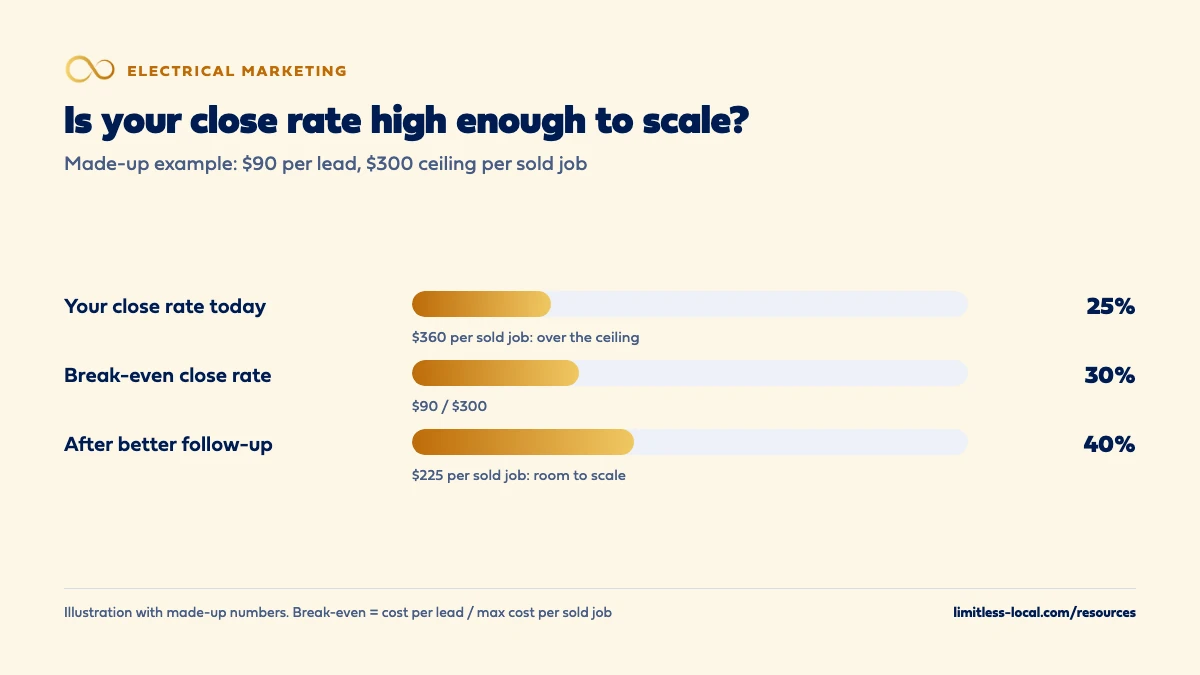
These numbers are made up to show the math, not a benchmark. Say a panel upgrade earns enough gross profit that you’ll pay up to $300 in marketing to win one. Your panel ads cost $90 per real lead. Break-even close rate: $90 divided by $300, or 30%.
If you close 25% of panel estimates, each sold job costs $90 divided by 25%, or $360, which is $60 over your ceiling. Scaling that campaign would lose more money, faster. Fix answering and follow-up first. If those lift your close rate to 40%, each sold job costs $225, comfortably under the ceiling.
Now say you double the panel budget and cost per lead rises to $110. Break-even becomes $110 divided by $300, about 37%. At 40% you’re still above it, but only just. That’s the point to hold and recheck, not to double again.
Ad spend is paid directly to Google and isn’t part of any package. Our Essentials package, at $3,500 a month, includes Google Ads management for up to $2,500 a month in spend, call tracking and monthly reports; Growth, at $4,500 a month, covers up to $5,000 a month in spend.
Frequently asked questions
Should I count every call when I work out close rate?
In our judgement, count real leads only: people asking for work you do in places you serve. Track wrong numbers, job seekers and sales calls separately so they don’t hide the real rate.
How many estimates do I need before the close rate means anything?
More than a handful. In our view, wait for at least a couple of months of estimates per job type before making a budget decision on it.
Can I raise my close rate by raising prices?
Usually the opposite happens to the rate, but margin per job rises, which raises your ceiling and so can lower the break-even close rate. Run both numbers before deciding.
Do Local Services Ads change the math?
The formula is the same: cost per lead divided by your ceiling. Only the lead cost and lead quality differ, so check them on their own.
Who should own the close rate, the office or the techs?
Both parts. The office owns the booking rate on calls; whoever writes estimates owns the close rate on them. Measuring them separately shows where the leak is.
What if my close rate is high but I still can't grow?
Then the limit is usually lead volume or capacity, not sales. Check whether budget, reach or crew availability is the real constraint before adding spend.
Key takeaways
- Your break-even close rate is cost per lead divided by the most you can pay per sold job.
- Below break-even, more ad spend loses money; just above it, scale in small steps.
- Measure booking rate and estimate close rate separately, and by job type.
- Cost per lead tends to rise with budget, which raises the break-even.
- Fix tracking, answering and follow-up before adding budget.
- Feed sold jobs back into Google Ads so bidding aims at closes, not calls.
Want a second set of eyes on your setup?
We'll look at how you show up locally and where calls are leaking, then send you a plain-English breakdown.
More in this section
- What Google Ads campaigns work best for electricians?
- What is a good cost per booked job for electrical marketing?
- How should I market a small electrical business on a tight budget?
- Electrician Google Ads geotargeting: how tight a service area?
- How do I know if my electrical marketing agency is getting results?
Sources
- Technician's Close or Conversion Rate does not look correct — ServiceTitan Help
- Getting Started with Pipeline — Housecall Pro Help Center
- About phone call conversion tracking — Google Ads Help
- About offline conversion imports — Google Ads Help
- About Target CPA bidding — Google Ads Help
- About Smart Bidding learning — Google Ads Help