
How much does a plumbing company website cost?

- What should a plumbing company budget for a website that brings in calls?
- What drives the cost of a plumbing website?
- What are my options, from cheapest to most expensive?
- What does a website from Limitless Local cost?
- What should the price include?
- What will I keep paying after the website launches?
- Is a cheap plumbing website a false economy?
- How many pages do I need to pay for?
- Who should own the website and the domain?
- How long does a plumbing website take, and when do I pay?
- How do I compare plumbing website quotes?
- How do I know if the website paid for itself?
- What's different about website costs for plumbing companies
- A worked example: how many jobs it takes to pay for a plumbing website
- Frequently asked questions
- Key takeaways
- More in this section
- Sources
The short version
- Price follows page count, template versus custom design, and what gets connected.
- A template build with real service pages covers most residential plumbers.
- Budget for the ongoing costs too: domain, hosting, updates and new pages.
- Judge the price by booked jobs, and own your domain whatever you pay.
For plumbing owners pricing a new website or a rebuild, who want to know what drives the cost and what the money should buy.
Get a free visibility audit · Book a growth call
What should a plumbing company budget for a website that brings in calls?
A plumbing company website can cost anything from the monthly fee of a do-it-yourself builder to several thousand dollars for a professionally built site, and the price mostly follows how many pages are written for you, whether the design is a template or custom, and what is connected to it, such as booking, forms and call tracking. A template-based build with a page for each main plumbing service usually costs less than a custom design. Whatever you pay, the site should load fast on a phone, make calling or booking easy, and sit on a domain your company owns.
Our websites come in two forms with published prices: a themed build and a custom build, and both are part of how we approach plumbing marketing. The numbers are below so you can compare them with other quotes. The rest of the plumbing marketing questions library covers what goes on the site and how it gets found.
What drives the cost of a plumbing website?
Three things move the price more than anything else. The first is how much content is written for you. A plumbing site with separate pages for emergency service, drain cleaning, sewer lines, water heaters, leak detection and repiping takes real writing time, and every extra service or town page adds more. The second is design: a template adapted to your brand costs less than a design drawn from scratch. The third is what gets connected: quote forms, online booking, your field software, call tracking and analytics.
Everything else is smaller: photography, logo work, migrating an old site, and how many rounds of changes are included. When two quotes look far apart, in our judgement it’s usually because one includes the writing and connections and the other expects you to supply them.
What are my options, from cheapest to most expensive?
In our judgement, plumbing owners usually choose between four routes:
- A do-it-yourself website builder. The lowest cash cost, paid as a monthly fee, but you write every page, take the photos and set up the forms yourself.
- The website offered by your field software. Some field-service platforms build sites that plug into the software you already use. Housecall Pro, for example, says its websites are built by its in-house team, add a lead form and customer portal by default, can add online booking, reviews and chat on request, and send website messages into the same inbox you use for customers (Housecall Pro Help Center).
- A themed build by a web team. A proven layout adapted to your brand, with the service pages written and the tracking set up for you.
- A custom build. A design made only for your company, with custom features such as calculators, special booking flows or several locations.
None of these is right for everyone. A one-truck shop starting out can run on a builder; a company spending real money on ads usually needs more control over its pages than a builder gives.
What does a website from Limitless Local cost?
Our prices are published. A themed website is $3,750, or $3,000 with any of our marketing packages, and includes up to 25 pages of content. A custom website starts at $5,000. Both can be paid over six or twelve months, there’s 10% off if you pay in full, and every build includes 30 days of support after launch.
For most residential plumbing companies, in our judgement, a themed build is enough: 25 pages covers a home page, the core service pages, an emergency page, a handful of town pages, and the about, reviews and contact pages. Custom makes sense when you run several locations, want special booking or pricing tools, or need a design that stands apart in a crowded metro.
What should the price include?
Whatever route you take, in our judgement the quote should cover these, or tell you plainly who does them:
- Written service pages for the jobs you want, not placeholder text.
- A mobile-first layout with a tap-to-call number and a short request form.
- Speed. Google’s Web Vitals guidance says that for a good experience the main content should load within 2.5 seconds, the page should respond to taps in 200 milliseconds or less, and layout shift should stay at 0.1 or less (web.dev).
- The search basics: page titles, a sitemap, and a site Google can crawl. Google’s starter guide covers these and says there’s no guarantee any particular site gets added to its index (Google Search Central).
- Call and form tracking, so you can see which calls the site produces.
- Your domain registered in your company’s name.
A cheaper quote that leaves out the writing or the tracking isn’t cheaper once you pay to add them later.
What will I keep paying after the website launches?
The build is a one-time cost, but a website has running costs too. Plan for the domain renewal, hosting, software and security updates, and changes when your services, prices, hours or service area move. Most plumbing companies also add pages over time, such as a new service, a town you’ve started covering, or answers to questions your office hears every week.
Ask any web provider exactly which of these are included, for how long, and what each change costs after that. In our judgement, the surprise costs owners complain about are usually changes they assumed were free.
Curious what your marketing is actually booking?
Get a free visibility audit — no obligation, no sales pitch.
Is a cheap plumbing website a false economy?
It can be, when the site is the place your paid clicks land. Google Ads gives each keyword a landing page experience status, and says pages that rate higher are usually well organized and have text that relates to what the person searched (Google Ads Help). A single generic page can’t do that for a water heater search, a drain search and a burst-pipe search at once.
In our judgement, a basic site is fine while most of your work comes from referrals and your Google Business Profile. Once you pay for clicks, weak pages cost you every day, which is why the emergency plumbing page and your main service pages deserve the most care.
How many pages do I need to pay for?
Fewer than many owners expect. Price the pages you need for the jobs you want more of, not a round number. For most residential plumbers that’s a single-digit to low-teens count of service pages plus the core pages. How many service pages walks through which ones come first.
Be wary of quotes that sell volume, such as dozens of near-identical town pages. In our judgement, a smaller site where every page answers a real customer’s question does more for calls than a large one built to hit a page count.
Who should own the website and the domain?
Your company, whoever builds it. ICANN, which oversees domain names, says it’s your right to transfer your domain name registration between registrars (ICANN), which only helps if the domain is registered to you, under a login you hold. Ask for admin access to the site and the hosting account too.
This matters more than the price. If a provider owns the domain or the only login, changing providers can mean starting again from nothing. Who should own your website covers the ownership questions to settle before you sign.
How long does a plumbing website take, and when do I pay?
Timelines vary with how fast you can review designs and pages, which is the usual wait. Our builds go from concept to launch in 100 days or less, and themed sites take about 60 days. Other providers will quote their own timelines; ask what they need from you and when.
On payment, the common pattern is a deposit and the rest on milestones or at launch. Payment plans spread the cost; ours run over six or twelve months, and we go through the terms when you ask.
How do I compare plumbing website quotes?
Put every quote in the same terms. Ask each provider:
- How many pages, and who writes them?
- Is it a template or a custom design?
- Are call tracking, forms and analytics set up and tested?
- Who owns the domain, the site and the hosting account?
- What happens after launch, for how long, and what do changes cost?
- How will I know which calls the site brings in?
Be careful with ranking promises. Google says no one can guarantee a #1 ranking on Google, and to beware of anyone who claims to (Google Search Central). A website can be built so Google can find and understand it, but rankings depend on much more than the build. Before you choose, what a plumbing website includes gives you the checklist to hold every quote against.
How do I know if the website paid for itself?
Count booked jobs, not visits. Use a tracking number on the site and tag web form leads, then check how many of those calls and requests became booked jobs and what they were worth. Tracking which marketing books jobs covers the setup.
In our judgement, give a new site a few months before you judge it on search traffic, because organic growth ramps up over time. You can judge it on calls from people who already found you, from your Google profile and your ads, almost straight away.
Talk it through with someone who runs this every day
A 15-minute growth call: your market, your numbers, and what a realistic budget looks like. No pressure.
What's different about website costs for plumbing companies
Emergency calls change what you’re paying for. Many plumbing calls come from someone with water on the floor, on a phone, in a hurry. In our judgement, the money should go first to a fast mobile site with a phone number that’s impossible to miss, not to design flourishes.
High-ticket jobs need real pages. Water heater replacement, repiping and sewer line work are bigger decisions with more research behind them, so their pages need real answers on options, process and how you price. That writing is where a plumbing website’s budget earns its keep.
Your software may already include a site. If you run your business on a field-service platform, check what website it offers before you pay for one elsewhere, and weigh that against how much control you’ll need over your pages once you run ads. If you’re starting out and wondering whether to skip the site entirely, a Facebook page instead covers that decision.
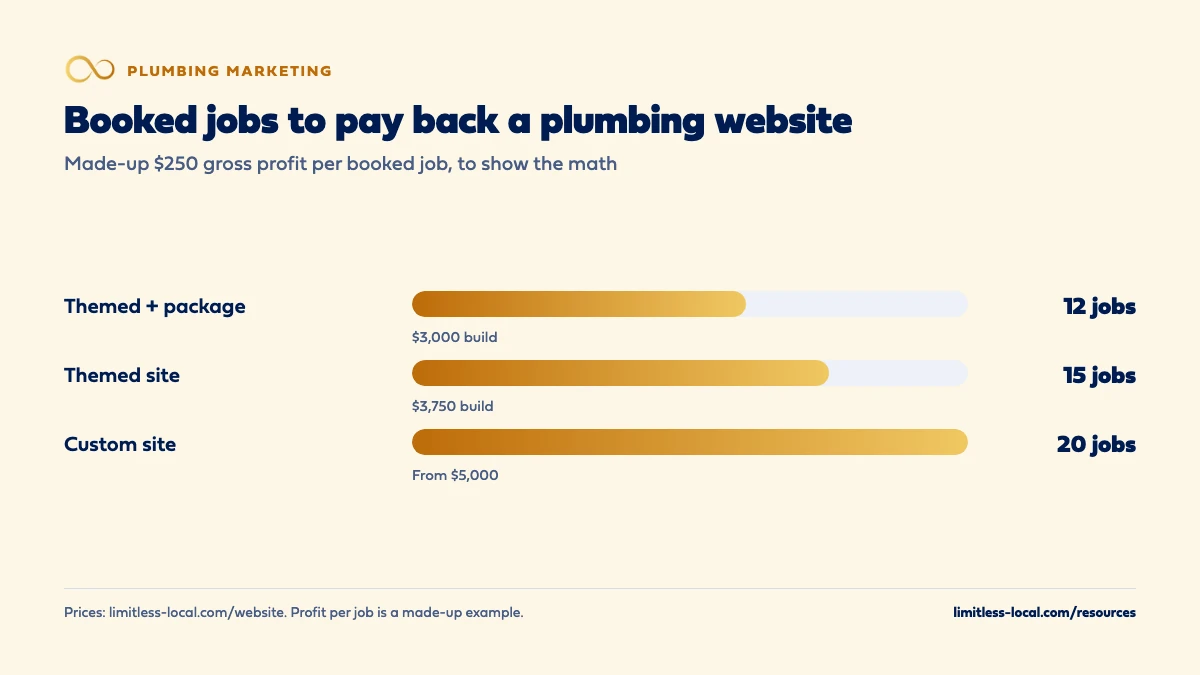
A worked example: how many jobs it takes to pay for a plumbing website
These numbers are made up to show the math, not a benchmark for your market. Say a plumbing company keeps a made-up $250 of gross profit on an average booked job after parts, labor and overhead.
- Themed site with a marketing package: $3,000 ÷ $250 = 12 booked jobs to cover the build.
- Themed site on its own: $3,750 ÷ $250 = 15 booked jobs.
- Custom site from: $5,000 ÷ $250 = 20 booked jobs.
Spread over a year, even the custom build needs fewer than two extra booked jobs a month to pay for itself, and a water heater or sewer job is usually worth more than an average call. Your numbers will be different. The point is to compare the price with the jobs the site has to win, not with the cheapest quote.
Frequently asked questions
Is a free website builder good enough for a plumber?
It can be for a new or very small shop, if it lets you use your own domain, works well on phones and lets you add a request form and call tracking. In our judgement, check before you start whether you can move your content if you outgrow it.
Should my plumbing website show prices?
Many plumbers show how they price, such as a trip fee or flat-rate approach, rather than a full price list. In our judgement, explaining how pricing works builds trust without locking you into numbers that change.
Do I pay extra for SEO on top of the website?
Usually, yes. A good build includes the search basics, but ongoing SEO, such as new content, reviews and Google Business Profile work, is separate work that builds over months.
Can I rebuild my site in stages instead of all at once?
Yes. In our judgement, start with the home page, emergency page and the service pages for your highest-value jobs, then add the rest. Keep the old pages’ addresses or redirect them so you don’t lose what already ranks.
What happens to my website if I change providers?
If your company owns the domain and has admin access to the site and hosting, you can move it. If the provider holds those, ask in writing how a handover works before you sign.
Key takeaways
- Website cost follows page count, template versus custom design, and what’s connected.
- Make sure the quote includes written service pages, speed, tracking and ownership.
- Budget for running costs after launch, not just the build.
- A themed build covers most residential plumbers; custom suits multi-location or special features.
- Judge the price by how many booked jobs it takes to pay back, not by the cheapest quote.
Ready to compare options?
Book a short growth call and we'll walk through the math for your service area, including when we're not the right fit.
More in this section
- How much does a plumbing marketing agency cost per month?
- What should a plumbing company website include?
- How much should a plumbing company spend on marketing each month?
- How much should a plumbing company spend on Google Ads?
- How much does a Google Ads click cost for plumbing keywords?
Sources
- Websites by Housecall Pro — Housecall Pro Help Center
- Web Vitals — web.dev (Google)
- SEO Starter Guide: The Basics — Google Search Central
- Landing page experience: Definition — Google Ads Help
- FAQs for Registrants: Transferring Your Domain Name — ICANN
- Do You Need an SEO? — Google Search Central