
How do I see what my plumbing competitors are doing online?

- How can a plumbing company check what rival plumbers are doing on Google, Maps and ads?
- Why should a plumber check what competitors are doing online?
- Who are my real competitors online?
- How do I check a competitor's Google Business Profile?
- How do I compare my reviews with a competitor's?
- How can I see the Google ads my plumbing competitors run?
- Should I search Google and click on competitors' ads to see them?
- How can I see which plumbers I'm up against in Google Ads?
- How do I size up a competitor's website?
- What can my own Google profile tell me about the competition?
- What should I do with what I find?
- What's different about competitor research for plumbers
- A worked example: closing a review gap
- Frequently asked questions
- Key takeaways
- More in this section
- Sources
The short version
- Search for the jobs you want from several towns, not just from your shop.
- Check each rival's Google profile, reviews, ads and website.
- Use the free Ads Transparency Center and your own auction insights report.
- Copy the honest work, report the rule-breaking, and ignore the rest.
For plumbing owners who keep seeing the same rivals at the top of Google and want a practical way to check their Maps profiles, ads, reviews and websites without paying for a tool.
Get a free visibility audit · Book a growth call
How can a plumbing company check what rival plumbers are doing on Google, Maps and ads?
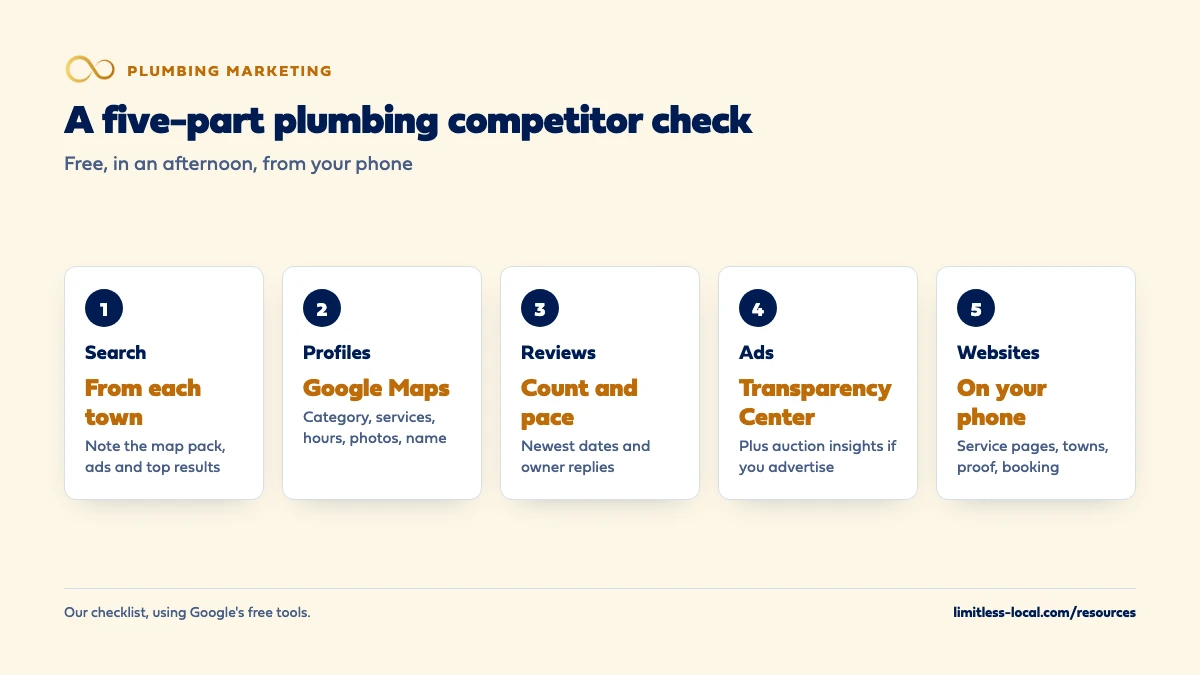
Search the way your customers do, from a few different towns in your service area, and write down which plumbers show up in the ads, the map pack and the regular results. Then check four things for each rival: their Google Business Profile (categories, services, photos, hours and how recently they get reviews), the ads they run in Google’s free Ads Transparency Center, their website’s service and town pages, and their review count and replies. If you already run Google Ads, the auction insights report shows which advertisers you meet in the same auctions and how often they outrank you.
Knowing what it takes to win the calls in your towns is where a sensible marketing plan starts. Our local SEO service covers the Google profile, website and review work that usually separates the plumbers at the top from everyone else. See how we work with plumbing companies, or browse the rest of the plumbing marketing library.
Why should a plumber check what competitors are doing online?
Because the homeowner with a leaking water heater is comparing you with them in the same few seconds. A quick audit tells you what you’re up against for the jobs you want: whether the rival at the top has hundreds of reviews or just a well-placed office, whether they run ads around the clock, and whether their website has a page for every service you also do.
In our judgement, the point isn’t to copy anyone. It’s to find the gap that’s cheapest for you to close. Sometimes that’s reviews, sometimes it’s a missing service page, and sometimes it’s simply that a competitor answers the phone at night and you don’t. The audit below takes an afternoon the first time and an hour or so after that.
Who are my real competitors online?
Not always the shops you know from the supply house. Online, your competitors are whoever shows up when a homeowner searches for the job. Make a short list of searches that match the work you want, such as “emergency plumber,” “water heater replacement,” “drain cleaning” and “sewer line repair,” with and without a town name.
Then search from more than one place. Google’s page of tips to improve your local ranking says local results are mainly based on relevance, distance and popularity, and that distance is how far each business is from the person searching. So the map pack a homeowner sees across town can be different from the one you see at your shop. Search from your phone at a job in each main town you serve, or ask a tech to do it, and note the top three plumbers in the map pack, the ads above it and the first few regular results.
After a few towns, the same names keep coming back. Those three to five companies are the ones to study.
How do I check a competitor's Google Business Profile?
Open each rival’s profile on Google Maps and look at what a homeowner sees:
- Category and services. The category under the name, and whether they list the specific jobs you also do.
- Hours. Whether they show open 24 hours, and whether that’s believable for their size.
- Photos. Real job photos and trucks, or a logo and a few stock images.
- Updates. Whether they post, and how recently.
- Name. Whether it’s their real business name or stuffed with words like “emergency” and a city.
That last one matters. Google’s guidelines for representing your business say your name should reflect your business’s real-world name, as used consistently on your storefront, website and stationery. A rival that has added keywords to its name may be outranking you while breaking the rules. Google’s page on reporting a business on Google Maps explains how to suggest an edit for wrong info or report misleading business info. Report what’s actually wrong, once, and don’t copy it: a name change of your own could put your profile at risk. Optimizing your own Google profile covers the honest version of each of these fields.
How do I compare my reviews with a competitor's?
Look past the star rating. For each rival, note the review count, the date of the most recent few reviews, whether the owner replies, and what customers mention: fast response, clean work, fair price, a named tech. Sort their reviews by newest to see their pace over the last couple of months.
Google’s local ranking tips say more reviews and positive ratings can help your business’s local ranking, and that replying to reviews shows customers you value their feedback. In our judgement, the pace matters more than the total. A rival with 400 old reviews and nothing new since spring is easier to catch than one adding a handful every week. How many reviews a plumbing company needs goes deeper on setting a target, and getting more Google reviews covers how to raise your own pace without breaking Google’s rules.
Curious what your marketing is actually booking?
Get a free visibility audit — no obligation, no sales pitch.
How can I see the Google ads my plumbing competitors run?
Use Google’s free Ads Transparency Center. Google’s announcement of the Ads Transparency Center describes it as a searchable hub of ads served from verified advertisers, where you can see the ads an advertiser has run, which ads were shown in a certain region, the last date an ad ran and its format. Search a competitor’s business name, set the region filter, and read their ads.
What to note, in our judgement:
- Which services they advertise: emergency calls, water heaters, drains, sewer, repipes.
- What they offer: free estimates, a dollar-off coupon, financing, same-day service.
- What they promise about speed or hours, and whether their profile backs it up.
- Whether they seem to be advertising all year or only when the weather turns.
The Ads Transparency Center shows the ads, not the spend, the keywords or the results. Don’t read a competitor’s ad as proof that it works. Which keywords plumbing ads should target covers building your own list.
Should I search Google and click on competitors' ads to see them?
No. Clicking a rival’s ad costs them money and tells you nothing the Transparency Center doesn’t. And if you run ads yourself, searching over and over to check your own position adds impressions without clicks to your account.
Google’s page on the Ad preview and diagnosis tool says using the tool to check how ads appear is preferable to searching Google yourself, because it avoids accumulating ad impressions and affecting your performance statistics. In our judgement, it’s also a cleaner way to check what shows for a search than refreshing Google on your own phone. Google adds that results in the tool can change over time, so treat any one check as a snapshot.
How can I see which plumbers I'm up against in Google Ads?
If you already run Google Ads, the auction insights report is the most useful competitor data you have. Google’s help page on auction insights says it compares your performance with other advertisers in the same auctions, and for Search campaigns gives six statistics, including impression share, overlap rate, outranking share and top of page rate. You can run it for a campaign, an ad group or a keyword, and segment by time and device.
For a plumber, in our judgement, the useful questions are simple: which advertisers keep appearing next to you, how often they show above you, and whether that changes on nights and weekends or during a freeze. Google notes the report doesn’t show insights when impression share is less than 10%, so a small or new account may not see much yet. If you don’t run ads, the Ads Transparency Center and your own searches are the free alternative.
How do I size up a competitor's website?
Open it on your phone, because that’s how most emergency callers will see it. In our judgement, these are the things worth writing down:
- Service pages. Does each main job have its own page, or is everything on one “services” page?
- Town pages. Do they have pages for the towns you serve, and are those pages genuinely useful or just the same text with the name swapped?
- Emergency handling. Is the phone number tappable and visible on the first screen? Do they say who answers after hours?
- Proof. License number, insurance, real photos, reviews and warranties.
- Ways to book. Phone, form, text, online booking, financing.
Then compare your own site line by line. What a plumbing website should include covers the full checklist.
What can my own Google profile tell me about the competition?
More than most owners use. Google’s guide to Business Profile performance says owners and managers can see the search terms people used to find the business, along with views, calls, website clicks and direction requests. The searches metric updates at the start of each month and can take up to 5 days to show.
Compare those search terms with what your competitors seem to target. If rivals advertise water heater replacement heavily and “water heater” barely appears in your own searches, that’s a gap to look at. If your searches are mostly your own business name, homeowners are finding you when they already know you, and new customers are going to someone else.
What should I do with what I find?
Turn it into a short list, not a project. In our judgement, a useful audit ends with three to five changes ranked by cost and speed, for example:
- Fix missing services, hours or photos on your own profile this week.
- Start asking every finished job for a review to match a rival’s pace.
- Add a page for the one job a competitor covers well and you don’t.
- Adjust your ad schedule or offer if rivals run around the clock and you don’t.
Don’t try to match a bigger competitor everywhere at once. Pick the jobs and towns where you can win, and repeat the audit every few months, or sooner if a new rival suddenly appears at the top. Google’s ranking page is clear that there’s no way to request or pay for a better local ranking, so the changes that count are the honest ones. Getting into the map pack covers how those pieces fit together.
Not sure which of these is costing you jobs?
A free visibility audit checks the Google profile, reviews, site and tracking, and shows what to fix first.
What's different about competitor research for plumbers
Emergency search changes the field. At 2 a.m., the plumber who wins isn’t always the best ranked; it’s the one whose ad is running and whose phone gets answered. Check rivals’ hours claims, and call a competitor’s line after hours if you want to know whether they really pick up.
Big-ticket jobs are a separate race. The rivals who dominate “emergency plumber” are often different from the ones who win water heater replacements, repipes and sewer lines. Run the audit separately for the jobs that pay best.
Weather resets the board. A hard freeze brings out advertisers you never see in summer. Repeat the ad check when the weather turns, not just once a year.
A worked example: closing a review gap
These numbers are made up to show the math, not typical counts. Say the rival at the top of the map pack in your main town has 340 reviews and, judging by the dates, adds about 12 a month. You have 85 and add about 4.
- Gap today: 340 – 85 = 255 reviews.
- Gap each month at today’s pace: 12 – 4 = 8 more for them.
- To match their pace: if you finish 120 jobs a month, you need about one review for every ten jobs to reach 12 a month.
You won’t close a 255-review gap quickly, and in our judgement you don’t need to. Matching their pace stops the gap from growing, and recent reviews plus better photos, services and hours can make your profile the more convincing one to the homeowner reading both.
Frequently asked questions
Do I need a paid tool to research plumbing competitors?
Not to start. Google’s search results, Maps, the Ads Transparency Center and your own auction insights report cover most of what an owner needs. Paid tools add estimates of traffic and keywords, which are estimates, not Google’s data.
Can I see how much a competitor spends on Google Ads?
No. The Ads Transparency Center shows a verified advertiser’s ads, regions, formats and the last date they ran, not budgets or results.
Why does a competitor show up in the map pack for my town but I don't?
Distance to the person searching is one of the main factors Google names, so a rival closer to that town has an edge there. Relevance and popularity, including reviews, also count.
Should I report a competitor with a fake or keyword-stuffed listing?
If the information is genuinely wrong or misleading, Google provides forms to suggest an edit or report the business. Report facts, once, and keep improving your own profile.
How often should I check what competitors are doing?
Every few months is enough for most shops, plus whenever a new name suddenly appears at the top or the weather turns and ad competition jumps.
Should I copy a competitor's ads?
No. Note what they offer and promise, then write ads that describe your own service, hours and warranties honestly.
Key takeaways
- Search for the jobs you want from several towns, because distance changes who shows up.
- Check each rival’s Google profile, review pace, ads and website, and write it down.
- Use the free Ads Transparency Center, the Ad preview tool and, if you advertise, auction insights.
- Don’t click rivals’ ads or copy rule-breaking names; report genuinely misleading listings once.
- End with three to five changes ranked by cost and speed, and repeat the check every few months.
Want a second set of eyes on your setup?
We'll look at how you show up locally and where calls are leaking, then send you a plain-English breakdown.
More in this section
- How do I make my plumbing company look trustworthy online?
- How do I get more plumbing leads?
- How should a plumbing company market to commercial customers?
- How do I track which plumbing marketing books jobs?
- What should a plumbing company website include?
Sources
- Tips to improve your local ranking on Google — Google Business Profile Help
- Guidelines for representing your business on Google — Google Business Profile Help
- Report a business on Google Maps — Google Maps Help
- Announcing the launch of the new Ads Transparency Center — Google (The Keyword)
- About the Ad preview and diagnosis tool — Google Ads Help
- Use auction insights to compare performance — Google Ads Help
- Understand your Business Profile performance & insights — Google Business Profile Help