
Google reviews a pool builder needs: how many is enough?

- How many Google reviews does a pool construction company need before it looks credible?
- Is there a minimum number of Google reviews to show up in Maps?
- How do I find the right review number for my towns?
- How many reviews before a pool company looks credible?
- Do reviews matter more for a pool builder than for a small trade job?
- Does my star rating matter more than my review count?
- What is review velocity, and should a pool builder care?
- How many new reviews a month should a pool builder aim for?
- How quickly do new reviews show up and count?
- Can I catch up faster by buying reviews or offering a discount?
- Should I stop worrying about reviews once I match my competitors?
- Why review targets look different for pool builders
- A worked example: setting a review target for your towns
- Frequently asked questions
- Key takeaways
- More in this section
- Sources
The short version
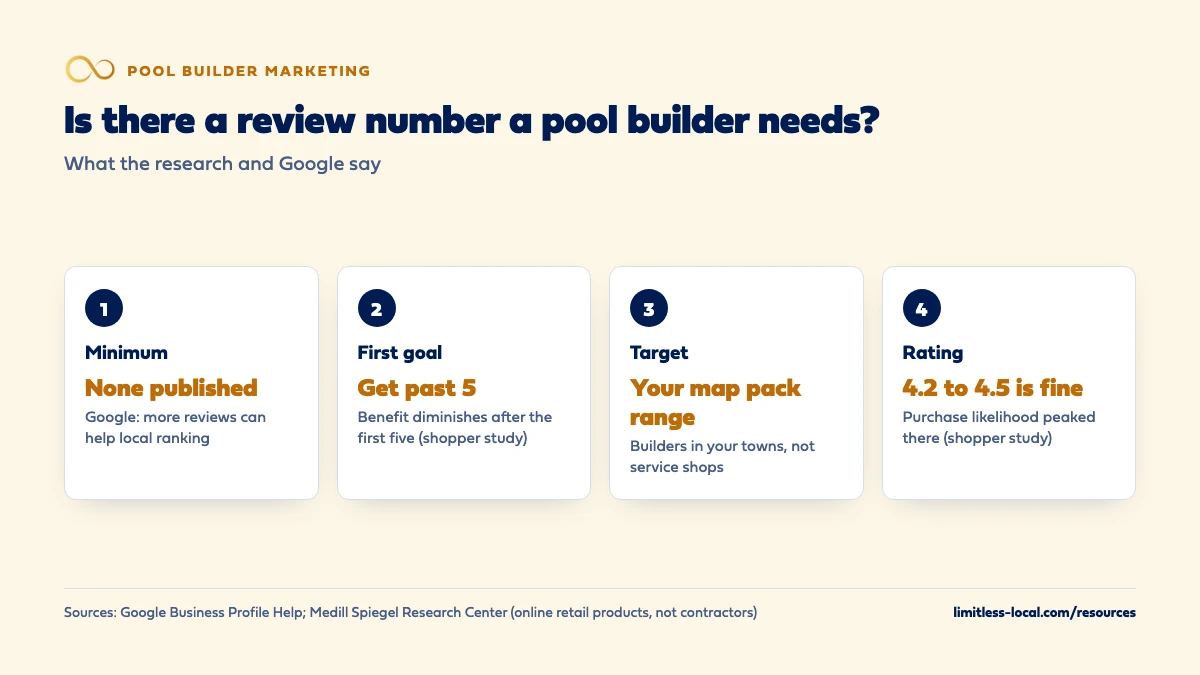
- Google sets no minimum; it says more reviews and positive ratings can help local ranking.
- Your target is the review range of the builders already in your town's map pack.
- Recency matters to homeowners: aim for new reviews across the season, not a one-time push.
- A spotless 5.0 isn't the goal; shopper research found purchase likelihood peaks between 4.2 and 4.5 stars.
For pool builders trying to set a realistic review target against the builders already showing up in their towns.
Get a free visibility audit · Book a growth call
How many Google reviews does a pool construction company need before it looks credible?
Google doesn’t publish a minimum number of reviews, so there’s no single count that makes a pool builder competitive. The practical target is the range held by the builders already showing in the map pack for your main searches in your main towns, plus a steady flow of new reviews through the season so your newest one is never months old. Research on online shoppers suggests the first handful of reviews matters most for trust, so a builder with very few should treat getting past that point as the first goal.
Reviews are one of the few ranking signals a pool builder fully controls, and every build you finish is a chance to earn one. Our local SEO work includes review response and review generation, and the pool builder marketing page shows how it fits with the rest of what we run for pool companies. We won’t promise a ranking from any number of reviews; nobody honestly can. More answers are in the pool builder marketing questions library.
Is there a minimum number of Google reviews to show up in Maps?
No. Google doesn’t publish a minimum. It says local results are mainly based on relevance, distance and popularity, and that the popularity side is based in part on how many websites link to your business and how many reviews you have. It also says more reviews and positive ratings can help your business’s local ranking. Source: Tips to improve your local ranking on Google.
That means reviews help, but they’re one input among several. A builder with fewer reviews can still show up above one with more if their office is closer to the person searching or their profile better matches the search. If that’s happening in your market, why a competitor outranks you in Maps walks through the other gaps.
How do I find the right review number for my towns?
Look at who you’re actually up against. In our judgement, the most useful target comes from a short, repeatable check:
- Search the way your buyers do, such as “pool builder” or “inground pool builder” plus your main towns.
- Note the review count and star rating of each builder in the map pack, and of the next few below it.
- Ignore pool service and supply stores; compare only builders.
- Repeat for your two or three most important towns.
The middle of that range is a sensible near-term target; the top of it is the longer-term one. Searches from different spots give different results, so check from the towns you want work in, not only from your office. Write the numbers down and check again each quarter, because competitors keep adding reviews too.
How many reviews before a pool company looks credible?
Research on online shoppers gives a useful hint. In findings first published in 2017, the Medill Spiegel Research Center found that the purchase likelihood for a product with five reviews was 270% greater than for one with no reviews, and that the benefit of more reviews diminishes rapidly after the first five. Source: How Online Reviews Influence Sales. That study covered online retail products, not contractors, so treat it as a direction, not a pool industry benchmark.
In our judgement, the lesson for a pool builder is that zero to a handful of reviews is the biggest gap to close, and closing it should be the first goal for a new company. Past that point, credibility depends more on what the reviews say and how recent they are than on adding one more to the count. What homeowners look for in those reviews is covered in what pool customers mention in reviews.
Do reviews matter more for a pool builder than for a small trade job?
Likely, yes. The same Spiegel research on online products found that reviews have a greater effect on purchase likelihood for higher-priced items: displaying reviews raised the conversion rate by 190% for a lower-priced product and by 380% for a higher-priced one. Source: How Online Reviews Influence Sales. Pools weren’t part of it, so read it as a direction, not a pool benchmark.
A pool is one of the largest purchases a homeowner makes for the house, and it’s a months-long relationship with the builder. In our judgement, that makes homeowners read pool builder reviews more carefully than they’d read reviews for a one-hour repair, looking for stories about communication, timelines and how problems were handled. A smaller number of detailed reviews from real builds can do more for you than a large number of one-line ones.
Curious what your marketing is actually booking?
Get a free visibility audit — no obligation, no sales pitch.
Does my star rating matter more than my review count?
Both matter, and a perfect score isn’t the goal. Google says the review score on your profile is the average of all ratings published on Google for the business, and that after a new review it may take up to 2 weeks for the score to update. Source: Understand review scores for local places & businesses.
The Medill Spiegel Research Center found, across more than 40 categories of online products, that purchase likelihood peaks when the average rating is between 4.2 and 4.5 stars and starts to drop as it approaches a perfect 5, because negative reviews help establish trust. Source: Star Ratings and Review Content. Google’s own tips make a similar point: a mix of positive and negative feedback often feels more trustworthy. Source: Tips to get more reviews.
A calm, specific reply to a critical review often does more for you than the review costs. How to write one is in responding to negative reviews.
What is review velocity, and should a pool builder care?
Review velocity is the pace at which new reviews arrive, such as a few a month. Google doesn’t use that term in its ranking help, so we won’t claim it’s a ranking factor. In our judgement, it matters anyway, for two reasons.
First, homeowners notice dates. A builder whose newest review is from last summer looks quieter than one with a review from last week, even if the older builder has more in total. Second, a steady flow is simply how a review count grows without bursts that look unnatural. For a pool builder, the natural pace follows your build calendar: reviews come as pools are handed over, so expect more in the months you finish the most builds.
The way to keep the pace steady is to ask at the same point in every build. When to ask for a review during a build covers the timing.
How many new reviews a month should a pool builder aim for?
Work it back from your builds rather than picking a number. In our judgement, a reasonable goal is a review request to every customer at handover, with a reminder a few days later, and an honest count of how many of those turn into posted reviews.
If you finish a handful of pools a month in season, your review flow will be a handful at best, and that’s fine. You can add to it by asking customers from past seasons who were never asked, and by asking renovation and remodel customers too. Google’s tips for getting more reviews include reminding customers to leave reviews through a Google link or QR code. Source: Tips to get more reviews. The full process is in getting more Google reviews.
How quickly do new reviews show up and count?
Not instantly. Google says reviews are checked to make sure they comply with its policies, and that this can take a few days, which can delay a review’s appearance on your profile. Source: About missing or delayed reviews. The overall score can take up to 2 weeks to update after a new review.
As for ranking, Google doesn’t say how fast reviews affect your position, and we won’t guess. In our judgement, treat reviews as a steady, long-term input rather than a lever that moves Maps in a week.
Can I catch up faster by buying reviews or offering a discount?
No. Google says reviews must reflect a genuine experience, and that offering incentives such as free or discounted goods or services in exchange for posting, changing or removing reviews isn’t allowed. Source: Tips to get more reviews. Its contribution policy also prohibits fake engagement. Source: Prohibited & restricted content.
For a pool builder, that rules out a discount on the final payment in exchange for a review, and it rules out swapping reviews with other contractors. The slow way, asking every real customer, is the only way that doesn’t put your profile at risk.
Should I stop worrying about reviews once I match my competitors?
No, but you can stop chasing a number. In our judgement, once you’re in the range of the builders in your map pack, the priorities shift: keep the flow steady, reply to every review, and make sure the reviews describe the work you want more of, whether that’s custom gunite pools, renovations or full backyard projects. Reviews that mention those projects help homeowners see that you build what they want.
Your competitors will keep adding reviews, so the target moves. Re-check the range each quarter and adjust.
Not sure which of these is costing you jobs?
A free visibility audit checks the Google profile, reviews, site and tracking, and shows what to fix first.
Why review targets look different for pool builders
Fewer jobs means fewer reviews. A plumber can finish dozens of jobs a week; a pool builder finishes far fewer. Your review count will grow more slowly than a service trade’s, so compare yourself with other builders, not with every home-service business in town.
Reviews follow your build calendar. Most come at handover, so expect them to bunch up when pools are finished and thin out in the off-season. Past-season customers fill the gaps.
Pool service companies aren’t your benchmark. They serve many recurring customers and can collect reviews much faster. Leave them out of your comparison.
Each review carries more weight. Homeowners making a large, long purchase read the details, so a review describing the build, the crew and the finished backyard is worth more than a star count alone.
A worked example: setting a review target for your towns
These numbers are made up to show the method, not a benchmark. Say you check the map pack for “pool builder” in your two main towns and find three builders with 60, 85 and 120 reviews, and you have 25. The middle of that range, 85, is a sensible near-term target and the top, 120, a longer-term one. A first step is reaching the bottom of the range, 60, which means 35 more reviews.
Say you finish 30 pools a year and about half of those customers leave a review when asked at handover with a reminder, so 15 a year. Add a one-time request to past customers from earlier seasons, and say 10 of them respond. That’s 25 new reviews in the first year, putting you at 50, with the bottom of the range within reach in the second year. Meanwhile the three competitors keep collecting too, so re-check their counts each quarter. Swap in your own build count and response rate.
Frequently asked questions
Is 25 reviews enough for a pool builder?
It depends entirely on your towns. If the builders in your map pack have about that many, it may be; if they have several times more, treat it as a starting point.
Do reviews on other sites count toward my Google ranking?
Google’s ranking help talks about the reviews on your Business Profile. Reviews elsewhere can still help homeowners decide, but focus your requests on Google first.
Should I ask customers to mention specific words in their review?
Ask them to describe their experience in their own words, such as the build, the crew and the finished pool. Scripting reviews risks making them read as less than genuine.
Can I count reviews from my old business name?
Reviews stay with the Business Profile they were left on. If you renamed the business on the same profile, they come with it; a new profile starts from zero.
Do renovation customers' reviews help a pool construction company?
Yes. They’re genuine customers of your business, and their reviews describe work homeowners also search for. Ask them the same way you ask new-build customers.
Key takeaways
- Google publishes no minimum review count; it says more reviews and positive ratings can help local ranking.
- Set your target from the builders in your town’s map pack, and re-check it every quarter.
- Shopper research suggests the first five reviews matter most; a new company should get there first.
- A 4.2 to 4.5 average with detailed reviews can be more convincing than a spotless 5.0.
- Keep reviews coming through the season by asking at every handover, and never buy or incentivize them.
Want a second set of eyes on your setup?
We'll look at how you show up locally and where calls are leaking, then send you a plain-English breakdown.
More in this section
- How do I get more Google reviews for my pool company?
- When should a pool builder ask for a review during the build?
- How should a pool builder respond to negative Google reviews?
- Which online listings should a pool builder have besides Google?
- What should pool customers mention in their Google reviews?
Sources
- Tips to improve your local ranking on Google — Google Business Profile Help
- Understand review scores for local places & businesses — Google Business Profile Help
- About missing or delayed reviews — Google Business Profile Help
- Tips to get more reviews — Google Business Profile Help
- Prohibited & restricted content — Google Maps User Contributed Content Policy Help
- How Online Reviews Influence Sales — Medill Spiegel Research Center
- Star Ratings and Review Content — Medill Spiegel Research Center