
Do Nextdoor and Facebook groups bring in pool jobs?
- Are Nextdoor and local Facebook groups worth a pool builder's time?
- Do Nextdoor and local Facebook groups actually bring in serious pool jobs?
- How are Nextdoor and Facebook groups different?
- Should a pool builder advertise on Nextdoor?
- How do I get recommended in local Facebook groups and on Nextdoor?
- Can I post about my own pool company in neighborhood groups?
- What should a pool builder post on Nextdoor?
- How should I answer pool questions in Facebook groups?
- How do I track whether neighborhood platforms bring in pool jobs?
- When are Nextdoor and Facebook groups not worth the time?
- What's different about neighborhood platforms for pool construction
- A worked example: is a Nextdoor ad test worth it?
- Frequently asked questions
- Key takeaways
- More in this section
- Sources
The short version
- Both work mainly through neighbors recommending a builder they hired, not through ads or self-promotion.
- Claim a free Nextdoor business page and ask happy customers to recommend you there.
- In Facebook groups, follow each group's rules, answer questions helpfully, and let customers do the recommending.
- Treat both as support for Google, reviews and referrals, and track whether they produce signed contracts.
For pool builders who see neighbors asking “who built your pool?” online and want to know whether Nextdoor or local Facebook groups can turn that into signed contracts.
Get a free visibility audit · Book a growth call
Are Nextdoor and local Facebook groups worth a pool builder's time?
Nextdoor and local Facebook groups can bring in pool jobs, mostly through recommendations from past customers when a neighbor asks who built their pool, not through a builder’s own promotion. Nextdoor offers a free business page, free business posts and paid ads, and Facebook community groups set their own rules about business posts. In practice they work best as a word-of-mouth channel that supports, rather than replaces, Google search, your Google Business Profile and referrals.
Neighborhood recommendations work best when the homeowner who hears your name can then find you easily on Google, with strong reviews and a consistent listing everywhere, and that’s what our local SEO work covers. Our pool builder marketing page shows how we approach a high-ticket, long-cycle sale, and the rest of the pool builder marketing questions take the related steps one at a time.
Do Nextdoor and local Facebook groups actually bring in serious pool jobs?
They can, but not the way most builders first try to use them. In our judgement, the jobs come from recommendations: a homeowner posts “Who built your pool? Would you use them again?” and a past customer answers with your name. That kind of mention carries weight because it comes from a neighbor, not from you.
What rarely works is treating a community platform like an ad board. Posting “Now booking spring pool builds!” in every neighborhood group tends to get ignored, removed or resented. The serious pool buyer on these platforms is usually asking for a name they can trust, and the builder’s job is to make sure past customers are there to give it and that the name leads somewhere convincing when they look it up.
How are Nextdoor and Facebook groups different?
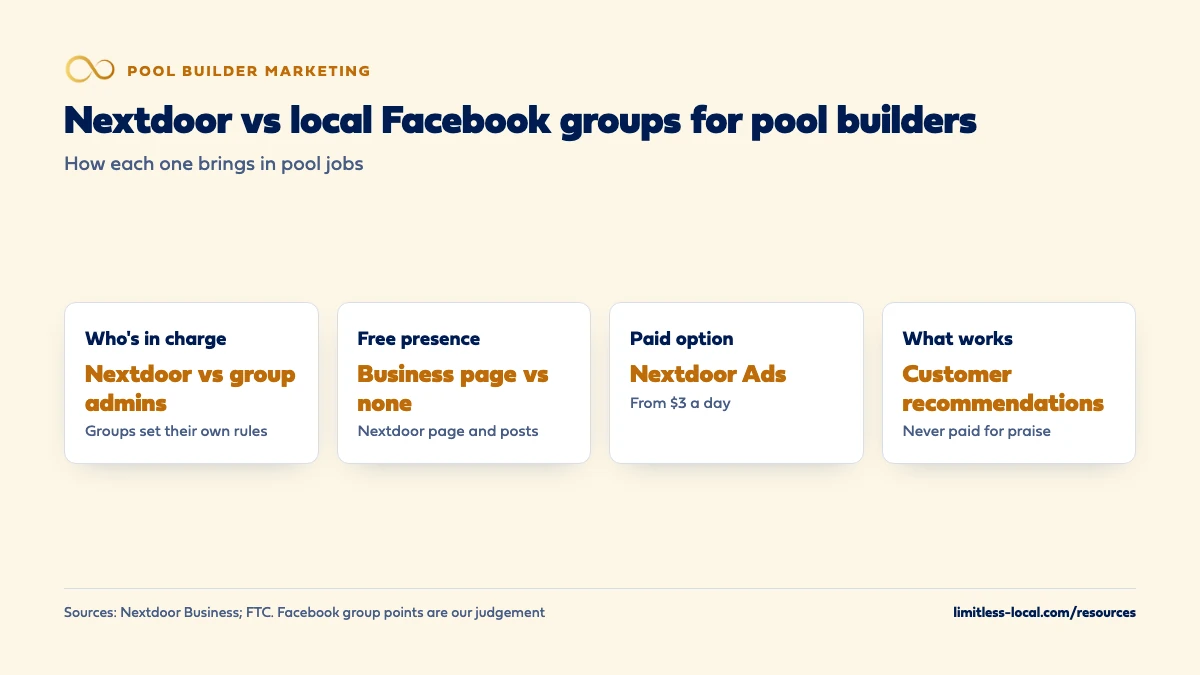
Nextdoor is built around neighborhoods. Nextdoor’s small business page describes it as a local social platform that brings neighbors and businesses together, and says businesses can create a free Business Page, publish free Business Posts that appear in the neighborhood newsfeed, show up in search, get recommendations from customers and run ads. Nextdoor says one in three US households are on it; that’s the company’s own figure.
Facebook groups are run by their members. Local community, neighborhood, homeowners’ association and “moms of” groups each have their own admins and rules, and many limit or ban business posts. In our judgement, that makes a Facebook group closer to a room you’re invited into than a channel you control: helpful answers and customer recommendations are welcome, sales posts often aren’t.
Should a pool builder advertise on Nextdoor?
It’s worth a small, tracked test once your free business page has recommendations on it. Nextdoor’s post on selecting a budget for Nextdoor Ads describes recommended monthly plans of $3, $5 or $10 a day that run until you cancel, or a budget you customize yourself. On a recommended plan, Nextdoor charges your daily budget times 31 days upfront and bills the same amount every 31 days after.
In our judgement, a pool builder should be cautious about expecting a small social ad to produce a large, considered purchase on its own. Treat a Nextdoor ad like other social ads: it puts finished pools in front of nearby homeowners, and the homeowners who are serious will look you up, read reviews and visit your website before they call. Measure it by inquiries and signed contracts you can trace to it, not by views. Whether Facebook and Instagram ads work for pool builders covers the same logic for Meta’s paid ads.
How do I get recommended in local Facebook groups and on Nextdoor?
By doing work people want to talk about, then making it easy for them to say so. In our judgement, a few habits make the difference:
- Ask at the right moment. The weeks after the first swim, when the family is happiest, are the time to ask a customer to recommend you on Nextdoor or answer if anyone asks about builders in their groups.
- Make it easy. Send a short link to your Nextdoor business page so they can add a recommendation in a minute.
- Don’t script them. A recommendation in a customer’s own words reads as real; copied text doesn’t.
- Never pay for a positive post. The FTC’s final rule on fake reviews and testimonials prohibits businesses from providing compensation or other incentives conditioned on reviews expressing a particular sentiment, positive or negative.
That’s general information, not legal advice. The same timing works for Google reviews; when to ask for a review during a build covers it.
Curious what your marketing is actually booking?
Get a free visibility audit — no obligation, no sales pitch.
Can I post about my own pool company in neighborhood groups?
Only where the group’s rules allow it, and with care about who’s speaking. If you, a family member or an employee answer “who’s a good pool builder?” with your company’s name, say plainly that it’s your company. The FTC’s endorsement guides FAQ says that if there’s a connection between an endorser and a marketer that consumers wouldn’t expect and it would affect how they evaluate the endorsement, it should be disclosed clearly and conspicuously, and the FTC’s fake reviews rule addresses undisclosed insider reviews and testimonials. That’s general information, not legal advice.
Beyond the rules, neighbors notice. In our judgement, a builder caught recommending themselves under a family member’s name loses more trust in that neighborhood than any post could win.
What should a pool builder post on Nextdoor?
Useful, local and occasional. In our judgement, the posts that fit a neighborhood feed are the ones a neighbor would find interesting even if they weren’t buying: a finished pool in the area with the homeowner’s permission, a short explanation of how long permitting usually takes in your town, a reminder about opening or safety before the season. Keep the sales language light and give a clear way to contact you or book a consultation.
Don’t post the same thing you post everywhere. What a pool builder should post on Instagram and Facebook covers your own pages, which follow different norms from a shared neighborhood feed.
How should I answer pool questions in Facebook groups?
As a helpful expert, not a salesperson. When someone asks how long a pool takes to build, what affects the price, or whether fiberglass or concrete suits their yard, a clear, honest answer from someone who builds pools locally is often the most useful reply in the thread. In our judgement, answering well, saying who you are, and leaving the pitch out builds more credibility than any promotional post, and people who want to hire you will find you.
Follow the group’s rules on whether you may include a link or a phone number. If the rules say no promotion, don’t add one.
How do I track whether neighborhood platforms bring in pool jobs?
Ask every new lead how they heard about you, and give the answer a specific option for Nextdoor and for Facebook groups rather than lumping them under “social media” or “word of mouth.” Use a tracked link for your Nextdoor page and any Nextdoor ads. Then keep the source on the lead until the contract signs or is lost.
Expect overlap. A homeowner who saw your name in a group will often search for you on Google before calling, so the first touch and the last touch may differ. Tracking which marketing produces signed contracts covers how to record both.
When are Nextdoor and Facebook groups not worth the time?
- When you have few finished pools in the area. Recommendations need customers to make them.
- When your Google presence is weak. A name mentioned in a group is only as good as what the homeowner finds when they search it.
- When posting takes the owner away from consultations. In our judgement, an hour a week is plenty for most builders.
- When the groups are full of price-only requests. Some groups mostly attract bargain hunters, which may not fit the work you want.
What's different about neighborhood platforms for pool construction
Pools are visible. Neighbors see the excavation, the trucks and the finished backyard. A pool builder’s work advertises itself on the street in a way a furnace repair never does, so neighborhood conversations about builders are common.
The recommendation question is common. A homeowner planning a large, rare purchase wants a name someone they know has used. In our judgement, that makes recommendations from past customers more valuable to a pool builder than to most trades.
Bad builds get discussed too. Delays and disputes also surface in neighborhood threads. Responding calmly and fixing problems matters as much as collecting praise.
The cycle is long. A homeowner who saves your name in May may call in the fall, so these platforms show results slowly and unevenly.
Not sure which of these is costing you jobs?
A free visibility audit checks the Google profile, reviews, site and tracking, and shows what to fix first.
A worked example: is a Nextdoor ad test worth it?
These numbers are made up to show the math, not a benchmark for your market. Say a pool builder runs a Nextdoor ad at one of Nextdoor’s recommended plans, $10 a day, for three 31-day billing periods. That’s $310 a period and $930 for the test.
Say the tracked link and the “how did you hear about us” answer show 6 inquiries and 2 design consultations from the ad, and 1 signed contract arrives later in the season. That’s $155 per inquiry and $930 for the signed contract. If one pool leaves far more than that after costs, the test earned a second round. If no contract traces back after a full season, put the money into what’s already producing signed contracts. How much you can afford to win one pool customer walks through that ceiling.
Frequently asked questions
Is Nextdoor free for a pool builder?
Nextdoor says its Business Page and Business Posts are free; ads are paid. You can use the free parts without ever running an ad.
Can I offer customers a discount for recommending me on Nextdoor?
Be careful. The FTC’s fake reviews rule prohibits incentives conditioned on a positive or negative review, and its endorsement guides call for disclosing incentives that could affect how people weigh a recommendation. That’s general information, not legal advice.
Should I join every local Facebook group in my service area?
Join the ones where homeowners in the towns you build in actually ask for recommendations, read the rules, and follow them. A few active groups beat dozens you never check.
What do I do about a negative post about my pool company in a group?
Respond once, calmly and briefly, offer to resolve it directly, and take the details offline. Arguing in public rarely helps. Responding to negative reviews covers the same approach for Google.
Do Nextdoor recommendations help my Google ranking?
Not directly, as far as we know. Google reviews and your Google Business Profile are what show on Google; treat Nextdoor as its own word-of-mouth channel.
Should I run Nextdoor ads or Facebook ads?
Test whichever reaches more homeowners in the towns you build in, with a small tracked budget, and keep the one that produces signed contracts. In our judgement, Google search ads and retargeting usually matter more than either.
Key takeaways
- Nextdoor and Facebook groups bring in pool jobs mainly through past customers recommending you, not your own promotion.
- Claim a free Nextdoor business page and ask happy customers to recommend you after the first swim.
- Follow each Facebook group’s rules, answer questions helpfully, and disclose when you’re talking about your own company.
- Never pay or reward customers for positive posts; the FTC prohibits incentives conditioned on a review’s sentiment.
- Track these platforms as their own lead source and judge them by signed contracts over a season.
Want a second set of eyes on your setup?
We'll look at how you show up locally and where calls are leaking, then send you a plain-English breakdown.
More in this section
- Do Facebook and Instagram ads work for pool builders?
- What should a pool builder post on Instagram and Facebook?
- Are Local Services Ads worth it for pool builders?
- How do pool builders target high-income neighborhoods with ads?
- Which online listings should a pool builder have besides Google?
Sources
- Small Business Ads: Promote Locally with Nextdoor — Nextdoor
- Tips for selecting a budget for Nextdoor Ads — Nextdoor
- Federal Trade Commission Announces Final Rule Banning Fake Reviews and Testimonials — Federal Trade Commission
- FTC's Endorsement Guides: What People Are Asking — Federal Trade Commission