
Which search terms should a roofing company target for jobs it wants?

- What keywords should a roofer go after to win the jobs it actually wants?
- Why should search terms start from the jobs I want?
- Which groups of search terms matter most for a roofer?
- How do I find out what homeowners in my area actually search?
- How specific should roofing search terms be?
- Should I put town names in my roofing search terms?
- How do these search terms shape my website pages?
- How do search terms shape my Google Business Profile?
- How do search terms shape my Google Ads?
- Which search terms should a roofer avoid?
- What's different about search terms for roofing companies
- A worked example: turning a job list into search terms
- Frequently asked questions
- Key takeaways
- More in this section
- Sources
The short version
- Start from the jobs you want most, not the biggest keyword list.
- Group terms by job: replacement, repair and leaks, storm damage, materials, commercial.
- Check demand in Keyword Planner and your search terms report.
- Each job gets its own page, Google profile service and ad group.
For roofing company owners deciding which searches to build pages, Google profile services and ad groups around.
Get a free visibility audit · Book a growth call
What keywords should a roofer go after to win the jobs it actually wants?
A roofing company should target the searches homeowners use when they’re ready to hire for the specific jobs it wants most: replacement, repair, leak, storm damage and material terms like metal or tile roofing, each paired with the towns it serves. Start from your most profitable jobs, not from the biggest keyword list, then check real search volume in Google’s Keyword Planner and the searches already triggering your ads. Give each job its own page on your website, list it as a service on your Google Business Profile and its own ad group, and leave out terms for work you don’t want, like DIY, supply or job-seeker searches.
Picking the jobs and towns to target is the first step of our local SEO work for roofing companies, and the same job list drives the ad groups when we run ads. If you’re still deciding whether SEO is worth it at all, start with is SEO worth it for roofers, and the roofing marketing questions library covers the rest one at a time.
Why should search terms start from the jobs I want?
Because every term you target brings in a certain kind of caller. If you build pages and ads around “roofing” in general, you’ll get calls for everything from a missing shingle to a commercial flat roof to a homeowner asking for advice. If you build them around “roof replacement” and “metal roof installation” in the towns you serve, you get more of those calls.
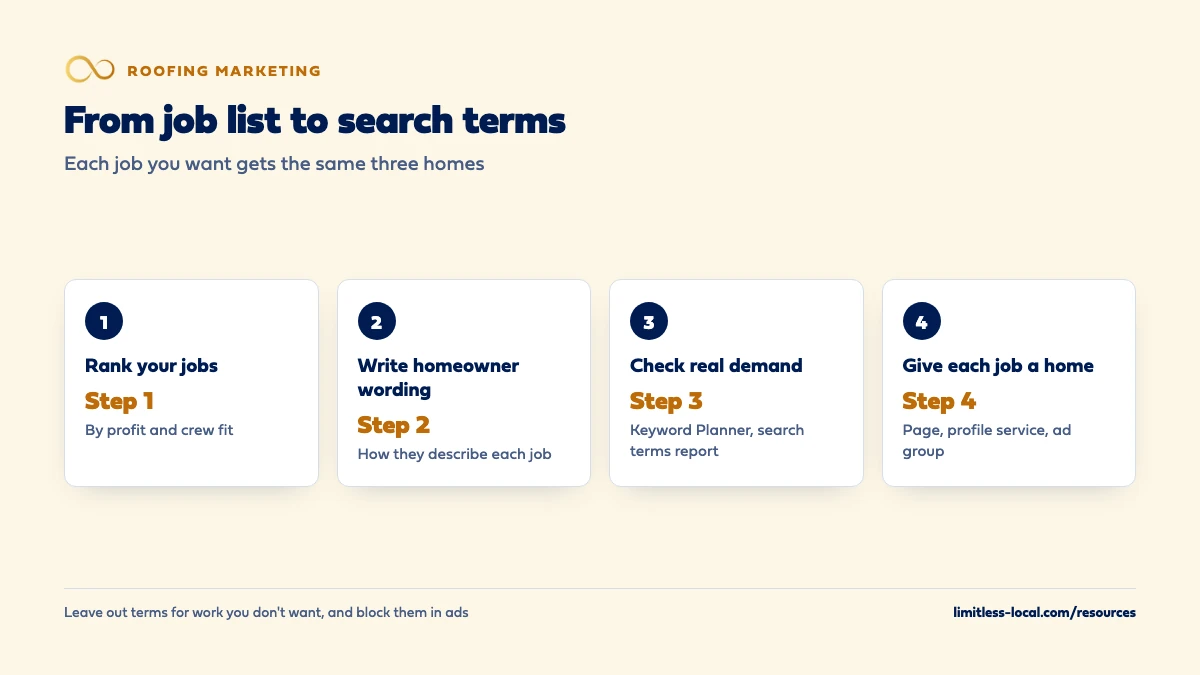
In our judgement, the right order is:
- List the jobs you want more of, ranked by profit and by how well your crews can handle them.
- Write down how a homeowner would describe each job when they need it.
- Check which of those terms people actually search in your area.
- Decide where each term lives: a website page, a Google profile service, an ad group, or all three.
Whether to lean toward repairs or replacements in the first place is its own decision; repairs or replacements covers that trade-off.
Which groups of search terms matter most for a roofer?
Most roofing searches fall into a handful of job groups. In our judgement, these are the ones worth organizing around:
- Replacement: roof replacement, new roof, reroof, replace roof cost, roof replacement near me.
- Repair and leaks: roof repair, roof leak repair, emergency roof repair, missing shingles, roof leak.
- Storm damage: hail damage roof, wind damage roof repair, storm damage roof inspection.
- Materials: metal roofing, standing seam metal roof, tile roof repair, slate roof, flat roof, shingle roof replacement.
- Inspections: roof inspection, free roof inspection.
- Commercial: commercial roofing, flat roof repair, TPO roofing, if you do that work.
- Related exterior jobs: gutters, siding, skylights, only if you want them.
Each group is a different homeowner with a different budget and urgency. A leak search is often urgent; a metal roof search is usually a longer, higher-ticket decision. Keep them apart so each one can get its own page and its own ad.
How do I find out what homeowners in my area actually search?
Use Google’s own tools rather than guessing. Google says Keyword Planner lets you discover keywords related to your business and see estimates of the searches they receive and the cost to target them, including estimated monthly searches. Source: Use Keyword Planner. Set the location to the towns you serve, enter each job group and look at what comes back.
Two cautions from Google itself: keywords with very low search volume can’t be discovered or forecast, and campaign performance depends on more than the estimate, including your bid, budget, ad quality and location targeting. Same source. In smaller towns, that means Keyword Planner may show little or nothing for terms people do search occasionally.
If you already run Google Ads, the search terms report shows the actual searches that triggered your ads. Source: About the search terms report. That’s the best list you’ll ever get of how homeowners near you really phrase it. Your own call notes help too: write down the words callers use when they describe the job.
How specific should roofing search terms be?
Specific enough to describe the job, not so specific that nobody searches it. Google’s keyword guidance says to describe how customers think of your service category, to use the right amount of detail, and not to be overly general or too specific. Source: Best practices for finding new keywords.
Applied to roofing, in our judgement:
- Too general: “roof” or “roofing”. It pulls in homeowners, students, job seekers and suppliers.
- About right: “roof replacement”, “metal roof installation”, “roof leak repair”.
- Too narrow to build around: “30-year architectural shingle replacement on a ranch house”. Real people may search it, but too rarely to plan a page or ad group around.
Google also says to use adjectives sparingly when you start your research, beginning with the core term and adding words like “best” later. Same source. For roofers, that means starting from the job, not from “best roofer” or “top rated roofing company”.
Curious what your marketing is actually booking?
Get a free visibility audit — no obligation, no sales pitch.
Should I put town names in my roofing search terms?
It depends on where the term is used. For ads, Google’s keyword guidance says not to include a location in keywords if you plan to use location targeting, and to include one when your customers aren’t in the same location as your service. Source: Best practices for finding new keywords. Most roofers target ads by location, so in our judgement “roof replacement” with location targeting usually covers “roof replacement [town]” too.
For your website and Google profile, town names do more work. Google says local results are mainly based on relevance, distance, and popularity, and that relevance is how well a profile matches what someone is searching for. Source: Tips to improve your local ranking on Google. In our judgement, a service page that names the towns you actually serve, with real jobs from those towns, helps homeowners and search engines see you’re local. A page for every suburb with the same text and the town name swapped does not.
How do these search terms shape my website pages?
In our judgement, each job group you want should have one strong page: roof replacement, roof repair, storm damage, metal roofing, commercial roofing, and so on. The page should describe the job the way a homeowner would, answer the questions they ask before calling, and show your own work on that job.
Google’s guidance for search is to write people-first content, not content made primarily to gain search rankings. Source: Creating helpful, reliable, people-first content. That’s a good test for roofing pages: if a page only exists to repeat a keyword and would be no use to a homeowner, it’s not worth publishing.
Specialty work deserves its own page when you want more of it. If metal roofs are a priority, marketing metal roof installs shows how one job group becomes a page, an ad group and a review ask.
How do search terms shape my Google Business Profile?
Two places matter. First, your categories: your primary category should be the main thing you do, and additional categories should cover other real services. Choosing Google profile categories covers that in detail.
Second, your services list. Google says businesses in service categories can list their offerings on the profile, choose from suggested services or add custom ones, and that when local customers search for something you offer, that service may be highlighted on your profile. Source: Manage your services on your Business Profile.
In our judgement, the services list should mirror your job groups: roof replacement, roof repair, leak repair, storm damage inspection, metal roof installation and anything else you want more of. Google also says custom service names that include prices, phone numbers or gibberish are rejected, so keep each one a plain job name. Same source.
How do search terms shape my Google Ads?
Each job group becomes its own ad group with its own ad and landing page. Google’s ad guidance is to group keywords by theme instead of putting them all in one ad group, so each ad can be written for that theme, and to send people to a page that matches. Source: Optimize your ads and landing pages.
Match types decide how far each term reaches. Google says broad match, the default, can show your ads on searches related to your keyword that don’t contain its direct meaning, while narrower match types stay closer to the keyword. Source: About keyword matching options. For a roofer on a small budget, in our judgement, that’s a reason to start with phrase or exact match on your best terms and watch the search terms report before broadening.
For bigger-ticket commercial work, the ad side is different enough to read commercial roofing leads with Google Ads.
Which search terms should a roofer avoid?
The ones that bring calls for work you don’t do or people who will never hire you. In our judgement, the usual suspects for roofers are:
- Job seekers: roofing jobs, roofer salary, hiring.
- Do-it-yourself: how to fix a roof leak, DIY roof repair.
- Materials shoppers: roofing supply, shingles wholesale.
- Work you don’t want: commercial, if you’re residential only; tile, if you don’t do tile; towns outside your area.
On your website, the fix is simply not building pages around those terms. In ads, it means negative keywords; negative keywords for roofers has the list and the routine. Be careful not to block buying words like cost, price or inspection, which homeowners use when they’re close to hiring.
What's different about search terms for roofing companies
Storms change the searches overnight. After hail or high wind, searches for storm damage and roof inspections jump in the affected towns. In our judgement, that’s a reason to have a storm page and ad group ready before you need them, not to build them the week after a storm.
Replacement terms are worth more but compete harder. A replacement search is a bigger ticket than a repair, so more roofers bid on it and build pages for it. Keyword Planner’s cost estimates show what you’d likely pay to target each term in your area.
Material terms reveal the buyer. A homeowner searching standing seam metal or slate has usually done some research and has a budget in mind. If you install those materials well, those terms can be worth more than their search volume suggests.
Insurance words need care. Terms about insurance claims bring in homeowners at a stressful moment. Target them only if you do that work, and never promise claim outcomes in pages or ads.
Want to see where your company stands?
A free visibility audit shows where you show up on Google, Maps and AI answers, and what it's costing you in calls.
A worked example: turning a job list into search terms
These numbers are made up to show the method, not real search data for any market. Say you’re a residential roofer who wants more replacements and metal roofs, takes repairs to keep crews busy, and doesn’t do commercial.
- Replacement: Keyword Planner shows about 480 searches a month across your towns for replacement terms. One page, one ad group, a profile service.
- Repair and leaks: about 720 searches a month. One page, one ad group, a profile service.
- Metal roofing: about 90 searches a month. Small, but each job is large and it’s what you want more of. One page, one ad group, a profile service.
- Commercial: left out of pages and added as negative keywords in ads.
The biggest group, repair, isn’t the top priority, because replacements and metal roofs carry the profit you want. You’d likely put more ad budget behind replacement and metal, and let repair pages and your Google profile bring in repair calls. Our Essentials package at $3,500 a month covers local SEO for one location and Google Ads management.
Frequently asked questions
Should I target "roofer near me"?
In our judgement, in ads, broad and phrase match keywords for your core jobs with location targeting usually cover near-me searches. On your website, in our judgement, it’s better to name the towns you serve than to write “near me” into pages.
How many search terms should a roofing company target?
There’s no set number. In our judgement, think in job groups, usually five to eight, each with a handful of closely related terms, rather than hundreds of separate keywords.
Should I target my competitors' company names?
In our judgement, no. It usually brings in people looking for someone else; spend the money on your own job terms.
Do I need different search terms for SEO and ads?
The job groups are the same. Ads can test terms quickly and show you real searches; SEO pages then build around the terms that bring in the jobs you want.
How often should I revisit my roofing search terms?
In our judgement, check the search terms report weekly while ads run, and review the job list and pages every few months or when you add a service.
Key takeaways
- Start from the roofing jobs you want most, ranked by profit and crew fit, not from the biggest keyword list.
- Group terms by job: replacement, repair and leaks, storm damage, materials, inspections, commercial.
- Check demand in Keyword Planner and the search terms report, knowing low-volume terms may not show.
- Give each job group a website page, a Google profile service and its own ad group.
- Use location targeting in ads; on pages, name the towns you serve with real local work.
- Leave out job-seeker, DIY and supply searches, but don’t block buying words like cost or inspection.
Not sure what's working right now?
Start with a free visibility audit: rankings, Google profile, reviews and tracking, checked against your service area.
More in this section
- What marketing should a roofing company add first to grow?
- What should a roofing website include to get more estimate requests?
- Which negative keywords should a roofer add to Google Ads?
- How should a roofing company market commercial roofing?
- What should a roofing Google ad actually say?
Sources
- Use Keyword Planner — Google Ads Help
- Best practices for finding new keywords — Google Ads Help
- About the search terms report — Google Ads Help
- About keyword matching options — Google Ads Help
- Optimize your ads and landing pages — Google Ads Help
- Tips to improve your local ranking on Google — Google Business Profile Help
- Manage your services on your Business Profile — Google Business Profile Help
- Creating helpful, reliable, people-first content — Google Search Central