
How do I market a new electrical business from day one?
- What marketing should a brand-new electrical contractor set up in the first month?
- What does marketing from day one actually mean for a new electrical business?
- Step 1: Decide which jobs and which towns you want
- Step 2: Lock in a business name, phone number and domain you'll keep
- Step 3: Set up and verify your Google Business Profile
- Step 4: Put up a small website that turns visits into calls
- Step 5: Set up tracking before the first call comes in
- Step 6: Have a review link ready for the very first job
- Step 7: Decide who answers the phone while you're on a job
- Step 8: Turn on paid search when you can handle the calls
- What can a new electrical business skip at first?
- How much should a brand-new electrical business budget for marketing?
- What's different when the new business is an electrical contractor
- A worked example: the first month of paid search for a new electrician
- Frequently asked questions
- Key takeaways
- More in this section
- Sources
The short version
- Decide the jobs and towns you want before you build anything.
- Own your business name, main phone number, domain and Google Business Profile from day one.
- Verify your Google profile, build a small website, and set up call tracking before the first call.
- Ask every early customer for a review, and make sure the phone gets answered.
- Add paid search once you can take the calls it brings.
For electricians opening their own shop who want the marketing set up right from the start: the Google profile, the website, tracking and the phones. Licensing, permits and setting up the company itself are outside this page.
Get a free visibility audit · Book a growth call
What marketing should a brand-new electrical contractor set up in the first month?
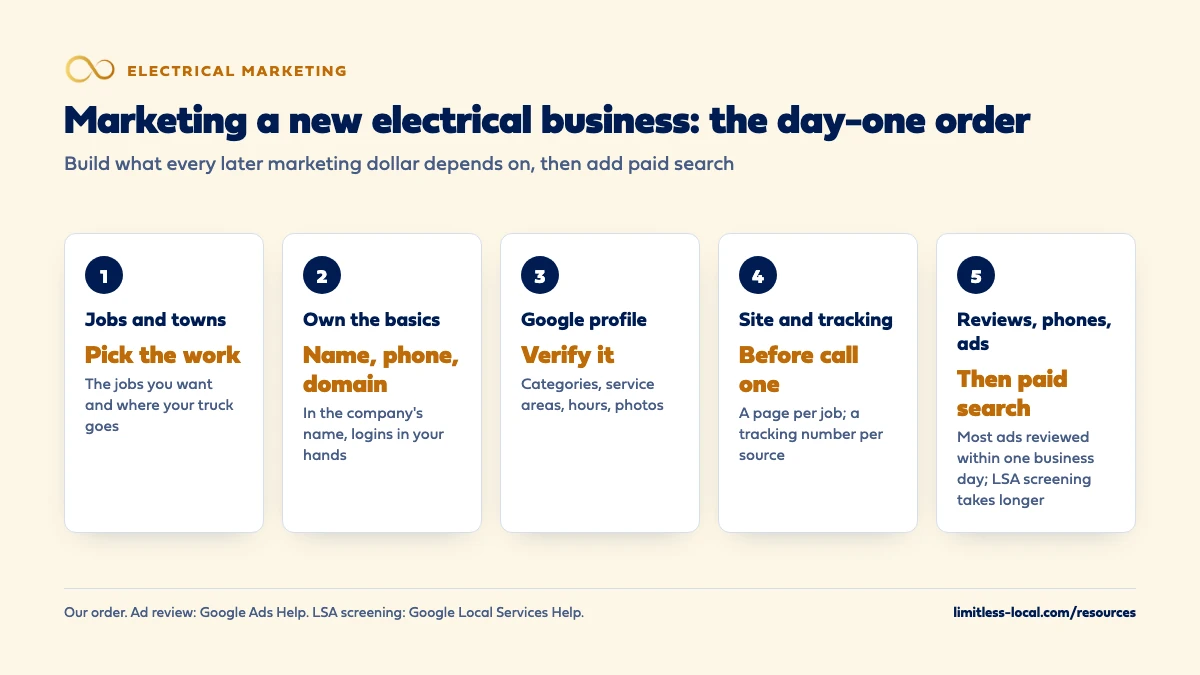
The right order depends on your market and the work you want, but most new electrical businesses should start with the pieces every later marketing dollar depends on: decide which jobs and towns you want, lock in a business name, phone number and website domain you own, verify a Google Business Profile, and put up a simple website with a page for each main kind of work. Set up call tracking before the first call comes in, ask every early customer for a Google review, and make sure someone answers the phone. Paid search can come next, once you can handle the calls: Google says most ads are reviewed within one business day, while Local Services Ads screening takes 3–4 weeks on average.
Setting up that foundation is the first of the three phases in how we work: tracking, follow-up and a clean online presence first, then lead flow from local SEO and ads, then monthly improvement based on calls, leads and revenue. Our packages page shows what each tier includes, our electrical contractor marketing page explains how we approach the trade, and the rest of the electrical marketing questions library goes question by question.
What does marketing from day one actually mean for a new electrical business?
It means building the pieces that every later marketing dollar runs through, before you spend those dollars: a Google profile people can find, a website that turns a visit into a call, a phone that gets answered, and a way to tell which marketing brought each job. Most of it costs time more than money.
In our judgement, the order matters more than the budget. A new shop that runs ads before it has a verified Google profile, a working website or any tracking pays for clicks it can’t measure and calls it may not catch. A new shop that sets up the foundation first can turn on paid search later and know within weeks what a booked job cost. Where your first customers usually come from, such as friends, past employers, general contractors and other trades, is covered in how a new electrical contractor gets its first customers; this page is the marketing setup that sits underneath all of it.
Step 1: Decide which jobs and which towns you want
Before you build a profile or a website, write down two short lists. The first is the work you want more of: service calls and troubleshooting, panel upgrades, EV charger installs, generators, lighting, remodel wiring or commercial tenant work. The second is the towns or ZIP codes your truck can reach in a reasonable drive.
Those two lists decide almost everything that follows: the categories and service areas on your Google profile, the pages on your website, and later the keywords and locations in your ads. A shop that says it does “all electrical work, everywhere” gives Google and customers little to go on. Keep the first version narrow and widen it as you add trucks.
Step 2: Lock in a business name, phone number and domain you'll keep
Your business name, main phone number and website address will end up on your Google profile, your trucks, your invoices and dozens of other listings. Changing any of them later means chasing every copy, so pick them once and keep them.
- The name should be the real business name you’ll use everywhere, without extra keywords stuffed in.
- The main phone number should be a business line you control and can move between carriers or phones, not a personal cell you might give up.
- The domain (yourcompany.com) should be registered in the company’s name, with the login in your hands, not a web designer’s or a relative’s.
In our judgement, ownership is the part new owners most often get wrong.
Step 3: Set up and verify your Google Business Profile
For most new electricians, the Google Business Profile is the first place new customers will find you, on Maps and in local search. Google’s overview for service businesses describes a service-area business as one that visits customers directly but doesn’t serve them at its business address, which is how most electrical contractors work. Your profile can show your business name, website, phone number, hours, reviews, services and the areas you serve.
Verification is the step new owners stall on. Google’s verification help says the methods available are determined automatically and can’t be changed, that they depend on your business type, public info, region and hours, and that some businesses need more than one method. Options can include phone or text, email and video. Google’s local ranking tips say verifying makes your business more likely to show up in search results, and that businesses with complete and accurate info are more likely to show up in local results.
Fill in the categories, service areas, hours, services and photos of your real work and truck. Google also notes there’s no way to request or pay for a better local ranking. Our page on optimizing an electrician’s Google Business Profile goes field by field.
Step 4: Put up a small website that turns visits into calls
A new electrical business doesn’t need a large website on day one. It needs a site that loads fast on a phone, shows the phone number at the top of every page, and has a page for each main kind of work from your Step 1 list, such as panel upgrades, EV chargers and service calls, plus a page for the area you serve.
In our judgement, the pages that matter most early are the ones a homeowner lands on when they’re ready to call: what you do, where you do it, how to reach you, and why to trust you. That last part means your license number where your state requires or allows it, your insurance, photos of real work and, as they come in, reviews. Our page on what an electrician’s website needs to get more calls covers each element.
Curious what your marketing is actually booking?
Get a free visibility audit — no obligation, no sales pitch.
Step 5: Set up tracking before the first call comes in
Tracking is the step new owners put off, and it’s the one that’s hardest to fix later, because you can’t go back and find out where last month’s calls came from. Set up two things from the start.
A tracking number per source. CallRail’s source tracking help recommends using one source tracking number per campaign to prevent inaccuracies in your reports, and lists online and offline sources it can track, including paid search, organic search, directory listings such as Google My Business (now Google Business Profile) and printed materials such as flyers, signs and business cards. For a new electrician that might mean one number on the Google profile, one on the website and one on the truck.
A lead source on every job. Whatever field software you use, such as Jobber, Housecall Pro or ServiceTitan, make the lead source a required field when a job is booked. A 2019 SBA blog post on getting the most from a marketing budget makes the same point at its simplest: tracking can be as easy as asking new customers where they learned about your business. Our page on tracking which electrical marketing brings in real jobs covers the full setup.
Step 6: Have a review link ready for the very first job
A new profile with no reviews is easy to skip. Google’s help on review links shows how to create a link or QR code from your Business Profile and suggests sharing it on receipts and in thank-you emails; Google also says review requests can go out by email, WhatsApp message or Facebook post.
The same page is firm on one rule: offering incentives, such as free or discounted services, in exchange for reviews is prohibited. Ask every customer, including the small service calls, and ask on the day the job is finished, while the work is fresh. Put the link in your invoice template.
Step 7: Decide who answers the phone while you're on a job
When you’re the only electrician, you’re also the receptionist, and every call that rings out while you’re in a crawlspace is a customer who may call the next name on the list. Decide before you advertise how calls get answered: forwarding to a family member or office helper, an answering service, or a set callback routine for every missed call.
Electrical calls add one wrinkle. Some callers describe a burning smell, a warm outlet or a panel that sparked, and in our judgement those calls should reach a person quickly rather than wait for a callback. Our page on how to stop missing calls lays out the options from cheapest to most complete.
Step 8: Turn on paid search when you can handle the calls
Once the profile, website, tracking and phones are in place, paid search is the fastest way to add calls. Google’s page on the ad review process says most ads are reviewed within one business day, though more complex reviews can take longer. Start with the jobs from your Step 1 list that are worth the most to you, in the towns you actually want.
Local Services Ads take longer to get going. Google’s screening requirements for the United States list state-level business and owner license requirements, require a public and verified Google Business Profile, and say the screening process takes 3–4 weeks on average after you submit your documents; Google recommends starting it as soon as possible after creating your account. Which to start with, and when SEO should come in, is covered in whether to start with LSAs, Google Ads or SEO.
What can a new electrical business skip at first?
In our judgement, these can usually wait until the foundation is working:
- A daily social media schedule. A business page with real photos is worth having; posting every day isn’t the first priority.
- Paid directory upgrades and bulk listing packages. Get your free listings right first.
- Ads for every kind of electrical work at once. Start with a few jobs and towns, then add more once you can see what a booked job costs.
- Long contracts with anyone. A new business changes fast; keep marketing commitments short until you know what works.
How much should a brand-new electrical business budget for marketing?
There’s no single right number. The 2019 SBA blog post says there’s no hard and fast answer, that many businesses use a percentage of revenue as a guide (projected revenue, if you’re a startup), and that a business usually needs to budget more for marketing when it’s just starting out, because it’s still building awareness and attracting customers.
For a new electrical shop, in our judgement, that usually means spending owner time on the free setup first, then putting a modest, tracked amount into paid search and raising it only when the numbers show what a booked job costs.
Not sure which of these is costing you jobs?
A free visibility audit checks the Google profile, reviews, site and tracking, and shows what to fix first.
What's different when the new business is an electrical contractor
Your license is part of your marketing. Licensing rules for electrical contractors vary by state, so check with your state’s licensing board what you must show, and where. Local Services Ads screening, for one, can include state-level business and owner license requirements, and in our judgement a license number shown up front helps a homeowner decide to call. This isn’t legal advice.
Service calls and project work start differently. Small service and troubleshooting calls tend to come in fast from Maps and paid search. Panel upgrades, EV chargers and generators usually involve a quote and a decision, so in our judgement they show up later and need their own pages and their own tracking.
Safety calls need a plan from the first day. A caller with a burning smell or a sparking panel isn’t a lead to call back tomorrow. Decide how those calls reach someone before your number goes on a truck.
A worked example: the first month of paid search for a new electrician
These numbers are made up to show the math, not a benchmark for your market. Say a new one-truck electrician finishes the setup in Steps 1 to 7 and then spends $1,200 on Google search ads in the first month, aimed at service calls and panel upgrades in four nearby towns.
- Call tracking shows 36 calls from the ads.
- The field software, with the lead source filled in on every job, shows 9 of those calls booked a job.
- Cost per booked job: $1,200 divided by 9, or about $133.
With tracking in place, the owner can compare $133 against what a booked service call and a booked panel upgrade are worth, and decide whether to raise the budget, change the jobs the ads target, or fix how calls get answered. If you want help instead, our Essentials package is $3,500 a month and includes business listing cleanup and buildout, Google Business Profile management, call, web and form tracking with basic attribution, and Google Ads management up to $2,500 a month in ad spend, which is paid to Google separately. For many brand-new shops, the free setup on this page comes first.
Frequently asked questions
Can I market an electrical business before I have a license?
That’s a licensing question, and the rules vary by state, so check with your state’s licensing board before you advertise any electrical work. On the marketing side, Local Services Ads screening can include state-level business and owner license requirements. This isn’t legal advice.
Do I need a website if I have a Google Business Profile?
You can start with the profile alone, but in our judgement a small website helps: it gives each main kind of work its own page, gives paid search somewhere to send people, and gives you a place to show your license, insurance and project photos.
Should I use my personal cell number for the business?
In our judgement, use a business number you can keep and move, because that number ends up on your Google profile, truck and listings. Call tracking numbers can forward to whatever phone you carry.
How long does it take to verify a Google Business Profile?
It depends on the method Google offers you. Google says verification methods are determined automatically, depend on your business type, public info, region and hours, and that some businesses need more than one method.
Should a new electrician buy leads from lead marketplaces?
It can bring early calls; whether it pays depends on the lead price, whether the lead is shared, and how fast you respond. Our page on paying for leads from lead marketplaces covers the trade-offs.
When should a new electrical business start SEO?
The setup on this page is already the start of local SEO. Ongoing SEO work makes the most sense once the profile, site and tracking are in place, and it typically takes 3-6 months to show meaningful organic growth.
Key takeaways
- Set up the foundation before you spend on ads: Google profile, website, tracking and phones.
- Own your business name, main phone number, domain and Google profile from the start.
- Track every call by source and record the lead source on every job, so you can judge cost per booked job.
- Ask every early customer for a review with your Google review link; never offer incentives for reviews.
- Add paid search when you can take the calls; Local Services Ads screening takes weeks, not days.
Want a second set of eyes on your setup?
We'll look at how you show up locally and where calls are leaking, then send you a plain-English breakdown.
More in this section
- How do I grow a small electrical business with marketing?
- How should a new electrical contractor get its first customers?
- How should I market a small electrical business on a tight budget?
- What should I expect from electrical marketing in the first 90 days?
- How do I run an electrical business that gets steady calls?
Sources
- Verify your business on Google — Google Business Profile Help
- Business Profile for service businesses overview — Google Business Profile Help
- Tips to improve your local ranking on Google — Google Business Profile Help
- Create a Google link or QR code to request reviews — Google Business Profile Help
- Business screening and verification requirements – United States — Google Local Services Help
- About the ad review process — Google Ads Help
- How to Get the Most From Your Marketing Budget — U.S. Small Business Administration
- Source tracking basics — CallRail Help Center