
What makes roofing marketing work faster or slower?
- Why does roofing marketing pay off in weeks for some roofers and months for others?
- Which roofing marketing channels work fastest?
- How does my starting point change how fast marketing works?
- Do reviews make roofing marketing work faster?
- Does competition in my area slow roofing marketing down?
- Does where my office is located change how fast I show up?
- Does tracking make roofing marketing work faster?
- Can changing things too often slow my roofing marketing?
- How does answering leads change how fast marketing works?
- How do storm season and winter change the pace?
- What do I control that makes roofing marketing work faster?
- What's different about the pace for roofing companies
- A worked example: same ads, different pace
- Frequently asked questions
- Key takeaways
- More in this section
- Sources
The short version
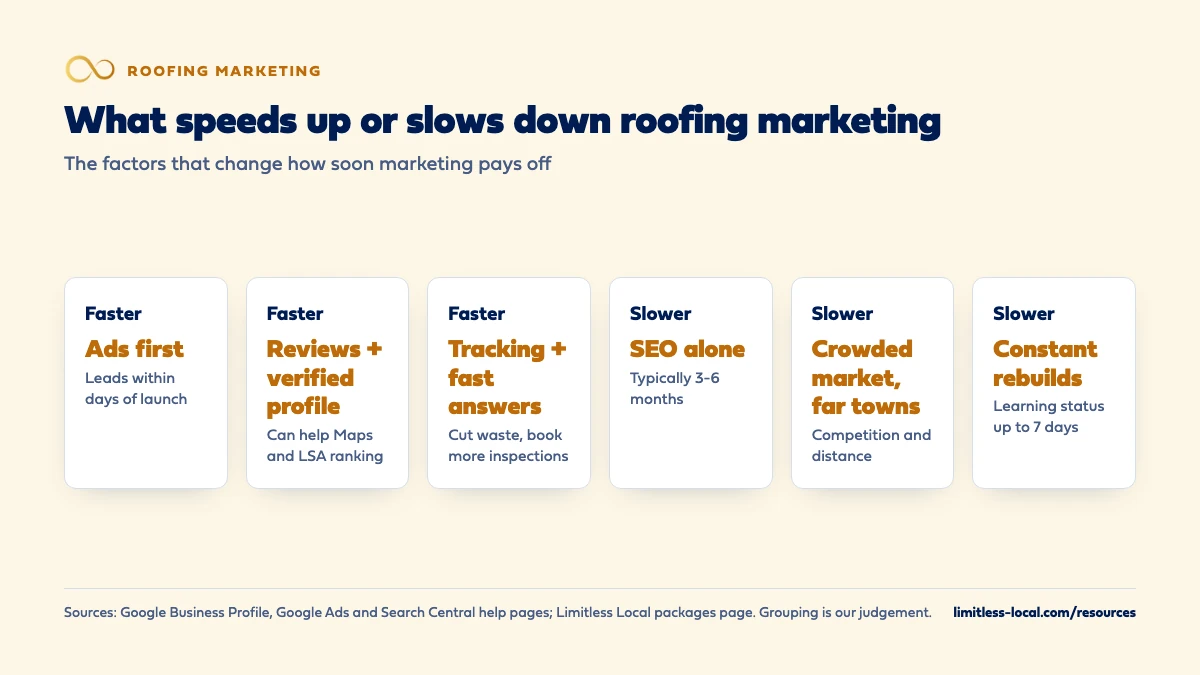
- Ads can bring leads within days; SEO typically takes months.
- Your starting point (profile, reviews, website, tracking) sets the pace.
- Competition, distance from the towns you want and season slow or speed things up.
- Fast call-backs and steady settings make every channel pay off sooner.
For roofing owners trying to understand why their marketing is taking longer than they hoped, or what would make the next push pay off sooner.
Get a free visibility audit · Book a growth call
Why does roofing marketing pay off in weeks for some roofers and months for others?
Roofing marketing works faster when it starts from paid channels, a verified Google profile with real reviews, a website Google has already indexed, tracking that works from day one, and an office that answers and books leads quickly. It works slower when it leans on SEO alone, starts from a new or thin profile and website, runs in a crowded market or in towns far from your address, changes direction every few weeks, or can’t connect leads to signed roofs. Season matters too: storms pull demand forward and winter pushes it back, and roofs that sign weeks after the first call make every channel look slower than it is.
This is why our packages start by fixing tracking, follow-up and your online presence before turning on lead flow: it removes the most common things that slow results down. The roofing marketing page shows how that plays out for a roofing company, and the roofing marketing guide covers each channel. More owner questions are in the roofing marketing questions library.
Which roofing marketing channels work fastest?
Paid channels. Ads can generate leads within days of launch, while SEO typically takes 3-6 months to show meaningful organic growth. Google Ads and Local Services Ads put you on the page as soon as they’re approved and running; organic rankings and Maps rankings have to be earned.
That doesn’t make ads better, only quicker. In our judgement, a roofer who needs calls this month should lean on ads, while building the profile, reviews and pages that make the organic side pay off later. Each channel has its own clock, and the live pages on how quickly a Google Business Profile brings in roofing calls and how long to run roofing Google Ads before judging them go channel by channel. This page is about what speeds up or slows down all of them.
How does my starting point change how fast marketing works?
A roofer who already has a verified Google profile, a few years of reviews and a website Google has indexed is starting a lap ahead of one who doesn’t. The steps that have to happen first take real time:
- Verification. Google says verification reviews take up to 5 business days, though on rare occasions they may take longer, and that if a postcard is involved, most codes arrive within 14 days.
- Indexing and ranking. Google says some website changes might take effect in a few hours and others could take several months, and that you’ll likely want to wait a few weeks to judge whether a change helped.
- Reviews. These build one finished job at a time.
In our judgement, the honest way to set expectations is to list what already exists before anything starts, so you can tell a slow channel from a slow start.
Do reviews make roofing marketing work faster?
They make several channels work at once. Google says local results are mainly based on relevance, distance and popularity, and that prominence is based partly on how many reviews you have; more reviews and positive ratings can help your local ranking. For Local Services Ads, Google lists your rating and number of reviews as part of profile quality, and says higher-quality profiles may rank higher and may pay lower costs per lead.
Reviews also help the homeowner who’s comparing three roofers, which speeds up the step from lead to booked inspection. In our judgement, a steady trickle of new reviews from every finished job does more for the pace of everything else than any single marketing project.
Does competition in my area slow roofing marketing down?
Yes, on every channel. On Google Ads, Google says Ad Rank depends on your bid, the quality of your ads and landing page, the competitiveness of the auction and the context of the search, and that your position can change from auction to auction. In a metro where many roofers bid on the same searches, you either pay more per click or work harder on ad and page quality to keep up.
On the organic side, in our judgement, a market full of established roofers with hundreds of reviews and strong websites takes longer to break into than a small town where nobody has bothered. How to tell how competitive roofing marketing is in your city shows how to size that up before you set a timeline.
Curious what your marketing is actually booking?
Get a free visibility audit — no obligation, no sales pitch.
Does where my office is located change how fast I show up?
For Maps, yes. Google lists distance as one of the three main local ranking factors: how far each business is from the person searching. A roofer based in one town who wants to rank in Maps for a town thirty minutes away is working against distance, and in our judgement that often takes longer than winning the home town, or doesn’t happen in Maps at all.
Ads and website pages are less tied to your address. You can target ads at towns you serve, and a solid service page for a nearby town can earn organic traffic there. So if most of the work you want is in towns away from your office, expect ads and pages to carry those towns faster than your Maps listing will.
Does tracking make roofing marketing work faster?
Indirectly, and by a lot. Without tracking, nobody can tell which searches, ads or pages produce booked inspections, so money keeps flowing to what doesn’t work. With it, you can cut the waste within weeks instead of guessing for months.
It also matters for Google’s own systems. Google defines a conversion cycle as how long it takes for a click to turn into a conversion, and if you import conversions, it includes the time for them to be reported. For a roofer, a lead might come in today and a signed roof weeks later. If the signed roof is never reported back, the account can only learn from leads, not from jobs. In our judgement, setting up tracking before turning on spend is the cheapest way to make everything after it faster.
Can changing things too often slow my roofing marketing?
Yes, especially in Google Ads. Google says a bid strategy shows a “Learning” status for up to 7 days after major structural changes, such as a new or reactivated strategy, adding or removing campaigns or keywords, or changing the conversion goals it optimizes for. Google also says changes to budgets, targets, ads or location targeting don’t trigger that status. Your ads keep running during “Learning”, but Google says Smart Bidding performance typically takes one to two conversion cycles to settle on a new goal.
The pattern we’d watch for: an owner sees a slow week, rebuilds the campaign, sees another slow week, and rebuilds again. In our judgement, each rebuild restarts that settling period. In our judgement, it’s better to fix tracking and obvious waste, then hold the structure steady long enough for the numbers to mean something. The same applies to SEO: rewriting a page every two weeks makes it impossible to tell what worked.

How does answering leads change how fast marketing works?
Marketing produces leads; the office turns them into inspections. If calls go to voicemail and web leads wait until the evening, the same marketing produces fewer signed roofs, and it looks like it’s working slowly when the problem is downstream.
For Local Services Ads, it also affects ranking. Google lists responsiveness as a factor in how likely your ad is to produce a lead, and says missed calls may hurt it. Turning on message or booking leads gives customers more ways to reach you on nights and weekends. How fast a roofing company should call back a new lead covers the targets.
How do storm season and winter change the pace?
Seasons change the speed of everything. In our judgement, marketing started just before or during storm season tends to show results sooner because more homeowners are searching, while the same work started in a quiet winter month can look slow even when it’s set up well. Neither tells you much about the marketing itself.
That’s why it helps to judge a roofing channel over a full season, compare months to the same months last year where you can, and keep storm work in its own column. A hailstorm in month two can make a new campaign look brilliant; a dry month three can make it look broken.
What do I control that makes roofing marketing work faster?
More than most owners expect. In our judgement, the owner-side factors that speed things up are:
- Quick answers to your marketer. Approvals, photos, service details and logins that take weeks to arrive hold up everything else.
- Real job photos for the profile, pages and ads.
- A review ask at every finished job.
- Fast call-backs and a booked inspection on the first call where possible.
- Marking signed jobs in your field software so the numbers close the loop.
- A clear list of the jobs and towns you want, and the ones you don’t.
What a roofing marketer actually does each month shows how the work splits between you and the marketer.
Want to see where your company stands?
A free visibility audit shows where you show up on Google, Maps and AI answers, and what it's costing you in calls.
What's different about the pace for roofing companies
Long time from lead to signed roof. A repair can be booked the same week, but a replacement often signs weeks after the first call, after an inspection, an estimate and sometimes an insurance decision. That’s our judgement, and it means roofing marketing always looks slower in a monthly report than it is.
Storm spikes distort the clock. One storm can bring more leads in a week than a normal month, which makes any before-and-after comparison unreliable unless storm work is kept separate.
Big tickets, small numbers. A roofer may sign a modest number of replacements a month, so a couple of jobs either way swings the results. Judging over a longer stretch smooths that out.
Trust takes time to show. Homeowners hiring for a large job check reviews, photos and licensing before they call, and those take months to build.
A worked example: same ads, different pace
These numbers are made up to show the math, not a benchmark and not a client result. Two roofers in similar towns each spend $1,500 on Google Ads in a month and each get 30 leads.
- Roofer A answers live or calls back within minutes, books 16 inspections and signs 6 roofs. Cost per signed roof: $1,500 divided by 6, or $250.
- Roofer B returns calls in the evening, books 9 inspections and signs 3 roofs. Cost per signed roof: $1,500 divided by 3, or $500.
The ads performed the same. Roofer B’s marketing looks like it’s “working slowly” when the difference is what happened after the phone rang.
How we’d approach it: our process starts with a 15-minute discovery call, onboarding takes your team about 2-3 hours, and campaigns go live in weeks 1-2, followed by monthly reviews. We don’t guarantee rankings, lead counts or revenue. Nobody honestly can; platforms change how they work.
Frequently asked questions
Can more money make roofing SEO work faster?
Only to a point. More budget can pay for more pages, fixes and outreach, but Google still has to crawl, index and rank the changes, which Google says can take from a few hours to several months.
Does a brand-new roofing company take longer to see results?
Usually, for organic search and Maps, because there’s no verified history, reviews or indexed website yet. Ads can still produce leads within days of launch.
Does posting on my Google profile make it rank faster?
Google’s tips for improving local ranking point to verifying, keeping your information complete and accurate, responding to reviews and adding photos; posts aren’t on that list. Posts help customers who already found your profile.
Can I pay Google to rank higher in Maps?
No. Google says there’s no way to request or pay for a better local ranking on Google. Reviews, complete information and distance are what its ranking guidance points to.
How long should I give roofing marketing before deciding it isn't working?
In our judgement, judge ads after a few weeks of steady settings and SEO over months, and always on signed roofs, not leads alone.
Does starting in storm season make marketing work faster?
It usually shows results sooner because more homeowners are searching. In our judgement, that early burst says more about the season than about the marketing.
Key takeaways
- Ads can produce leads within days; SEO typically takes 3-6 months to show meaningful organic growth.
- A verified profile, steady reviews, an indexed site and working tracking make every channel faster.
- Competition, distance from the towns you want and the season all change the pace.
- Rebuilding campaigns every few weeks restarts the clock; hold the structure steady.
- Fast call-backs turn the same leads into more signed roofs, which is what ‘working’ means.
Not sure what's working right now?
Start with a free visibility audit: rankings, Google profile, reviews and tracking, checked against your service area.
More in this section
- How should roofing marketing change when adding more crews?
- What marketing should a roofing company add first to grow?
- What does a roofing marketer actually do each month?
- Which roofing marketing tasks should I do myself or hand off?
- How do I know if my roofing marketing agency is getting results?
Sources
- SEO Starter Guide: The Basics — Google Search Central
- Verify your business on Google — Google Business Profile Help
- Tips to improve your local ranking on Google — Google Business Profile Help
- About ad rankings — Google Local Services Help
- Ad Rank: Definition — Google Ads Help
- Conversion cycle: Definition — Google Ads Help
- About Smart Bidding learning — Google Ads Help