
What should a roofer expect in the first 90 days of marketing?
- What happens at day 30, 60 and 90 of a new roofing marketing campaign?
- What happens in the first two weeks?
- How soon will roofing ads make the phone ring?
- When do Local Services Ads start for a roofing company?
- What should happen with my Google Business Profile?
- When will SEO start bringing in roofing calls?
- What should I see by day 30?
- What should I see by day 60?
- What should I see by day 90?
- Why won't most signed roofs show up until later?
- What do I need to do as the owner in the first 90 days?
- When is it fair to say the marketing isn't working?
- What's different about the first 90 days for roofers
- A worked example: reading signed roofs at day 90
- Frequently asked questions
- Key takeaways
- More in this section
- Sources
The short version
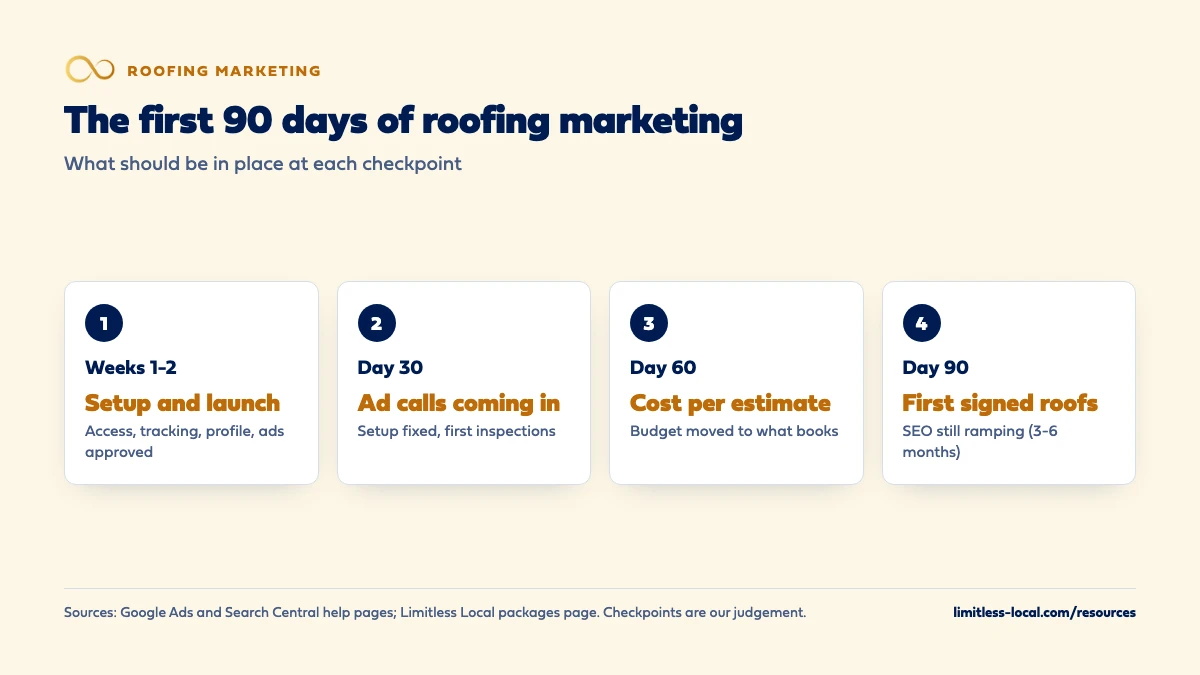
- Weeks one and two: access, tracking, Google profile cleanup, and ads approved and live.
- Day 30: real calls from ads, fixed setup problems, and the first inspections booked.
- Day 60: enough leads to judge cost per inspection or estimate and cut wasted spend.
- Day 90: first signed roofs and early search progress; SEO is still ramping.
For roofing owners starting a new marketing plan, with or without an agency, who want to know what each month should look like and what not to judge too early.
Get a free visibility audit · Book a growth call
What happens at day 30, 60 and 90 of a new roofing marketing campaign?
In the first 90 days of roofing marketing, expect setup and launch in the first couple of weeks, the first ad calls within days of launch, and enough data by day 60 to judge cost per inspection or estimate. By day 90 you should know which channels bring estimates and may see the first signed roofs, but SEO typically takes 3-6 months to show meaningful growth, so organic calls are usually only starting. Judge the first 90 days on whether tracking works, calls are answered and estimates are booking, not on a full quarter of signed revenue.
That pacing, setup first and lead flow second, is how our packages start: tracking, follow-up and a clean online presence come before turning on ads and local SEO. The roofing marketing page shows what that looks like for a roofing company, the roofing marketing guide covers each channel and gives a shorter version of the first 90 days, and more owner questions are in the roofing marketing questions library.
What happens in the first two weeks?
Most of the first two weeks is setup, and it decides whether the next ten weeks can be measured at all. Expect these to happen, whoever does the work:
- Access. The person running your marketing gets manager access to your Google Business Profile and their own login to your Google Ads account, while your company stays the profile owner and keeps admin access to the ad account.
- Tracking. Call tracking numbers on the website and ads, form tracking, and a lead-source field in the software you use for estimates, so every lead can be followed to a signed roof.
- Google profile cleanup. Categories, services, service area, hours, phone number and photos checked against what you actually do.
- Ads built and submitted. Google says most ads are reviewed within one business day, though more complex reviews can take longer.
Your part is a few hours of answers: which jobs and towns you want, who answers the phone, and how estimates are logged. If tracking isn’t in place by the end of week two, the rest of the 90 days becomes guesswork.
How soon will roofing ads make the phone ring?
Usually within days of launch, once the ads are approved. Paid search is the fastest channel to start because you’re paying to appear, not waiting to earn a position.
The first weeks are noisy, though. If the campaign uses automated bidding, Google may show a “Learning” status after major structural changes. Google says it lasts up to 7 days and that ads keep running as normal during it. Early weeks are for catching setup problems: calls going to the wrong number, searches you don’t want, towns outside your area. How long to run roofing Google Ads before judging them covers the point at which ad numbers start to mean something.
When do Local Services Ads start for a roofing company?
That depends on screening, not on the agency. Google says the screening and verification process varies by business category and location and may include background, business registration, insurance and license checks, plus minimum review requirements. A roofer who has the documents ready moves faster than one who has to chase them.
Local Services Ads are also being moved into Google Ads. Google lists roofing among the categories in the first phase of that migration, which began in August 2026 for select advertisers, and notes that old Local Services Ads performance reports won’t carry over, so save them before the move. How long Local Services Ads verification takes for a roofing company goes through each step.
What should happen with my Google Business Profile?
If your profile is new or unverified, verification comes first. Google says verification reviews take up to 5 business days after you complete the steps, and on rare occasions longer; if verification is by postcard, most codes arrive within 14 days. Calls from people searching your company name can start soon after that.
Calls from homeowners searching “roofer near me” take longer. Google says local results are mainly based on relevance, distance and popularity, and that more reviews and positive ratings can help your local ranking. In the first 90 days, the work is a complete and accurate profile, a steady habit of asking every finished customer for a review, replying to reviews, and adding real job photos. How quickly a Google Business Profile can bring in roofing calls has the detail.
When will SEO start bringing in roofing calls?
Usually after the first 90 days, not inside them. SEO typically takes 3-6 months to show meaningful organic growth. Google’s own guidance says some changes might take effect in a few hours and others could take several months, and that you’ll likely want to wait a few weeks to assess whether a change helped.
What you can see in the first 90 days are early signs: service and town pages indexed in Google, impressions climbing in Search Console for searches like roof replacement or roof repair in your towns, and more calls from people searching your name. In our judgement, those are reasons to keep going, not proof of results yet. Judge SEO on signed roofs after it has had time to ramp.
Curious what your marketing is actually booking?
Get a free visibility audit — no obligation, no sales pitch.
What should I see by day 30?
- Ads live and producing calls and form leads.
- Tracking confirmed: test calls and forms show up with the right source.
- The obvious waste cut: wrong-service searches, wrong towns, job seekers.
- The first inspections booked from marketing leads.
- A first report listing the work done and the leads by source.
Don’t expect a clear cost per signed roof yet. A month of roofing data is too short and too dependent on weather to settle anything.
What should I see by day 60?
- Enough leads to see cost per lead and cost per inspection or estimate by channel.
- A short list of changes made because of the numbers, such as budget moved toward the searches and towns that book inspections.
- Review requests going out after every finished job, and new reviews arriving.
- A check on how fast leads are answered and how many become inspections, because that’s where many roofing leads are lost.
By this point the conversation should be about estimates booked, not clicks.
What should I see by day 90?
- The first signed roofs traced to their source, with the cost per signed roof so far.
- A clear view of which channels bring estimates and which don’t.
- Early search progress on your service and town pages, even if organic calls are still few.
- A plan for the next three months: where to add budget, what to fix and what to stop.
If those four aren’t in front of you at day 90, ask why before you decide anything else.
Why won't most signed roofs show up until later?
Because a roof replacement rarely signs on the first call. There’s an inspection, an estimate, sometimes an insurance adjuster’s visit and a second opinion, and the homeowner decides weeks later. A lead from day 70 may sign on day 110.
That lag means the 90-day number for signed roofs is always an undercount. In our judgement, keep the open estimates from marketing leads in view next to the signed ones, and look again a month later. Tracking which roofing leads turn into signed jobs shows how to set that up in your own software.
What do I need to do as the owner in the first 90 days?
- Answer the phone. Leads that ring out or wait until evening book fewer inspections, and that looks like bad marketing in the report.
- Log every lead’s source and outcome in your job software, so the report can match leads to signed roofs.
- Ask for reviews after every finished job.
- Send real photos of finished work for your profile and website.
- Tell your marketer about capacity. If crews are booked out, or a storm hits, say so the same week.
- Don’t change direction every two weeks. Constant rebuilds reset what the ads have learned and muddy the numbers.
When is it fair to say the marketing isn't working?
At day 90, judge the parts that should be working by then: tracking, ad leads, inspections booked, and the cost per estimate. If calls are coming in but few book inspections, look at answering and follow-up before blaming the marketing. If ads bring the wrong jobs or towns after two months of adjustments, that’s a fair concern to raise.
What’s not fair at day 90 is judging SEO on signed roofs, or judging a whole quarter that included a dead winter month against a storm month. What makes roofing marketing work faster or slower explains why two roofers starting the same week can see very different 90 days.
Talk it through with someone who runs this every day
A 15-minute growth call: your market, your numbers, and what a realistic budget looks like. No pressure.
What's different about the first 90 days for roofers
Season decides the start. A plan that launches before storm season has time to set up tracking and collect reviews before demand jumps. One that launches in winter will look slow for reasons that have nothing to do with the marketing.
Storms distort the numbers. A hail week can flood a new campaign with leads and make month one look better than the plan really is. Keep storm leads in their own column.
High ticket, long sign time. A handful of signed replacements can pay for the quarter, which is why the 90-day review should look at open estimates as well as signed ones.
Repairs come first. Repair leads often book faster than replacements. In our judgement, an early mix that’s heavy on repairs isn’t failure, but it should be reported separately.
A worked example: reading signed roofs at day 90
These numbers are made up to show the math, not a benchmark for your market and not a client result. A roofer spends $2,000 a month on ads, or $6,000 over the first three months. By day 90, marketing leads have produced 18 estimates. Five have signed, and three more are still open.
- Counting only signed roofs, and ad spend only: $6,000 divided by 5 is $1,200 per signed roof.
- If the three open estimates sign next month: $6,000 divided by 8 is $750 per signed roof.
Same spend, very different verdict, depending on when you look. That’s why the day-90 review should include open estimates, and why the final number is worth checking again a month later.
How we’d approach it: our process starts with a 15-minute discovery call, onboarding takes your team about 2-3 hours, and campaigns go live in weeks 1-2, followed by monthly reviews. The standard ask is three months, written into the contract, but we won’t make you stay. We don’t guarantee rankings, lead counts or revenue. Nobody honestly can; platforms change how they work.
Frequently asked questions
Can a roofer get leads in the first week?
From ads, often yes. Google says most ads are reviewed within one business day, though more complex reviews can take longer, and once live, ads can generate leads within days of launch. From SEO, rarely, because it typically takes months to ramp.
Should I pause marketing if the first month is slow?
Usually not on one month alone. Check that tracking works and calls are being answered first; a slow first month in winter or before a storm season says little about the plan.
Do I need to be verified on Google before marketing starts?
Not for every channel, but it matters for Maps. Google says verifying tells it you’re authorized to represent the business, so it’s more likely to show up in results, and Local Services Ads have their own screening. Start both early.
Should I add more channels during the first 90 days?
In our judgement, only once the first ones are tracked and working. Adding channels before tracking is clean makes it harder to tell which one signed the roof.
What if a storm hits during the first 90 days?
Tell whoever runs your marketing the same day so budgets and ads can follow the demand, and keep storm leads separate in the numbers so they don’t distort the review.
Is 90 days long enough to judge an agency?
It’s long enough to judge setup, tracking, ad leads and estimates booked. It isn’t long enough to judge SEO on signed roofs. Choosing a roofing marketing agency covers what to agree on before the clock starts.
Key takeaways
- The first two weeks are setup: access, tracking, Google profile cleanup and ads approved.
- Ads can bring calls within days; SEO typically takes 3-6 months to show meaningful growth.
- By day 60, judge cost per inspection or estimate, not clicks.
- At day 90, count open estimates as well as signed roofs, because roofs sign late.
- Answering fast and logging lead sources are the owner’s part of making the 90 days readable.
Ready to compare options?
Book a short growth call and we'll walk through the math for your service area, including when we're not the right fit.
More in this section
- What ROI should a roofer expect from a monthly marketing budget?
- What marketing should a roofing company add first to grow?
- What does a roofing marketer actually do each month?
- Should a roofer sign a 12-month marketing contract?
- When is a roofing company ready for a full-time marketing hire?
Sources
- About the ad review process — Google Ads Help
- About Smart Bidding learning — Google Ads Help
- Understand the screening and verification process — Google Local Services Help
- Local Services Ads transition to Performance Max campaigns with pay-per-lead goals — Google Ads Help
- Verify your business on Google — Google Business Profile Help
- Tips to improve your local ranking on Google — Google Business Profile Help
- SEO Starter Guide: The Basics — Google Search Central