
What offer gets more people to call a plumbing company?
- What offer or call to action gets more plumbing customers to pick up the phone?
- What counts as an offer for a plumbing company?
- Which offers tend to get plumbing customers to call?
- Why does the call to action matter as much as the offer?
- Can I promise same-day or fast service in my ads?
- Does upfront pricing get more plumbing calls?
- Should my plumbing company advertise a warranty or a money-back promise?
- Where should the offer show up: ads, Google profile or website?
- How do I make calling easy once someone sees the offer?
- How do I test which offer gets more calls?
- Which offers tend to backfire for plumbers?
- What's different about plumbing offers
- A worked example: fewer calls, more booked jobs
- Frequently asked questions
- Key takeaways
- More in this section
- Sources
The short version
- An offer is the reason to call you now, not just a discount.
- Speed, upfront pricing, a warranty you stand behind and an easy next step tend to matter most.
- Every claim has to be true and backed up; promise only what you can staff.
- Test one change at a time and judge it by booked jobs.
For plumbing owners rewriting their ads, Google profile or website and wondering what to say that actually makes people call.
Get a free visibility audit · Book a growth call
What offer or call to action gets more plumbing customers to pick up the phone?
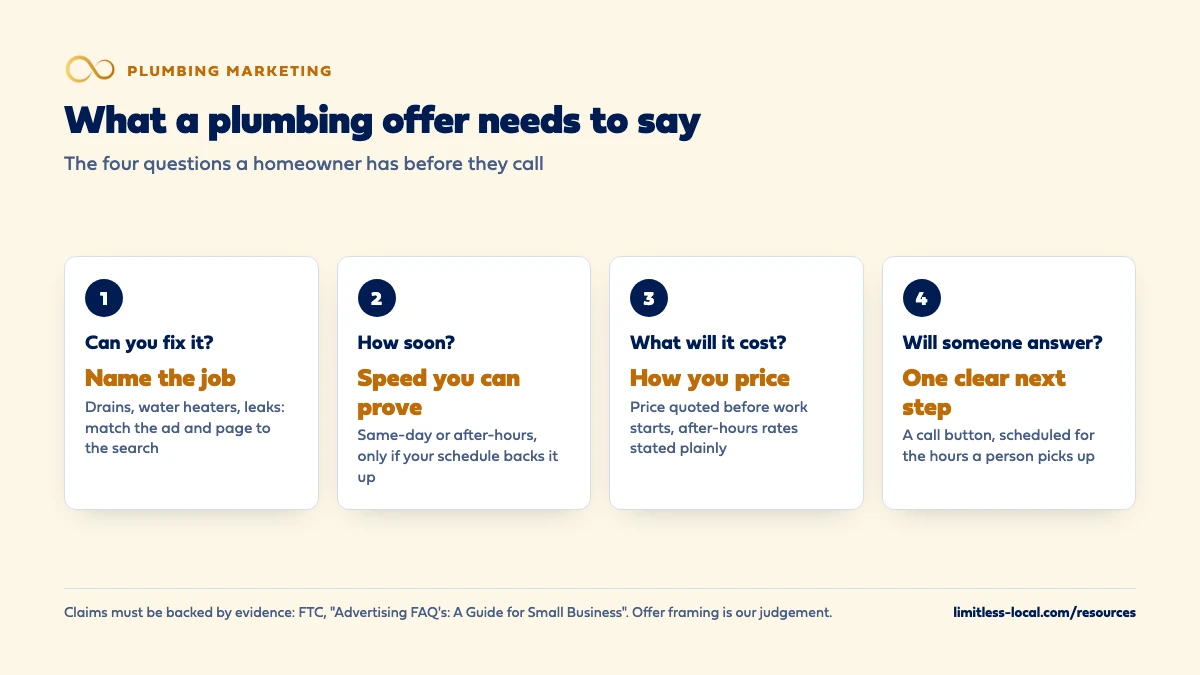
The offers that tend to get plumbing calls answer the questions a homeowner has in that moment: can you fix this, how soon can you come, roughly what will it cost, and will a person answer. A clear call to action like “Call now, a plumber answers” or “Get a price before we start”, backed by something true such as same-day service or upfront pricing, usually does more than a discount. Only promise what your crew can deliver, and test one change at a time against booked jobs, not just call volume.
Writing and testing the offer is part of running the ads and the pages they point to. Our Essentials package ($3,500 a month) includes Google Ads management and a landing page; Growth ($4,500 a month) adds Local Services Ads and ad design and creative, with limits. The tiers are on our marketing packages page, how it fits a plumbing shop is on our plumbing marketing page, and the rest of the plumbing marketing questions library covers the other pieces.
What counts as an offer for a plumbing company?
An offer is the reason someone should call you instead of the next listing. For a plumber, that’s rarely a coupon. It’s usually a short promise about the things a homeowner is worried about when the water heater is leaking or the drain backs up: whether you do that job, how soon you can be there, how you price, what you stand behind, and how easy it is to reach a person.
Discounts are one kind of offer, and they come with their own trade-offs. Whether coupons and discounts attract good plumbing customers covers those. This page is about everything else you can put in front of a caller.
Which offers tend to get plumbing customers to call?
In our judgement, these do most of the work, and the right one depends on the job:
- Speed. “Same-day service” or “A plumber on the way today” for emergencies, if your schedule can keep that promise.
- A person answers. “Call now, a real plumber’s office answers” matters to someone who has already hit two voicemails.
- Upfront pricing. “Price quoted before any work starts” takes away the fear of an open-ended bill.
- A warranty you’ll honor. A clearly stated workmanship warranty, with the terms written out.
- Proof. Licensed and insured, local, with reviews that mention real jobs.
For planned work like a water heater replacement or repipe, the order shifts: people are comparing, so upfront pricing, proof and an easy way to book an estimate usually matter more than speed.
Why does the call to action matter as much as the offer?
Because a good offer with no clear next step still loses the call. Google’s advice on writing ads describes a call to action as a clear and concise message, based on an action verb, that tells the reader what you want them to do, and lists examples such as “Call us now”, “Book now” and “Get a quote”. It notes these are specific about the next step (Google Ads: How to write successful online ads).
For a plumbing company, in our judgement, pick one main action per ad and per page. Emergency pages and ads should push a phone call. Planned-work pages can offer a call or a booking request. A page that asks people to call, fill in a form, chat, download a guide and follow you on social media gives them five reasons to hesitate.
Can I promise same-day or fast service in my ads?
Only if it’s true often enough that you can back it up. The FTC’s advertising guide for small businesses says that before a company runs an ad, it has to have a “reasonable basis” for its claims, meaning objective evidence that supports the claim, and that offering a money-back guarantee is not a substitute for substantiation (FTC: Advertising FAQ’s: A Guide for Small Business).
For a plumber, that means a promise like “on site in 60 minutes” needs dispatch records that show you hit it. Safer wording describes what you actually do: “same-day appointments when booked before noon” if that’s your rule. If your after-hours line goes to voicemail, don’t lead with “24/7”. What an emergency plumbing page should include covers response-time claims in more detail. This isn’t legal advice; check claims you’re unsure about with an attorney.
Curious what your marketing is actually booking?
Get a free visibility audit — no obligation, no sales pitch.
Does upfront pricing get more plumbing calls?
In our judgement, it often gets better calls, which matters more. Saying how you price, such as a flat rate quoted before work starts, or a service fee that’s credited to the repair, tells homeowners what to expect and screens out people who only want the lowest number.
Google Ads has a format for this. Price assets show below your text ad as a set of up to 8 cards that people can scroll through, each linking to the matching item on your site, and you can edit them without resetting their performance statistics (Google Ads Help: About price assets). If you list prices, make sure the page they link to shows the same price and terms. How to stop attracting price shoppers covers how to talk about price without inviting a bidding war.
Should my plumbing company advertise a warranty or a money-back promise?
A workmanship warranty can be a strong reason to call, but only one you’ll honor in full. The FTC’s guide to federal warranty law says its advertising guides advise that terms like “satisfaction guaranteed” or “money back guarantee” should not be used unless the advertiser is willing to give full refunds when, for any reason, customers return the merchandise, and that an ad should disclose any material conditions or limits, such as a time period like 30 days (FTC: Businessperson’s Guide to Federal Warranty Law). That guide is written mainly about consumer products, and it says the Guides can’t substitute for talking to your own lawyer.
In our judgement, a plainly worded workmanship warranty with its terms on your website is easier to stand behind than a broad promise of satisfaction. This isn’t legal advice; have an attorney review the wording of any warranty or refund promise you advertise.
Where should the offer show up: ads, Google profile or website?
Everywhere a homeowner might decide, and saying the same thing in each place:
- Google Ads. Call assets add your phone number and a call button to your ads, and you can schedule them to show only when your business can take calls (Google Ads Help: About call assets). Price assets carry upfront pricing.
- Your Google Business Profile. Offer posts need a title and start and end dates, automatically include a “View Offer” button, and can carry a coupon code, a link and terms and conditions (Google Business Profile Help: Create & manage posts).
- Your website. The offer belongs on the first phone screen of the page the ad sends people to, next to the call button.
If the ad promises upfront pricing and the page says “call for a quote”, the mismatch costs you calls.
How do I make calling easy once someone sees the offer?
Put the phone number where a thumb can reach it, and make sure someone answers. When call assets show on a device that can make calls, Google shows a clickable call button under your ad (Google Ads Help: About call assets). On your site, Google’s guide to mobile landing pages advises a design that’s free of clutter, easy to read and quick to load, and warns that full-size pop-ups and chat boxes over the page can disrupt the experience (Google Ads: 5 things to consider when optimizing your mobile landing page).
Whether your plumbing website is turning visitors into calls is a self-check for the page side. And the best offer in the world fails if the call rings out; how to stop losing after-hours plumbing calls covers the phone side.
How do I test which offer gets more calls?
Change one thing at a time and count booked jobs. Google suggests creating two different ads for an ad group to see if one gets more results, testing different ways of phrasing an offer, and keeping the variations small enough that you can tell what made the difference (Google Ads: How to write successful online ads).
For a cleaner test, Google Ads custom experiments let a changed version of a campaign share your original campaign’s traffic and budget, so you can compare the two over time. Google notes that changing either version while the experiment runs can make the results harder to interpret (Google Ads Help: Set up a custom experiment).
In our judgement, the score that matters is booked jobs per version, not clicks or even calls. An offer that brings fewer, better calls can win.
Which offers tend to backfire for plumbers?
In our judgement, these cost more than they bring:
- Promises you can’t staff. “24/7” or “60-minute arrival” when evenings go to voicemail. The caller who gets voicemail calls the next plumber, and may leave a review about it.
- Leading with the lowest price. It brings the callers least likely to book bigger work.
- Vague claims. “Quality service” and “customer satisfaction” say nothing a homeowner can check.
- Offers that change by channel. One price in the ad, another on the site, a third on the phone.
- Too many offers at once. Pick the one that matters most for the job the page is about.
Want to see where your company stands?
A free visibility audit shows where you show up on Google, Maps and AI answers, and what it's costing you in calls.
What's different about plumbing offers
Urgency changes what people want to hear. Someone with a burst pipe wants to know you’ll answer and come soon; price comes second. Someone replacing a water heater next month wants to know what it will cost and whether you’ll do it right. In our judgement, emergency and planned-work ads should carry different offers.
After-hours pricing needs to be stated plainly. If nights and weekends cost more, saying so up front avoids an angry caller and a bad review later.
The tech is part of the offer. Homeowners are letting someone into their house. Licensed, background-checked techs, if that’s true for your crew, belong near the call button.
A worked example: fewer calls, more booked jobs
These numbers are made up to show the math, not a benchmark for your market. Say you run two versions of the same emergency ad for a month, with the same budget and keywords, and change only the headline.
- Version A, “Fast Local Plumbers, Call Now”: 40 calls, 18 booked jobs. That’s a 45% booking rate.
- Version B, “Upfront Price Before We Start”: 32 calls, 20 booked jobs. That’s about a 63% booking rate.
Version A got more calls, but Version B booked more jobs from the same spend. Judged on calls alone, you’d keep the wrong ad. A free visibility audit can check whether your calls are tracked well enough to run this kind of test.
Frequently asked questions
Is "free estimate" a good offer for a plumbing company?
It can be for planned work like repipes or water heater replacements, where people compare quotes. For emergency repairs, in our judgement, saying how you price the visit is usually clearer than “free”.
Can I put my phone number in the ad text itself?
Google says putting a phone number elsewhere in your ad text may lead to the ad being disapproved; call assets are the way to add a number to search ads.
Should a plumbing offer have an end date?
Google’s ad-writing advice says a time limit on an offer can build urgency, and Google Business Profile offer posts need start and end dates. For an always-on promise like upfront pricing, an end date isn’t needed.
How long should I run an offer test?
In our judgement, long enough to get a meaningful number of booked jobs from each version, which for a small plumbing account usually means weeks, not days.
Should my Google profile and website show the same offer as my ads?
Yes. Homeowners often see more than one of them before calling, and a mismatch in price or terms makes people hesitate.
Key takeaways
- An offer is the reason to call you now: what you fix, how soon, how you price and what you stand behind.
- Pair it with one clear call to action, such as a call button that a person answers.
- Back every claim with evidence, and promise only what your crew can deliver.
- Don’t advertise a satisfaction or money-back guarantee unless you’ll honor it in full, with the terms stated.
- Test one change at a time and judge it by booked jobs, not calls.
Not sure what's working right now?
Start with a free visibility audit: rankings, Google profile, reviews and tracking, checked against your service area.
More in this section
- How do I get more repeat customers and referrals for plumbing?
- How do I get more plumbing leads?
- How should a new plumbing company get its first customers?
- Do coupons and discounts attract good plumbing customers?
- Which marketing works best for emergency vs planned plumbing jobs?
Sources
- How to write successful online ads with Google — Google Ads
- About call assets — Google Ads Help
- About price assets — Google Ads Help
- Set up a custom experiment — Google Ads Help
- Create & manage posts on your Business Profile — Google Business Profile Help
- 5 things to consider when optimizing your mobile landing page — Google Ads
- Advertising FAQ's: A Guide for Small Business — Federal Trade Commission
- Businessperson's Guide to Federal Warranty Law — Federal Trade Commission