
What marketing brings a roofing company the most phone calls?
- Which roofing marketing channels bring phone calls instead of form fills?
- Which roofing marketing usually brings the most phone calls?
- Why do some channels bring calls and others bring forms?
- How does a Google Business Profile bring roofing calls?
- Do Local Services Ads bring calls or messages?
- How do I get more calls, not just clicks, from Google Ads?
- Does SEO bring roofing calls or form fills?
- What about mailers, yard signs and truck wraps?
- Are more phone calls always better for a roofer?
- How do I find out which marketing brings me the most calls?
- What if the calls come in but nobody answers?
- What's different about phone calls for roofers
- A worked example: most calls versus most signed roofs
- Frequently asked questions
- Key takeaways
- More in this section
- Sources
The short version
- Channels that put a call button in front of people searching on a phone bring the most calls.
- That usually means your Google profile in Maps, Local Services Ads and Google Ads with call assets.
- Websites bring a mix of calls and forms; social ads lean toward forms.
- Track each source with its own number, and judge it on signed roofs.
For roofing owners who want the phone to ring, and want to know which marketing tends to bring calls and how to check it in their own numbers.
Get a free visibility audit · Book a growth call
Which roofing marketing channels bring phone calls instead of form fills?
For most roofing companies, the marketing that brings the most phone calls is the kind that shows a call button to someone searching on a phone: a Google Business Profile in the map pack, Local Services Ads, and Google Ads with call assets. Websites from SEO bring a mix of calls and forms, and social media ads lean toward forms. Which one leads for you depends on your reviews, your market and your budget, so give each source its own tracking number and judge it on signed roofs, not just calls.
Calls you can trace to a source are the starting point for everything we do, which is why every one of our marketing packages includes call tracking with recording and transcription, form tracking and source tagging, and a monthly report with a cost-per-lead breakdown. Our roofing marketing page covers how we work with roofers across Maps, ads and the website. For every way to bring in roofing work, the guide to getting roofing leads covers each source, and the rest of the roofing marketing questions library goes question by question.
Which roofing marketing usually brings the most phone calls?
No primary source ranks marketing channels by phone calls for roofers, so this is our judgement, and your own tracking should have the final say. The channels most built around calling, roughly in order:
- Your Google Business Profile in the map pack. Homeowners searching on a phone can tap the call button straight from your listing.
- Local Services Ads. Google counts answered calls, some missed calls, messages and booking requests through the ad as leads (How leads work).
- Google Ads with call assets or call ads. These put a call button on the ad itself.
- Your website from SEO. A mix of calls and estimate forms, depending on how the page is built.
- Social media ads. These tend toward forms and messages more than calls.
What sits at the top for you depends on where you already show up. A roofer with a strong profile and plenty of reviews may get most calls from Maps; a new company may get most from paid ads at first.
Why do some channels bring calls and others bring forms?
Mostly because of the device and the urgency, in our judgement. Someone with water coming through the ceiling picks up the phone. Someone thinking about replacing an old roof next spring may be happier filling out a form at night. Channels that show up on phones, at the moment someone searches, with a call button front and center, skew toward calls.
Google builds some ads that way on purpose. Call ads are made to show only on mobile devices that can make calls, and if you leave the website address blank, the ad only allows clicks to call (About call campaigns). Social feeds work the other way: people aren’t searching for a roofer when they see the ad, so a form is the easier next step.
How does a Google Business Profile bring roofing calls?
Through the call button on your listing in Search and Maps. Google’s performance report counts calls as the number of times a customer clicked the call button on your Business Profile, and you need your phone number on the profile for that metric to show (Understand your Business Profile performance & insights).
What the profile no longer gives you is a call log. As of July 31, 2024, Google removed the call history feature from Business Profiles; you still get the calls and the performance metrics, but not a list of who called (Changes to Google Business Profile chat and call history). That’s one reason a tracking number on the profile is worth setting up.
Maps visibility and calls go together in our own published results: A roofing client got 3x map pack visibility in its target towns; better presence and consistent info across the web increased inbound calls. That’s one past result, not a forecast for your towns.
Do Local Services Ads bring calls or messages?
Both. Google counts a valid lead when you answer a call or call the customer back and speak with them, when you miss a call during business hours and the caller stays on the line for more than 20 seconds, when a customer sends a text message or email, or leaves a voicemail, or sends a booking request (How leads work). Message leads are typically priced lower than phone leads, though Google says that’s not always the case.
Calls are where LSAs reward you for being ready. Google lists responsiveness as a ranking factor and says missed calls may hurt it (About ad rankings). So an LSA account can bring plenty of calls, but only if someone answers them. Whether Local Services Ads are worth it for a roofing company covers when they pay off.
Curious what your marketing is actually booking?
Get a free visibility audit — no obligation, no sales pitch.
How do I get more calls, not just clicks, from Google Ads?
Add a phone number to the ad itself. Call assets let people tap or click a button to call your business directly or go to your website, and you can set the number to show only when your business can take calls. Clicks on the call button cost the same as a click on the headline (About call assets).
If you want calls only, a call campaign can do that: with no website address on the ad, people can only click to call, and Google says your bid should then match what a phone call from the ad is worth to you (Google Ads Help). For roofing, in our judgement, that suits urgent repair and leak searches better than replacement shoppers, who often want to see your work before calling.
Does SEO bring roofing calls or form fills?
Both, and the page decides the mix. In our judgement, a service page that shows a tap-to-call number at the top on a phone, says which towns you cover and shows real roofs you’ve done gets more calls; one that hides the number at the bottom pushes people to the form or back to the search results.
SEO calls are the hardest to count. Google Ads can track calls to a number on your website from people who clicked an ad, using a Google forwarding number (About phone call conversion tracking), but that doesn’t cover visitors who found you in the free results. For those, you need your own call tracking on the site. What call tracking is and whether a roofer needs it explains how it works.
What about mailers, yard signs and truck wraps?
They can bring calls, and they’re easy to undercount. A homeowner who sees your yard sign may search your name and call from your Google profile, so the call shows up as a Maps call, not a yard-sign call.
If you spend real money on offline marketing, give each piece its own phone number. Call tracking tools can do this: CallRail, for example, describes an offline tracking number used in print and TV ads, direct mail and email signatures, set up so it doesn’t swap on your website (Create a number for print, TV, or radio ads). Then you’ll know whether the mailer or the sign is doing the work.
Are more phone calls always better for a roofer?
No. The channel with the most calls isn’t always the one with the most signed roofs. Some calls are repairs you don’t want, out-of-area homeowners, sales pitches or robocalls. Some channels bring fewer calls that sign more often.
Count calls, then follow each one to an inspection and a signed job. The number that tells you which marketing is working is cost per signed roof, not calls per month. Tracking which roofing leads turn into signed jobs shows how to connect the two in the software you already use.
How do I find out which marketing brings me the most calls?
- Give each source its own number. One for your Google profile, one for the website, one for each offline piece.
- Turn on call tracking in Google Ads. It can count calls from ads, calls to your website number after an ad click, and calls imported from another system you use to track them, which lets you count only calls that included a sale.
- Check your Google profile’s Calls metric each month, knowing it counts call-button clicks, not connected calls.
- Check your LSA leads by type: calls, messages and bookings.
- Ask every caller how they found you and write it on the lead.
Do this for at least a few months before you decide. How a roofer can track calls and forms from Google has the step-by-step setup.
What if the calls come in but nobody answers?
Then the marketing that brings the most calls may also be the marketing that wastes the most money. With Local Services Ads, a missed call during business hours can still count as a charged lead once the caller stays on the line for more than 20 seconds, and missed calls may hurt your ranking. With Google Ads, you’ve paid for the click either way.
Before chasing more calls, check how many you’re answering. If calls go to voicemail while you’re on a roof, decide who picks up during working hours. How fast a roofing company should call back a new lead covers what to do when you can’t answer live.
Want to see where your company stands?
A free visibility audit shows where you show up on Google, Maps and AI answers, and what it's costing you in calls.
What's different about phone calls for roofers
Leaks call, replacements browse. Active leaks and storm damage are urgent, so those homeowners pick up the phone. Replacement shoppers often research first and reach out by form or message. In our judgement, a roofer who wants more replacement work shouldn’t judge channels on call volume alone.
Storms flood the phones. After hail, call volume can jump overnight across every channel. Compare channels outside storm weeks too, or the numbers mostly tell you when the storm hit.
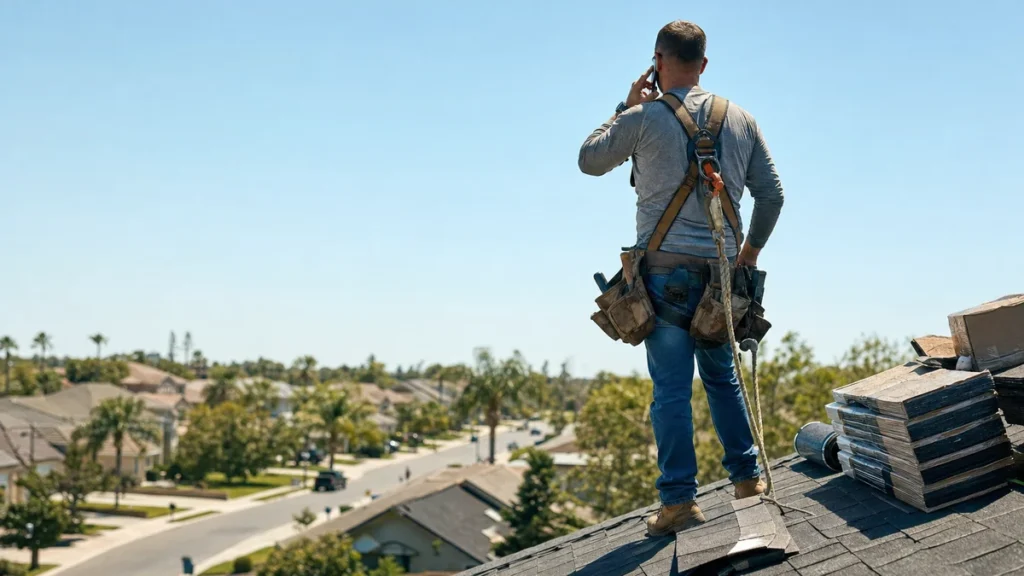
You’re often on a roof. Many roofing owners still run crews, so calls during the workday go unanswered. The channel that brings the most calls is only worth it if someone can answer them.
A worked example: most calls versus most signed roofs
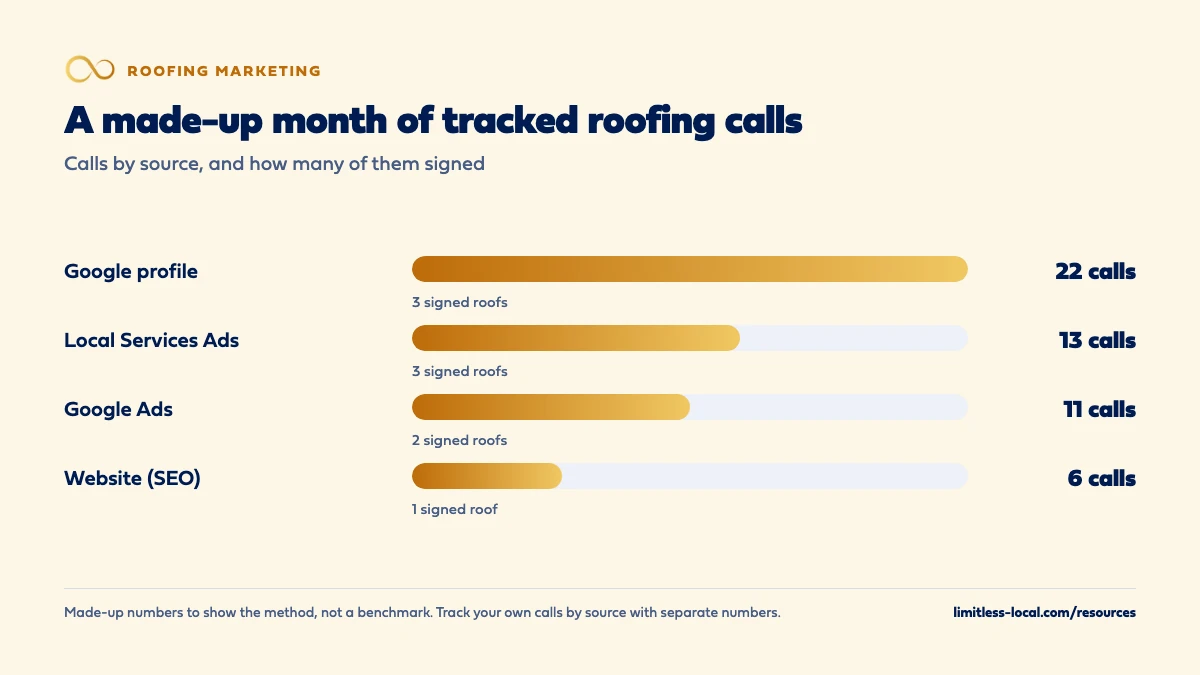
These numbers are made up to show the math, not a benchmark for your market. Say a roofer tracks one month of calls by source: 22 from the Google profile, 13 from Local Services Ads, 11 from Google Ads and 6 from the website.
The Google profile wins on calls. Now follow them to signed roofs: say 3 from the profile, 3 from LSAs, 2 from Google Ads and 1 from the website. LSAs signed as many roofs as the profile from 13 calls instead of 22. And if LSAs cost $1,800 that month and Google Ads $1,600, that’s $600 and $800 per signed roof, while the profile’s calls had no per-call cost.
So the honest answer to “what brings the most calls” and “what should get more money” can be different channels. One month is too short to decide either; a free visibility audit checks whether your tracking can answer both.
Frequently asked questions
Do Google Ads or Local Services Ads bring more roofing calls?
It depends on your reviews, budget and market. LSAs reward fast answering and strong reviews; Google Ads with call assets let you choose the searches. Run both long enough with tracking and compare calls and signed roofs.
Can I see who called me from my Google Business Profile?
Not inside the profile anymore. Google removed call history in July 2024. You still see a Calls count, which is call-button clicks, so use a tracking number or ask callers how they found you.
Do call assets cost extra in Google Ads?
Google says clicks on the call button cost the same as clicks on the ad’s headline: a standard cost per click.
Should I remove the form from my roofing website to get more calls?
In our judgement, no. Some homeowners, especially replacement shoppers, would rather send a form. Make the phone number easy to tap on mobile and keep the form for those who prefer it.
Are message leads from Local Services Ads worth answering?
Yes. Google counts a text or email through the ad as a valid lead, and says message leads are typically priced lower than phone leads, though not always.
Will a call-only ad work for roofing replacements?
It can, but replacement shoppers often want to see your work before calling. In our judgement, call-only ads fit urgent repair and leak searches best.
Key takeaways
- Marketing that shows a call button to people searching on a phone brings the most roofing calls.
- That usually means your Google profile in Maps, Local Services Ads, and Google Ads with call assets.
- Websites bring a mix of calls and forms; social ads lean toward forms.
- The channel with the most calls isn’t always the one with the most signed roofs.
- Give every source its own tracking number and answer the calls you pay for.
Not sure what's working right now?
Start with a free visibility audit: rankings, Google profile, reviews and tracking, checked against your service area.
More in this section
- What marketing should a roofing company add first to grow?
- Is door knocking or online marketing better for a roofing company?
- How should a roofing company market commercial roofing?
- Why are my roofing ads getting clicks but no calls?
- Which keywords should a roofing company target for local leads?
Sources
- Understand your Business Profile performance & insights — Google Business Profile Help
- Changes to Google Business Profile chat and call history — Google Business Profile Help
- How leads work — Google Local Services Help
- About ad rankings — Google Local Services Help
- About call assets — Google Ads Help
- About call campaigns — Google Ads Help
- About phone call conversion tracking — Google Ads Help
- Create a number for print, TV, or radio ads — CallRail Help Center