
Will cheap backlinks or fake reviews speed up electrician SEO?
- Can buying links or reviews get my electrical company ranking faster on Google?
- What counts as a cheap backlink or a fake review?
- What does Google say about buying links?
- What happens if Google catches bought links to my site?
- What does Google say about fake or paid reviews?
- What can Google do to my Business Profile over fake reviews?
- Is buying reviews against the law?
- Do links and reviews matter for an electrician's Google ranking at all?
- What if a past SEO company bought links or reviews for me?
- How do I get real reviews faster?
- How does an electrician earn real links?
- How do I spot an SEO offer that will get me in trouble?
- What's different about shortcuts for electricians
- A worked example: the honest review pace
- Frequently asked questions
- Key takeaways
- More in this section
- Sources
The short version
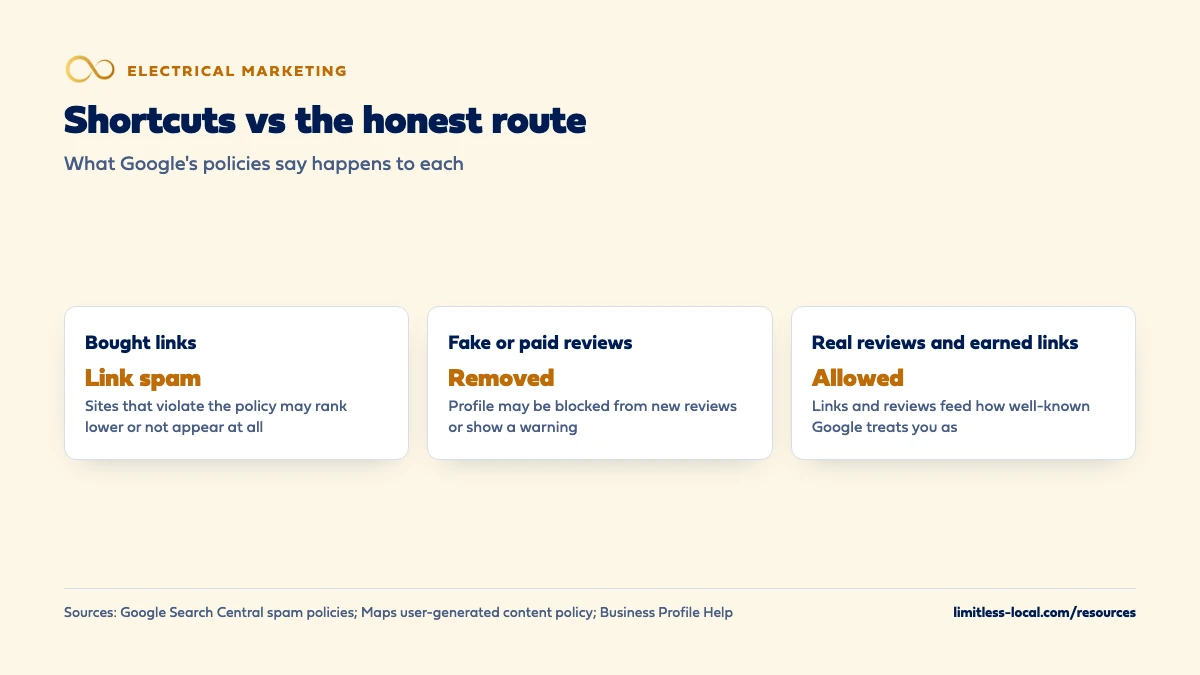
- Bought links are link spam; violating sites may rank lower or disappear from results.
- Fake or paid reviews are removed, and Google may restrict your Business Profile.
- In the U.S., the FTC's rule bans buying fake reviews; this isn't legal advice.
- Real reviews and earned links are slower to start but don't get taken away.
For electrical contractors who’ve been offered a package of links or reviews and want to know what it could cost them before they say yes.
Get a free visibility audit · Book a growth call
Can buying links or reviews get my electrical company ranking faster on Google?
No. Buying links to improve rankings is link spam under Google’s spam policies, and Google says sites that violate them may rank lower or not appear in results at all. Paid or fake reviews break Google Maps policy: they’re removed, and Google may restrict the Business Profile, for example by blocking new reviews for a set period or showing customers a warning that fake reviews were removed. The faster route that holds up is asking every customer for an honest review and earning links from suppliers, trade groups and the local organizations you already work with.
Honest local SEO takes time: SEO typically takes 3-6 months to show meaningful organic growth, and no one can honestly guarantee a ranking. Our local SEO and Google Business Profile work includes link building, review response and basic review generation in our Essentials and Growth packages, without shortcuts that put your profile at risk. The electrical contractor marketing page shows how SEO, ads and follow-up fit together, and the rest of the electrical marketing questions library goes question by question.
What counts as a cheap backlink or a fake review?
A backlink is a link from another website to yours. A cheap backlink, in the sense these offers mean it, is one you pay for so that Google will rank you higher. Google’s spam policies list examples of link spam, including:
- Buying or selling links for ranking purposes, including exchanging money, goods or services for links.
- Excessive link exchanges (“link to me and I’ll link to you”).
- Using automated programs or services to create links to your site.
- Low-quality directory or bookmark site links.
- Forum comments with optimized links in the post or signature.
A fake review is one that doesn’t reflect a real customer’s real experience. Google’s Maps policy on prohibited and restricted content lists fake engagement as content not based on a real experience, reviews or ratings that have been paid for directly or in kind, and content posted from multiple accounts by or at the request of one person.
What does Google say about buying links?
Google defines link spam as creating links to or from a site primarily for the purpose of manipulating search rankings, and buying links for ranking purposes is its first example. Google says it detects policy-violating practices through automated systems and, as needed, human review that can result in a manual action, and that sites that violate its policies may rank lower in results or not appear in results at all.
There’s an important line here. Google says buying and selling links is a normal part of the web for advertising and sponsorship, and it isn’t a violation to have such links as long as they’re qualified with a rel="nofollow" or rel="sponsored" attribute. So sponsoring the local Little League and getting a link from their site is fine. Paying a stranger for links precisely because they’ll pass ranking credit is what the policy is about.
In our judgement, that’s why “cheap” link packages are a poor bet even before any penalty: links built only to move rankings are the kind Google says it works to spot, so you may pay for links that do nothing.
What happens if Google catches bought links to my site?
Google’s Manual actions report in Search Console lists “unnatural links to your site” as one type of manual action, used when Google has detected a pattern of unnatural, artificial, deceptive or manipulative links pointing to a site. If you get one, the report tells you, and you can fix the problem and request a review. Google says most reconsideration reviews can take several days or weeks, and that link-related requests may take longer than usual.
For an electrician whose phone depends on showing up for “electrician near me”, in our judgement even a few weeks of weaker rankings during a busy season can cost more jobs than the links were ever likely to bring.
What does Google say about fake or paid reviews?
Google’s Maps policy says fake engagement is not allowed and will be removed. It also says merchants may not:
- Offer incentives, such as payment, discounts, or free goods or services, in exchange for posting a review, or for changing or removing a negative one.
- Discourage or prohibit negative reviews, or selectively solicit positive reviews from customers.
- Require or pressure customers to leave reviews while on the premises, or ask for specific content to be included, including content that identifies a staff member.
That last point catches a lot of electrical companies by surprise. Asking customers to mention a tech by name, or setting each tech a quota of reviews, is the kind of request the policy describes. Google also lists content based on a conflict of interest, such as reviews from current or former employees or family members, as rating manipulation.
What can Google do to my Business Profile over fake reviews?
More than delete the reviews. Google’s page on Business Profile restrictions for policy violations says that if it determines a business owner has violated its Fake Engagement policy, it might place restrictions on the profile in addition to removing the reviews. Its examples include:
- The profile can’t receive new reviews or ratings for a set period of time.
- The profile’s existing reviews or ratings are unpublished for a set period of time.
- The profile displays a warning to let customers know that fake reviews were removed.
Google says it notifies business owners by email before applying a restriction, and that businesses can appeal. In our judgement, a public warning on your profile, seen by every homeowner comparing electricians, is a far bigger cost than any ranking bump the reviews might have bought. Our page on getting an electrical company into the map pack covers what actually moves Maps rankings.
Curious what your marketing is actually booking?
Get a free visibility audit — no obligation, no sales pitch.
Is buying reviews against the law?
In the United States, the Federal Trade Commission’s Rule on the Use of Consumer Reviews and Testimonials went into effect on October 21, 2024, and authorizes courts to impose civil penalties for knowing violations. The FTC’s announcement of the final rule says it prohibits, among other things:
- Creating, selling or buying fake reviews, including reviews by someone who doesn’t exist or who had no actual experience with the business.
- Offering compensation or other incentives conditioned on a review expressing a particular sentiment, positive or negative.
- Certain reviews by company insiders that don’t clearly disclose their connection to the business, including reviews by officers or managers.
- Using unfounded legal threats, intimidation or certain false public accusations to prevent or remove a negative review.
This isn’t legal advice. If you’ve already bought reviews or aren’t sure whether something you’re doing crosses the line, talk to a lawyer who handles advertising law.
Do links and reviews matter for an electrician's Google ranking at all?
Yes, which is why the shortcuts are tempting. Google’s page on improving your local ranking says local results are mainly based on relevance, distance and popularity, and that how well-known a business is depends partly on info like how many websites link to your business and how many reviews you have. It adds that more reviews and positive ratings can help your local ranking.
So the honest version of the same idea works: real links from real organizations, and a steady flow of real reviews. In our judgement, what doesn’t work is faking either one, because the same policies that make links and reviews count are the ones that strip out the fake ones. Our page on why SEO takes longer than Google Ads for electricians explains the timeline you’re trying to shortcut.
What if a past SEO company bought links or reviews for me?
Start by finding out what’s there.
- Check Search Console’s Manual actions report. In our reading, if the report lists no manual action, Google hasn’t flagged your site for one.
- Look at who links to you. Search Console or a backlink tool can list the sites linking to you. In our judgement, a long list of unrelated foreign blogs or directories is a sign of bought links.
- Be careful with the disavow tool. Google’s page on disavowing links says most sites will not need it, and that you should use it only if you have a considerable number of spammy, artificial or low-quality links and they have caused, or likely will cause, a manual action. It calls it an advanced feature that can harm your site’s performance if used incorrectly.
- Stop any review buying immediately, and don’t post more to cover a gap. If Google restricts your profile, use its appeal process.
Then make sure the next company you hire can’t do the same. Our page on red flags that an electrical marketing agency will waste your money covers what to ask before you sign.
How do I get real reviews faster?
Ask every customer, every time, and make it one tap. Google’s Maps policy says merchants may solicit or encourage reviews that represent a genuine experience, as long as they don’t offer incentives or try to influence the rating or the contents of the review. Google’s page on improving local ranking adds that replying to customer reviews shows you value their feedback.
In our judgement, the biggest speed-up for most electricians is consistency: a request that goes out automatically after every completed job, rather than one that depends on a tech remembering. Asking everyone, not just the customers you think were happy, also keeps you inside Google’s rule against selectively soliciting positive reviews. Our page on getting more Google reviews for an electrical business covers timing, wording and automation.
How does an electrician earn real links?
Mostly from relationships you already have. In our judgement, the most realistic sources for an electrical company are:
- Manufacturer and installer locators for the generators, EV chargers or panels you’re certified to install.
- Suppliers and distributors that list local contractors.
- Trade associations and licensing-related groups you belong to.
- Your chamber of commerce and local business groups.
- Sponsorships and community work, such as a youth sports team or a school event, where the link is a thank-you rather than a purchase.
- Builders, remodelers and property managers you work with, who may list trusted trade partners.
Our page on which local citations and directories matter for electricians covers the listings side.
How do I spot an SEO offer that will get me in trouble?
In our judgement, these are the signs:
- A price per link, or a promised number of links per month.
- Links from sites that have nothing to do with electrical work or your area.
- Any offer to supply, write or post reviews for you, or to “boost” your rating.
- A promise of a ranking or a timeline. Nobody controls Google’s results.
- Reluctance to show you exactly which sites the links will be on.
If an offer arrived as a cold email or text, treat it with extra suspicion. A real link-building plan for a local electrician looks like the list above: introductions, listings and community work, done under your name, where you can see every link.
Not sure which of these is costing you jobs?
A free visibility audit checks the Google profile, reviews, site and tracking, and shows what to fix first.
What's different about shortcuts for electricians
Trust is the product. Homeowners are letting someone work on the wiring in their house. In our judgement, a public warning that fake reviews were removed hurts an electrician more than it would a business where safety isn’t on the customer’s mind.
License and permit work leaves a real trail. Electricians usually have genuine sources of credibility that many businesses don’t: licensing, permits, inspections, manufacturer certifications. Those are better material for your website and your Google profile than anything a link package can offer.
Tech-name requests are common, and risky. Many electrical companies ask customers to name the tech in their review. Google’s policy says merchants shouldn’t request specific content, including content that identifies a staff member, so ask for an honest review and let customers mention whoever they like.
Busy seasons raise the stakes. Storm season and outage spikes are when your Maps listing matters most. A restricted profile during those weeks costs the most jobs.
A worked example: the honest review pace
These numbers are made up to show the math, not a benchmark. Say an offer lands in your inbox: 50 five-star reviews for $250. Compare it with simply asking.
Your company completes 60 jobs a month. You send every customer a review link by text after the job is done, and one in five leaves a review. That’s 12 real reviews a month, or 36 in a quarter, at no cost beyond setting up the request.
The bought reviews arrive faster, but Google’s Maps policy says paid reviews will be removed, and the profile can lose new reviews or show a warning for a set period. The 36 real ones stay, describe real jobs, and keep coming every month after that.
If you’d rather have someone run the honest version, our Essentials package, at $3,500 a month, includes review response and basic review generation, and also covers Google Business Profile management, link building and up to 10 pages of content. We don’t guarantee rankings, lead counts or revenue.
Frequently asked questions
Can I give customers a discount for leaving a review?
Not on Google. Its Maps policy says merchants may not offer incentives, such as payment, discounts, or free goods or services, in exchange for posting a review.
Can my techs ask customers for reviews?
Yes, asking for honest reviews is allowed. Google’s policy says merchants shouldn’t set staff a quota of reviews or ask customers to include specific content, such as a staff member’s name.
Is it OK to have family or employees leave reviews?
Google lists reviews based on a conflict of interest, including from current or former employees and family members, as rating manipulation. Keep reviews to real customers.
Are sponsorship links allowed?
Google says paid links for advertising or sponsorship aren’t a violation as long as they’re qualified with rel=”nofollow” or rel=”sponsored”. A link from a team you sponsor is fine.
Will a competitor's fake reviews hurt me?
Google’s Maps policy prohibits posting content on a competitor’s business to undermine its reputation, and says fake engagement will be removed. In our judgement, don’t answer in kind; keep collecting real reviews from every customer.
Should I disavow links I don't recognize?
Usually not. Google says most sites will not need the disavow tool and recommends it only for a considerable number of spammy links that have caused, or likely will cause, a manual action.
Key takeaways
- Buying links for rankings is link spam under Google’s policies; violating sites may rank lower or not appear.
- Fake or paid reviews are removed, and Google may restrict your Business Profile or show a public warning.
- In the U.S., the FTC’s rule bans buying or creating fake reviews; this isn’t legal advice.
- Don’t offer discounts for reviews, ask only happy customers, or ask customers to name a tech.
- Ask every customer for an honest review with a one-tap link, automatically after each job.
- Earn links from suppliers, trade groups, sponsorships and partners you already work with.
Want a second set of eyes on your setup?
We'll look at how you show up locally and where calls are leaking, then send you a plain-English breakdown.
More in this section
- Why does SEO take longer than Google Ads for electricians?
- What should I fix on my electrical website before investing in SEO?
- What happens to electrician calls if I stop paying for SEO?
- How competitive is my market for electrical SEO and Google Ads?
- Are Google Local Services Ads worth it for electricians?
Sources
- Spam policies for Google web search — Google Search Central
- Manual actions report — Search Console Help
- Disavow links to your site — Search Console Help
- Prohibited & restricted content — Maps User Generated Content Policy Help
- Business Profile restrictions for policy violations — Google Business Profile Help
- The Consumer Reviews and Testimonials Rule: Questions and Answers — Federal Trade Commission
- Federal Trade Commission Announces Final Rule Banning Fake Reviews and Testimonials — Federal Trade Commission
- Tips to improve your local ranking on Google — Google Business Profile Help