
Which marketing channels give an HVAC company the best leads?
- Google Ads, LSAs, SEO, Facebook, mail or referrals: which HVAC channel books the best jobs?
- What makes one HVAC lead better than another?
- How do HVAC marketing channels compare on lead quality?
- Why do past customers and referrals give the best leads?
- How good are leads from Google Maps and my Business Profile?
- Are Local Services Ads leads better than Google search ad leads?
- Do SEO leads from my website beat paid leads?
- Where do Facebook and Instagram ads fit?
- Is direct mail still a good HVAC lead source?
- Why do shared lead sites give the weakest leads?
- How should I mix channels on a small budget?
- How do I find out which channel is best for my company?
- What's different about HVAC marketing channels
- A worked example: ranking four channels by cost per booked job
- Frequently asked questions
- Key takeaways
- More in this section
- Sources
The short version
- Best: past customers, referrals and people searching right now on Google or Maps.
- Paid search (LSAs and Google Ads) is fast; SEO is just as strong but slow to build.
- Facebook and mail suit planned work like tune-ups and replacements.
- Shared lead sites are usually weakest. Your own cost per booked job is the final word.
For HVAC owners comparing channels side by side and deciding where the next marketing dollar should go.
Get a free visibility audit · Book a growth call
Google Ads, LSAs, SEO, Facebook, mail or referrals: which HVAC channel books the best jobs?
For most HVAC companies, the best leads come from people who already know you or are searching right now: past customers and referrals first, then your Google Business Profile in Maps, then paid search through Local Services Ads or Google search ads. Leads from your website’s organic search are just as strong but take months to build, Facebook and direct mail work best for planned jobs like tune-ups and replacements, and shared lead sites usually give the weakest leads because several companies get the same request. In the end, the only ranking that counts is your own cost per booked job by channel, so track every source before you move money.
That’s how we pick channels for HVAC companies too: by what each booked job costs, with tracking on every source from day one. Our packages start with Essentials at $3,500 a month, which covers local SEO, Google Business Profile management and Google Ads management up to $2,500 a month in ad spend; Growth, at $4,500 a month, adds Local Services Ads management and Meta remarketing. Ad spend is paid to Google or Meta directly. The HVAC marketing page shows how it fits together for HVAC, the HVAC marketing guide covers each channel in depth, and the rest of the HVAC marketing questions library goes question by question.
What makes one HVAC lead better than another?
A good lead has four things going for it. The homeowner needs work now or soon. They’re in the area you serve. They want a job you actually do and want. And they contacted you, not you and four other companies at once.
Channels differ mostly on the first and last of those. Someone searching “AC repair near me” on a hot afternoon needs help today. Someone scrolling Facebook might need a tune-up eventually. A past customer calling your number already trusts you; a request from a lead site may have gone to everyone in town.
That’s why channel quality isn’t about lead count. A channel that sends half as many leads can still book more jobs, at a lower cost each. Keep that in mind as you read the comparison below, because the number that settles every argument is cost per booked job, by channel.
How do HVAC marketing channels compare on lead quality?
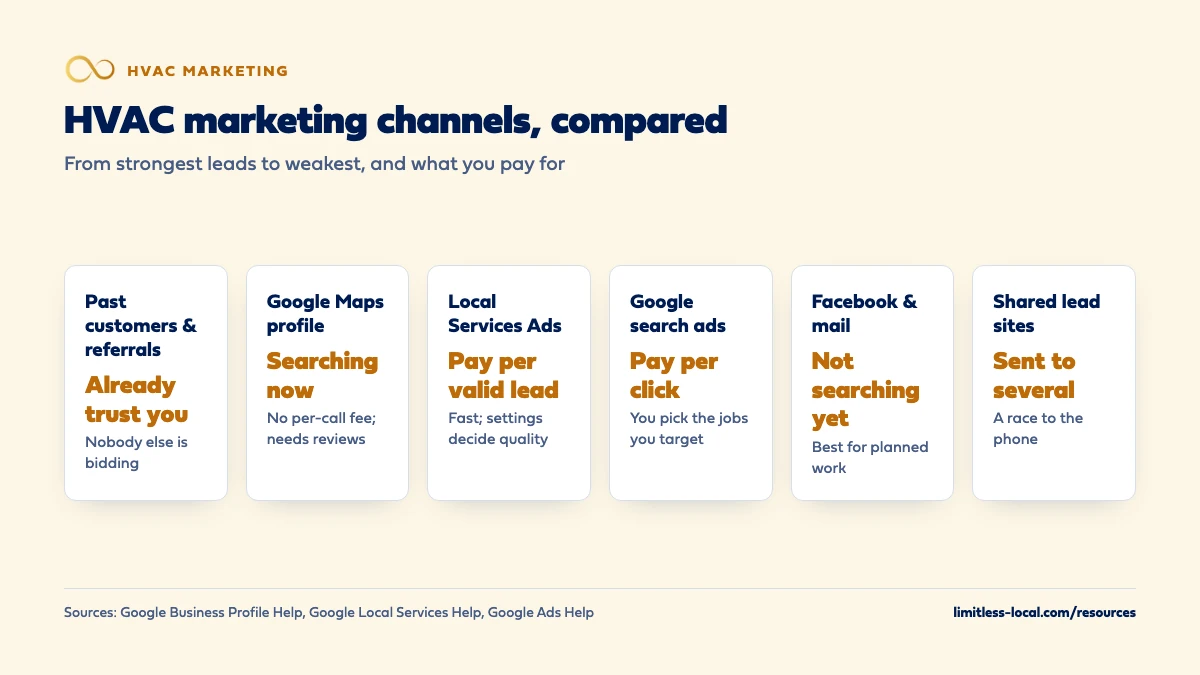
Here’s how the main channels usually stack up for a residential HVAC company, from strongest leads to weakest:
- Past customers and referrals. Already trust you, nobody else is bidding.
- Google Business Profile and Maps. Searching right now, close by, no per-call fee.
- Local Services Ads. Searching right now; you pay per lead.
- Google search ads. Searching right now; you pay per click and pick the jobs.
- Your website’s organic search (SEO). Same intent as ads, but takes months to build.
- Facebook, Instagram and direct mail. Not searching yet; best for planned work.
- Shared lead sites. Real requests, but the same lead goes to several companies.
Treat that list as a starting order, not a verdict. In your market, LSAs might beat search ads or mail might beat Facebook. The sections below explain what makes each one strong or weak, so you know what to check in your own numbers.
Why do past customers and referrals give the best leads?
They skip the hardest part of marketing: getting a stranger to trust you. A homeowner whose furnace you fixed last winter doesn’t compare five companies when the AC quits. They call you. A neighbor who hears “use these guys” over the fence calls with half the sale already made.
These leads also cost the least. You aren’t bidding against anyone for them, and the work that produces them is work you should be doing anyway: a maintenance plan, a reminder before each season, a thank-you and a referral ask after a good job. Getting more repeat customers and referrals for your HVAC company walks through setting that up.
The catch is volume. Referrals can’t be switched on when the schedule is empty, and a young company has few past customers to draw on. That’s why the next channels matter.
How good are leads from Google Maps and my Business Profile?
Very good, and they don’t cost you per call. Someone who finds you in the Maps results is usually searching for a service nearby right now, and they can tap to call straight from your profile.
The work is in showing up. Google’s local ranking tips say local results are mainly based on relevance, distance and popularity: how well your profile matches the search, how far you are from the searcher, and how well known your business is, which takes in how many reviews you have and how many websites link to you. You can’t move your shop, but you can fill out every service and category, keep hours accurate, add real photos and keep a steady flow of new reviews.
For most HVAC companies this is the best channel per dollar once it’s working, because every call it brings is free. Optimizing your HVAC Google Business Profile for more calls has the checklist.
Are Local Services Ads leads better than Google search ad leads?
Both reach people searching right now, so both can bring strong leads. They differ in how you pay and how much control you get.
With Local Services Ads, you pay for valid leads: answered calls, messages, booking requests, and missed calls during business hours where the caller stayed on the line more than 20 seconds. Google filters out spam and duplicates before charging. You choose job types and service areas, not keywords, which makes setup simple but gives you less say over exactly which searches you show for.
With search ads, you pay for each click, and you choose the keywords. That’s more work, but it lets you go after specific high-value jobs, like system replacements, with their own ads and landing pages. Lead quality depends on how well you block the wrong searches.
Many HVAC shops run both. If you’re weighing LSAs alone, whether Google Local Services Ads are worth it for HVAC goes deeper.
Curious what your marketing is actually booking?
Get a free visibility audit — no obligation, no sales pitch.
Do SEO leads from my website beat paid leads?
They’re about equal on quality and much better on cost once they arrive. A homeowner who finds your AC repair page in the regular Google results has the same urgent need as one who clicks an ad. The difference is that you don’t pay for that click.
The trade-off is time. Ads can bring leads within days of launch; SEO typically takes 3-6 months to show meaningful organic growth. And SEO isn’t one job, it’s a steady stream of them: a page for each main service and town, a site that loads fast on a phone, and content that answers what homeowners actually search.
That’s why SEO rarely works as a first and only channel for a company that needs calls this month. It works best started early and run alongside a paid channel, so ads cover the gap while the organic calls build. As those organic calls grow, you can trim ad spend in the towns where you rank well.
Where do Facebook and Instagram ads fit?
Facebook and Instagram reach people who aren’t searching for HVAC at that moment. That makes them weak for emergency repairs and useful for planned work: tune-up specials before summer or winter, maintenance plan sign-ups, and replacement offers for homes likely to have aging systems.
Lead quality depends heavily on setup. Lead ads with instant forms let people send their details without leaving the app, and their contact info may be prefilled, which makes submitting very easy. Easy is good for volume and bad for intent, so many of those leads need a fast, friendly callback to turn into anything. Showing ads to people who already know you, like past customers and recent website visitors, usually brings better leads than cold audiences.
Judge Facebook on booked jobs over a whole season, not on the first week’s lead count. Whether Facebook ads work for HVAC calls covers audiences and offers in more detail.
Is direct mail still a good HVAC lead source?
It can be, for the right job and the right neighborhood. Like Facebook, mail reaches people who aren’t searching, so it suits planned work: seasonal tune-ups, maintenance plan offers, and replacements in neighborhoods where the homes and systems are getting old.
The USPS Every Door Direct Mail tool lets you map ZIP Codes and neighborhoods and filter by age, income or household size using Census data, and it lists EDDM Retail postage at $0.26 a piece. That makes it cheap to reach a tight area around where your trucks already are. Printing and design come on top.
Mail lives or dies on tracking. Put a phone number or web address on the card that you use nowhere else, so every call it brings can be counted. Without that, a mailing that booked ten jobs and one that booked none look exactly the same in your records.

Why do shared lead sites give the weakest leads?
The homeowners are usually real, and they do need work. The problem is that the same request can go to several contractors, so you’re in a race the moment it arrives: whoever calls first and quotes lowest tends to win. You pay for the lead whether you win or not.
That doesn’t make them worthless. They can help a new company fill gaps in the schedule, and some owners book them profitably by calling back within a couple of minutes, every time. But they rarely beat a homeowner who called you from Maps, an ad or a referral. Avoiding wasted money on shared HVAC leads covers how to buy them without bleeding money.
How should I mix channels on a small budget?
Build in layers, cheapest and strongest first, and add one channel at a time so you can see what each one does:
- Answer every call. No channel works if leads hit voicemail.
- Google Business Profile and reviews. Free calls once it ranks, and it helps every other channel.
- Past customers. Maintenance plans and seasonal reminders.
- One paid search channel. Local Services Ads or Google search ads, in your closest towns.
- SEO. Started early, so it’s paying off by next season.
- Facebook or mail. Once the basics are booking, for tune-ups and replacements.
With more budget, you don’t skip steps; you run more of them at once and push harder on the ones with the lowest cost per booked job.
How do I find out which channel is best for my company?
Give every channel its own way to be counted, then follow each lead to the money. That means a separate tracking number per channel, tracked web forms, and a lead source on every job in your field software.
Most field software can then show you the answer. Jobber’s lead source report, for example, shows how many leads each source brought in, how many got a quote, a job and an invoice, and the value of the first invoice tied to each lead. Divide what each channel cost by the booked jobs it produced, and set that next to the revenue.
Check it weekly for problems and monthly for decisions. Which numbers an HVAC owner should track every week lays out a short scorecard that makes the comparison quick.
Not sure which of these is costing you jobs?
A free visibility audit checks the Google profile, reviews, site and tracking, and shows what to fix first.
What's different about HVAC marketing channels
Emergency and planned work need different channels. A no-cool call in July comes from Maps, LSAs and search ads. A tune-up or a replacement you plan months ahead can come from mail, Facebook or a past-customer list. Judge each channel on the kind of job it’s meant to bring.
The season moves the best channel. Search channels carry the peaks; the shoulder seasons are when mail, email and Facebook offers for tune-ups do their best work. A channel that looks weak in October may be doing exactly its job.
Replacements change the math. One system replacement can be worth many service calls, so a channel with a higher cost per booked job can still win if it brings replacement work. Track revenue by channel, not only bookings.
Maintenance plan members are a channel of their own. They call you first, and they’re where many replacement leads come from. Count them separately so they don’t make another channel look better than it is.
A worked example: ranking four channels by cost per booked job
These numbers are made up to show the math, not a benchmark for your market. Say you track four channels for one month:
- Local Services Ads: $1,200 spent, 8 booked jobs = $150 per booked job.
- Google search ads: $1,980 spent, 12 booked jobs = $165 per booked job.
- Facebook: $600 spent, 3 booked jobs = $200 per booked job.
- Postcards: $900 spent, 4 booked jobs = $225 per booked job.
On cost alone, LSAs win. Now add what the jobs were worth. If one of the Facebook bookings was a full system replacement and the LSA jobs were all small repairs, Facebook may have brought in more money than any other channel. That’s why you rank channels on both columns: cost per booked job and revenue per channel. A free visibility audit runs this comparison on your real numbers.
Frequently asked questions
Which channel is best for HVAC replacement leads?
Usually your own past customers with older systems, referrals, and Google search ads aimed at replacement searches with their own landing page. Maintenance plan visits are where many replacement conversations start.
Should a new HVAC company use every channel at once?
No. Start with your Google Business Profile, one paid search channel and tracking on both. Add the next channel only once you can see what the first ones are booking.
Do Google Maps calls cost anything?
Google doesn’t charge per call for your Business Profile. The cost is the time, or the help you pay for, to keep the profile complete and the reviews coming in.
How long should I test a channel before judging it?
Long enough to book a meaningful number of jobs, and across similar weather. One heat-wave week makes every search channel look great, and one mild week makes them all look bad.
Is word of mouth really a marketing channel?
Yes, if you treat it like one. Ask for referrals, make it easy to pass your name along, and tag referral jobs in your software so you can see how much work they bring.
Are other directories and apps worth testing?
They can be. Give each one its own tracking number, run it for a full season, and keep it only if its cost per booked job holds up against your other channels.
Key takeaways
- Past customers and referrals give the strongest leads; build them with maintenance plans and asking.
- Your Google Business Profile brings high-intent calls with no per-call fee once it ranks.
- Local Services Ads and Google search ads are the fastest paid channels; SEO matches their quality but takes months.
- Facebook and mail suit planned work; shared lead sites are usually the weakest buy.
- Rank channels by your own cost per booked job and revenue, not lead count.
Want a second set of eyes on your setup?
We'll look at how you show up locally and where calls are leaking, then send you a plain-English breakdown.
More in this section
- How can an HVAC company get more leads?
- How do I grow my HVAC company with marketing?
- How should a commercial HVAC company market itself?
- How do I market a second HVAC location?
- What promotions and offers work for an HVAC company?
Sources
- Tips to improve your local ranking on Google — Google Business Profile Help
- How leads work — Google Local Services Help
- Cost-per-click (CPC): Definition — Google Ads Help
- About lead ads with instant form — Meta Business Help Center
- Every Door Direct Mail (EDDM) — USPS
- Lead Source Report — Jobber Help Center