
How do backlinks and listings help a pool builder rank in Maps?

- Do backlinks and directory listings really help a pool company show up in Google Maps?
- Where do backlinks and listings fit in Google Maps rankings?
- What's the difference between a backlink and a listing?
- How do listings help my pool company show up in Maps?
- How do backlinks help a pool builder rank in Maps?
- Which links are worth the most for a pool builder?
- How can a pool builder earn links without buying them?
- Which link tactics can hurt a pool company?
- How many listings and backlinks does a pool builder need?
- How do I see which websites link to my pool company now?
- Why might new links and listings not move my Maps ranking?
- How long before links and listings help in Maps?
- What's different about links and listings for pool builders
- A worked example: reading your own links report
- Frequently asked questions
- Key takeaways
- More in this section
- Sources
The short version
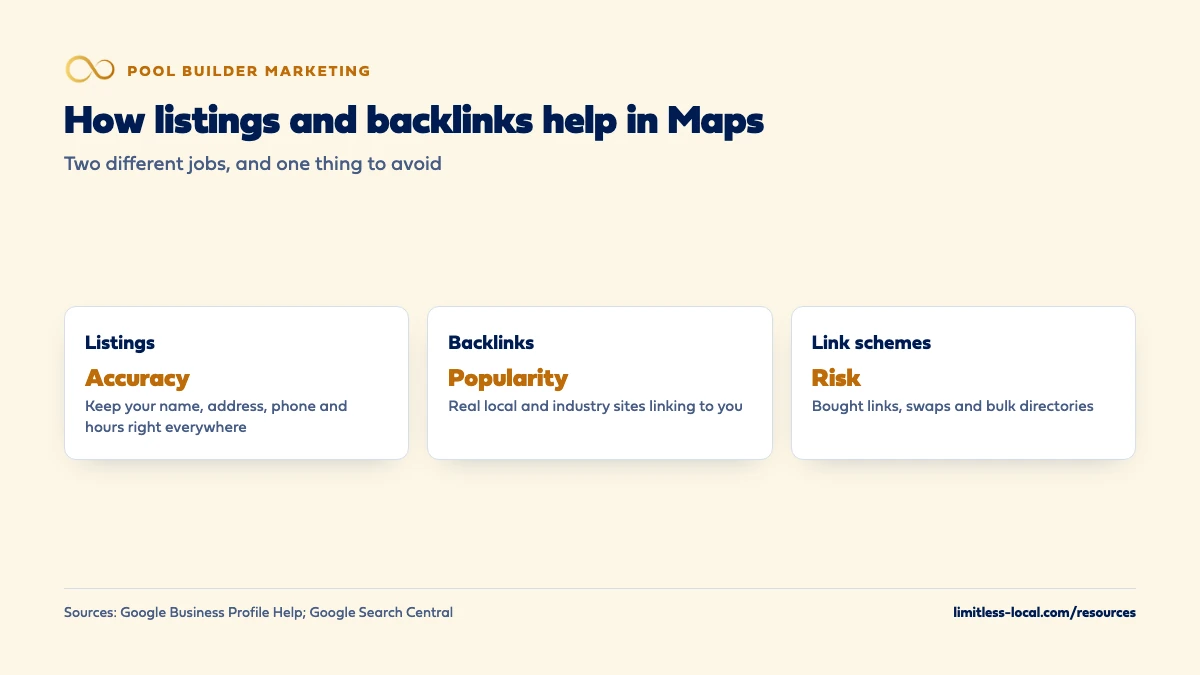
- Listings keep your name, address, phone and hours accurate wherever Google looks.
- Backlinks from real local websites help Google see your company as well-known.
- Distance, relevance and reviews still matter as much or more.
- Buying links or link swaps for ranking breaks Google's spam policies.
For pool builders who keep hearing that links and listings matter for Maps and want to know how, which ones count, and what to stay away from.
Get a free visibility audit · Book a growth call
Do backlinks and directory listings really help a pool company show up in Google Maps?
Listings help by keeping the details Google shows about your pool company accurate, because Google builds business information partly from your website, other websites and data it licenses from other companies. Backlinks help through what Google calls popularity: how well-known a business is, which it judges partly from how many websites link to you and how many reviews you have. Neither one beats distance or a weak Google profile, and bought links or bulk directory packages can work against you.
Both pieces are part of the local SEO foundation we build from the Essentials package up: listing cleanup and buildout, your name, address and phone synced across 50+ directories, and link building from real websites, alongside Google profile management and review generation. Our local SEO page explains how that work fits together, the pool builder marketing page shows how we work with pool companies, and the pool builder marketing questions library covers the rest of Maps question by question.
Where do backlinks and listings fit in Google Maps rankings?
Google’s local ranking tips say local results are mainly based on relevance, distance and popularity, and that there’s no way to request or pay for a better local ranking. Links and listings touch two of those three.
- Popularity is how well-known a business is. It’s based partly on how many websites link to your business and how many reviews you have. That’s where backlinks come in.
- Relevance is how well your profile matches a search. Accurate, complete business information helps here: businesses with complete and accurate info are more likely to show up in local results. That’s where listings come in.
- Distance is how far you are from the person searching. Links and listings don’t change it.
So links and listings are real levers, but they’re two of several. A pool builder with a thin Google profile and a handful of reviews won’t fix that with more directory listings.
What's the difference between a backlink and a listing?
A backlink is a link on another website that points to a page on yours. A supplier’s dealer page that links to your homepage is a backlink. So is a local news story that links to your project gallery.
A listing is a profile of your business on another site, usually with your name, address, phone, hours and website: Bing Places, Apple Business, Yelp, the Better Business Bureau, Facebook, Nextdoor and industry directories.
Plenty of things are both. A Yelp profile is a listing, and if it links to your site, that’s a backlink too. A mention of your company in an association member list with no link is a listing-style mention, often called a citation, but not a backlink. If the terms are new to you, what NAP is and why it matters covers the name, address and phone side.
How do listings help my pool company show up in Maps?
Mostly by keeping your details right. Google’s page on how it sources business information says profiles are compiled from a variety of sources, including crawled web content such as your official website, licensed data from third parties, users who contribute information, including business owners, and Google’s own interactions with a business.
That’s why a stale listing somewhere else can matter. If an old directory, a data company and your website all show different phone numbers, any of them can end up in front of a homeowner. Accurate listings remove that problem and back up what your Google profile says.
Listings also help in a simpler way: homeowners use them. Plenty of people check a builder on Yelp, the BBB or Nextdoor before they call. Which online listings a pool builder should have besides Google goes through the ones worth claiming.
How do backlinks help a pool builder rank in Maps?
Through popularity. When real websites in your area and your industry link to you, that’s one of the signals Google uses to judge how well-known your company is. More reviews and positive ratings feed the same factor.
Links also help your website rank in the regular results under the map. Google’s overview of how it ranks results says one of the factors used to determine quality is understanding if other prominent websites link or refer to the content, which it calls generally a good sign that the information is trustworthy. A pool company that shows up in both places gets two chances at the same homeowner.
What makes a link count is where it comes from. A link from a local newspaper, a manufacturer that lists you as a dealer or a landscaper you actually work with says something real about your company. A link from a page that exists only to hold links says very little.
Which links are worth the most for a pool builder?
The ones a homeowner might actually click. For pool companies, that usually means:
- Manufacturer and dealer locators for the pool, equipment or finish brands you install.
- Industry associations you genuinely belong to.
- Home shows and local events that list exhibitors or sponsors.
- Partner trades, such as landscapers, outdoor kitchen builders, fence companies and home builders, that link to you because they send you work.
- Local news and community sites covering a standout build, a community project or your company’s story.
- Your local chamber of commerce or business association.
A partner who links to you because they really recommend you is also a referral source, and getting referrals from landscapers and home builders covers how to build those relationships.
Curious what your marketing is actually booking?
Get a free visibility audit — no obligation, no sales pitch.
How can a pool builder earn links without buying them?
Mostly by asking the people you already work with, and by giving local sites something worth linking to. A practical list:
- Ask your suppliers. If a manufacturer has a dealer locator and you qualify, make sure you’re on it with your website.
- Check your memberships. Association and chamber member pages often include a website field nobody filled in.
- Trade links with real partners, not strangers. A landscaper you refer work to can reasonably list you on a partners page.
- Pitch a story. A tricky hillside build, a pool for a local charity or a long-running family business can interest local reporters.
- Publish something useful. A clear guide to your county’s pool permit process or HOA approvals is the kind of page other local sites link to.
Google’s SEO starter guide says other sites linking to you is something that happens naturally over time, and that you can encourage people to discover your content by promoting your site. That’s the pace to expect: a few good links a season, not hundreds a month.
Which link tactics can hurt a pool company?
Anything built mainly to game rankings. Google’s spam policies define link spam as creating links to or from a site primarily for the purpose of manipulating search rankings. Its examples include:
- Buying or selling links for ranking purposes, including exchanging goods or services for links.
- Excessive link exchanges, or partner pages exclusively for the sake of cross-linking.
- Using automated programs or services to create links to your site.
- Low-quality directory or bookmark site links.
- Widely distributed links in the footers or templates of various sites.
Sponsorships aren’t banned. Buying and selling links is a normal part of the web for advertising and sponsorship, as long as those links are qualified with a nofollow or sponsored attribute. So if you sponsor a youth league or a charity event, the link on their site is fine; it just shouldn’t be sold to you as a ranking boost.
If anyone pitches you a package of hundreds of links or directory submissions, walk away. Whether citations are worth paying for covers which listing work is worth the money.
How many listings and backlinks does a pool builder need?
There’s no magic number, and anyone quoting one is guessing. Google doesn’t publish a target, and what counts is where the links come from, not how many there are.
A better way to set a goal: look at the pool builders who show up above you in Maps for the searches you care about, and compare what’s genuinely different. If they’re on every manufacturer locator and local association page and you’re on none, that’s a gap worth closing. If they have far more reviews, that gap probably matters more than links.
For listings, the goal is simple: every listing that matters is claimed, complete and matches your Google profile exactly. After that, more directories add little.

How do I see which websites link to my pool company now?
Use the Links report in Google Search Console, which is free once your website is verified there. Google’s Links report help page describes a backlink as a link on a page from another site that links to a page on your site, and the report shows your top linked pages, the top linking sites and the most common link text.
Two things to check:
- Do you recognize the sites? Confirm that you recognize the sites listed and look for unknown and possibly spammy ones.
- Are the sites that matter to you there? If your main supplier, your association or your local paper isn’t on the list, that’s your to-do list.
Don’t panic over a few junk links. Google’s disavow page says that in most cases Google can assess which links to trust without additional guidance, so most sites won’t need its disavow tool. The report also isn’t a complete list of every link, so treat it as a sample, not an inventory.
Why might new links and listings not move my Maps ranking?
Usually because something else is the real gap. The most common ones for pool builders:
- Distance. If the homeowner is searching from a town well away from your listed location, builders closer to them have an edge that links can’t erase. How proximity affects a pool builder’s Maps ranking explains what you can and can’t change.
- Relevance. If your primary category, services and description don’t match what homeowners search, links won’t fix that.
- Reviews. A builder with steady, recent reviews often beats one with more links and fewer reviews.
- Profile problems. Duplicates, a suspended profile or a mismatched business name can hold everything back.
If you’re not sure which gap is yours, why a competitor outranks your pool company in Google Maps walks through how to find it.
How long before links and listings help in Maps?
Nobody can honestly promise a date. Fixing a wrong phone number or address on a major listing removes a problem as soon as the platform accepts the change, but the effect on ranking isn’t something you can schedule. New links are slower still, because good ones arrive a few at a time.
As a broad guide, SEO typically takes three to six months to show meaningful organic growth, and links and listings are part of that ramp, not a shortcut around it. Judge the work by what you can see along the way: listings fixed, real local links added, and over a season, more calls and consultation requests from Maps in your Google Business Profile performance numbers.
Want to see where your company stands?
A free visibility audit shows where you show up on Google, Maps and AI answers, and what it's costing you in calls.
What's different about links and listings for pool builders
Your industry has its own link sources. Dealer locators for the brands you install and pool industry associations put you in front of homeowners already shopping for a pool. Most trades don’t have anything as targeted.
You work alongside other trades. Landscapers, hardscapers, outdoor kitchen builders, fence installers and home builders are natural partners, and a genuine partner page is a link that also sends referrals.
Builds make good stories. A pool on a tough lot, a community project or a family business milestone gives local media something to cover. A plumbing repair rarely does.
Many builders work from a yard, not a storefront. Decide how your address appears and keep it the same on every listing, because mixed approaches are a common source of mismatches.
A worked example: reading your own links report
These numbers are made up to show how to read the report, not a benchmark. Say a pool builder opens the Links report and sees 30 linking sites:
- 17 are directory pages they’ve never heard of.
- 7 are listings they set up themselves, like Yelp, the BBB and Facebook.
- 4 are suppliers or partners.
- 2 are local: a newspaper story and a home show exhibitor page.
The 17 unknown directories aren’t worth worrying about, and adding more like them won’t help. The useful number is the 6 that come from real local and industry relationships (4 suppliers or partners plus 2 local sites). The plan writes itself: ask the other manufacturers they install for dealer locator listings, fill in the website field on their association page, ask their two biggest landscaping partners about a partner link, and pitch the newspaper on this season’s most unusual build.
Frequently asked questions
Do links to my website help my Google Business Profile?
They can. Google lists how many websites link to your business as part of how well-known it judges you to be, and that feeds local rankings alongside your reviews.
Is a Yelp or BBB listing a backlink?
It can be both a listing and a backlink if it links to your website. Even without a link, it still helps keep your details consistent and gives homeowners another place to check you.
Should I pay for a sponsorship to get a link?
Sponsor things you’d support anyway. A sponsorship link is fine under Google’s policies when it’s marked as sponsored or nofollow, but don’t buy one expecting a ranking boost.
Can bad backlinks get my pool company penalized?
Links you didn’t build are rarely a problem, since Google says it can usually work out which links to trust. The risk comes from link schemes you or a vendor set up on purpose.
Should my landscaping partners and I link to each other?
If you genuinely refer work to each other, a partner link on each site is normal. Swapping links with dozens of companies just for rankings is the kind of exchange Google’s spam policies warn about.
Do listings on Bing and Apple Maps help me in Google Maps?
Not directly as a ranking factor that Google spells out, but they keep your details consistent across the web and put you in front of people who use those maps.
Key takeaways
- Listings keep your details accurate, which supports relevance and stops wrong numbers reaching homeowners.
- Backlinks from real local and industry sites feed the popularity side of local ranking, alongside reviews.
- Dealer locators, associations, partner trades, home shows and local news are a pool builder’s best link sources.
- Bought links, link swaps for ranking and bulk directory packages break Google’s spam policies or add nothing.
- Links and listings can’t beat distance or a weak profile; find your real gap first.
Not sure what's working right now?
Start with a free visibility audit: rankings, Google profile, reviews and tracking, checked against your service area.
More in this section
- How does proximity affect a pool builder's Google Maps ranking?
- How do reviews affect a pool builder in Maps and AI search?
- Which online listings should a pool builder have besides Google?
- How do I get my pool company to rank in Google Maps?
- Why does my competitor outrank my pool company in Google Maps?
Sources
- Tips to improve your local ranking on Google — Google Business Profile Help
- Understand how Google sources & uses info in Business Profiles & local search results — Google Business Profile Help
- How Google determines ranking results — Google Search
- SEO Starter Guide — Google Search Central
- Spam policies for Google web search — Google Search Central
- Links report — Search Console Help
- Disavow links to your site — Search Console Help