
What is the best marketing idea for a roofing company to try first?
- Which single marketing idea should a roofer with little time and budget try first?
- Why does the first marketing idea matter so much for a roofer?
- What makes a marketing idea a good first move?
- Why is the Google Business Profile the best first move for most roofers?
- Why pair the profile with a review habit?
- When should a roofer try Google Ads first instead?
- What if I'm sitting on a pile of open estimates?
- What if I already have a long list of past customers?
- Which marketing ideas sound good but shouldn't come first?
- How do I run my first idea as a real test?
- What do I add once the first idea is working?
- Which first idea fits my roofing company right now?
- What's different about a first marketing idea for a roofing company
- A worked example: two first ideas side by side
- Frequently asked questions
- Key takeaways
- More in this section
- Sources
The short version
- Default first move: finish your Google Business Profile and ask every customer for a review.
- Already strong on Google and need calls now? Try a small search ad campaign in your closest towns.
- Sitting on open estimates? Follow them up before spending anything new.
- Run one idea at a time, track it, and judge it by signed roofs.
For roofing owners with limited time and money who want one first move that pays off, not a list of twenty ideas.
Get a free visibility audit · Book a growth call
Which single marketing idea should a roofer with little time and budget try first?
For most roofing companies, the best marketing idea to try first is a complete, verified Google Business Profile paired with a habit of asking every finished customer for a review. It costs nothing but time, puts you in Maps where homeowners look for a local roofer, and makes everything you add later work better. If your profile is already strong and you need calls this month, try a small Google search ad campaign aimed at your closest towns instead.
That’s the same order our work starts in: build the foundation first (tracking, follow-up and a clean online presence), then turn on lead flow with local SEO and ads around the towns and jobs you want. See how that fits a roofing company on our roofing marketing page, or what each tier covers on the packages page. For every channel in more depth, the guide to getting roofing leads lays them out, and the roofing marketing questions library takes the follow-ups one at a time.
Why does the first marketing idea matter so much for a roofer?
Because you only get to learn from one thing at a time. Start three new ideas in the same month and you won’t know which one brought the calls, which one wasted money and which one just needed more time.
Time is usually tighter than money. Most roofing owners are still on roofs, running crews or chasing estimates, so the first idea has to fit into a few hours a week and keep working when storm season takes over. Pick one, run it properly, and you’ll have a real answer in weeks or months instead of a pile of half-finished experiments.
What makes a marketing idea a good first move?
Score any idea against five questions:
- Does it reach people already looking for a roofer? Someone searching “roof repair near me” is closer to calling than someone scrolling a feed.
- Is it cheap to start? Your first move shouldn’t need a big check before you know it works.
- Can you set it up quickly? Days or weeks, not a three-month project.
- Does it keep working? Some ideas stop the day you stop paying; others build over time.
- Can you measure it? If you can’t tell which signed roofs it produced, you can’t judge it.
Very few ideas score well on all five. The Google profile and review habit comes closest, which is why it’s the default first move.
Why is the Google Business Profile the best first move for most roofers?
It’s free, it shows up where homeowners look for a local roofer, and it keeps working whether or not you ever run ads. Google says a Business Profile lets you manage how your business shows up on Maps and Search at no charge.
Google also says local results are mainly based on relevance, distance and popularity, and that businesses with complete and accurate info are more likely to show up in local search results. For a roofer, getting it right means:
- Verifying the profile, so Google knows you’re authorized to represent the business.
- Setting the right primary category and adding only the services you actually sell.
- Drawing your service area around the towns your crews drive to, with your address hidden if homeowners don’t visit you.
- Adding real photos of your crews, trucks and finished roofs.
- Making sure the phone number on the profile gets answered.
There’s no way to request or pay for a better local ranking, so this is work, not spend. Whether your roofing Google Business Profile is set up to bring in calls has a full checklist.
Why pair the profile with a review habit?
Because reviews feed both the ranking and the call. More reviews and positive ratings can help your local ranking, and a homeowner choosing between three roofers in Maps reads the reviews before tapping call.
Make it a habit, not a campaign:
- Ask at the end of every job, while the crew is still on site or the same day.
- Send a direct link by text. Google lets you create a review link or QR code from your profile.
- Have the person who ran the job ask, by name.
- Reply to every review, good and bad.
Keep it clean: Google’s review tips say offering incentives, like free or discounted goods or services, in exchange for reviews counts as fake and misleading content. Ask everyone and offer nothing. Getting more Google reviews after a roof replacement covers timing and wording.
When should a roofer try Google Ads first instead?
When your profile is already in good shape and you need calls soon. Ads can generate leads within days of launch, while the profile and SEO build over months.
Keep the first campaign small and tight:
- One campaign for the job you want most, usually replacements or repairs.
- Only your closest towns. Google Ads lets you use the “Presence” location option so ads show to people in, or regularly in, the areas you target.
- A landing page or service page with a tap-to-call number and a short form.
- Call tracking from day one, so you can see what each call cost.
The trade-off is that ads charge from the first click and stop the day you stop paying. The fastest way for a roofer to get leads online compares ads with the other quick options.
Curious what your marketing is actually booking?
Get a free visibility audit — no obligation, no sales pitch.
What if I'm sitting on a pile of open estimates?
Then your best marketing idea isn’t marketing at all. It’s follow-up. Every unsigned estimate is a homeowner who already let you on the roof, which makes them the warmest leads you have.
Pull every estimate from the last few months that hasn’t signed or been marked lost, and give each one a real follow-up this week: a call, then a text with inspection photos or an answer to a question they asked. Mark each one signed, still open with a next date, or lost with a reason.
It costs nothing, and it often brings in work faster than any new channel could. How to follow up on unsigned roofing estimates has a schedule and what to say.
What if I already have a long list of past customers?
Use it. Past customers already trust you, and their neighbors have roofs the same age built by the same builder. A few low-cost ideas work well here:
- Ask for reviews from anyone in the last year or two who never left one.
- Ask for referrals plainly, with a thank-you note when one turns into a job.
- Check in after big storms with past customers in the area, offering an inspection.
- Mark the neighborhood around each current job with yard signs, where the homeowner agrees.
These ideas only work for a company with some history. If you’re just starting out, go back to the profile and reviews.
Which marketing ideas sound good but shouldn't come first?
- A full website redesign. A clear, working site matters, but a months-long rebuild before you have a profile and reviews delays everything. Fix what’s broken and move on.
- Posting on social media every day. It takes time every week and rarely reaches someone who needs a roofer today.
- Broad mailers to a whole city. Hard to track, and expensive to test properly.
- Buying shared leads. Fast, but the same homeowner may go to several roofers, and you own nothing when you stop paying.
- A long agency contract before you know what you need. Start with the basics, then hire help for the parts you can’t do well.
- A new name or logo. Your trucks and yard signs already carry the one homeowners know.
None of these is always wrong. They just shouldn’t be first.
How do I run my first idea as a real test?
Write down four things before you start:
- What you’re doing. “Finish the profile and ask every customer for a review” or “Run search ads in our closest towns.”
- What it costs. Ad spend, fees and your own hours.
- How you’ll measure it. Profile calls from Google’s performance report, tracked ad calls, and which leads became signed roofs.
- When you’ll judge it. Ads need a few weeks of steady spend. The profile and reviews need a few months.
Change one thing at a time, and put a source on every lead as it comes in. Tracking which roofing leads turn into signed jobs shows a simple way to do it.
What do I add once the first idea is working?
Keep the first idea running as a habit, then add one thing at a time. For most roofers the order after the profile and reviews is a simple website with a page for each main service, then search ads, then SEO for the long ramp, with Local Services Ads somewhere in between once you have the reviews to compete.
Add the next channel only when the current one is steady and you can see what it produces. What marketing a roofing company should add first to grow lays out the full order.
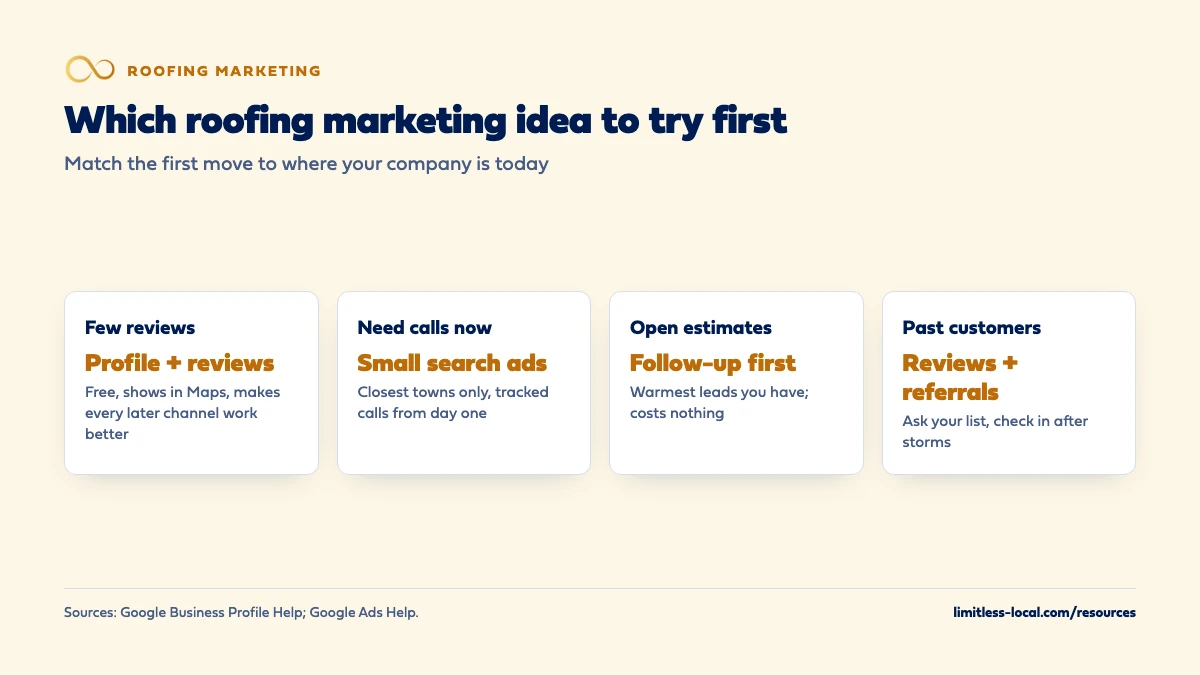
Which first idea fits my roofing company right now?
- No profile, or a profile with few reviews: the profile and review habit.
- A strong profile, but you need calls this month: a small search ad campaign in your closest towns.
- Plenty of estimates, few signatures: follow-up on open estimates.
- Years of past customers, few reviews: a review and referral push to that list.
- Just had a storm in your area: answer the phones, update the profile and check in with past customers in the hit neighborhoods.
Pick the one line that fits, start this week, and give it time to show results before you add the next idea.
Want to see where your company stands?
A free visibility audit shows where you show up on Google, Maps and AI answers, and what it's costing you in calls.
What's different about a first marketing idea for a roofing company
One job can pay for a lot of testing. A single replacement is a high-ticket job, so even a small first idea only needs a few signed roofs to pay for itself. That’s also why tracking each idea to signed roofs matters more than counting calls.
Weather sets the calendar. Slow months are the best time to build the profile, collect reviews and fix the website. Storm season is when ads and fast phones matter most.
Trust decides the call. Homeowners worry about storm chasers. A verified profile with recent reviews and photos of your own crews tells them you’re the local company that will still be here next year.
The sale takes several steps. Call, inspection, estimate, signature. A first idea that brings calls but no inspections needs a look at the phones, not more marketing.
A worked example: two first ideas side by side
These numbers are made up to show the math, not a benchmark for your market.
Idea A, the profile and reviews. The owner spends a couple of hours a week finishing the profile, adding photos and texting review links. Of 30 customers asked, 12 leave reviews. Over the next few months, profile calls in Google’s performance report rise from 9 a month to 15. The cash cost is zero, and the work keeps paying off after it’s done.
Idea B, a small search ad test. A different roofer with a strong profile spends $1,500 in a month on ads in three nearby towns and gets 25 leads, or $60 per lead. Eight become inspections and 2 sign. Cost per signed roof is $1,500 divided by 2, or $750, and the calls stop when the spend does.
Neither idea is better in every case. A is the stronger base; B is the faster test once the base is there.
Frequently asked questions
How much should I spend on my first roofing marketing idea?
The profile and review habit costs time, not money. If you start with ads, spend enough to get a steady flow of clicks for a few weeks in a small area, and set a cap you’re comfortable losing while you learn.
Do I need a website before I try anything else?
Not for the profile and reviews. For ads, you need at least one clear page with a tap-to-call number and a short form, so a simple site or landing page should come before the first ad dollar.
Are Local Services Ads a good first idea?
They can be once you have reviews, because Google counts your rating, number of reviews and response time in where your ad shows. For a brand-new company with few reviews, the profile usually comes first. Whether Local Services Ads are worth it for a roofer goes deeper.
Is door knocking a good first marketing idea?
It can bring inspections quickly around a recent job or storm, but it stops when your reps stop walking. Many roofers use it alongside the profile, not instead of it.
How long should I give the first idea before trying something else?
Long enough to see signed roofs, not just calls. Ads usually show a pattern within a few weeks of steady spend; the profile and reviews take a few months.
Can I do the first idea myself?
The profile and review habit, yes, with a few protected hours a week. Ads are easier to get wrong, so many owners get help setting them up even if they watch the results themselves.
Key takeaways
- For most roofers, the best first idea is a complete, verified Google profile plus a review habit.
- If the profile is already strong and you need calls this month, try a small search ad test in your closest towns.
- Open estimates and past customers are cheaper wins than any new channel.
- Skip redesigns, daily social posting and broad mailers as first moves.
- Run one idea at a time, track it, and judge it by signed roofs.
Not sure what's working right now?
Start with a free visibility audit: rankings, Google profile, reviews and tracking, checked against your service area.
More in this section
- What marketing should a roofing company add first to grow?
- How should a roofing company market commercial roofing?
- What marketing brings a roofing company the most phone calls?
- How do I market a roofing company in the slow season?
- Is door knocking or online marketing better for a roofing company?
Sources
- Get started with Google Business Profile — Google Business Profile Help
- Tips to improve your local ranking on Google — Google Business Profile Help
- Tips to get more reviews — Google Business Profile Help
- Create a Google link or QR code to request reviews — Google Business Profile Help
- About advanced location options — Google Ads Help
- How ad ranking works for Local Services Ads — Google Local Services Help