
What marketing should an electrician never hand to an agency?

- Which parts of electrical marketing should the owner always keep control of?
- Why does it matter what I keep if the agency does the work?
- Who should own my Google Business Profile?
- Who should own the Google Ads account and the card on it?
- Who should own my website, domain and Search Console?
- Who should own my tracking phone numbers?
- Why shouldn't an agency answer my phone or book my jobs?
- Should an agency set my prices, offers or warranties?
- Can an agency handle my Google reviews?
- Who should own my customer list and job history?
- What should I still decide when the agency runs everything else?
- What's safe to hand off to an agency?
- What's different for electrical contractors
- A worked example: what's at stake in one ad account
- Frequently asked questions
- Key takeaways
- More in this section
- Sources
The short version
- Stay the owner of your Google profile, Google Ads account, domain and tracking numbers; give the agency its own login.
- Keep answering and booking calls, and keep the say on prices, offers, jobs and towns.
- Ask for reviews yourself and approve replies to complaints; never let anyone write, buy or filter reviews.
- Hand off the daily work: ads, SEO, listings, landing pages and reporting.
For electrical contractors who already use an agency, or are about to hire one, and want to know which pieces should stay in the owner’s hands.
Get a free visibility audit · Book a growth call
Which parts of electrical marketing should the owner always keep control of?
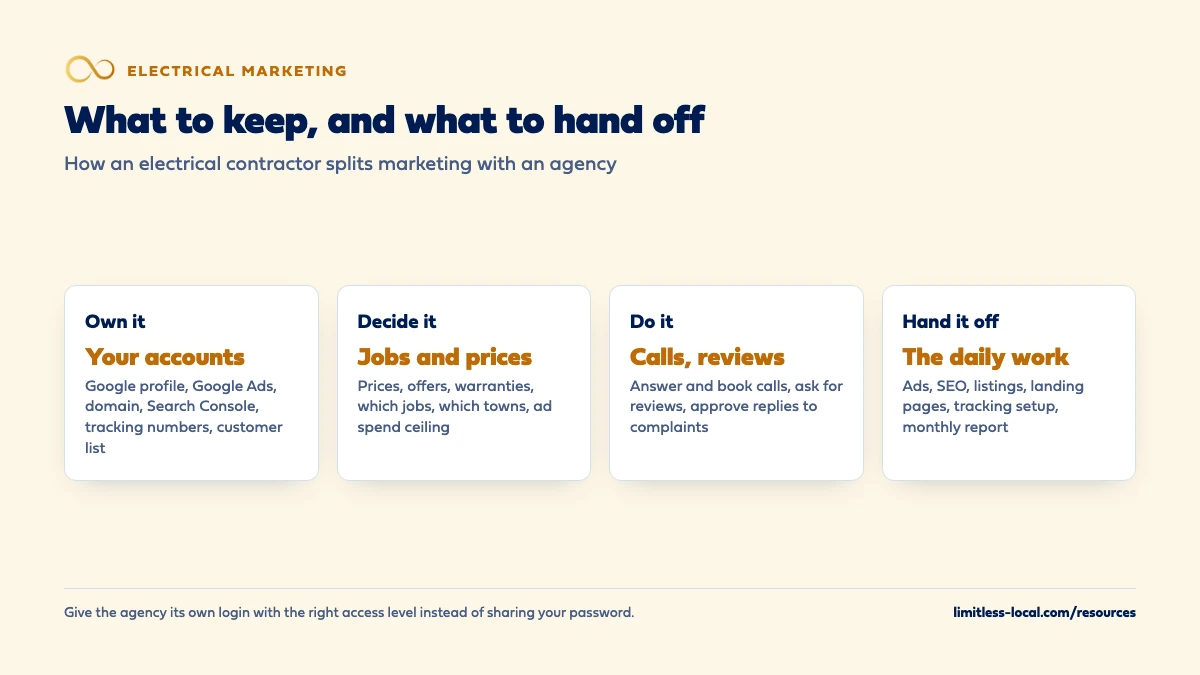
Never hand an agency ownership of your accounts: stay the owner of your Google Business Profile, Google Ads account, website domain and tracking phone numbers, and give the agency its own access instead. Keep answering and booking calls, setting prices and offers, deciding which jobs and towns you want, and asking customers for reviews, because those depend on knowing your business. An agency can run the campaigns, SEO, listings and reporting, but the keys and the customer relationship stay with you.
That split is how our packages are built: the team runs the ads, local SEO, listings and tracking, and every package includes a real-time dashboard and monthly reports with a cost-per-lead breakdown. You’ll know what we’re doing, why, and what it produced. The packages page shows what each tier covers, our electrical contractor marketing page explains how we approach the trade, and the electrical marketing questions library goes question by question.
Why does it matter what I keep if the agency does the work?
Because owners and agencies part ways, and when that happens you want to walk away with everything you paid to build. Your Google profile carries your reviews. Your ad account carries months of data on which searches turned into calls. Your domain carries every page that ranks. Your tracking numbers are printed on trucks and yard signs. If any of those sit in someone else’s name, leaving gets slow and expensive.
Some marketing also depends on knowing the business: how calls get answered, what a panel upgrade costs, which towns are worth the drive. An agency can support that work, but it isn’t the one standing behind the job. If you’re still weighing outside help against doing it all yourself, whether to hire an agency or DIY your electrical marketing covers that choice first.
Who should own my Google Business Profile?
You, as the primary owner. A profile can have several owners but only one primary owner, and owners have full control: they can add or remove users and even delete the profile. Managers can do nearly everything else, including editing your info, posting and replying to reviews. They just can’t add or remove users or remove the profile. Google’s page on Business Profile owners and managers lays out who can do what.
So add your agency as a manager. Each person signs in with their own Google Account, which means you never have to share your password. If an agency asks to be made primary owner, or set the profile up under its own login before you came along, fix it now. Transferring primary ownership needs at least one other owner or manager on the profile, and it goes a lot faster while everyone is still on good terms.
Who should own the Google Ads account and the card on it?
You should. Keep the account in your business’s name, keep yourself as an admin, and pay Google with your own card or bank details. Only users with admin access can give account access, change access levels and unlink manager accounts, which is why that seat belongs to you. It’s how our packages work too: ad spend isn’t included in any of them, and it’s paid directly to Google or Meta.
Watch how the account gets created. Agencies manage clients through manager accounts, and when a manager creates a new account, it automatically becomes the owner of that account, according to Google’s help on ownership of client accounts. If the agency links to an account you already have, it doesn’t get ownership unless you turn it on, and the client account still owns its data and can remove ownership by unlinking. In practice: open the account yourself, then invite the agency in. An account with only one admin may also lose access to its tags if that person becomes unavailable, so add a second admin from your own side, such as your office manager.
Who should own my website, domain and Search Console?
Register the domain in your business’s name, with an email address you control, and keep the login to the registrar. Do the same for the website platform and hosting. A web designer or agency can have its own user account on the site, but the account that pays the bill and holds the domain should be yours.
Moving a domain has rules, and they take time. ICANN’s FAQ on transferring a domain name says it’s your right to move a domain between registrars, and your registrar must give you the transfer code within five calendar days of asking. It also says you can’t move a domain to a different registrar within 60 days of changing the registrant name, organization or email address. So if your domain turns out to be in the agency’s name, getting it changed is a job for this month, not the week you want to leave.
One more login people forget is Google Search Console, which shows how your site does in search. A property must have at least one verified owner, and if the only verified owner leaves your team, you have to verify again to keep access (owners, users and permissions explains the roles). Make yourself a verified owner and give the agency a user seat.
Who should own my tracking phone numbers?
Tracking numbers sit on your ads, your Google profile and sometimes your truck wraps and yard signs, and forward to your real line so you can see which channel made the phone ring. They’re worth having, but if they sit in the agency’s call tracking account and the agency closes it, every place that number is printed stops ringing.
Ask in writing, before you sign, what happens to the numbers if you part ways. Some providers spell it out. CallRail’s help page on porting a number away says you own the numbers you create in CallRail, porting a U.S. tracking number away is free, and the process typically takes 4-6 weeks. The simplest protection: keep your main business number on anything permanent, like the truck wrap, and use tracking numbers where a change wouldn’t cost you a reprint. Whether your electrical business needs call tracking numbers covers the setup.
Curious what your marketing is actually booking?
Get a free visibility audit — no obligation, no sales pitch.
Why shouldn't an agency answer my phone or book my jobs?
Because that’s where marketing turns into money, and you know what to say. The person on the phone decides whether a caller with a burning smell at the panel gets a same-day slot, whether a panel upgrade caller gets an estimate visit, and whether a job two towns past your area gets a polite no. An agency can’t make those decisions for you.
That doesn’t mean you have to pick up every ring from a ladder. After-hours answering, AI website chat and automated appointment reminders can catch people you’d otherwise lose, and we offer those as add-ons. But you set the rules they follow: which calls count as emergencies, what gets booked straight away, what gets a callback, and what nobody promises on the phone. Write those rules down once, and every person and tool answering for you uses the same script. How to stop your electrical company from missing calls covers the options.
Should an agency set my prices, offers or warranties?
No. Your hourly rate, flat prices, service call fee, financing, discounts and any warranty are business decisions with your name on them, and you’re the one honoring them on the job. An agency can suggest how to present an offer, test two versions of an ad and tell you which one booked more jobs. It shouldn’t invent a discount to fill an ad, or publish a price you haven’t approved.
The same goes for anything that makes a promise or a claim in your name: your license number, “licensed and insured” lines, statements about permits, response-time claims like “same-day service”. Read every new ad and page before it goes live, or at least the first version of each.
Can an agency handle my Google reviews?
Part of it. An agency can set up your review link, build the follow-up text or email, track how many reviews come in and draft replies. What it shouldn’t do is the ask itself, or reply to an unhappy customer without your OK. You and your electricians know which jobs went well, and the ask lands best from the person who just finished the work.
Some review work is off limits for anyone. The FTC’s Q&A on its consumer reviews rule says advertising agencies, review brokers and reputation management companies aren’t immune: they can be liable for writing or selling fake reviews, for offering incentives conditioned on reviews with a particular sentiment, and for review suppression. If an agency offers to take care of your reviews in any of those ways, say no. How to respond to a negative Google review covers the replies you’ll want to keep for yourself.

Who should own my customer list and job history?
You. Your field software, whether that’s ServiceTitan, Housecall Pro or Jobber, should be in your company’s name, and an agency should get only the access it needs to pull reports. Your past customers are the cheapest marketing you’ll ever have: the generator service reminder, the follow-up after a panel upgrade, the homeowner who’ll call you again when they buy an EV.
Make sure you can get the data out. Jobber, for example, lets you export your client list as a CSV or vCard file, with tags, property addresses and contact details. Whatever you use, run an export once a year so you know it works. And make sure every new job records where the customer came from. That one field is how you’ll check any agency’s report against real invoices, which how to know if your electrical marketing agency is getting results walks through.
What should I still decide when the agency runs everything else?
The direction. An agency can do the work, but these calls are yours, and a good one will ask about them before it builds anything:
- Which jobs you want more of. Service calls, panel upgrades, EV chargers, generators, rewiring or commercial work. They need different pages, ads and budgets.
- Which towns your trucks will drive to. A wide service area brings calls you’ll turn down.
- How much more work your crews can take. More calls than your licensed electricians can handle just means longer waits and lost jobs.
- Your monthly ceiling on ad spend. Set it in writing, and know where to see it in your own account.
- What counts as a good month. Cost per booked job, not clicks, impressions or form fills.
If your agency never asks about any of these, the red flags that an electrical marketing agency will waste your money lists the other warning signs.
What's safe to hand off to an agency?
Most of the hours: running Google Ads day to day, SEO and service pages, keeping your listings consistent, Google profile posts using your own job photos, call tracking setup and the monthly report. That’s the work that takes steady weekly hours and punishes gaps.
For anything in between, use one test: if the agency disappeared tomorrow, could you pick the work back up from your own logins with your history intact? If yes, hand it off. If not, fix the ownership first, then hand it off.
Want to see where your company stands?
A free visibility audit shows where you show up on Google, Maps and AI answers, and what it's costing you in calls.
What's different for electrical contractors
Your license is on the line, not the agency’s. Anything that names your license, permits, code work or safety is a claim you stand behind. Licensing rules, including how a license number has to appear in advertising, vary by state, so check with your state’s licensing board before you approve ad copy.
Commercial relationships stay with you. General contractors, builders and property managers hire the electrician they know. An agency can build a commercial services page and run ads to it; the relationships and the bids are yours.
Emergency calls need your rules. A dead panel or a burning smell isn’t the same call as a quote for recessed lighting. Whoever answers for you after hours needs your list of what’s urgent and what can wait until morning.
Job photos come from your trucks. Clean panel swaps, EV charger installs and generator pads show your work better than stock photos, and only your crew can take them.
A worked example: what's at stake in one ad account
These numbers are made up to show the math, not a benchmark or a forecast. Say you’ve spent $2,000 a month on Google Ads for 18 months. That’s $36,000 in ad spend, and the account now holds a year and a half of data on which searches, towns and hours turned into calls and booked jobs.
- If the account is in your name: you remove the old agency’s access, invite the new one, and it starts from that history on day one.
- If the account was opened under the agency’s business and billing: you’re asking for it on their terms, and that history may stay with them while you start a new account and pay to learn the same lessons again.
The same goes for a Google profile holding every review you’ve earned and a domain holding every page that ranks. None of it costs extra to keep in your name; it just has to be set up that way from the start.
Frequently asked questions
Is it a red flag if an agency asks for my passwords?
Usually, yes. Google Business Profile, Google Ads and Search Console all let you invite people with their own login and a set access level, so there’s rarely a reason to hand over yours. Shared passwords also make it hard to remove someone cleanly later.
What if my old agency set up my Google Ads account?
Log in and check who the admins are and whether a manager account has ownership. If you aren’t an admin, ask the agency in writing to make you one before anything else changes. If the account was opened under the agency’s business, ask what it would take to move it to you.
Can the agency post to my Google profile without my approval?
Routine posts and job photos, yes, once you’ve agreed on the topics. Anything with a price, an offer, a warranty or a license claim should come to you first.
What happens to my Google reviews if I leave my agency?
They stay on your Business Profile, as long as the profile is yours. That’s the main reason to stay its primary owner and add the agency as a manager.
Should my website be built on the agency's own platform?
Be careful with a site that only runs on an agency’s private system. Ask whether you can take the site, or at least its content and images, with you if you leave, and get the answer in writing.
Key takeaways
- Stay primary owner of your Google Business Profile and an admin of your Google Ads account; invite the agency with its own access.
- Keep your domain and Search Console in your name, and ask in writing who owns the tracking numbers.
- Answering and booking calls, setting prices and offers, and asking for reviews stay with you.
- Never let anyone write, buy or filter reviews for you.
- Hand off the daily work: ads, SEO, listings, landing pages and reporting.
Not sure what's working right now?
Start with a free visibility audit: rankings, Google profile, reviews and tracking, checked against your service area.
More in this section
- Will a marketing agency understand the electrical trade?
- Should I hire an agency or DIY my electrical marketing?
- What marketing mistakes do independent electricians make?
- Can an electrical owner do DIY marketing first, then hire an agency?
- How much does a marketing agency cost for an electrician?
Sources
- Manage your Business Profile owners & managers — Google Business Profile Help
- About access levels in your Google Ads account — Google Ads Help
- Manager Accounts (MCC): About ownership of client accounts — Google Ads Help
- FAQs for Registrants: Transferring Your Domain Name — ICANN
- Managing owners, users, and permissions — Search Console Help
- Port a phone number away from CallRail — CallRail Help Center
- The Consumer Reviews and Testimonials Rule: Questions and Answers — Federal Trade Commission
- Export Client Information — Jobber Help Center