
How should an electrician change marketing to grow vs stay busy?

- How does an electrical marketing plan change when the goal is growth, not a full schedule?
- What's the difference between marketing to grow and marketing to stay busy?
- What should I fund if I just want to stay busy?
- How do I use ads as a valve when the schedule fills or empties?
- What changes when I want to grow?
- Which comes first: more marketing or another crew?
- How should my budget split change between the two modes?
- How much more should I spend to grow?
- Should I grow with new job types or new towns?
- What should I measure in each mode?
- When is it time to switch from staying busy to growing?
- What mistakes do owners make when they switch modes?
- What's different for electrical contractors
- A worked example: a stay-busy budget versus a growth budget
- Frequently asked questions
- Key takeaways
- More in this section
- Sources
The short version
- Staying busy: keep the free and cheap sources strong, and use ads to fill gaps.
- Growing: size the budget to the jobs your next crew needs, not to this month's gaps.
- Growth spend goes to channels that scale: Google Ads, Local Services Ads and SEO for new jobs and towns.
- Switch modes when you're booked out and turning work away, not before.
For electrical contractors deciding whether this year’s marketing should keep the current crews booked or build demand for the next truck.
Get a free visibility audit · Book a growth call
How does an electrical marketing plan change when the goal is growth, not a full schedule?
To stay busy, fund the steady, low-cost sources that keep the schedule full (your Google profile, reviews, past customers and referrals) and treat paid ads as a valve you open when the calendar has gaps and close when it’s full. To grow, you need marketing that books more jobs than your current crews can handle, so the budget is sized to the work your next tech or truck needs, more of it goes to ads you can scale and to SEO for new job types and towns, and you accept a higher cost while it ramps. The stay-busy budget follows your schedule; the growth budget follows your hiring plan.
Whichever mode you’re in, the number that decides it is what each booked job costs and how many your crews can handle. Our packages are built around that: Essentials manages Google Ads up to $2,500 a month in spend, and Growth adds Local Services Ads with Google Ads up to $5,000 in spend, with ad spend paid to Google separately. Our electrical contractor marketing page explains how we work with electrical shops, and the rest of the electrical marketing questions library goes question by question.
What's the difference between marketing to grow and marketing to stay busy?
Marketing to stay busy is about filling the crews you already have. The question each month is simple: are there holes in the schedule, and what’s the cheapest way to fill them?
Marketing to grow is about creating more work than you can handle today, so you can hire into it. The question changes: how many extra booked jobs does the next tech or truck need every month, and what will it cost to produce them reliably?
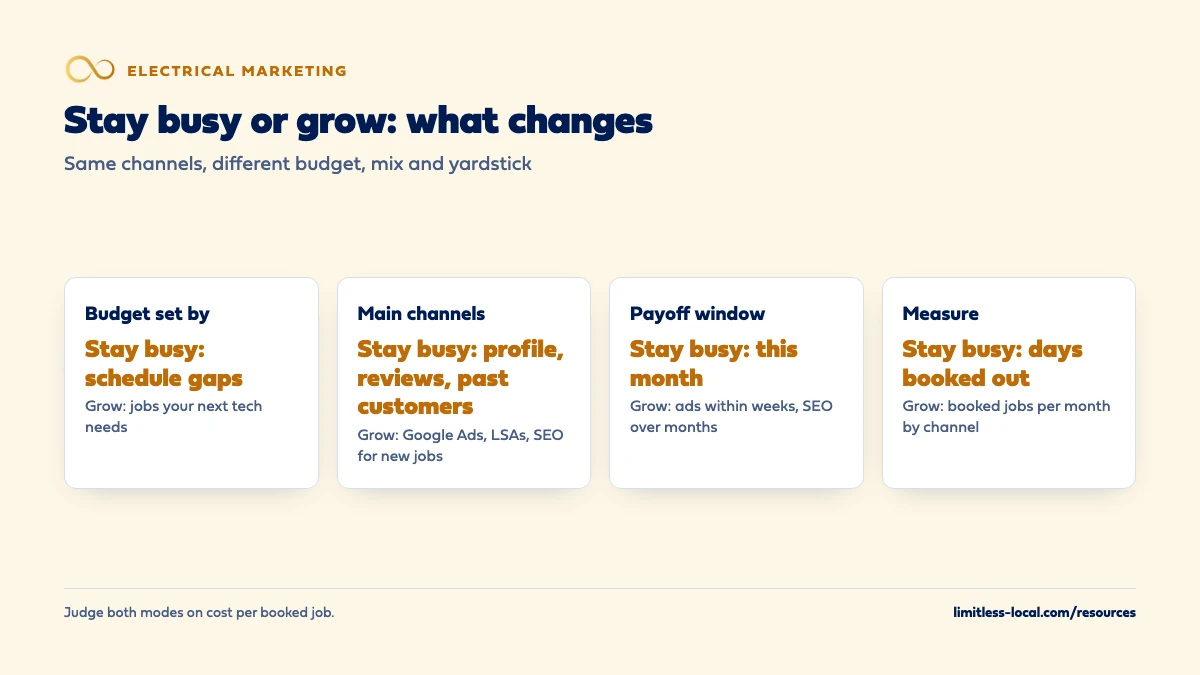
The two goals use most of the same channels. What changes is how much you spend, where it goes, how long you’re willing to wait for it to pay off and what you measure.
What should I fund if I just want to stay busy?
The sources that bring steady work for little or no spend:
- Your Google profile. A complete profile with real photos and a services list that names your best jobs.
- Reviews. A steady flow, asked for after every good job.
- Past customers. Reminders, safety checks for older homes, generator service before storm season.
- Referrals and builders. The people who already send you work.
- Answering every call. The cheapest job you’ll ever book is the one you didn’t let go to voicemail.
On top of that, keep a modest paid budget running so you don’t start cold when you need it. For a shop happy at its current size, this mix usually beats a big ad budget, because most of the work comes from people who already know you. Getting more referrals from past electrical customers covers the cheapest piece.
How do I use ads as a valve when the schedule fills or empties?
Paid ads are the one channel you can turn up and down quickly, which is what makes them useful for staying busy. In Google Ads, a change to your average daily budget shows in your account right away and Google starts serving your ads with the new budget, according to Google’s page on how budget changes take effect. Raising or lowering the budget doesn’t send the campaign into a “Learning” status either; Google’s page on Smart Bidding learning says budget changes take effect in the next auction.
A practical rhythm: look at how far out you’re booked every Monday. Two weeks out and turning work away? Trim the budget. Three open days next week? Raise it. Don’t switch the campaign off entirely each time it gets busy, because that’s how owners end up starting from zero in the slow month.
If you use Smart Bidding and expect a short jump in conversion rates, seasonality adjustments work best for events of 1 to 7 days, not for whole seasons. For a slow stretch, getting more electrical leads in a slow season has the full playbook.
What changes when I want to grow?
Four things change at once.
- The budget gets a target. Instead of “enough to fill gaps”, it’s “enough booked jobs for one more tech, every month.”
- The mix shifts toward channels that scale. Referrals and repeat work don’t grow on demand. Google Ads and Local Services Ads do, within the limits of your market.
- You invest ahead of the payoff. SEO for new job types and towns typically takes 3-6 months to show meaningful organic growth, while ads can generate leads within days. Growth plans need both: ads for the next few months, SEO for next year.
- Tracking stops being optional. You can’t scale a channel if you don’t know what each booked job from it costs.
Growth also means accepting a higher total spend before the new capacity is fully booked. That’s a planned cost, not a sign that something’s wrong.
Which comes first: more marketing or another crew?
Usually the marketing, slightly ahead of the hire. If you hire first, you’re paying a tech to wait for calls. If you market too far ahead, you’re paying for leads you can’t serve, and slow response turns good homeowners into bad reviews.
A simple approach: raise the budget in steps until you’re consistently booked out further than you’d like and turning down work you’d normally take. Hold it there for a month or two to make sure it isn’t a seasonal bump. Then hire, and keep the budget up so the new tech has a full schedule from week one.
If you’re in the middle of hiring now, whether to pause marketing while you’re hiring electricians covers what to keep running.
Curious what your marketing is actually booking?
Get a free visibility audit — no obligation, no sales pitch.
How should my budget split change between the two modes?
In stay-busy mode, most of the effort goes to the things that keep existing demand coming back: the Google profile, reviews, past-customer reminders, a website that turns visitors into calls, and a paid budget sized to fill gaps.
In growth mode, the same foundation stays, but new money goes mostly to three places:
- Paid search and Local Services Ads, for the job types you want more of, because they can scale within weeks.
- SEO and content for new services and the next ring of towns, because it’s slower but keeps paying once it ranks.
- Tracking and follow-up, so a bigger lead flow doesn’t leak at the phone.
Keep every line visible. What electricians should include in a monthly marketing budget lists them all.
How much more should I spend to grow?
Work backward from the hire. Decide how many booked jobs a new tech can handle in a month, multiply by what a booked job costs you in marketing today, and that’s roughly the extra monthly spend the growth plan needs once it’s running. Then add a cushion for the ramp, because the first months of a bigger budget often cost more per job while you find the searches and towns that work.
Two numbers make this honest: your real cost per booked job by channel, and how much of your current work comes in without marketing. How many jobs a month an electrician needs to hit a revenue goal walks through the job math step by step.
Should I grow with new job types or new towns?
New job types near home are usually the easier first step. Your Google profile already ranks best close to your base, so adding EV chargers, generators or panel upgrades to your services list, website and ads lets you sell more to the homeowners who can already find you.
New towns are harder. Map rankings favor businesses close to the person searching, so a town far from your shop leans on ads and takes longer to build. It’s worth doing, but plan it as a slower project with its own budget. Whether five service areas is too many to market covers how to tier towns.

What should I measure in each mode?
Staying busy: how many days out you’re booked, how many open slots you had last week, and cost per booked job. If the schedule stays full and cost per job is steady, the plan is working.
Growing: booked jobs per month by channel, the trend as spend rises, and whether cost per booked job holds steady or creeps up. In Google Ads, the Search lost IS (budget) column shows the percentage of time your ads weren’t shown because the budget ran out, a sign there’s room to spend more. If your campaign uses Maximize conversions, Google recommends the budget simulator over that column, because that strategy is designed to spend the full daily budget.
In both modes, tie leads to revenue. Housecall Pro’s ROI table tracks which lead sources generate customers, jobs and revenue, and most field software has a similar report.
When is it time to switch from staying busy to growing?
Watch for most of these together:
- You’re booked out further than you’d like, most weeks, outside your busy season.
- You’re turning away work you’d normally take, or pushing it weeks out.
- Your ads are losing impressions to budget, and your cost per booked job is comfortably below what a job is worth.
- You have the cash to carry a bigger budget and a new hire for a few months before both pay off.
- You know who you’d hire, or you’re already interviewing.
If only the first two are true, you might just need better scheduling or higher prices, not growth. Growth is a decision about the business, and the marketing follows it.
What mistakes do owners make when they switch modes?
- Turning ads up while calls go to voicemail. More leads into a leaky office makes cost per job worse, not better.
- Cutting SEO the moment the schedule fills. The work you stop today is the ranking you don’t have next year.
- Scaling without tracking. If you can’t see cost per booked job by channel, you can’t tell good growth spend from waste.
- Judging growth spend in the first month. Give a bigger budget enough time and enough jobs to read clearly.
- Hiring before demand is proven. A seasonal rush can look like growth for a few weeks.
Not sure which of these is costing you jobs?
A free visibility audit checks the Google profile, reviews, site and tracking, and shows what to fix first.
What's different for electrical contractors
Your growth limit is usually licensed people. Finding electricians you trust is often harder than finding the work. Time your growth budget to your hiring pipeline, not just to the calendar.
Builder work can fill the schedule without growing profit. A big builder account can keep every truck busy on tight margins. If you want to grow residential service and upgrades, that marketing has to be planned separately from the builder work.
Some growth comes from new kinds of work. EV chargers, generators and battery backup bring homeowners who may never have needed an electrician before. These are good growth lines because you can add them without adding towns.
Storms and heat waves can fake growth. A storm can fill the schedule with generator and repair calls for weeks. Wait until the rush passes before deciding you’ve outgrown your crews.
A worked example: a stay-busy budget versus a growth budget
These numbers are made up to show the math, not a benchmark. Say your shop books 70 jobs a month, and 50 of them come from repeat customers, referrals and builders without marketing spend. Your marketing needs to bring in the other 20, and a booked job from your ads costs about $150.
- Stay-busy budget: 20 jobs times $150 is $3,000 a month, adjusted up or down as the schedule fills.
- Growth budget: a new tech could handle 40 more jobs a month. That’s 60 marketing jobs in total, times $150, or $9,000 a month, plus a cushion while you find what works at the higher spend.
The jump looks big, but it’s the honest cost of filling a second schedule. If $150 per booked job leaves you healthy profit on each one, the extra $6,000 a month is buying a tech’s worth of work. If it doesn’t, fix the cost per job first, because growth will multiply whatever you’re losing.
Frequently asked questions
Can I grow without spending more on marketing?
Somewhat. Answering more calls, following up on every quote, raising prices and selling bigger jobs to existing customers all grow revenue without more spend. Adding a whole new crew’s worth of work usually needs more.
Should I stop ads when I'm fully booked?
Trim them rather than stopping. A small budget keeps the campaign running so you can turn it back up quickly when the schedule opens.
Is SEO worth it if I only want to stay busy?
Basic local SEO and your Google profile are worth it in either mode, because they keep bringing calls without paying per click. Big content projects for new towns are mainly a growth investment.
How long should I fund a growth push before judging it?
Long enough for a meaningful number of booked jobs at the new spend, usually a few months. Ads show results fastest; SEO typically takes 3-6 months.
Does growing mean I need a bigger agency package?
Not always. The package should match the channels and spend your plan needs, such as Local Services Ads or a higher Google Ads budget. Ad spend is paid to Google separately from any management fee.
What if I want to grow but can't find electricians to hire?
Grow revenue per job instead: market the higher-value work like panel upgrades, EV chargers and generators, and protect your margins. Marketing for volume you can’t staff only creates slow response times.
Key takeaways
- A stay-busy budget follows your schedule; a growth budget follows your hiring plan.
- To stay busy, keep the profile, reviews and past customers strong, and use ads as a valve.
- To grow, size spend to the booked jobs a new tech needs and fund channels that scale.
- Market slightly ahead of the hire, and make sure the extra demand isn’t seasonal.
- Judge both modes on cost per booked job, by channel.
Want a second set of eyes on your setup?
We'll look at how you show up locally and where calls are leaking, then send you a plain-English breakdown.
More in this section
- How do I grow a small electrical business with marketing?
- What marketing should I pause while I'm hiring electricians?
- What should electricians include in their monthly marketing budget?
- How should an electrician market lighting upgrades and LED retrofits?
- What marketing mistakes do independent electricians make?
Sources
- How budget changes take effect — Google Ads Help
- About Smart Bidding learning — Google Ads Help
- About seasonality adjustments — Google Ads Help
- Get impression share data — Google Ads Help
- About Maximize conversions bidding — Google Ads Help
- Marketing Dashboard: ROI Table — Housecall Pro Help Center