
What percentage of roofing leads come from Google?

- How much of a roofing company's lead flow usually comes through Google, and how do I find my own number?
- Is there a standard percentage of roofing leads that come from Google?
- What does "from Google" actually include?
- Why do referral leads often show up as Google leads?
- What decides how much of my work comes from Google?
- How do I find my own percentage?
- Should I count leads, signed roofs or revenue?
- What if almost all my leads come from referrals?
- What if almost all my leads come from Google?
- Does the share of leads from Google change through the year?
- Where do AI search tools fit in?
- What's different for roofers
- A worked example: why the percentage depends on what you count
- Frequently asked questions
- Key takeaways
- More in this section
- Sources
The short version
- No trustworthy national figure exists; the share varies a lot from one roofer to the next.
- Google means ads, Local Services Ads, the map pack and your website, which behave very differently.
- Many referral and yard-sign leads still pass through Google before they call.
- Track the source of every lead, then measure the share of signed roofs and revenue, not just calls.
For roofing company owners trying to figure out how much of their work really starts on Google, compared with referrals, repeat customers, canvassing and everything else.
Get a free visibility audit · Book a growth call
How much of a roofing company's lead flow usually comes through Google, and how do I find my own number?
There’s no reliable industry-wide percentage. It can be a small slice for an established roofer who lives on referrals and storm canvassing, and most of the lead flow for a newer company that markets online. “From Google” also covers several places at once: search ads, Local Services Ads, the map pack, your website in the regular results, and homeowners who heard your name somewhere else and then looked you up. The number worth knowing is your own, and you can get it in a few months by tagging every lead with its source and counting signed roofs, not just calls.
Knowing your real mix is the starting point for every budget decision, which is why every one of our roofing marketing packages includes call tracking, form tracking and source tagging, with a monthly report that shows where leads came from. If you want the bigger picture on lead sources first, how to get roofing leads covers every channel, and the roofing marketing questions library goes one question at a time.
Is there a standard percentage of roofing leads that come from Google?
No, and be careful with any article that gives you one. A single national figure mixes together roofers with completely different businesses: a 30-year family company that gets most of its work from past customers, a storm-restoration outfit that knocks doors after every hailstorm, and a two-year-old company that’s never had a referral base to lean on. Averaging them tells you very little about yours.
For many residential roofers, Google is involved in a lot of leads somewhere along the way, even when it isn’t the reason the homeowner first heard of you. That’s what makes the question tricky to answer, and why your own tracking beats any average.
What does "from Google" actually include?
When owners say a lead came from Google, they could mean any of these, and each one costs and behaves differently:
- Search ads, paid per click, with you choosing the keywords.
- Local Services Ads, paid per lead, with the Google Verified badge.
- Your Google Business Profile in the map pack and on Maps, which is free.
- Your website in the regular search results, also free once you rank.
- AI Overviews and other AI answers that mention your company.
Lumping them together hides what’s working. A roofer who gets plenty of map pack calls and pays heavily for ads that don’t book has a very different problem from one who’s invisible in Maps. Split Google into its parts when you count. Whether homeowners click the ads or the free results covers how they choose between them.
Why do referral leads often show up as Google leads?
Because homeowners look you up before they call. A neighbor says “we used them for our roof,” the homeowner searches your company name, finds your Google profile or your website, and taps call. Your call tracking says Google. The real start was a referral.
The same happens with yard signs, truck wraps, door hangers and canvassing. Google is where a lot of homeowners go to check you out and find your number, whatever made them curious in the first place.
That isn’t a reason to distrust your tracking. It’s a reason to record two things for every lead:
- How they found your number: Google profile, website, ad, flyer, a phone number on the truck.
- How they first heard of you: a neighbor, a past job, a sign, a search.
Your call tracking can tell you the first one. Only the homeowner can tell you the second, so ask on every call.
What decides how much of my work comes from Google?
A few things push the share up or down:
- How long you’ve been around. Older companies usually have more past customers and referrals; newer ones lean harder on Google.
- How you sell after storms. If you canvass hit neighborhoods, a lot of your storm work starts at the door, not on a phone.
- Residential or commercial. Commercial roofing often runs on relationships with property managers and general contractors, not homeowners searching.
- How strong your Google presence is. A thin profile with a handful of reviews and no ads will naturally show a small Google share.
- Where you work. In a crowded metro, more homeowners shop online and compare; in a small town, word of mouth can carry more weight.
- Lead sites and marketplaces. Leads bought from sites that themselves rank on Google usually get logged under the site’s name.
A low Google share isn’t automatically a problem, and a high one isn’t automatically good. What matters is whether each source books roofs at a cost you can live with.
Curious what your marketing is actually booking?
Get a free visibility audit — no obligation, no sales pitch.
How do I find my own percentage?
Start with a lead source field and the habit of filling it in. Most job management software has one: Housecall Pro’s Lead Source field tracks where customers found you on customers, jobs and estimates, and Jobber, ServiceTitan and roofing CRMs have their own versions. Then add the automatic tracking:
- Google Ads: turn on call reporting so calls from your ads are counted as conversions, and track estimate request forms.
- Google Business Profile: its performance report shows calls, website clicks and direction requests from your profile.
- Your website: Google Analytics’ Traffic acquisition report shows where visitors came from, such as organic Google search versus Google Ads.
- Call tracking numbers that change by source, so phone calls from the website are tagged automatically.
- One question on every call: “How did you hear about us?”
Give it a few months so one storm or one slow stretch doesn’t skew the picture. How a roofer can track calls and forms from Google walks through each step.
Should I count leads, signed roofs or revenue?
All three, but decide on signed roofs and revenue. Lead counts flatter the cheapest, noisiest sources. A channel that sends lots of tire-kickers and a few small repairs can look like your biggest source by leads and your weakest by revenue.
Software can do a lot of this for you. Jobber’s Lead Source Report, for example, shows each source’s leads alongside how many reached a quote, a job and an invoice, plus the value of the first invoice. That’s exactly the view you want: what percentage of your revenue started on Google.
If you can, look at your average job size by source too. Homeowners who find you on Google may skew toward repairs or toward full replacements depending on which searches you show up for. Tracking which roofing leads turn into signed jobs covers how to connect the two.
What if almost all my leads come from referrals?
That’s a sign of good work, and those leads are usually the easiest to close. The catch is that referrals grow at the speed of your past jobs. You can’t turn them up when you hire a new crew, and they can dry up after a slow year.
Google is usually the fastest way to add work on top of referrals. Even then, the referral base keeps helping: past customers leave reviews, and reviews help your Google profile rank and convince the homeowners who find you there.
Make sure the referrals you do get can find you easily. Search your own company name on a phone. If your profile is incomplete, your reviews are thin or a lead site shows up above you, you’re losing some of the work your past customers sent your way.
What if almost all my leads come from Google?
That works, but it puts a lot of weight on one company’s rules and prices. Click costs can rise, Local Services Ads are moving into Google Ads with new settings, and a profile suspension or a drop in the map pack can cut calls overnight.
A few ways to spread the load:
- Ask every happy customer for a referral, and make it easy for them to pass your name along.
- Mark your jobs with yard signs where allowed, and let the neighbors of each job know you’re working nearby.
- Stay in touch with past customers, who need gutters, repairs and their next roof.
- Keep your Google sources balanced too: map pack, website and ads, so one change doesn’t take everything.
Door knocking versus online marketing for a roofer weighs up the main offline option.
Does the share of leads from Google change through the year?
Yes, often a lot. After a big storm, searches for roof repair and inspections jump, and so do calls from ads and the map pack. Storm canvassing can jump at the same time, so the Google share can rise or fall depending on how you work a storm.
In the slow months, referrals and repeat customers often make up a bigger part of a smaller pie. That’s why a single month tells you little. Compare the same season year over year, or look at a rolling few months.
Where do AI search tools fit in?
They’re a growing part of how homeowners research, and they’re hard to count. A homeowner might ask ChatGPT or see a Google AI Overview, then search your name and call from your profile. Your tracking will most likely file that under Google or direct, not under the AI tool.
The “how did you hear about us?” question is your best tool here too. How to tell if AI search is sending your roofing company leads covers the signs to look for.
Want to see where your company stands?
A free visibility audit shows where you show up on Google, Maps and AI answers, and what it's costing you in calls.
What's different for roofers
Storms scramble the mix. A hailstorm can spike one month’s leads from Google and from canvassing at the same time. Roofers need to read lead sources by season, not by month.
Insurance work often starts offline. Many storm jobs begin with a knock on the door or a neighbor’s recommendation after an adjuster visit. Those homeowners may still look you up on Google before they sign, so the “first heard” question matters more in roofing than in most trades.
One roof is a big ticket. A single replacement can be worth more than a month of small repairs. Counting leads alone can make a source look weak when it brings the few big jobs that make your year. Count revenue by source.
A worked example: why the percentage depends on what you count
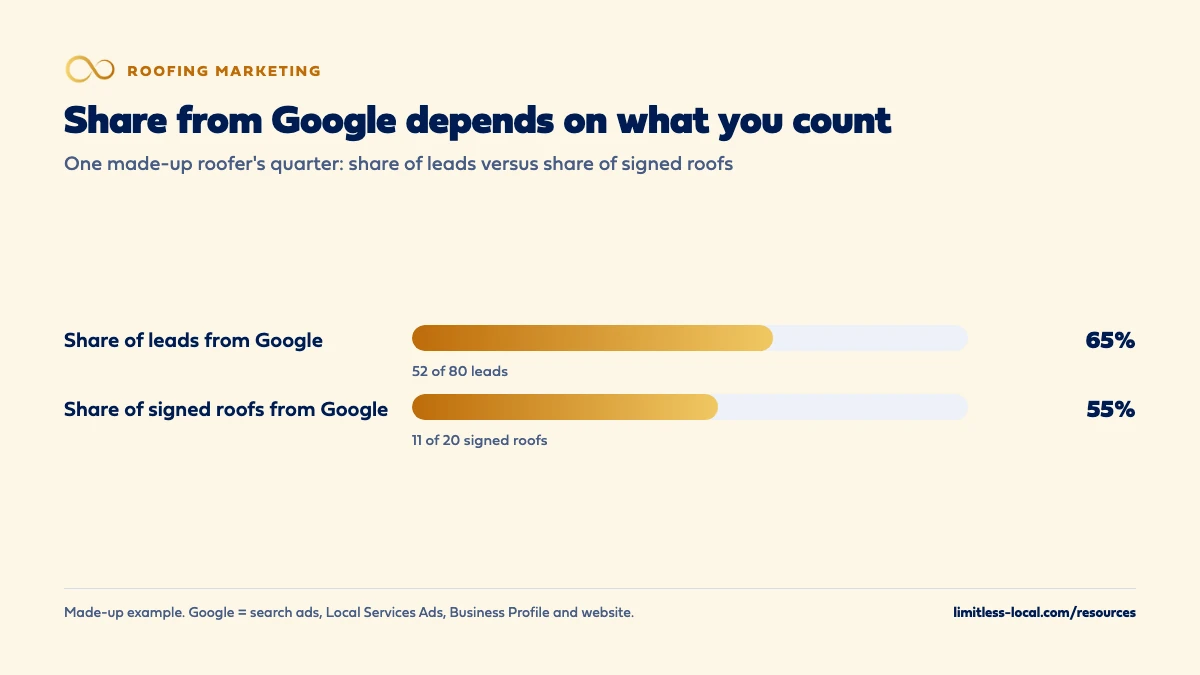
These numbers are made up to show the math, not a benchmark for your market. Say a roofer tags every lead for a quarter and gets 80 leads:
- Google Ads: 18 leads, 4 signed roofs
- Local Services Ads: 10 leads, 2 signed
- Google Business Profile: 16 leads, 4 signed
- Website from the regular results: 8 leads, 1 signed
- Referrals, repeat customers, canvassing and signs: 28 leads, 9 signed
Google sources brought 52 of the 80 leads, which is 65%. But they brought 11 of the 20 signed roofs, which is 55%. Referrals and repeat customers closed far more often.
Neither number is wrong. The first tells you how much of your phone traffic Google drives. The second tells you how much of your work it drives. If you’d rather not build this report yourself, every one of our packages includes call, web and form tracking with source tagging and a monthly report; Essentials is $3,500 a month.
Frequently asked questions
Does a lead from a lead site count as a Google lead?
Log it under the lead site. The homeowner may have found that site on Google, but you paid the site, and its leads behave differently from your own.
My call tracking says most calls are direct. What does that mean?
Usually the homeowner typed your website address, saved your number, or called from a sign or truck. Many of them looked you up first, so ask how they heard about you to fill in the gap.
Do calls from my Google Business Profile show up in Google Ads?
If your profile is linked to your Google Ads account and call history is turned on, calls from your profile that can be tied to an ad interaction are reported in the “Calls from ads” conversion action. Other profile calls show in the profile’s own performance report.
How long should I track lead sources before trusting the numbers?
A few months at least, and ideally across a full year so you see storm season and the slow months. Keep tracking after that; the mix shifts as you grow.
Is a high share of leads from Google a good sign?
Only if those leads turn into signed roofs at a cost you’re happy with. A high share can also mean you depend on one source, so keep referrals and repeat work growing alongside it.
Should my office staff ask every caller how they found us?
Yes. It takes seconds, it catches the referrals and yard-sign leads that tracking misses, and it gives you the “first heard” answer no software can.
Key takeaways
- There’s no reliable industry-wide percentage of roofing leads from Google; your mix is your own.
- Split Google into ads, Local Services Ads, your profile and your website when you count.
- Record how each homeowner found your number and how they first heard of you.
- Judge sources by signed roofs and revenue, not lead counts.
- Read your mix across seasons, because storms shift it fast.
Not sure what's working right now?
Start with a free visibility audit: rankings, Google profile, reviews and tracking, checked against your service area.
More in this section
- How quickly can a Google Business Profile bring in roofing calls?
- What is a good cost per lead for roofing Google Ads?
- How do I get commercial roofing leads with Google Ads?
- How does a roofer see which searches and pages bring leads?
- What close rate should a roofer expect from online leads?
Sources
- How to Use Lead Sources — Housecall Pro Help Center
- Lead Source Report — Jobber Help Center
- Understand your Business Profile performance & insights — Google Business Profile Help
- Measure calls from ads — Google Ads Help
- [GA4] Traffic acquisition report — Analytics Help
- Local Services Ads transition to Performance Max campaigns with pay-per-lead goals — Google Ads Help