
Which service provides qualified roofing leads?

- Where do the most qualified roofing leads come from: marketplaces, Google or an agency?
- What makes a roofing lead qualified?
- What kinds of services supply roofing leads?
- How qualified are leads from shared marketplaces?
- Are Google Local Services Ads leads more qualified?
- What about Google search ads?
- Do my own Google profile and website bring better leads?
- Should I buy exclusive leads from a lead seller?
- What does a marketing agency add?
- How do I qualify a roofing lead on the first call?
- How do I compare lead services fairly?
- Which lead service fits my roofing company right now?
- What's different for roofers
- A worked example: cheapest lead, most expensive roof
- Frequently asked questions
- Key takeaways
- More in this section
- Sources
The short version
- Qualified means: in your towns, a job you want, the decision-maker, ready to book an inspection.
- Leads that come to you directly from Google tend to be more qualified than shared marketplace leads.
- Marketplaces and lead sellers are fast but often shared, and you usually pay whether or not you win.
- Compare every service on cost per signed roof, using your own tracking.
For roofing company owners comparing lead marketplaces, Google’s ad options, lead sellers and agencies, and tired of paying for leads that never become roofs.
Get a free visibility audit · Book a growth call
Where do the most qualified roofing leads come from: marketplaces, Google or an agency?
No single service hands you qualified roofing leads; the best ones usually come from channels you control, like Google Local Services Ads, Google search ads and your own Google Business Profile, where the homeowner contacts you directly. Shared lead marketplaces can fill gaps, but you typically pay per lead whether or not you win the job, and the same homeowner may be talking to other roofers. A qualified lead is a homeowner in your service area who needs a job you do and will book an inspection, so judge every service by cost per signed roof, not cost per lead.
Most of the qualified leads a roofer can get come from Google, and that’s the work our roofing marketing is built around: Google Ads, Local Services Ads on Growth and Scale, a well-kept Google Business Profile and local SEO, with call tracking so you can see which leads sign. Ad spend goes to Google directly, so the leads come to you, not to a list of roofers. For the wider picture, read how to get roofing leads, and browse the roofing marketing questions library for the follow-ups.
What makes a roofing lead qualified?
A lead is just a name and a phone number. A qualified lead is one with a real chance of becoming a signed roof. For most roofing companies, that means:
- In your service area. A town your crews actually drive to.
- A job you do. A replacement, repair or storm job that fits your crews, not a flat commercial roof if you only do shingles.
- The decision-maker. The homeowner, not a tenant or someone “just getting prices” for a relative.
- Ready to move. Willing to book an inspection in the next few weeks.
- Reaching you, not everyone. A homeowner who called you is easier to win than one whose details went to several roofers at once.
Write your own version of this list before you compare services. It becomes your yardstick, and it’s what your office should screen for on the first call.
What kinds of services supply roofing leads?
Roofing leads come from a handful of places, and they work very differently:
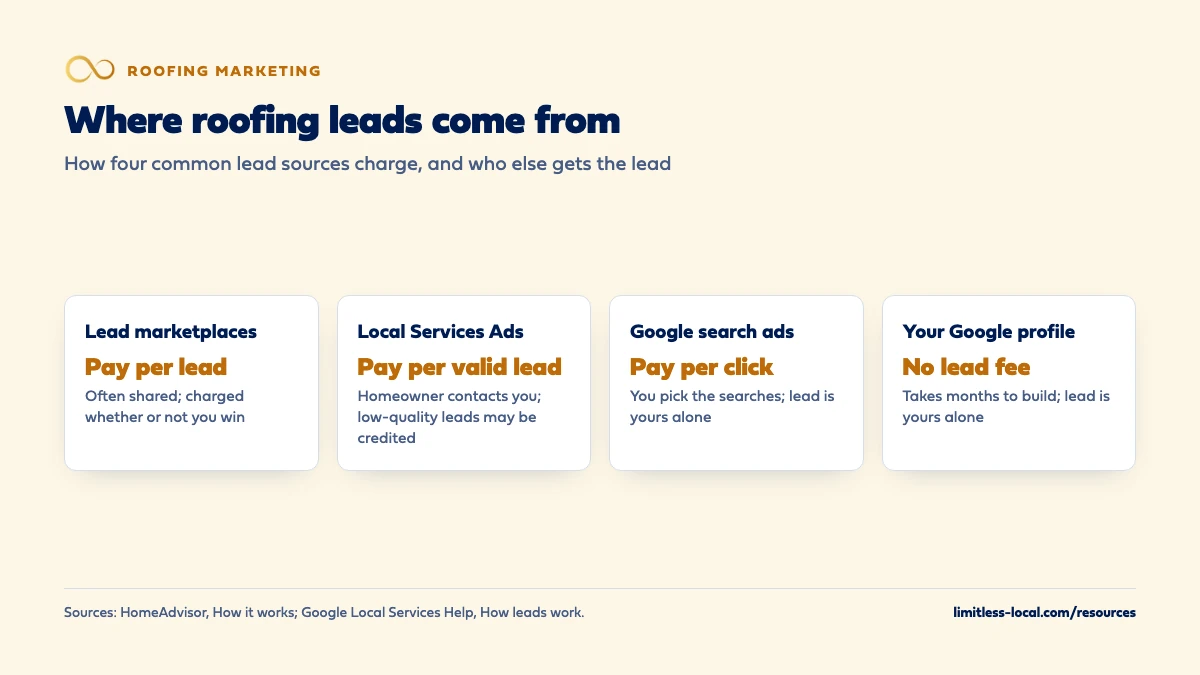
- Lead marketplaces. Homeowners post a job and the platform matches them with roofers, who pay per lead.
- Lead sellers. Companies that generate leads with their own ads and sell them to you, sometimes “exclusive”, sometimes not.
- Google Local Services Ads. You pay per valid lead, and the homeowner contacts you straight from the ad.
- Google search ads. You pay per click on searches you choose, and the homeowner lands on your website or calls you.
- Your Google Business Profile and website. No per-lead fee, but they take months of work to rank.
- Referrals and past customers. Often your best leads, and nobody sells them.
A marketing agency isn’t really a lead source. A good one runs the Google channels for you, in accounts you own. The rest of this page takes each source in turn.
How qualified are leads from shared marketplaces?
Marketplaces are quick to start. The trade-off is how they charge and who else gets the lead. HomeAdvisor’s own how-it-works page says you’re charged for each lead you receive, whether or not you win the job, and regardless of whether the customer hires any pro. On Thumbtack, lead prices vary with the type and size of the job, how many pros are available and your market.
That doesn’t make marketplace leads bad. It means:
- Speed matters even more, because the homeowner may be hearing from other roofers.
- Your job and area settings decide a lot of the quality, so set them tight.
- Your close rate has to cover leads that never sign.
Many roofers use marketplaces as a short bridge while their own channels build. Whether to use Angi or Thumbtack while your SEO ramps up covers how to cap that spend and when to drop it.
Are Google Local Services Ads leads more qualified?
Often, yes, for two reasons. The homeowner chose your listing on Google and contacted you directly, and Google screens what it charges for. Google’s page on how leads work says leads it decides are invalid or low quality aren’t charged, and charged leads are reassessed over time and may be credited automatically if they turn out to be low quality.
A valid lead includes an answered call, a call you return and speak on, a missed call during business hours where the homeowner stays on the line for more than 20 seconds, a message, a voicemail or a booking request. So answering the phone matters twice: a missed call during business hours can still be charged, and the roofer who picks up is the one who books the inspection.
Quality still depends on your settings. List only the job types you want and only the towns you serve. Whether Local Services Ads are worth it for a roofing company goes deeper.
What about Google search ads?
With search ads, you choose the searches. That’s the big quality lever: you can bid on “roof replacement” in your best towns and skip “roofing jobs” or “DIY roof repair”. You pay per click, not per lead, so a click that never calls still costs money.
The tool that keeps search ads qualified is the negative keyword. Google’s guide to negative keywords explains that they let you exclude search terms from your campaigns, so your ads don’t show for searches that look similar but want something else. For a roofer, that’s searches for roofing jobs, materials, DIY help or services you don’t offer. Which negative keywords a roofer should add has a starter list.
Search ads also send homeowners to your own website and phone number, so every lead is yours alone. The catch is that someone has to manage them every week, or wasted clicks pile up quietly.
Curious what your marketing is actually booking?
Get a free visibility audit — no obligation, no sales pitch.
Do my own Google profile and website bring better leads?
They usually bring the best leads per dollar, once they’re working. A homeowner who finds your Google Business Profile in the map pack, reads your reviews, looks at your photos and then calls you has already picked you. There’s no per-lead fee, and nobody else gets the lead.
The catch is time. Ranking in the map pack and on Google’s regular results takes months of work: a complete profile, steady reviews, a website with real pages for your services and towns, and consistent business details across the web. Search work typically takes 3 to 6 months to show meaningful growth.
You can see what your profile produces in its performance report, which shows calls, website clicks and the searches people used to find you. That’s a good first check on whether your profile is pulling its weight.
Should I buy exclusive leads from a lead seller?
Maybe, but ask hard questions first. “Exclusive” can mean very different things. Before you pay, get clear answers to these:
- Is each lead sold only to me, and for how long? Get it in writing.
- Where do the leads come from? Ads, websites, call centers or old lists. Fresh leads from a homeowner’s own search usually beat recycled ones.
- How fast do I get them? A lead that arrives an hour late is half cold.
- What’s the credit policy? Wrong numbers, out-of-area jobs and renters should be credited.
- Can I set towns and job types? If not, you’ll pay for work you don’t want.
- Is there a contract or minimum? Start small and measure.
Then test with a small budget and track every lead through to a signed roof or a lost one. The answers matter less than the cost per signed roof after a couple of months.
What does a marketing agency add?
An agency doesn’t sell you leads off a list. It builds and runs the channels that bring leads to you: Google Ads, Local Services Ads, your Google profile, your website and the tracking that shows which leads signed. The leads belong to you, and so should the accounts.
The difference shows up over time. Paying per lead buys a contact that stops the day you stop paying. Paying for marketing builds things you keep, like reviews, rankings and an ad account with years of data, alongside the leads you get now. Whether to pay per lead or a monthly retainer breaks down that choice.
Whoever you hire, make sure they report signed jobs by source, not just clicks and calls, and that your company owns the Google profile, ad accounts and website.
How do I qualify a roofing lead on the first call?
Even the best source sends some leads that won’t fit. A short first-call script sorts them fast, without sounding like an interrogation:
- What’s going on with the roof: a leak, storm damage, age, or a sale coming up?
- What’s the address? That confirms the town and lets you look up the house.
- Are you the homeowner, and is anyone else part of the decision?
- When would you like someone out to look at it?
- How did you hear about us? Record the answer even if the call is tagged already.
Book the inspection on that call if you can. A homeowner with a date on the calendar is far more likely to sign than one who “will call back”. How to turn roofing leads into booked inspections has more on the handoff.
Then mark every lead as qualified or not, with the reason. After a month, you’ll see which sources send the most real roofs.
How do I compare lead services fairly?
Cost per lead is the number every service wants to show you, and it’s the least useful one. Compare on what each source costs per signed roof:
- Total cost: lead fees or ad spend, plus any monthly fee.
- Signed roofs: from your own records, not the service’s report.
- Cost per signed roof: total cost divided by signed roofs.
- Average job size: because one source may sign replacements while another signs small repairs.
Run the comparison over at least two or three months, since roofs often sign weeks after the first call. And compare your close rate by source, too. What close rate a roofer should expect from online leads explains what goes into that number.
Which lead service fits my roofing company right now?
It depends on where you are:
- Just starting, schedule empty: Local Services Ads and tight search ads bring calls quickly. A marketplace can bridge the gap if you cap spend and answer fast.
- Steady, but paying too much per job: shift money from shared leads toward your own Google profile, reviews and search ads, and track which sign.
- Busy and growing: keep owned channels building, and use paid ones to fill specific gaps, like a new town or replacement season.
- Storm surge: raise paid budgets only as far as your crews can install.
Whatever mix you choose, it should get steadily more of your leads from channels you own and fewer from ones you rent.
Not sure which of these is costing you jobs?
A free visibility audit checks the Google profile, reviews, site and tracking, and shows what to fix first.
What's different for roofers
Storm leads are a different animal. After hail or high winds, lead volume can jump overnight and quality can drop, with more out-of-area calls and more homeowners collecting several quotes. Tighten your areas and screen harder in a surge.
The inspection is the real conversion. For most roofers, a lead that books an inspection is worth tracking separately from one that only asked for a price. Count inspections by source as well as signed roofs.
Job size varies wildly. A source that signs mostly small repairs and one that signs full replacements can show the same cost per signed job and be worth very different amounts to you. Track job value too.
A worked example: cheapest lead, most expensive roof
These numbers are made up to show the math, not a benchmark for your market. A roofer spends $1,500 on each of three sources in a month:
- Shared marketplace: 30 leads at $50 each. 2 sign. Cost per signed roof: $750.
- Local Services Ads: 15 leads at $100 each. 3 sign. Cost per signed roof: $500.
- Google search ads: 12 leads at $125 each. 4 sign. Cost per signed roof: $375.
The cheapest lead turned into the most expensive roof, because most of those shared leads were also talking to other roofers. The owner moves money from the marketplace toward search ads and Local Services Ads, and checks again after another month or two.
Our Growth package, which includes Google Ads management for up to $5,000 a month in spend plus Local Services Ads management, is $4,500 a month, with ad spend paid to Google separately.
Frequently asked questions
Are exclusive roofing leads worth the higher price?
They can be, if exclusive really means only you, for a set period, and the leads come from homeowners’ own recent searches. Test with a small budget and compare cost per signed roof against your other sources.
Can I get a refund for bad roofing leads?
It depends on the service. Google’s Local Services Ads don’t charge for leads judged invalid or low quality and may credit charged leads later. Marketplaces and lead sellers each have their own credit rules, so read them before you sign up.
Are door knocking and canvassing leads qualified?
They can be, especially after storms, because you choose the streets. But they cost crew or sales time, and the homeowner didn’t ask for you. Track them as their own source so you can compare them fairly.
How many leads should a roofing lead service send me each month?
Work backward from the roofs you want to sign and your close rate. A service that sends lots of leads you can’t close is worth less than one that sends fewer you can.
Do roofing leads from Facebook count as qualified?
Some do, but many are homeowners who weren’t actively looking yet. Expect more follow-up and a lower close rate than from someone who searched for a roofer on Google, and measure it.
Should I stop buying leads once my own marketing works?
Not all at once. Shift money gradually as your own channels sign roofs at a lower cost per job, and keep a small paid budget for gaps like a slow month or a new town.
Key takeaways
- A qualified roofing lead is in your area, wants a job you do, is the decision-maker and will book an inspection.
- Leads that contact you directly from Google tend to be more qualified than shared marketplace leads.
- Marketplaces typically charge per lead whether or not you win, so speed and tight settings matter.
- Ask lead sellers exactly what exclusive means, where leads come from and what gets credited.
- Compare every source on cost per signed roof and job size, over two or three months.
Want a second set of eyes on your setup?
We'll look at how you show up locally and where calls are leaking, then send you a plain-English breakdown.
More in this section
- What is the fastest way for a roofer to get leads online?
- How quickly can each roofing marketing channel produce leads?
- How does a roofer see which searches and pages bring leads?
- How can a roofing company find leads after a storm?
- How does a roofer keep up with leads coming in fast?
Sources
- How leads work — Google Local Services Help
- HomeAdvisor Leads | Growing Your Business — HomeAdvisor
- How much do I pay for leads and opportunities? — Thumbtack Help
- About negative keywords — Google Ads Help
- Understand your Business Profile performance & insights — Google Business Profile Help