
Which marketing channel gives a small plumbing company the best ROI?

- Which plumbing marketing channel pays back the most for a one- or two-truck shop?
- What does ROI mean for a plumbing marketing channel?
- Why isn't there one best channel for every plumbing company?
- Which channels usually return the most for a small plumbing company?
- Why do the free channels look best, and what's the catch?
- How do Local Services Ads and Google search ads compare on return?
- When does SEO give a small plumber the best return?
- How do I compare channels fairly?
- Should I count repeat work in a channel's return?
- How do I test a new channel without wasting money?
- Why does a channel's return change as I spend more?
- What's different about channel ROI for plumbing companies
- A worked example: three channels, three months
- Frequently asked questions
- Key takeaways
- More in this section
- Sources
The short version
- Return = gross profit from a channel's booked jobs for every $1 that channel cost.
- Repeat customers, referrals and your Google profile usually return the most per dollar, but you can't buy more of them on demand.
- Local Services Ads and search ads are the paid channels that usually pay back fastest for emergency-heavy work.
- Judge return and total profit together, over the same months, from your own tracked jobs.
For owners of small plumbing shops who want to put the next marketing dollar where it comes back with the most profit, not the most calls.
Get a free visibility audit · Book a growth call
Which plumbing marketing channel pays back the most for a one- or two-truck shop?
For most small plumbing companies, the best return comes from the channels that cost almost nothing per booked job: repeat customers, referrals, and a well-kept Google Business Profile with a steady flow of reviews. Among paid channels, Local Services Ads and Google search ads usually pay back fastest because they reach homeowners who need a plumber now, while SEO pays back slower but tends to get cheaper per job over time. The ranking that counts is your own: compare the gross profit from each channel’s booked jobs with everything that channel costs, over the same few months.
Measuring every channel on booked jobs and what they paid is how we run local ads for owners, with call tracking and a monthly cost-per-lead breakdown in every package. Our plumbing marketing page shows how ads, local SEO and follow-up fit together, and the rest of the plumbing marketing questions library goes channel by channel.
What does ROI mean for a plumbing marketing channel?
Return on investment is what a channel gave back compared with what it cost. For a plumber, the easiest version to use is:
Gross profit from the jobs the channel booked ÷ what the channel cost.
That tells you how many dollars of gross profit came back for every $1 you spent. The ROI percentage you’ll see elsewhere is the same idea with the original dollar taken out: $3 back per $1 is a 200% return.
Two details make or break it:
- Use gross profit, not revenue. A $3,000 repipe isn’t $3,000 of return after pipe, fittings and two plumbers for two days. Revenue makes every channel look better than it is.
- Count every cost. Ad spend, management fees, tracking, mailer printing and postage, and the hours you or your office spend running it.
A channel that returns $3 of gross profit for every $1 it costs is working. A channel at $0.80 is losing money, no matter how busy the phone feels.
Why isn't there one best channel for every plumbing company?
Because the return depends on things that change from shop to shop:
- Your market. How many plumbers compete for the same searches, and what leads cost where you work.
- Your job mix. A shop that lives on water heaters and sewer lines can afford a channel with pricier leads; a drain-and-service shop needs cheaper ones.
- Your booking rate. If calls roll to voicemail, every paid channel returns less.
- Your reviews. Strong reviews lift the Google profile and Local Services Ads at the same time.
That’s why the same channel can be a winner for the plumber across town and a loser for you. Which plumbing channel brings the highest-quality leads covers lead quality; this page is about the money that comes back.
Which channels usually return the most for a small plumbing company?
Roughly in order of what they cost per booked job for a small shop:
- Repeat customers and maintenance members. You already paid to win them once. A reminder or a phone call costs next to nothing.
- Referrals. Past customers, realtors, property managers and general contractors who send you work.
- Your Google Business Profile and reviews. No fee, and Google says there’s no way to pay for a better local ranking. The cost is time: asking for reviews, adding photos, keeping services and hours right.
- Local Services Ads. You pay per lead, not per click.
- Google search ads. You pay per click and control which searches you show for.
- SEO and your website. Slow to start, cheaper per job once it’s working.
- Everything else: mailers, door hangers, shared-lead sites and social ads, which work for some shops and not others.
That order is a starting guess, not a verdict. Your tracked numbers decide the real order for your shop.
Why do the free channels look best, and what's the catch?
They look best because the cost side of the math is tiny. The catch is that you can’t buy more of them when you need jobs this week. Referrals come when they come, and your list of past customers only grows as fast as your business does.
So treat them as the floor, not the whole plan. Work them hard because the return is so good: ask every happy customer for a review, follow up after big jobs, and stay in touch with the realtors and property managers who send work. Getting more repeat customers and referrals covers the habits that keep that floor high. Then add a paid channel for the jobs the floor can’t cover.
Curious what your marketing is actually booking?
Get a free visibility audit — no obligation, no sales pitch.
How do Local Services Ads and Google search ads compare on return?
Both put you in front of people searching for a plumber right now, which is why they tend to pay back quickly for emergency work. They charge differently:
- Local Services Ads charge per valid lead: an answered call, a missed call during business hours that lasts long enough, a message or a booking request. Google screens out leads it decides are invalid or low quality and can credit charged leads it later finds poor quality, and lead prices may vary by location, job type, type of lead and bidding (How leads work).
- Google search ads charge per click, and you choose the keywords. The search terms report shows the actual searches that triggered your ads (About the search terms report), which is how you steer spend toward water heater and sewer searches and away from junk.
Small shops often find Local Services Ads simpler to run for service calls, and search ads better for chasing specific high-ticket work. LSAs or Google Ads for emergency plumbing calls goes deeper on that choice.
When does SEO give a small plumber the best return?
Over time. SEO typically takes 3 to 6 months to show meaningful organic growth, so its return looks terrible in month one and can look excellent in year two, because the calls keep coming without a per-click charge.
It tends to be worth it when you plan to stay in the same towns for years, when there are a few high-value job types you want to own in search, and when you can fund it without starving the channels that pay this month. It’s a poor first move when you need jobs next week. Judge it on a rolling window of several months, not month by month.
How do I compare channels fairly?
Use the same rules for every channel, or the comparison means nothing:
- Same months. Compare a summer month with a summer month, and use at least three months where you can.
- Same costs. Include fees and time for every channel, not just ad spend for the paid ones.
- Booked jobs, not calls. Only new customers who booked and paid. Leave out repeat customers who happened to click an ad.
- Gross profit, not invoices.
Your field software does most of the counting if every job gets a lead source. Jobber’s lead source report, for example, shows leads, leads that turned into a job, and the value of the first invoice for each source. Google Ads can go further: if you give conversions a value, it reports the total business value your campaigns generated, not just the number of conversions (About conversion values). Working out your plumbing customer acquisition cost walks through the counting step by step.
Should I count repeat work in a channel's return?
Yes, but carefully, and keep two numbers. The first-job return tells you whether the channel pays for itself right away. The longer-term return adds the repeat work, memberships and referrals that came from those first customers.
A channel that barely breaks even on the first job but brings customers who come back for a water heater two years later can beat one that looks better on paper today. Just don’t let a hopeful lifetime value prop up a channel that loses money every month. Lean on the first-job number for decisions this quarter.
How do I test a new channel without wasting money?
Treat it like a trial, with the rules written down before you start:
- A fixed budget you can afford to lose.
- A fixed window, long enough to get past the first weeks of setup.
- A tracking number or a lead source in your software, set before the first call.
- A pass mark: the cost per booked job, or the return per dollar, that keeps it running.
Test one new channel at a time so you know what caused what. And keep the channels that already work running while you test, so a failed trial costs you a test budget, not a slow month.
Why does a channel's return change as I spend more?
Because the first dollars buy the best opportunities. In search ads, a small budget goes to your most specific, ready-to-hire searches in your closest towns. Spend more and you start reaching broader searches, farther towns and pricier clicks, so each extra job usually costs more than the last.
That’s why a channel with a great return at a small budget can disappoint when you double it. Raise spend in steps, check cost per booked job after each step, and stop raising when the extra jobs cost more than they earn. The other limit is your crew: extra calls you can’t run don’t add any return at all. How much a plumber should budget to book a set number of jobs turns that into a monthly number.
Not sure which of these is costing you jobs?
A free visibility audit checks the Google profile, reviews, site and tracking, and shows what to fix first.
What's different about channel ROI for plumbing companies
Emergency work rewards being findable right now. A burst pipe doesn’t wait for a mailer to land. Channels that show up at the moment of the search, like your Google profile, Local Services Ads and search ads, tend to return the most for urgent calls.
Big tickets change the math. One water heater, repipe or sewer line job can pay for a month of a channel. A channel that books few jobs can still have the best return if those few are the big ones, so track job type, not just job count.
Plumbing customers come back. Water heaters age, drains clog again and houses get sold. That makes repeat and referral work more valuable for plumbers than for trades where a customer buys once a decade, and it’s one more reason to count first-job return and longer-term return separately.
A worked example: three channels, three months
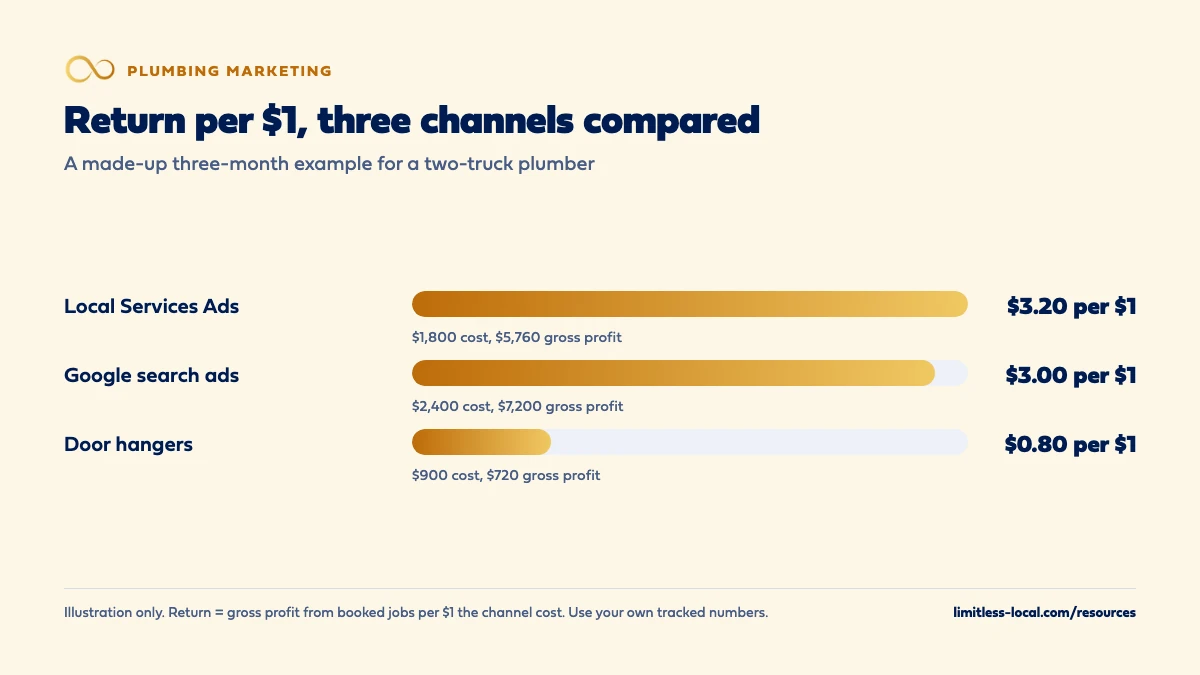
These numbers are made up to show the math, not a benchmark for your market. A two-truck plumber tracks three channels over the same three months:
- Local Services Ads: cost $1,800 and booked 24 service calls worth $5,760 in gross profit. Return: about $3.20 of gross profit per $1, and $3,960 left after the cost.
- Google search ads: cost $2,400 and booked 12 jobs, several of them water heaters, worth $7,200 in gross profit. Return: $3.00 per $1, and $4,800 left after the cost.
- Door hangers: cost $900 and booked 3 jobs worth $720 in gross profit. Return: $0.80 per $1, a loss of $180.
Local Services Ads win on return per dollar, but search ads leave more money in the bank because they book bigger jobs. The owner keeps both, drops the door hangers, and moves that $900 toward water heater searches, then checks whether the extra jobs still come in at a good return.
Frequently asked questions
Is cost per lead a good way to compare plumbing channels?
Not on its own. A cheap lead that rarely books, or books only small jobs, can return less than a pricier lead that books water heaters. Compare gross profit from booked jobs against cost.
What return should a small plumbing company aim for?
At the very least, more gross profit than the channel costs, with room left over for overhead. Set your own pass mark from your margins rather than borrowing a number from another shop.
Are Facebook ads a good return for plumbers?
They can work for planned work and staying in front of past customers, but they reach people who weren’t searching for a plumber, so they’re rarely the first pick for emergency calls. Test them with a fixed budget and a tracking number.
How long should I test a channel before judging its return?
Long enough to get past setup, usually a couple of months for paid ads. SEO needs longer, because it typically takes 3 to 6 months to show meaningful growth.
Should a small plumber spread money across many channels?
Not at first. Run the free basics well, add one paid channel, and only add the next once the first is tracked and paying back.
Do I need special software to work out channel ROI?
No. A lead source on every job in ServiceTitan, Housecall Pro or Jobber, plus a monthly list of what each channel cost, is enough to start.
Key takeaways
- Judge channels on gross profit from booked jobs compared with everything the channel cost.
- Repeat customers, referrals and your Google profile usually return the most, but they can’t be switched on when you need jobs.
- Local Services Ads and search ads tend to pay back fastest for urgent plumbing work; SEO pays back later and cheaper.
- Compare channels over the same months with the same rules, and keep return per dollar and total profit side by side.
- Test one new channel at a time with a fixed budget, window and pass mark.
Want a second set of eyes on your setup?
We'll look at how you show up locally and where calls are leaking, then send you a plain-English breakdown.
More in this section
- How much budget and time does each plumbing marketing channel need?
- Is a plumbing business profitable, and where does marketing fit?
- What marketing gets a plumbing company to two jobs a day?
- What makes a good plumbing marketing company?
- Which marketing works best for emergency vs planned plumbing jobs?
Sources
- How leads work — Google Local Services Help
- About the search terms report — Google Ads Help
- About conversion values — Google Ads Help
- Tips to improve your local ranking on Google — Google Business Profile Help
- Lead Source Report — Jobber Help Center