
What is a good landing page conversion rate for a plumber?
- What landing page conversion rate should a plumbing website aim for?
- What does landing page conversion rate mean for a plumbing website?
- What should count as a conversion on a plumbing landing page?
- Why is there no single good conversion rate for plumbers?
- How do I work out my landing page conversion rate?
- What rate should an emergency page get compared with a water heater or repipe page?
- Why can my conversion rate look good while the phone stays quiet?
- What usually drags a plumbing landing page's conversion rate down?
- How fast does a plumbing landing page need to load?
- Does Google Ads grade my plumbing landing page?
- Should my plumbing ads go to the home page or a separate landing page?
- How long should I wait before judging a landing page change?
- What's different about landing pages for plumbing companies
- A worked example: two pages, two very different rates
- Frequently asked questions
- Key takeaways
- More in this section
- Sources
The short version
- Conversion rate = real calls and completed forms divided by visits, for one page.
- Count calls and forms, not taps on the phone number or page views.
- Compare each page with its own history, not with a national figure.
- The final test is booked jobs per visit, not conversions per visit.
For plumbing owners sending ads or search traffic to a page and wondering whether the number of calls it produces is any good.
Get a free visibility audit · Book a growth call
What landing page conversion rate should a plumbing website aim for?
A good landing page conversion rate for a plumber is one that’s holding steady or rising and turning into booked jobs, not a number borrowed from a national average. Work it out as real calls plus completed forms from the page, divided by visits to that page, and compare it page by page and month by month. Emergency pages usually convert more of their visitors than water heater or repipe pages, so judge each page against its own history. If a page gets steady visits and almost no calls, fix the page before you pay for more clicks.
Landing pages and the tracking behind them are part of every Limitless Engine package: Essentials includes a landing page with Google Ads management, plus call, web and form tracking with basic attribution, so each page’s calls can be matched to the jobs they booked. If the whole site is the problem, our website builds start with how a homeowner calls you from a phone. See how we work with plumbing companies, or browse more plumbing marketing questions.
What does landing page conversion rate mean for a plumbing website?
A landing page is the page someone lands on after clicking your ad or your listing. For a plumber that’s usually a service page, such as drain cleaning, water heaters or emergency plumbing, or sometimes the home page.
Its conversion rate is the share of visits that turned into a call or a request. Google Ads defines conversion rate as conversions divided by the ad interactions that can be tracked to a conversion in the same period, and gives the example of 50 conversions from 1,000 interactions being 5%. The same idea works for any page: real calls and completed forms, divided by visits.
Two things make that number worth watching. It tells you whether the page is doing its job, and it multiplies straight into your cost per lead. A page that turns twice as many visits into calls halves what each call costs you, with the same ad spend.
What should count as a conversion on a plumbing landing page?
Only actions that mean a homeowner actually reached you:
- Phone calls from the page that last long enough to be a real conversation.
- Completed forms with a working phone number or email.
- Online bookings that land on your schedule.
- Text or chat conversations that start from the page, if you offer them.
Leave out page views, scrolls and time on page. Be careful with taps on your phone number, too. Google’s guide to phone call conversion tracking notes that when it tracks clicks on a number on your mobile website, it can track only the clicks, not the calls themselves. A tap that never connects isn’t a lead. Calls tracked through a forwarding number with a minimum call length are much closer to the truth. Which conversions to track in your plumbing Google Ads covers the setup.
Why is there no single good conversion rate for plumbers?
Because the number depends on things that have nothing to do with how good your page is:
- The job. Someone with water on the floor calls fast. Someone pricing a tankless water heater reads, compares and comes back.
- Where the visit came from. Ad clicks, Maps clicks, organic search and people typing your name all behave differently.
- Your market. More plumbers bidding on the same searches means more homeowners clicking two or three ads before calling one.
- How you count. If you track more than one conversion action, or count every conversion instead of one per click, Google says your conversion rate can even go over 100%.
A national average blends all of that together. Your own page’s rate, measured the same way every month, is the number that tells you something.
How do I work out my landing page conversion rate?
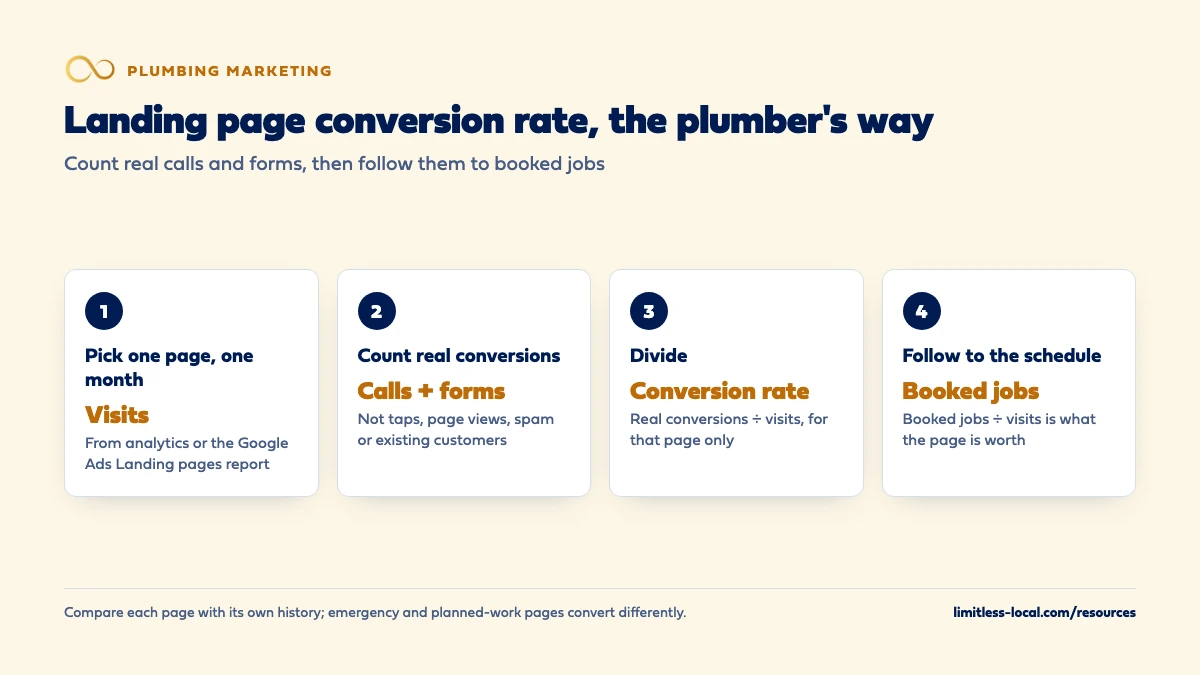
- Pick one page and one period, such as the emergency plumbing page for last month.
- Count the visits. Your website analytics shows visits per page. For ad traffic, the Google Ads Landing pages report gives a performance breakdown for each page your ads send people to, including which pages could give a better experience on phones.
- Count the real conversions. Use your call tracking and form inbox, not just the ad platform’s number. Remove spam, vendors, existing customers and calls under your minimum length.
- Divide. Real conversions divided by visits is your rate.
- Go one step further. Match those calls and forms to booked jobs. Booked jobs divided by visits tells you what the page is really worth.
Do this for each page that gets meaningful traffic. The comparison between your own pages is often more useful than any outside number.
What rate should an emergency page get compared with a water heater or repipe page?
Expect them to be different, and judge each against itself.
- Emergency pages (burst pipes, sewer backups, no hot water) should turn a high share of visits into calls, because the visitor needs someone now. A low rate here usually points to something on the page getting in the way: a slow load, a number that doesn’t dial, or no sign you cover their town tonight.
- Planned-work pages (water heater replacement, repipes, sewer line replacement, water treatment) get more readers who are comparing options and prices. Their rate is usually lower, and many of their calls come days later, sometimes from a different page or straight to your number.
- Drain cleaning and general repair pages usually sit between the two.
If you only have one page for everything, you can’t see any of this. What an emergency plumbing page should include shows how to build the page that has to work hardest.
Curious what your marketing is actually booking?
Get a free visibility audit — no obligation, no sales pitch.
Why can my conversion rate look good while the phone stays quiet?
Because the conversions being counted aren’t all real customers. Common causes:
- Taps counted as calls. The tap is counted whether the call connects or not.
- Several conversion actions counted for one visitor. A call and a form from the same person count twice.
- Short and junk calls. Wrong numbers, robocalls and two-second hang-ups.
- Spam forms. Bots fill forms, and they never answer when you call back.
- Existing customers. Past customers who search your name and click through were already yours.
Then there’s the step after the page. A page can produce plenty of real calls that never book because they ring out or stall on price. If that’s where the jobs disappear, whether to worry about a plumbing close rate under 30% walks through it.
What usually drags a plumbing landing page's conversion rate down?
- The page doesn’t match the search. Someone searched for a water heater replacement and landed on the home page. Google’s advice on mobile landing pages is to send people straight to the page for what they searched for, not a general page that makes them start over.
- It’s slow on a phone. Plumbing visitors are often on a phone and in a hurry.
- Something covers the page. Full-size pop-ups, coupon boxes and chat windows that block the screen get in the way.
- The number doesn’t dial on one tap, or it’s buried at the bottom.
- The form is long. Name, phone, town and the problem is plenty.
- Nothing shows you serve their town or that you’re licensed and insured.
Whether your plumbing website is turning visitors into calls walks through each of these from a phone, step by step.
How fast does a plumbing landing page need to load?
Fast enough that a homeowner with a leak doesn’t hit the back button. There’s no magic number of seconds for plumbers, but you can see how real visitors experience your page. Google’s PageSpeed Insights shows field data, drawn from real visits over the previous 28 days, and sorts the experience into good, needs improvement or poor.
Test your top landing pages on the mobile setting, not just the home page. Large photos, sliders and extra plugins are the usual culprits on contractor sites. If a page lands in poor and its conversion rate is also low, speed is a good first fix.
Does Google Ads grade my plumbing landing page?
Yes, in a way. Google Ads gives each keyword a landing page experience status of above average, average or below average. It estimates how relevant and useful your page will be to people who click, and pages rated higher are usually well organized, with text that relates to what the person searched for. Below average is a sign to improve the page.
That status isn’t a conversion rate, but they tend to move together: a page that clearly answers the search usually gets more calls too. How it ties into what you pay per click is covered in how Quality Score affects plumbing ad costs.
Should my plumbing ads go to the home page or a separate landing page?
Send each ad to the page that matches the job in the ad. Drain cleaning ads go to the drain cleaning page, water heater ads to the water heater page, emergency ads to the emergency page. The home page is fine for people searching your company name.
A separate landing page, built only for ads, can help when your website is old, slow or hard to change, or when you want to test one offer. It doesn’t have to be fancy: the service, the towns, a tap-to-call number, a short form, real reviews and proof you’re licensed and insured. Keep it consistent with your website and Google profile, so the homeowner sees the same business everywhere.
How long should I wait before judging a landing page change?
Long enough for the page to get a real number of visits. With a few dozen visits a week, one or two calls either way swings the rate wildly, so a single good or bad week tells you little. Compare whole months, or at least several weeks, and keep the season in mind: a cold snap fills emergency pages without any change to the page.
Change one thing at a time, note the date, and compare the same length of time before and after. If you change the page, the ads and the budget in the same week, you won’t know which one did it. How long a plumber should wait before changing Google Ads covers the same rule on the ad side.
Want to see where your company stands?
A free visibility audit shows where you show up on Google, Maps and AI answers, and what it's costing you in calls.
What's different about landing pages for plumbing companies
The phone number does the converting. Most plumbing leads are calls, not forms, so the number has to be at the top of the screen, dial on one tap and reach a person, including at night if you advertise emergency service.
Night traffic needs its own check. An emergency page that converts well at 2 p.m. can fall apart at 2 a.m. if the call goes to voicemail. Look at conversions and booked jobs by hour, and only advertise the hours you can answer.
Towns matter more than design. A homeowner with a leak wants to know you’ll come to their street today. Listing the towns you cover, near the top, often does more than a new layout.
A worked example: two pages, two very different rates
These numbers are made up to show the math, not a benchmark for your market. Say a plumbing company checks two pages for last month.
Emergency page: 400 visits. Google Ads shows 70 conversions, which looks like about 18%. But many of those were taps on the number. Call tracking shows 48 real calls plus 8 completed forms, so 56 real conversions, and a real rate of 14%. Of those, 31 booked. With $2,400 in ad spend on that page, each booked job cost about $77.
Water heater page: 250 visits, 11 real calls and 4 forms, so 15 real conversions and a rate of 6%. Six booked replacements. With $1,500 in ad spend, each booked job cost $250.
The water heater page converts at less than half the rate, but each job is worth far more than an emergency call, so it may be the better page. The useful move is to compare each page with its own last few months, fix the counting first, and then work on the page whose booked jobs per visit are falling.
Frequently asked questions
Is conversion rate the same as click-through rate?
No. Click-through rate is how many people who saw your ad clicked it. Conversion rate is how many of those visitors then called or filled out a form.
Should organic and ad visits be measured separately?
Yes, when you can. People who arrive from an ad, from Maps and from regular search results behave differently, and mixing them hides which traffic the page converts well.
Does a chat widget raise my conversion rate?
It can add conversations, but only count chats that turn into a real request, and make sure the widget doesn’t cover the phone number or the page on a phone.
Can my conversion rate be too high?
A rate that suddenly jumps usually means something is being double counted or spam is getting through. Check the calls and forms behind it before you celebrate.
Do I need a separate landing page for every town?
Not for ads. One strong page per service, with the towns you cover listed clearly, usually works better than many thin copies of the same page.
Should I put prices on my landing page?
Showing a service-call fee or a starting price can set expectations. Test it on one page and watch both the conversion rate and the booking rate, because it can lower calls but raise the share that book.
Key takeaways
- Landing page conversion rate is real calls and completed forms divided by visits, for one page.
- Taps on a number, page views and duplicate counts make the rate look better than it is.
- Emergency and planned-work pages convert differently, so compare each with its own history.
- Mismatched pages, slow phones, pop-ups and hidden numbers are the usual drags.
- Booked jobs per visit is the number that tells you what a page is worth.
Not sure what's working right now?
Start with a free visibility audit: rankings, Google profile, reviews and tracking, checked against your service area.
More in this section
- Is my plumbing website turning visitors into calls?
- How many service pages should a plumbing website have?
- What percentage of plumbing leads should turn into booked jobs?
- Which conversions should I track in my plumbing Google Ads?
- How long does plumbing SEO take to bring in calls?
Sources
- Conversion rate: Definition — Google Ads Help
- About phone call conversion tracking — Google Ads Help
- Evaluate the performance of your landing pages — Google Ads Help
- 5 things to consider when optimizing your mobile landing page — Google Business
- About PageSpeed Insights — Google for Developers
- Landing page experience: Definition — Google Ads Help