
What does map pack mean for an HVAC company, and how do I rank?
- What is the Google map pack, and what puts an HVAC company in it?
- What exactly is the map pack?
- Why does the map pack matter so much for HVAC?
- How is the map pack different from Local Services Ads and Google Ads?
- What decides which HVAC companies show up in the map pack?
- Why do I show up in one part of town and not another?
- What can I do about relevance?
- How do reviews affect the map pack?
- Does my website matter for the map pack?
- What gets HVAC companies pushed out of the map pack?
- Can a service-area HVAC company rank without a storefront?
- How long does it take to rank in the map pack?
- How do I know if the map pack is bringing in calls?
- What's different about the map pack for HVAC companies
- A worked example: what a map pack spot can be worth
- Frequently asked questions
- Key takeaways
- More in this section
- Sources
The short version
- The map pack is the group of local listings with a map at the top of local searches.
- HVAC homeowners can call you right from it, and you don't pay per click.
- Google ranks it on relevance, distance and popularity.
- You rank with a complete profile, the right category and services, honest service areas and steady reviews.
For HVAC owners who keep hearing “map pack” from agencies and want to know what it is, why it matters for calls, and what they can actually do about it.
Get a free visibility audit · Book a growth call
What is the Google map pack, and what puts an HVAC company in it?
The map pack is the short list of local businesses, usually three, that Google shows with a map near the top of a local search like “AC repair near me.” For an HVAC company it’s one of the most valuable spots on the page, because homeowners can call straight from the listing and you don’t pay per click. Google says local results are mainly based on relevance, distance and popularity, so you rank by keeping a verified, complete Google Business Profile, listing the services and service area you really cover, and earning a steady flow of reviews. There’s no way to pay for a better spot.
We optimize for three places HVAC owners need to show up: the regular Google results, the Maps 3-pack and AI answers. Our local SEO work covers the Google Business Profile, listings, reviews and the website behind it, and the HVAC marketing page shows how it fits with ads and follow-up. The HVAC marketing guide covers every channel, and the HVAC marketing questions library goes question by question.
What exactly is the map pack?
Search “furnace repair” or “AC repair near me” on your phone and you’ll usually see a small map with a few business listings under it, often below the ads. That block is what marketers call the map pack, the local pack or the 3-pack. Each listing shows the business name, star rating, number of reviews, hours, and buttons to call, get directions or visit the website. A link below it opens the full list in Google Maps.
Google itself doesn’t use the term. It calls these local results on Google Maps and Search, and they’re built from Google Business Profiles. If you don’t have a verified profile, you aren’t in the running.
Why does the map pack matter so much for HVAC?
HVAC searches are often urgent and local. A homeowner with no cooling on a hot afternoon isn’t comparing ten websites; they’re looking at the first few companies with good reviews and tapping call. The map pack puts your rating, your hours and a call button in front of them before they’ve scrolled.
It’s also free traffic. You don’t pay per click or per lead for a map pack listing, so every call it brings in lowers your average cost per booked job across all your marketing. For a lot of HVAC companies, it’s one of the biggest sources of calls once it’s working.
How is the map pack different from Local Services Ads and Google Ads?
On a typical HVAC search you might see three different things stacked on the page:
- Local Services Ads at the top, marked as sponsored, with a Google Verified badge. You pay per lead.
- Google Ads search ads, also marked as sponsored. You usually pay per click.
- The map pack, which is unpaid. You can’t buy your way into it.
There’s no way to request or pay for a better local ranking. The ads and the map pack work well together, but they’re separate systems with separate rules. If you’re weighing the paid side, whether Local Services Ads are worth it for HVAC covers it.
What decides which HVAC companies show up in the map pack?
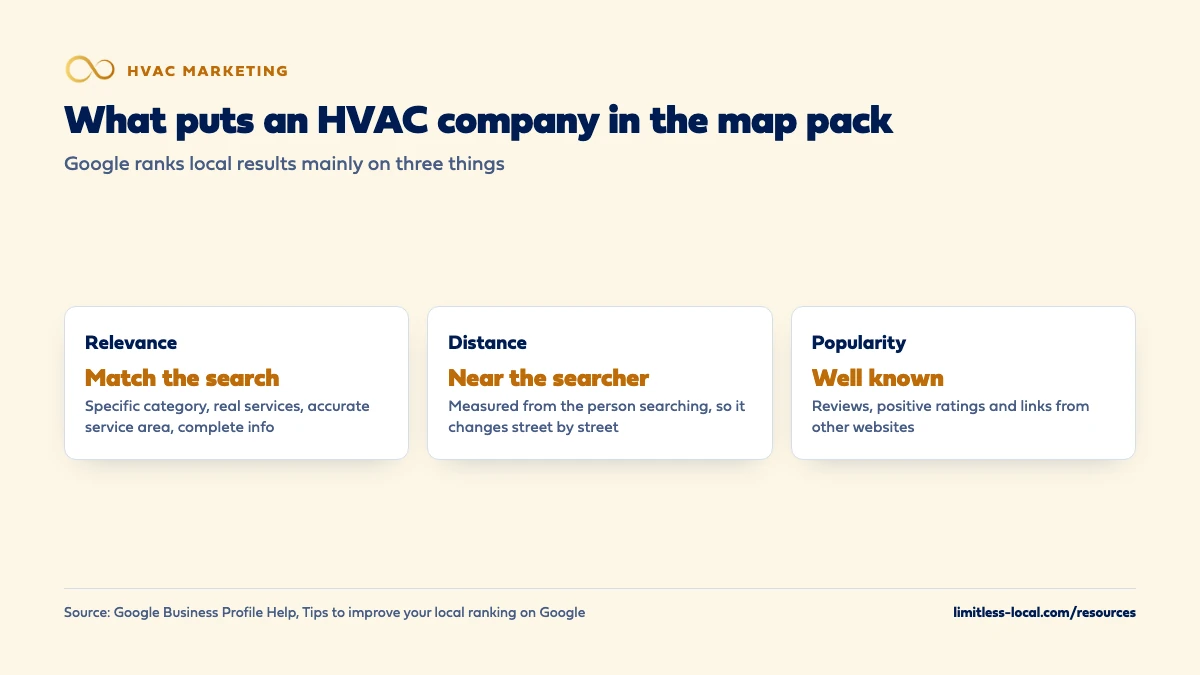
According to Google’s own local ranking tips, local results are mainly based on relevance, distance and popularity:
- Relevance is how well your profile matches what someone searched. Complete, detailed business info helps Google match you to the right searches.
- Distance is how far your business is from the person searching. If they don’t share their location, Google uses what it knows about where they are.
- Popularity, which Google also calls prominence, is how well known your business is. It’s partly based on how many websites link to your business and how many reviews you have, and that more reviews and positive ratings can help.
Businesses with complete and accurate info are more likely to show up, and verifying your profile makes it more likely to show in search results. The details of the algorithm are kept confidential, so anyone promising a set position is guessing.
Why do I show up in one part of town and not another?
Because distance is measured from the person searching, not from your shop. The same search for “AC repair” can show a different map pack on every street in your area. That’s why a check from your office or your house says little about what a homeowner across town sees.
It also explains a common frustration: you rank well near your base and fade in the towns farther out, even when they’re in your service area. The fix isn’t to fake an address closer to those towns, which breaks Google’s rules. It’s to build relevance and popularity there over time: reviews from jobs in those towns, a page on your site for each main town, and steady work in the area. Why other HVAC companies rank above you covers how to check your position properly.
Curious what your marketing is actually booking?
Get a free visibility audit — no obligation, no sales pitch.
What can I do about relevance?
Relevance is the factor you control most directly. Work through these on your Google Business Profile:
- Primary category. Pick the most specific category that describes your core business. Google’s guidelines say to use as few categories as possible and as specific as possible.
- Services. List the services you actually want calls for: AC repair, furnace repair, heat pump installation, and so on.
- Service area. Add the cities or postal codes you really serve, up to 20 areas, and keep the overall area within about 2 hours of driving time from your base, as Google’s service area help describes.
- Hours, phone and website. Accurate and the same as on your website.
- Photos. Real photos of your trucks, crews and finished installs.
How to optimize your HVAC Google Business Profile for more calls goes through each field.
How do reviews affect the map pack?
Reviews feed popularity directly, and they’re what homeowners look at first in the map pack: the star rating and the review count sit right next to your name. A company with a steady flow of recent reviews looks alive; one with a handful from three years ago looks risky, even if the work is great.
Ask every customer, every job, with a direct review link or QR code. Reply to reviews, good and bad, briefly and personally. And never pay for them: Google’s review tips say offering incentives such as discounts in exchange for reviews is strictly prohibited. How many Google reviews an HVAC company needs helps you set a target.
Does my website matter for the map pack?
Yes, more than many owners expect. Google builds business profiles from several sources, including publicly available information such as crawled content from a business’s official website, licensed data from third parties and what users contribute (see how Google sources business information). If your website says something different from your profile, such as an old number or different hours, Google sees the conflict.
Your website also helps with popularity. Links from other websites to yours are one of the signals Google mentions, and a site with a clear page for each service and each main town gives Google more to match against searches. Link your profile to the matching page on your site, and keep your name, address and phone number on the site identical to the profile.
What gets HVAC companies pushed out of the map pack?
- Keywords in the business name. Google says your name should reflect your real-world name, and including unnecessary information in it isn’t permitted and could result in the suspension of your profile (see Google’s guidelines for representing your business).
- Virtual offices and fake addresses. A rented mailing address you don’t operate from isn’t eligible.
- Duplicate profiles. Only one profile per business, or per staffed location.
- Showing a home address. Service-area businesses should hide their address and set a service area instead.
- Neglect. Wrong hours, an old phone number, no new reviews and no replies.
If you were in the map pack and dropped out, how to get back into the Google map pack walks through finding the cause.
Can a service-area HVAC company rank without a storefront?
Yes. Most HVAC companies are service-area businesses: they go to the customer, and customers don’t come to them. A service-area business should have one profile for its central office or location with a designated service area, and should hide its address if customers aren’t served there. If you run the business from home, that means clearing the address and listing a service area.
Hiding your address doesn’t take you out of the map pack. You still compete on relevance, distance and popularity in the towns you serve; you just don’t show your street address to the public.
How long does it take to rank in the map pack?
Longer than ads. Ads can generate leads within days of launch, while SEO, including map pack work, typically takes 3-6 months to show meaningful growth. A brand-new profile with few reviews in a busy metro will take longer than an established company fixing a few gaps in a smaller town.
Nobody can promise a map pack position or a date. The details of the algorithm are confidential, and the results move with every competitor’s reviews and every change Google makes. What you can do is keep the profile complete and accurate, keep reviews coming in, and measure whether calls from the profile are growing.
How do I know if the map pack is bringing in calls?
Your Business Profile’s performance report shows the search terms people used to find you, how many viewed your profile, and how many tapped the call button (see Business Profile performance). Those numbers include interactions from Google Ads as well as unpaid results, so read them alongside your ad reports.
Compare the call count with your own call log and field software each month. Better still, put a tracking number on the profile with your main number as an additional one, so you can see which profile calls booked jobs. That’s the number that tells you whether the map pack is paying off.
Want to see where your company stands?
A free visibility audit shows where you show up on Google, Maps and AI answers, and what it's costing you in calls.
What's different about the map pack for HVAC companies
Urgent searches. No-heat and no-cool searches are made on a phone by someone who wants a company today. Your hours, rating and call button in the map pack matter more than your homepage.
Two seasons of reviews. Reviews tend to pile up in peak heat and cold, when you’re busiest. Keep asking through spring and fall too, so your newest reviews never look stale.
Wide service areas. HVAC companies often cover a metro plus outlying towns. Expect to rank more easily near your base, and build reviews and town pages to compete farther out.
Emergency hours. If you take after-hours calls, set hours that match when someone actually answers. A listing that says open while calls go to voicemail costs you the job and the review.
A worked example: what a map pack spot can be worth
These numbers are made up to show the math, not a benchmark for HVAC call volume or ad costs.
Say your profile’s performance report shows 120 calls in a month. Your call log shows about 50% of them are real service calls; the rest are vendors, existing customers and wrong numbers. That’s 60 real calls. Your office books 70% of them: 42 booked jobs.
If those same jobs came from Google Ads at a cost of $80 per booked job, you’d be paying $3,360 a month for them. That’s roughly what the map pack spot is worth to you in ad money, before you count the reviews and trust it builds. It’s also why a drop out of the map pack can feel like the phone just stopped.
Frequently asked questions
Is the map pack the same as Google Maps?
Not quite. The map pack is the short block of local listings inside Google Search. Tapping through opens the full list in Google Maps, which is ranked on the same factors.
Can I pay to get into the map pack?
No. There’s no way to request or pay for a better local ranking. Local Services Ads and Google Ads are paid placements that show separately, usually above it.
Why does my agency's ranking report show me higher than I see?
Rankings change with the searcher’s location. Ask which locations the report checks, and look at calls from your profile, which tell you more than a position number.
Does putting "HVAC" and my city in my business name help?
Only if that’s your real business name. Adding keywords that aren’t part of your real-world name breaks Google’s guidelines and can get the profile suspended.
How long does a new HVAC company take to show up in the map pack?
It depends on your market and how fast you get reviews. How long a new HVAC company takes to show up on Google Maps covers the ramp.
Do Google Business Profile posts help me rank in the map pack?
Google doesn’t list posts among its local ranking factors. They can still help homeowners who find your profile, so use them for real updates and seasonal offers.
Key takeaways
- The map pack is the group of local listings with a map near the top of local searches.
- It’s unpaid; there’s no way to pay for a better local ranking.
- Google ranks local results mainly on relevance, distance and popularity.
- You control relevance and popularity: category, services, service area, accurate info and steady reviews.
- Judge it by calls and booked jobs from the profile, not by a ranking report.
Not sure what's working right now?
Start with a free visibility audit: rankings, Google profile, reviews and tracking, checked against your service area.
More in this section
- How do I get my HVAC company back into the Google Map Pack?
- How competitive is HVAC marketing in my area, and how do I check?
- What promotions and offers work for an HVAC company?
- Why are other HVAC companies ranking above me on Google?
- How should a commercial HVAC company market itself?
Sources
- Tips to improve your local ranking on Google — Google Business Profile Help
- Guidelines for representing your business on Google — Google Business Profile Help
- Manage your service areas for service-area & hybrid businesses — Google Business Profile Help
- Tips to get more reviews — Google Business Profile Help
- Understand how Google sources & uses info in Business Profiles & local search results — Google Business Profile Help
- Understand your Business Profile performance & insights — Google Business Profile Help