
What is marketing attribution for a roofing company?
- What does attribution mean when I'm deciding which source booked a roofing job?
- What does marketing attribution mean for a roofing company?
- Why is attribution harder for roofers than for many businesses?
- What are the main ways to give credit for a roofing lead?
- How do Google Ads and Google Analytics handle attribution?
- Which attribution approach should a roofing company use?
- How do I decide which source gets credit when several touched the lead?
- Why does branded search get too much credit?
- How do I connect attribution to signed roofs, not just leads?
- What attribution mistakes cost roofing companies money?
- How exact does attribution need to be for a roofer?
- What's different about attribution for roofing companies
- A worked example: one roof, four answers
- Frequently asked questions
- Key takeaways
- More in this section
- Sources
The short version
- Attribution decides which marketing gets credit when several sources touched the same roofing job.
- First touch, last touch, asking the homeowner and data-driven models each give a different answer.
- Ad platforms only see their own part of the path, so they tend to credit themselves.
- Write your credit rules down, put a source on every lead, and judge channels on signed roofs.
For roofing owners who see different platforms each claiming the same job, and want a fair way to decide which marketing actually earned the roof.
Get a free visibility audit · Book a growth call
What does attribution mean when I'm deciding which source booked a roofing job?
Marketing attribution is how you decide which marketing gets credit for a lead or a signed roof when a homeowner touched several sources before calling, such as a yard sign, a Google search, your reviews and an ad. The common approaches are first touch (credit to what introduced you), last touch (credit to the click or call right before the lead), asking the homeowner how they heard about you, and data-driven models like the default in Google Ads that split the credit. For most roofers, the practical setup is to record a source on every lead in your CRM, compare it with what your tracking and the homeowner say, and judge each channel on the signed roofs it’s credited with, not on the leads each platform claims.
Attribution is built into every one of our roofing marketing packages: call tracking with recording and transcription, form and chat tracking, source tagging across phone, web, chat and social, and a monthly report with a cost-per-lead breakdown, covering our Google Ads and Local Services Ads work too. Essentials includes basic attribution, Growth adds advanced attribution, and Scale gets custom attribution and dashboards. For how every channel fits together, see the roofing marketing guide, or browse the roofing marketing questions library.
What does marketing attribution mean for a roofing company?
Attribution is giving credit. A homeowner calls, the job signs, and you want to know which part of your marketing earned it, so you can spend more there and less somewhere else.
That’s simple when there’s one touch: someone clicks an ad and calls. It gets harder when there are several. A typical roofing job might look like this:
- The homeowner sees your yard sign on a neighbor’s house.
- A week later, after a storm, they search your company name and read your Google reviews.
- They visit your website but don’t reach out.
- Two days later they click one of your Google Ads and call.
Who gets the roof? The yard sign started it, your reviews made the case, and the ad got the call. Attribution is the set of rules you use to answer that question the same way every time.
Why is attribution harder for roofers than for many businesses?
Because a roof isn’t an impulse buy. Except for an active leak, homeowners take their time, and the path from first look to signed contract can run weeks or months, across several channels and devices.
- Offline touches don’t leave a trail. Yard signs, truck wraps, door knocking and word of mouth never show up in Google’s reports.
- Phone calls break the trail. Without call tracking, a caller who saw an ad and then dialed the number from memory looks like they came from nowhere.
- The sale happens days or weeks later. The lead comes in this month, the inspection next week, the contract after the insurance adjuster visits.
- Several people may be involved. One spouse searched, the other called.
No tool sees all of that. Attribution for a roofer is always part data, part judgement call, and the goal is a consistent, fair answer, not a perfect one.
What are the main ways to give credit for a roofing lead?
- First touch: all the credit goes to whatever first introduced the homeowner to you, like the yard sign in the example. Good for spotting what starts conversations; easy to over-credit things that never close.
- Last touch: all the credit goes to the last click or call before the lead, like the ad. Easy to measure and the default in many reports, but it tends to over-credit branded search and ads that catch people who already knew you.
- Self-reported: you ask the homeowner how they heard about you. It catches offline sources tools miss, but people forget, and “Google” can mean an ad, your profile or a search result.
- Data-driven (multi-touch): software splits the credit across touches based on how much each one seems to contribute. More complete, but it only sees the touches it can track.
None of these is wrong. Each answers a slightly different question, and the useful move is to look at more than one and see where they disagree.
How do Google Ads and Google Analytics handle attribution?
Google Ads offers two attribution models now: last click, which gives all the credit to the last-clicked ad and keyword, and data-driven, which spreads credit across ad interactions based on your account’s past data and is the default for most conversion actions. The older first-click, linear, time-decay and position-based models are no longer supported.
Google Analytics has its own attribution settings. By default it can credit both paid and organic channels in its own reports, and its lookback window, how far back a touch can still get credit, is 90 days by default for most key events, with 30 or 60 days as options.
Two things to keep in mind:
- Each platform mostly sees itself. Google Ads models only credit ad interactions it can see. Your yard sign, your Facebook page and the neighbor’s recommendation aren’t in there.
- Numbers won’t match across tools. Different models and windows mean Google Ads, Google Analytics and your call tracking will each tell a slightly different story about the same month.
Curious what your marketing is actually booking?
Get a free visibility audit — no obligation, no sales pitch.
Which attribution approach should a roofing company use?
For most roofers, a simple three-part setup works better than any single model:
- Put one lead source on every lead in your CRM or field software, the moment it comes in. This is your record of truth. Jobber’s lead source report, for example, ties the source to the first revenue each lead produced, and most field software has a lead source field you can report on.
- Fill that source from tracking first. A call to your Google Ads tracking number, a form from a tagged link, a Local Services Ads lead: those are known.
- Ask “how did you hear about us?” on every first call, and note the answer separately. When it disagrees with the tracked source, that’s useful information, not an error.
Then, once a quarter, look at both columns side by side. If tracking says Google Ads and homeowners keep saying “saw your sign on my neighbor’s roof”, the yard signs are doing more than any report will show. Tracking which roofing leads turn into signed jobs covers the CRM stages to set up first.
How do I decide which source gets credit when several touched the lead?
Write a short set of rules and apply them every time. A workable starting set for a roofing office:
- The tracked source of the first call or form is the lead source. If it came through an ad tracking number, it’s Google Ads. If it came through your profile’s tagged link, it’s your Google Business Profile.
- Branded searches get a second look. If someone searched your company name, ask how they first heard of you, and record that as the original source.
- Referrals win ties. If a homeowner names a neighbor or past customer, note the referral even if they clicked an ad to find your number.
- One lead, one source. Don’t count the same homeowner as a Google Ads lead and a Local Services Ads lead because both platforms claim them.
- Repeat callers keep their original source. A homeowner who calls back three times is still one lead.
The rules matter less than consistency. Change them rarely, and when you do, note the date so you’re not comparing months measured two different ways.
Why does branded search get too much credit?
Because it sits at the end of so many paths. A homeowner who saw your truck, got a door hanger or heard your name from a neighbor will often just search your company name and call from the result. Last-touch reporting hands the job to that search, or to the ad you bid on your own name, even though something else made them look you up.
That doesn’t make branded search worthless; it’s how a lot of homeowners find your number. It means a branded-search lead should be read as “someone who already knew our name”, and the interesting question is what made them know it.
The same goes for calls from your Google Business Profile. They’re real leads, but many are people who heard of you elsewhere first. If you want to see which searches and pages bring calls, how a roofer can see which searches and pages bring leads shows where to look.

How do I connect attribution to signed roofs, not just leads?
Leads are where most attribution stops, and that’s the problem. A source that brings cheap leads that never sign can look great in a lead report and lose you money.
- Close the loop in your CRM. Each lead keeps its source as it moves to inspection, estimate and signed contract, so you can count signed roofs and revenue by source.
- Send signed jobs back to Google Ads. Google’s offline conversion imports let you report what happened after an ad click or call, such as a sale at your office or over the phone, so Google Ads can see which clicks became roofs. Google now recommends starting with enhanced conversions for leads, its upgraded version.
- Watch the window. Google Ads counts a conversion only if it happens within the conversion window after the ad interaction, 30 days by default. Roofs that sign later than that won’t be credited unless you lengthen it.
Whether a CRM can help a roofer track marketing ROI goes deeper on the CRM side, including how to count roofs that sign weeks after the first call.
What attribution mistakes cost roofing companies money?
- Cutting what starts conversations. Yard signs, truck wraps and reviews rarely get last-touch credit. Cut them because a report says so, and the branded searches that do get credit can slowly dry up.
- Adding up each platform’s claims. Google Ads, Local Services Ads, Facebook and your call tracking may each count the same homeowner. Add them together and you’ll think you got far more leads than you did.
- No source on a third of the leads. “Unknown” isn’t a channel. If the office skips the source field, attribution falls apart.
- Judging on leads instead of roofs. The cheapest lead source isn’t the one that signs the most replacements.
- Untracked phone calls. For a roofer, missing calls means missing most of the picture. What call tracking is and whether a roofing company needs it covers the setup.
How exact does attribution need to be for a roofer?
Exact enough to make the next budget decision, and no more. You don’t need to know that a roof was 37% ad and 63% yard sign. You need to know which channels keep showing up in the paths of signed jobs, which ones bring leads that rarely sign, and what each signed roof cost by channel.
If two approaches, say your tracked source and what homeowners tell you, point the same way, act on it. If they disagree, dig into a handful of real jobs before moving money. That’s often where you discover a channel doing quiet work, like your profile and reviews, or the newer question of whether AI search is sending you anything; how to know if AI search is sending your roofing company leads covers that one.
Want to see where your company stands?
A free visibility audit shows where you show up on Google, Maps and AI answers, and what it's costing you in calls.
What's different about attribution for roofing companies
Offline marketing is a big part of the mix. Yard signs, truck wraps, door hangers and canvassing all start roofing conversations, and none of them show up in a digital report. Asking every caller how they heard about you is the only way to see them.
Storms scramble the data. After hail, everyone searches at once and every channel looks brilliant. Compare storm months with storm months, or the next quiet month will look like a collapse.
The sale is slow and high-ticket. One signed replacement can pay for a month of marketing, so a channel that brings only a few signed roofs can still be your best. Counting leads alone hides that.
Insurance jobs add a step. Claim work can take longer to sign, which pushes conversions outside short reporting windows. Track the lead’s source from day one so it’s still attached when the contract finally comes in.
A worked example: one roof, four answers
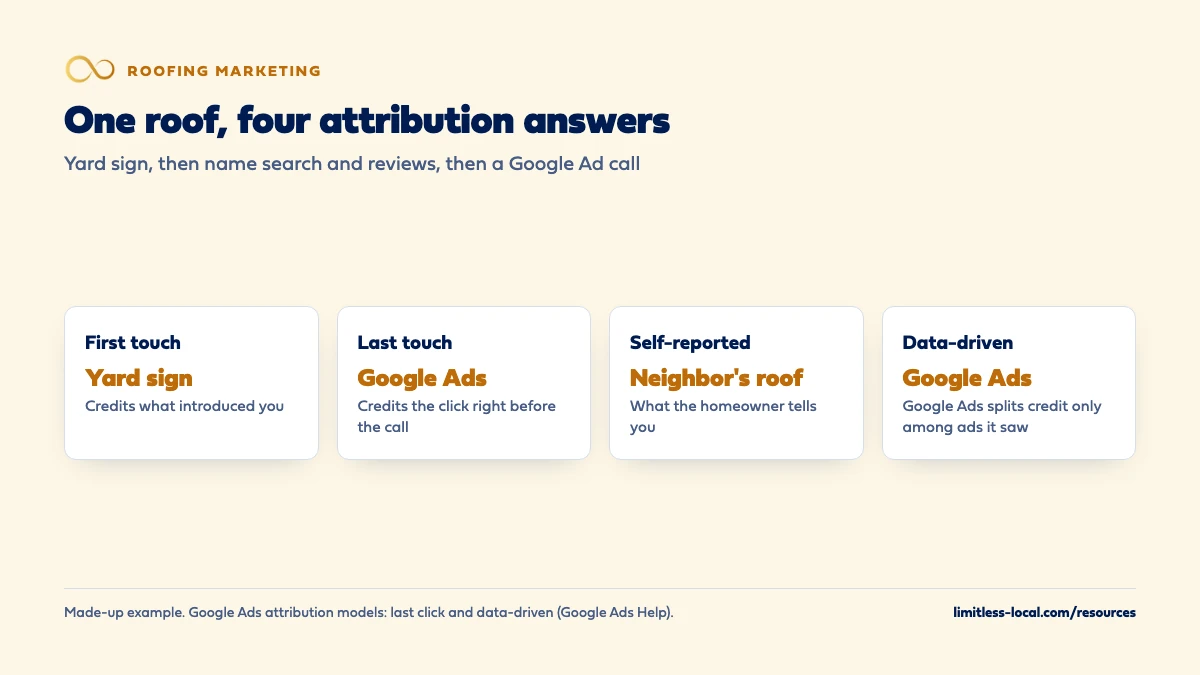
This example is made up to show how the models differ, not a benchmark. A homeowner’s path to a $14,000 replacement:
- Sees your yard sign on a neighbor’s house.
- Searches your company name, reads reviews on your Google profile.
- Visits your website, leaves.
- Clicks a Google Ad four days later and calls your tracking number. Signs after the inspection.
- Last touch gives the whole roof to Google Ads.
- First touch gives it to the yard sign.
- Self-reported: the homeowner says “my neighbor’s roof”.
- Data-driven in Google Ads still gives it to Google Ads, because the ad is the only ad interaction it saw.
Now scale it up. Say last touch credits Google Ads with 10 signed roofs a month, and when you check the “how did you hear” notes, four of those homeowners name a neighbor’s yard sign or a referral. The ads are still worth something; they caught those people. But the yard signs earned a share of those roofs too, and pulling them would quietly shrink the branded searches the ads depend on.
Frequently asked questions
Is attribution the same as call tracking?
No. Call tracking records where a call came from. Attribution is the set of rules you use to decide which marketing gets credit when several sources touched the same lead.
Why does Google Ads report more leads than my CRM shows?
It may count conversions your CRM doesn’t, such as short calls or repeat calls, and data-driven attribution can split one lead into fractions across ads. Your CRM, with one source per lead, is the better count of real leads.
Should I trust "how did you hear about us" answers?
As one input. Homeowners forget and often say “Google” for any search result or ad. Compare their answers with your tracked source rather than replacing it.
Can I track yard signs and truck wraps?
Partly. A dedicated tracking number or a short web address on signs helps, and asking every caller how they heard about you fills in the rest.
Does attribution work for Local Services Ads leads?
Yes. Local Services Ads leads arrive as calls, messages or bookings you can identify, so record them as their own source and follow them through to a signed contract.
How often should I review attribution?
Glance at sources monthly, but make budget decisions on a quarter or more, so storms and slow weeks don’t push you into the wrong call.
Key takeaways
- Attribution is how you decide which marketing gets credit when several sources touched one roofing job.
- First touch, last touch, self-reported and data-driven models each tell a different part of the story.
- Google Ads now offers last click and data-driven models, and only credits the ad interactions it can see.
- Put one source on every lead in your CRM, ask how they heard about you, and compare the two.
- Judge each channel on signed roofs and revenue, not on the leads each platform claims.
Not sure what's working right now?
Start with a free visibility audit: rankings, Google profile, reviews and tracking, checked against your service area.
More in this section
- What marketing should a roofing company add first to grow?
- What share of revenue should a roofer put into marketing?
- Will a marketing agency understand my local roofing market?
- What marketing brings a roofing company the most phone calls?
- Can a CRM help a roofer track marketing ROI?
Sources
- About attribution models — Google Ads Help
- Select attribution settings — Google Analytics Help
- About conversion windows — Google Ads Help
- About offline conversion imports — Google Ads Help
- Lead Source Report — Jobber Help Center